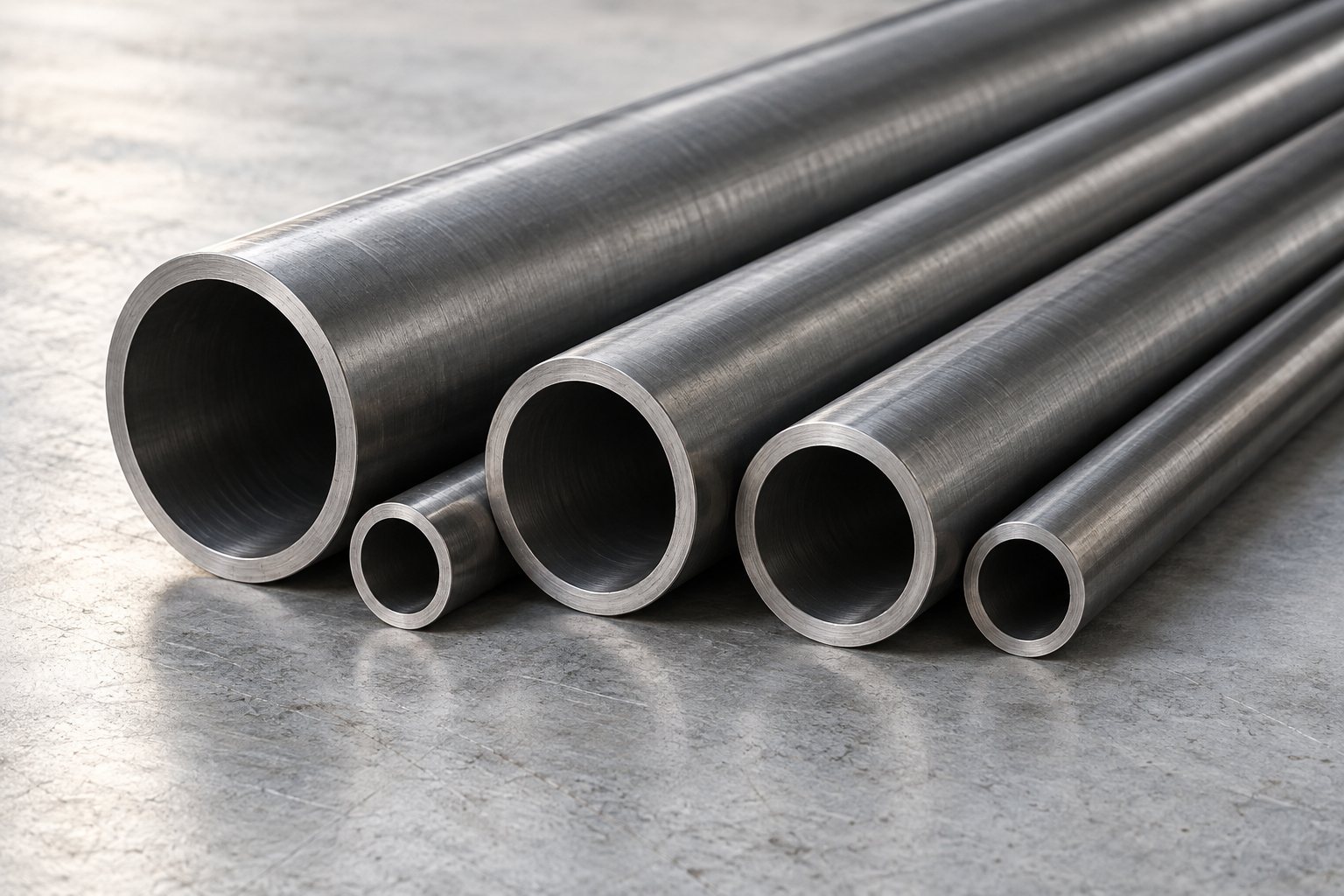
Industrial demand is often discussed in tonnes. Yet a tonne is a measure of material, not a description of the job that material must perform.
Value and volume tell different stories.
APO’s March 2026 study places the global precision steel tubes market at USD 8,013.27 million and 4,095.3 thousand tonnes in 2025. Its 2032 forecast is USD 10,482.04 million and 4,833.3 thousand tonnes. Value grows faster than volume across these endpoints. [1]
Market value
USD million
Sales volume
Thousand tonnes
Bars start at zero within each measure. Change compares the two endpoints; it is not an annual growth rate. No intervening years are inferred.
View source values
| Measure | 2025 estimate | 2032 forecast |
|---|---|---|
| Value, USD million | 8,013.27 | 10,482.04 |
| Volume, thousand tonnes | 4,095.3 | 4,833.3 |
Source: APO Research, 18 March 2026 . Forecasts reflect that study’s outlook.
That gap is a starting point for investigation. A market total alone cannot tell us how much of the difference reflects prices, product mix or changes within particular applications. Those questions require a more detailed comparison.
Specification gives the material its context.
A precision tube is an input to another system. Dimensions, surface condition and mechanical properties can influence how it is processed and where it can be used. Mannesmann publishes dimensional specifications for seamless and welded cold-drawn precision tubes, with tolerances tied to the listed product standard. [2]
Tenaris describes fatigue testing and component services for hydraulic-cylinder tubes, including machining and welding operations. These examples show why a comparison based only on material weight leaves out important aspects of the supplied product. They describe supplier capabilities, not the performance of every tube in the market. [3]
Research interpretation
The useful comparison is between products serving comparable requirements.
Price differences become more informative when the application, specification and delivery condition are understood.
Calculate the implied unit value. Then test its meaning.
Dividing the published value by volume gives approximately USD 1,956.70 per tonne for 2025 and USD 2,168.71 for the 2032 forecast. These are calculated market averages: value in USD million divided by thousand tonnes, multiplied by 1,000. They are not observed quotations for an unchanged grade.
A shift toward higher-specification products can raise the average even if each comparable product's price is unchanged. To distinguish that effect from pricing, hold the product mix constant, compare prices within matched specifications, and separately calculate the effect of changing shares.
That decomposition requires product-level volumes and prices beyond the four published endpoints. The aggregate values establish the question; they cannot resolve it alone.
Underlying APO study valuesRead the signal before drawing the conclusion.
For a producer, the next question is which applications and specifications match its capabilities. For a buyer, it is whether a comparison includes equivalent material, processing and delivery requirements. A market forecast provides context for these decisions; it does not replace the product-level assessment.
Compare like with like
Check the product boundary, unit, period and application before comparing market figures.
Separate the moving parts
Examine volume, unit value and product mix independently before interpreting the total.
Keep the forecast conditional
Ask which assumptions would change the outlook, and what evidence would support a different view.
This is the broader lesson of the tube example: a useful market view connects quantities with the requirements behind purchasing decisions. The numbers show the scale of the question. Product knowledge helps explain what to examine next.
Sources & scope
This perspective combines published market estimates with product context. The interpretation and questions above are editorial analysis; supplier examples are not market-wide measurements.
- APO Research — global steel precision tubes market study announcement 18 March 2026. Source of the four displayed market values. Percentage changes are calculated from those endpoints.
- Mannesmann — Precision tube dimensional specifications (PDF) Dimensions and tolerances under EN 10305-1 and EN 10305-2. Product specifications, not market-size evidence.
- Tenaris — hydraulic cylinders Product testing and component-service examples.
Put the research in context
A question about your market?
Discuss the product, application or geography you need the research to cover.
Discuss your research needsHow we approach research