The demand side
Separate clinical programmes from commercial supply. Test launches, dose patterns, treatment duration, geography and supply agreements instead of applying a therapy revenue growth rate to every peptide.
Pharma & Healthcare
A pharmaceutical ingredient market is shaped by what a site can repeatedly make, purify and release for a particular product—not only by installed equipment.
The demand connection
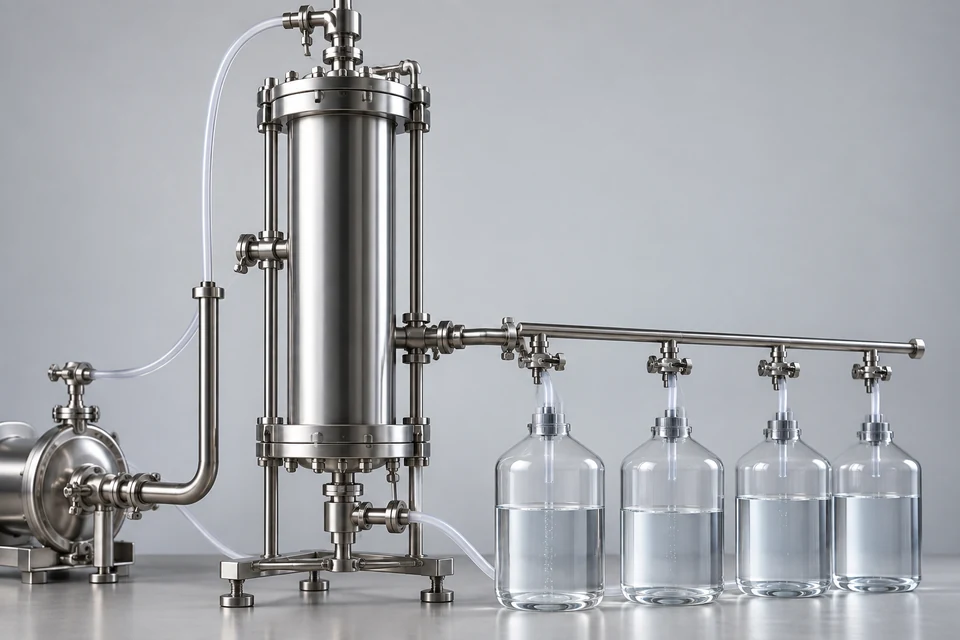
Synthesis output still has to pass purification, analytical control and release. Capacity becomes accessible supply through a qualified process and a purchasing relationship.
An analytical process map, not a yield estimate. Customer and product requirements remain separate checks.
Comparing suppliers starts with the molecule, specification and output stage. Without those boundaries, nominal capacity figures can describe different things.
In peptide synthesis, crude output includes material that must be separated from the target. Purification changes both the quantity retained and the work needed to obtain it. Isolation then introduces another recovery step.
Record whether a quoted kilogram refers to crude material, isolated product or material on a specified assay, water and counterion basis. Do not combine unlike measures into one capacity total.
Production completion, quality-unit release and suitability for a customer’s product are separate questions. FDA’s ICH Q7 guidance describes review of production and laboratory records before API batch release.
For market research, establish the molecule, site, process, destination and customer requirements. A general description of a facility does not prove every molecule can be supplied from it.
The commercial question
How much specified material can be delivered, to whom, and when?
That question connects process capability to a market. An announced expansion supplies only part of the answer.
More synthesis capacity does not automatically create the same increase in deliveries. Test the proposed molecule mix against each downstream requirement.
Explore a condition. These are research scenarios, not measured market forecasts.
Closely related impurities must be separated from the target peptide. Changes in the crude profile can alter loading, separation time and which fractions are retained. More synthesis batches can therefore add downstream work without a proportional gain in usable output.
Isolation, drying, cleaning and product changeovers can occupy equipment after purification finishes. A site serving several molecules must reconcile the portfolio schedule, not just the best performance of one process.
Testing, record review and investigation may determine when a batch is released. Customer or product qualification can also govern its commercial use. These are separate gates; passing one does not establish that every other requirement is met.
Methods evolve. Constraints move.
Merrifield’s solid-phase work established a different way to assemble peptides. Bachem’s technical account describes the subsequent purification of crude mixtures and its adoption of process-scale multicolumn systems in 2021.
These milestones illustrate different operations. They do not give a universal yield improvement or prove that two suppliers have interchangeable processes. A useful historical view tracks the operation that changed, the molecule for which it worked and the constraint left downstream.
Therapy sales, treatment volume and API kilograms are different measures. The bridge needs the product, dose, duration, process basis and sourcing arrangement.
Separate clinical programmes from commercial supply. Test launches, dose patterns, treatment duration, geography and supply agreements instead of applying a therapy revenue growth rate to every peptide.
Distinguish captive production from merchant supply, dedicated from shared equipment, and announced projects from qualified operations. Identify whose demand each capacity figure can actually serve.
Peptide active pharmaceutical ingredients
A focused analysis of synthesis, purification, isolation and release—and the assumptions that separate a capacity announcement from a supply forecast.
Read the peptide analysisFollow two further products through the decisions they create.
mRNA–lipid nanoparticles
RNA synthesis, purified RNA and formulated drug product are different boundaries. Reagents, separation media, mixing systems and fill-finish services enter at different stages. A therapeutic pipeline count does not establish recurring commercial doses or the material demand at any one step.
Identify the process route, intended scale and customer stage before translating programmes into consumables or equipment. Keep development batches, validation work and commercial manufacture separate.
Revise the demand bridge when a programme changes stage, dose, formulation or recovery. Batch records and qualification evidence are needed; a workflow diagram cannot establish achieved yield.
Cytiva — mRNA manufacturing workflow
2021 process overview. No customer production, clinical outcome or commercial forecast is inferred.
Chromatography media
A resin bed can be used across multiple runs under a qualified cleaning regime. Output growth can be met through additional cycles, more bed volume or fresh media; these lead to different purchase patterns. Capacity and recovery can also change as a bed ages.
Reconcile the opening usable media, new purchases and retirement. Track the customer's validated cleaning and reuse conditions alongside batch frequency and binding performance.
Change the replacement view when cleaning conditions, contamination control or performance acceptance changes. A supplier's life study under specified conditions is not a universal resin lifetime.
Cytiva — resin cleaning and reuse guidance
Condition-dependent guidance. No fixed industry-wide reuse count is assumed.
Related product markets
Follow a product into its scope, applications and research editions.
Service research
Peptide CXO covers outsourced research, process development and manufacturing for peptide programmes, from research material and analytical work to clinical and commercial supply.
Peptide CXO covers outsourced research, process development and manufacturing for peptide programmes, from research material and analytical work to clinical and commercial supply.
Peptide outsourcing demand follows the contracted activity and project stage, distinguishing development work from manufacturing supply and finished-drug value.
Ingredients
An active pharmaceutical ingredient is the substance or mixture incorporated into a medicine to provide its intended pharmacological activity; it is distinct from the finished dosage form.
An active pharmaceutical ingredient is the substance or mixture incorporated into a medicine to provide its intended pharmacological activity; it is distinct from the finished dosage form.
Process capability and customer qualification connect synthesis output to supplied ingredient, separating nominal production capacity from accepted commercial supply.
Service research
A pharmaceutical CDMO provides contracted drug-development and manufacturing services, including process development, analytical work and production of drug substances or finished dosage forms.
A pharmaceutical CDMO provides contracted drug-development and manufacturing services, including process development, analytical work and production of drug substances or finished dosage forms.
Development and manufacturing contracts define the revenue boundary, so outsourced-service value cannot be inferred directly from sales of the finished medicine.
Representative product and service imagery. The selected report defines the research scope.
Product distinctions draw on the sources below. Demand connections and scenarios are APO editorial interpretation.
Discuss the product, geography and decision you need the research to address.