What creates the ingredient volume?
Connect finished-product output to actual inclusion and the share of formulations adopting the ingredient. Separate more servings from a higher protein claim or a different recipe.
Food & Beverages
Understand the food being made, the process it must survive and the function the buyer needs. That is where an ingredient’s addressable market begins.
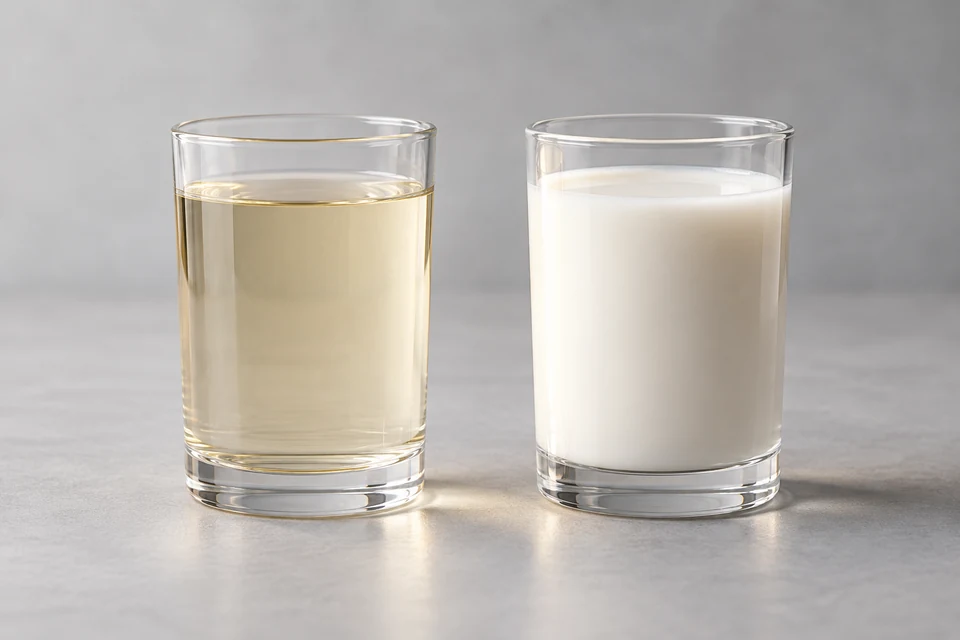
The demand connection
Protein content identifies one attribute. Heat, pH, taste and processing determine whether an ingredient serves a particular finished product.
Clarity
Acid conditions
Heat treatment
Texture
Formulation balance
Process stability
Illustrative application questions. Equal protein content does not establish equal performance.
A nutritional specification narrows the field. It does not settle how an ingredient behaves in the finished formulation.
Define the beverage, bar, powder or other food being sold. Then establish formulation conditions, the manufacturing process and the qualities that must remain acceptable through shelf life.
The relevant comparison is between ingredients that can do that job. A cheaper kilogram may not mean a lower cost per acceptable serving if inclusion, losses or processing requirements change.
For example, NZMP specifies a clear whey protein isolate grade for acidic conditions at pH 3.3–3.8. That is a claim about a particular ingredient and use condition, not a property of every whey protein isolate.
Research should connect grade-level evidence to the customer’s process. A technical sheet can identify a candidate; it cannot establish adoption, repeat purchases or the result in every formulation.
Explore a condition. These are research scenarios, not measured market forecasts.
Investigate the complete formulation under its intended acidity and processing conditions. An ingredient offered for a clear drink still needs to be assessed with the other ingredients, protein level and shelf-life requirements.
A dairy-style formulation may be designed around body, mouthfeel and stability rather than optical clarity. The combination of proteins, minerals and other ingredients matters under the selected process.
For bars, examine texture over storage within the full recipe. For dry mixes, examine dispersion and the prepared product. Neither format should inherit the acceptance criteria or demand estimate of a bottled drink.
Milk production, recoverable whey protein and a qualified food ingredient have different boundaries. Reconcile each before calculating supply.
Distinguish cheese-whey streams from milk fractionation. Record location, seasonality and competing uses before treating raw material as available feedstock.
Establish protein and solids on a consistent basis. Membrane separation, concentration and recovery determine what fraction of the stream becomes the target ingredient.
Convert to the stated powder composition and moisture basis. Keep nutritional protein tonnes separate from tonnes of ingredient sold.
Identify functional grade, customer approval and recurring consumption. Technical eligibility and commercial adoption are different filters.
A distinction with a history · 2013
A US Dairy Export Council technical report distinguished milk-derived whey proteins from cheese-whey proteins by composition and processing history. Tetra Pak’s handbook explains the role of membrane separation in concentrating and fractionating dairy components.
For a forecast, follow the actual stream and recovery route. Growth in total dairy output cannot, by itself, establish growth in every functional protein grade.
Test where the demand occurs, which grades can serve it, and what changes when price, formulation or process conditions move.
Connect finished-product output to actual inclusion and the share of formulations adopting the ingredient. Separate more servings from a higher protein claim or a different recipe.
Examine competing proteins, reformulation cost, qualification time and raw-material availability. A possible substitute is not an immediate, one-for-one switch.
Whey protein ingredients
Follow the distinction through ingredient selection, recovery routes and the evidence needed to define addressable demand.
Read the whey protein analysisFollow two further products through the decisions they create.
Oat beverage bases
Extraction and enzymatic treatment change what enters the formulation and how it behaves in later processing. An ingredient maker should distinguish dry grain inputs, extracted base and finished beverage volume instead of assigning one conversion ratio to every route.
Specify the customer's extraction, separation and heat-treatment route. Reconcile retained solids, losses and added ingredients, then examine accepted beverage quality and line output.
Revise input demand when a route retains different fractions, the target texture changes or existing equipment constrains conversion. Seek actual material balances and quality results before quantifying the effect.
Tetra Pak — oat beverage processing
Manufacturer process options, not an industry-average extraction yield.
Shelf-stable nutrition
A nutrition product has ingredient, process and storage requirements that cannot be inferred from package form alone. The processing route, protection and seal must preserve the specified product over its intended distribution conditions.
Compare complete product–process–package systems. Separate nominal filling speed from accepted output and agreed storage performance; link ingredient purchases to the qualified recipe and losses.
Reassess the chain when ingredients change heat behaviour, a package changes protection or the distribution environment changes. No shelf life should be assigned without product-specific validation.
Tetra Pak — aseptic packages
Combined processing and packaging context, not a shelf-life guarantee for an APO example.
Related product markets
Follow a product into its scope, applications and research editions.
Ingredients
Whey protein ingredients concentrate or isolate proteins from milk whey, with protein content, composition and hydrolysis distinguishing concentrates, isolates and hydrolyzed forms.
Whey protein ingredients concentrate or isolate proteins from milk whey, with protein content, composition and hydrolysis distinguishing concentrates, isolates and hydrolyzed forms.
Ingredient specification and formulation requirements determine where whey protein is adopted, linking demand to the grade and food process rather than protein content alone.
Processing aids
Food enzymes are enzyme preparations used to catalyze specific reactions in food processing, such as carbohydrate breakdown, protein modification or fat conversion.
Food enzymes are enzyme preparations used to catalyze specific reactions in food processing, such as carbohydrate breakdown, protein modification or fat conversion.
An enzyme creates commercial value through a specific process function under defined operating conditions, making qualified use more informative than food output alone.

Product protection
Retort pouches are flexible packages whose barrier layers and seals are designed to withstand the specified thermal process applied to the filled food package.
Retort pouches are flexible packages whose barrier layers and seals are designed to withstand the specified thermal process applied to the filled food package.
Seals and barrier construction must retain performance through thermal processing, making the complete filled-pack process central to pouch qualification.
Representative product and service imagery. The selected report defines the research scope.
Product distinctions draw on the sources below. Demand connections and scenarios are APO editorial interpretation.
Discuss the product, geography and decision you need the research to address.