
APO RESEARCH · REPORT
Magnetic Levitation Molecular Pump
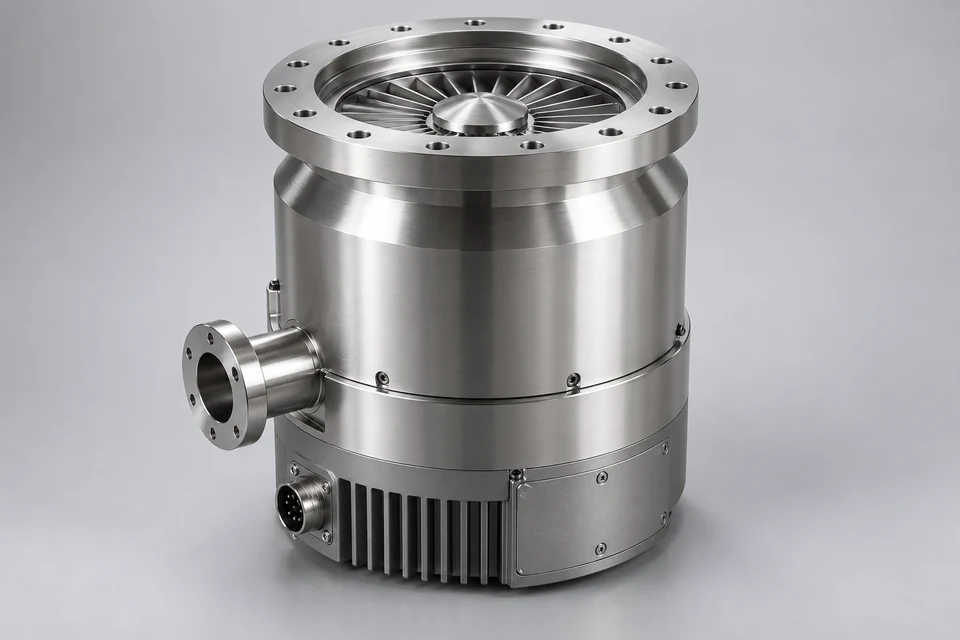
Magnetic Levitation Molecular Pump is a high vacuum kinetic pump in which the high speed rotor is suspended and controlled by magnetic bearings without continuous mechanical contact during normal operation.
Product & engineering
Understand the product.
Magnetic Levitation Molecular Pump is a high vacuum kinetic pump in which the high speed rotor is suspended and controlled by magnetic bearings without continuous mechanical contact during normal operation. The pumping element generally consists of multiple turbomolecular rotor and stator stages and may incorporate molecular drag stages to increase compression capability and allowable foreline pressure. Gas molecules entering the inlet receive directional momentum from rapidly rotating blades or drag surfaces and are progressively transferred toward the exhaust side, enabling operation in the molecular and transitional flow regimes required for high and ultra high vacuum systems.
The rotor assembly is normally supported in radial and axial directions by actively controlled electromagnetic bearings. Position sensors continuously measure rotor displacement, while the bearing controller regulates magnetic forces to maintain the rotor within its operating position at rotational speeds commonly reaching several tens of thousands of revolutions per minute. Permanent magnetic elements may provide part of the axial or radial load support in some architectures. Catcher or backup bearings remain mechanically isolated during normal operation and protect the rotor during power interruption, excessive displacement or abnormal deceleration.
A typical magnetic levitation molecular pump integrates the rotor, stator, high speed motor, magnetic bearing system, position sensors, power electronics, control electronics, cooling structure, purge gas interfaces and foreline connection within a compact vacuum assembly. Semiconductor and other process resistant versions may incorporate corrosion resistant materials, protective surface treatments, controlled heating, purge gas management and internal temperature regulation to tolerate reactive gases, condensable byproducts and deposition loading. Principal technical parameters include pumping speed for specified gases, compression ratio, ultimate pressure, maximum gas throughput, maximum foreline pressure, rotational speed, vibration level, thermal operating range and allowable process gas load.
The absence of continuous mechanical bearing contact reduces friction, lubricant dependence, particle generation and mechanically transmitted vibration at the rotor support. This operating architecture is widely used where clean high vacuum, stable high speed operation, low vibration and compatibility with demanding process gases are required, including semiconductor manufacturing, display manufacturing, photovoltaic manufacturing, vacuum coating and surface processing, analytical instrumentation, scientific research and industrial vacuum processing.
Equipment converts a defined input into a required mechanical or process result. Usable capacity depends on duty, auxiliaries, control, loading and maintenance, rather than an isolated maximum nameplate value.
What turns activity into demand
Production or operating duty leads to purchases when capacity, qualification and replacement requirements match the supplied machine or component. Site output alone does not determine equipment orders without the installed capacity and duty.
The commercial boundary
For Magnetic Levitation Molecular Pump, distinguish the supplied product from its inputs and the complete application. Report types and applications may overlap; retain the selected edition's product definition, geography, period, unit and transaction basis when comparing estimates.
Which conditions determine usable magnetic levitation molecular pump performance?
Magnetic Levitation Molecular Pump is a high vacuum kinetic pump in which the high speed rotor is suspended and controlled by magnetic bearings without continuous mechanical contact during normal operation. Compare the complete supplied assembly under the same operating conditions, including upstream and downstream interfaces, energy use and service requirements. Separate machine hardware, installed process line and maintenance revenue when defining the research boundary.
Selected research
Industry Growth & Trends
Global Magnetic Levitation Molecular Pump Industry Growth and Trends Forecast to 2032
Market perspective
According to APO Research, Inc, the global Magnetic Levitation Molecular Pump market was valued at USD 632.48 million in 2025 and is estimated at USD 736.22 million in 2026, before reaching USD 1,079.71 million in 2032, representing a CAGR of 6.59% from 2026 to 2032. The market value increases 16.40% in 2026, followed by a more normalized expansion over the forecast period. The near term increase is consistent with the current semiconductor equipment cycle. SEMI projects global wafer fab equipment sales of USD 143.9 billion in 2026, up 23.1%, while global installed 300 mm semiconductor capacity is projected to increase about 7% in 2026. Memory equipment investment alone is expected to reach USD 52 billion, including USD 37 billion for DRAM and USD 14 billion for 3D NAND. These investments increase the installed base of vacuum intensive etch, deposition, ion implantation, inspection and related process equipment.
Magnetic levitation molecular pumps carry a relatively high unit value because the pump combines a high speed rotor, active magnetic bearings, position sensors, electromagnetic control, drive electronics, precision balancing and vacuum compatible mechanical assemblies. Commercial product specifications also show a wide performance range. Edwards offers magnetic levitation pumps with pumping speeds from about 300 L/s to 4,500 L/s. Osaka Vacuum covers about 340 L/s to 4,200 L/s. ULVAC offers magnetic bearing models from about 300 L/s to 4,000 L/s, while Pfeiffer supplies magnetic levitation products from compact 255 L/s units to large models around the 3,000 L/s class. Shimadzu magnetic bearing products extend from compact units below 200 L/s to large pumps around 4,000 L/s and above. The resulting market value therefore reflects both shipment volume and product mix, with large pumping speed, high gas throughput, corrosive process and low vibration configurations carrying materially higher value per unit.
Semiconductor manufacturing remains the largest source of incremental demand through 2032. Etching and CVD place particularly high requirements on gas throughput, process resistance and continuous operation, while inspection, metrology, lithography and research systems emphasize vibration control and clean vacuum performance. Magnetic bearings eliminate mechanical contact during normal rotor operation, reducing wear, lubricant contamination and vibration. Edwards specifies five axis active magnetic bearing control for its STP pumps, while Osaka Vacuum similarly uses active control across five axes. These characteristics increase adoption in process chambers with demanding uptime and cleanliness requirements. Coating equipment, display manufacturing, analytical instruments, high energy physics, aerospace research and other scientific vacuum systems provide additional demand outside semiconductor fabrication.
Read the full market overview
The USD 343.49 million increase from 2026 to 2032 is expected to be concentrated in China, Taiwan, Korea, Japan, the Americas and other major semiconductor manufacturing regions. Taiwan investment is increasingly associated with advanced logic capacity, Korea with HBM and advanced DRAM, China with continued domestic wafer capacity expansion, and the Americas with new advanced semiconductor manufacturing capacity. SEMI expects logic and memory to remain the largest areas of 300 mm equipment spending, with global installed 300 mm capacity continuing to expand through 2029. Higher process complexity also increases the number and specification level of vacuum systems required per unit of wafer capacity.
Competition is led by established vacuum manufacturers including Edwards, Shimadzu, Pfeiffer Vacuum, Osaka Vacuum and ULVAC, together with an expanding group of Chinese suppliers. Edwards delivered its 250,000th STP turbomolecular pump in July 2025, demonstrating a large installed base for magnetic levitation technology. Shimadzu reported FY2025 turbomolecular pump sales of JPY 37.8 billion and stated that demand grew in Europe, China and other Asian markets. Its recurring revenue ratio for TMP reached 24%, reflecting increasing service activity around the installed base. Manufacturing economics are influenced by precision rotor machining, dynamic balancing, magnetic bearing control, sensors, drive electronics, thermal management, final vacuum testing and OEM qualification. These technical requirements limit rapid capacity expansion and help sustain the value contribution of higher specification pumps as shipment volume increases through 2032.
Report Scope
This report provides a structured, data-driven view of the global Magnetic Levitation Molecular Pump market, combining harmonized quantitative metrics with targeted qualitative insight to support business and growth strategy, market positioning, and capital allocation.
The Magnetic Levitation Molecular Pump market size, estimates, and forecasts are presented in terms of sales volume (units) and revenue (US$ million), with 2025 as the base year and historical and forecast data for 2021-2032. The report segments the global Magnetic Levitation Molecular Pump market by Type, Application, region/country, and company, provides regional market sizes at the segment level, profiles the competitive landscape and key players and their market ranks, and reviews technology trends and new product developments relevant to Magnetic Levitation Molecular Pump.
Key Companies & Market Share Insights
This section analyzes the strategies and performance of leading manufacturers in the global Magnetic Levitation Molecular Pump market, including portfolio focus, innovation and product development, mergers and acquisitions, collaborations, and geographic expansion used to sustain or enhance competitive positions. It also summarizes recent corporate developments and key financial indicators and provides global revenue, price, and sales volume data by manufacturer for 2020-2025, enabling benchmarking of scale, pricing, and market share and supporting assessment of market concentration through indicators such as CR5 and CR10.
Magnetic Levitation Molecular Pump Market by Company
Edwards
Pfeiffer Vacuum
Shimadzu Corporation
Leybold GmbH
ULVAC, Inc.
Osaka Vacuum, Ltd.
EBARA CORPORATION
Beijing KYKY Co., Ltd.
Tianjin EMAGING Technology
Hefei Yuchi Vacuum Technology
Zhongke Jiuwei Technology
Beijing Grand Hitek
Suzhou Supermag Intelligent Technology
Magnetic Levitation Molecular Pump Segment by Type
Up to 1000 L/s
Above 1000 to 3000 L/s
Above 3000 L/s
Magnetic Levitation Molecular Pump Segment by Application
Semiconductor Manufacturing
Display Manufacturing
Photovoltaic Manufacturing
Vacuum Coating and Surface Processing
Analytical Instrumentation
Scientific Research
Industrial Vacuum Processing
Magnetic Levitation Molecular Pump Segment by Region
North America
United States
Canada
Mexico
Europe
Germany
France
U.K.
Italy
Russia
Spain
Netherlands
Switzerland
Sweden
Poland
Asia-Pacific
China
Japan
South Korea
India
Australia
Taiwan
Southeast Asia
South America
Brazil
Argentina
Chile
Colombia
Middle East & Africa
Egypt
South Africa
Israel
Türkiye
GCC Countries
Key Drivers & Barriers
High-impact rendering factors and drivers have been studied in this report to aid the readers to understand the general development. Moreover, the report includes restraints and challenges that may act as stumbling blocks on the way of the players. This will assist the users to be attentive and make informed decisions related to business. Specialists have also laid their focus on the upcoming business prospects.
Reasons to Buy This Report
1. This report will help the readers to understand the competition within the industries and strategies for the competitive environment to enhance the potential profit. The report also focuses on the competitive landscape of the global Magnetic Levitation Molecular Pump market, and introduces in detail the market share, industry ranking, competitor ecosystem, market performance, new product development, operation situation, expansion, and acquisition. etc. of the main players, which helps the readers to identify the main competitors and deeply understand the competition pattern of the market.
2. This report will help stakeholders to understand the global industry status and trends of Magnetic Levitation Molecular Pump and provides them with information on key market drivers, restraints, challenges, and opportunities.
3. This report will help stakeholders to understand competitors better and gain more insights to strengthen their position in their businesses. The competitive landscape section includes the market share and rank (in volume and value), competitor ecosystem, new product development, expansion, and acquisition.
4. This report stays updated with novel technology integration, features, and the latest developments in the market.
5. This report helps stakeholders to gain insights into which regions to target globally.
6. This report helps stakeholders to gain insights into the end-user perception concerning the adoption of Magnetic Levitation Molecular Pump.
7. This report helps stakeholders to identify some of the key players in the market and understand their valuable contribution.
Chapter Outline
Chapter 1: Introduces the study scope of this report, executive summary of market segments by type, market size segments for North America, Europe, Asia Pacific, South America, Middle East & Africa.
Chapter 2: Introduces the market dynamics, latest developments of the market, the driving factors and restrictive factors of the market, the challenges and risks faced by manufacturers in the industry, and the analysis of relevant policies in the industry.
Chapter 3: Detailed analysis of Magnetic Levitation Molecular Pump manufacturers competitive landscape, price, sales, revenue, market share and ranking, latest development plan, merger, and acquisition information, etc.
Chapter 4: Sales, revenue of Magnetic Levitation Molecular Pump in regional level. It provides a quantitative analysis of the market size and development potential of each region and introduces the future development prospects, and market space in the world.
Chapter 5: Introduces market segments by application, market size segment for North America, Europe, Asia Pacific, South America, Middle East & Africa.
Chapter 6: Provides profiles of key players, introducing the basic situation of the main companies in the market in detail, including product sales, revenue, price, gross margin, product introduction, recent development, etc.
Chapter 7, 8, 9, 10 and 11: North America, Europe, Asia Pacific, South America, Middle East & Africa, sales and revenue by country.
Chapter 12: Analysis of industrial chain, key raw materials, manufacturing cost, and market dynamics.
Chapter 13: Concluding Insights of the report.
More report detail
Tables and figures
Scope & coverage.
Types
- Up to 1000 L/s
- Above 1000 to 3000 L/s
- Above 3000 L/s
Applications
- Semiconductor Manufacturing
- Display Manufacturing
- Photovoltaic Manufacturing
- Vacuum Coating and Surface Processing
- Analytical Instrumentation
- Scientific Research
- Industrial Vacuum Processing
Companies covered
- Edwards
- Pfeiffer Vacuum
- Shimadzu Corporation
- Leybold GmbH
- ULVAC, Inc.
- Osaka Vacuum, Ltd.
- EBARA CORPORATION
- Beijing KYKY Co., Ltd.
- Tianjin EMAGING Technology
- Hefei Yuchi Vacuum Technology
- Zhongke Jiuwei Technology
- Beijing Grand Hitek
- Suzhou Supermag Intelligent Technology
Inside the report.
1 Market Overview
- 1.1 Product Definition
- 1.2 Global Market Growth Prospects
- 1.2.1 Global Magnetic Levitation Molecular Pump Market Size Estimates and Forecasts (2021-2032)
- 1.2.2 Global Magnetic Levitation Molecular Pump Sales Estimates and Forecasts (2021-2032)
- 1.3 Magnetic Levitation Molecular Pump Market by Type
- 1.3.1 Up to 1000 L/s
- 1.3.2 Above 1000 to 3000 L/s
- 1.3.3 Above 3000 L/s
- 1.4 Global Magnetic Levitation Molecular Pump Market Size by Type
- 1.4.1 Global Magnetic Levitation Molecular Pump Market Size Overview by Type (2021-2032)
- 1.4.2 Global Magnetic Levitation Molecular Pump Historic Market Size Review by Type (2021-2026)
- 1.4.3 Global Magnetic Levitation Molecular Pump Forecasted Market Size by Type (2027-2032)
- 1.5 Key Regions Market Size by Type
- 1.5.1 North America Magnetic Levitation Molecular Pump Sales Breakdown by Type (2021-2026)
- 1.5.2 Europe Magnetic Levitation Molecular Pump Sales Breakdown by Type (2021-2026)
- 1.5.3 Asia-Pacific Magnetic Levitation Molecular Pump Sales Breakdown by Type (2021-2026)
- 1.5.4 South America Magnetic Levitation Molecular Pump Sales Breakdown by Type (2021-2026)
- 1.5.5 Middle East and Africa Magnetic Levitation Molecular Pump Sales Breakdown by Type (2021-2026)
2 Global Market Dynamics
- 2.1 Magnetic Levitation Molecular Pump Industry Trends
- 2.2 Magnetic Levitation Molecular Pump Industry Drivers
- 2.3 Magnetic Levitation Molecular Pump Industry Opportunities and Challenges
- 2.4 Magnetic Levitation Molecular Pump Industry Restraints
3 Market Competitive Landscape by Company
- 3.1 Global Top Players by Magnetic Levitation Molecular Pump Revenue (2021-2026)
- 3.2 Global Top Players by Magnetic Levitation Molecular Pump Sales (2021-2026)
- 3.3 Global Top Players by Magnetic Levitation Molecular Pump Price (2021-2026)
- 3.4 Global Magnetic Levitation Molecular Pump Industry Company Ranking, 2024 VS 2025 VS 2026
- 3.5 Global Magnetic Levitation Molecular Pump Major Company Production Sites & Headquarters
- 3.6 Global Magnetic Levitation Molecular Pump Company, Product Type & Application
- 3.7 Global Magnetic Levitation Molecular Pump Company Establishment Date
- 3.8 Market Competitive Analysis
- 3.8.1 Global Magnetic Levitation Molecular Pump Market CR5 and HHI
- 3.8.2 Global Top 5 and 10 Magnetic Levitation Molecular Pump Players Market Share by Revenue in 2025
- 3.8.3 2025 Magnetic Levitation Molecular Pump Tier 1, Tier 2, and Tier 3
4 Magnetic Levitation Molecular Pump Regional Status and Outlook
- 4.1 Global Magnetic Levitation Molecular Pump Market Size and CAGR by Region: 2021 VS 2025 VS 2032
- 4.2 Global Magnetic Levitation Molecular Pump Historic Market Size by Region
- 4.2.1 Global Magnetic Levitation Molecular Pump Sales in Volume by Region (2021-2026)
- 4.2.2 Global Magnetic Levitation Molecular Pump Sales in Value by Region (2021-2026)
- 4.2.3 Global Magnetic Levitation Molecular Pump Sales (Volume & Value), Price and Gross Margin (2021-2026)
- 4.3 Global Magnetic Levitation Molecular Pump Forecasted Market Size by Region
- 4.3.1 Global Magnetic Levitation Molecular Pump Sales in Volume by Region (2027-2032)
- 4.3.2 Global Magnetic Levitation Molecular Pump Sales in Value by Region (2027-2032)
- 4.3.3 Global Magnetic Levitation Molecular Pump Sales (Volume & Value), Price and Gross Margin (2027-2032)
5 Magnetic Levitation Molecular Pump by Application
- 5.1 Magnetic Levitation Molecular Pump Market by Application
- 5.1.1 Semiconductor Manufacturing
- 5.1.2 Display Manufacturing
- 5.1.3 Photovoltaic Manufacturing
- 5.1.4 Vacuum Coating and Surface Processing
- 5.1.5 Analytical Instrumentation
- 5.1.6 Scientific Research
- 5.1.7 Industrial Vacuum Processing
- 5.2 Global Magnetic Levitation Molecular Pump Market Size by Application
- 5.2.1 Global Magnetic Levitation Molecular Pump Market Size Overview by Application (2021-2032)
- 5.2.2 Global Magnetic Levitation Molecular Pump Historic Market Size Review by Application (2021-2026)
- 5.2.3 Global Magnetic Levitation Molecular Pump Forecasted Market Size by Application (2027-2032)
- 5.3 Key Regions Market Size by Application
- 5.3.1 North America Magnetic Levitation Molecular Pump Sales Breakdown by Application (2021-2026)
- 5.3.2 Europe Magnetic Levitation Molecular Pump Sales Breakdown by Application (2021-2026)
- 5.3.3 Asia-Pacific Magnetic Levitation Molecular Pump Sales Breakdown by Application (2021-2026)
- 5.3.4 South America Magnetic Levitation Molecular Pump Sales Breakdown by Application (2021-2026)
- 5.3.5 Middle East and Africa Magnetic Levitation Molecular Pump Sales Breakdown by Application (2021-2026)
6 Company Profiles
- 6.1 Edwards
- 6.1.1 Edwards Company Information
- 6.1.2 Edwards Business Overview
- 6.1.3 Edwards Magnetic Levitation Molecular Pump Sales, Revenue and Gross Margin (2021-2026)
- 6.1.4 Edwards Magnetic Levitation Molecular Pump Product Portfolio
- 6.1.5 Edwards Recent Developments
- 6.2 Pfeiffer Vacuum
- 6.2.1 Pfeiffer Vacuum Company Information
- 6.2.2 Pfeiffer Vacuum Business Overview
- 6.2.3 Pfeiffer Vacuum Magnetic Levitation Molecular Pump Sales, Revenue and Gross Margin (2021-2026)
- 6.2.4 Pfeiffer Vacuum Magnetic Levitation Molecular Pump Product Portfolio
- 6.2.5 Pfeiffer Vacuum Recent Developments
- 6.3 Shimadzu Corporation
- 6.3.1 Shimadzu Corporation Company Information
- 6.3.2 Shimadzu Corporation Business Overview
- 6.3.3 Shimadzu Corporation Magnetic Levitation Molecular Pump Sales, Revenue and Gross Margin (2021-2026)
- 6.3.4 Shimadzu Corporation Magnetic Levitation Molecular Pump Product Portfolio
- 6.3.5 Shimadzu Corporation Recent Developments
- 6.4 Leybold GmbH
- 6.4.1 Leybold GmbH Company Information
- 6.4.2 Leybold GmbH Business Overview
- 6.4.3 Leybold GmbH Magnetic Levitation Molecular Pump Sales, Revenue and Gross Margin (2021-2026)
- 6.4.4 Leybold GmbH Magnetic Levitation Molecular Pump Product Portfolio
- 6.4.5 Leybold GmbH Recent Developments
- 6.5 ULVAC, Inc.
- 6.5.1 ULVAC, Inc. Company Information
- 6.5.2 ULVAC, Inc. Business Overview
- 6.5.3 ULVAC, Inc. Magnetic Levitation Molecular Pump Sales, Revenue and Gross Margin (2021-2026)
- 6.5.4 ULVAC, Inc. Magnetic Levitation Molecular Pump Product Portfolio
- 6.5.5 ULVAC, Inc. Recent Developments
- 6.6 Osaka Vacuum, Ltd.
- 6.6.1 Osaka Vacuum, Ltd. Company Information
- 6.6.2 Osaka Vacuum, Ltd. Business Overview
- 6.6.3 Osaka Vacuum, Ltd. Magnetic Levitation Molecular Pump Sales, Revenue and Gross Margin (2021-2026)
- 6.6.4 Osaka Vacuum, Ltd. Magnetic Levitation Molecular Pump Product Portfolio
- 6.6.5 Osaka Vacuum, Ltd. Recent Developments
- 6.7 EBARA CORPORATION
- 6.7.1 EBARA CORPORATION Company Information
- 6.7.2 EBARA CORPORATION Business Overview
- 6.7.3 EBARA CORPORATION Magnetic Levitation Molecular Pump Sales, Revenue and Gross Margin (2021-2026)
- 6.7.4 EBARA CORPORATION Magnetic Levitation Molecular Pump Product Portfolio
- 6.7.5 EBARA CORPORATION Recent Developments
- 6.8 Beijing KYKY Co., Ltd.
- 6.8.1 Beijing KYKY Co., Ltd. Company Information
- 6.8.2 Beijing KYKY Co., Ltd. Business Overview
- 6.8.3 Beijing KYKY Co., Ltd. Magnetic Levitation Molecular Pump Sales, Revenue and Gross Margin (2021-2026)
- 6.8.4 Beijing KYKY Co., Ltd. Magnetic Levitation Molecular Pump Product Portfolio
- 6.8.5 Beijing KYKY Co., Ltd. Recent Developments
- 6.9 Tianjin EMAGING Technology
- 6.9.1 Tianjin EMAGING Technology Company Information
- 6.9.2 Tianjin EMAGING Technology Business Overview
- 6.9.3 Tianjin EMAGING Technology Magnetic Levitation Molecular Pump Sales, Revenue and Gross Margin (2021-2026)
- 6.9.4 Tianjin EMAGING Technology Magnetic Levitation Molecular Pump Product Portfolio
- 6.9.5 Tianjin EMAGING Technology Recent Developments
- 6.10 Hefei Yuchi Vacuum Technology
- 6.10.1 Hefei Yuchi Vacuum Technology Company Information
- 6.10.2 Hefei Yuchi Vacuum Technology Business Overview
- 6.10.3 Hefei Yuchi Vacuum Technology Magnetic Levitation Molecular Pump Sales, Revenue and Gross Margin (2021-2026)
- 6.10.4 Hefei Yuchi Vacuum Technology Magnetic Levitation Molecular Pump Product Portfolio
- 6.10.5 Hefei Yuchi Vacuum Technology Recent Developments
- 6.11 Zhongke Jiuwei Technology
- 6.11.1 Zhongke Jiuwei Technology Company Information
- 6.11.2 Zhongke Jiuwei Technology Business Overview
- 6.11.3 Zhongke Jiuwei Technology Magnetic Levitation Molecular Pump Sales, Revenue and Gross Margin (2021-2026)
- 6.11.4 Zhongke Jiuwei Technology Magnetic Levitation Molecular Pump Product Portfolio
- 6.11.5 Zhongke Jiuwei Technology Recent Developments
- 6.12 Beijing Grand Hitek
- 6.12.1 Beijing Grand Hitek Company Information
- 6.12.2 Beijing Grand Hitek Business Overview
- 6.12.3 Beijing Grand Hitek Magnetic Levitation Molecular Pump Sales, Revenue and Gross Margin (2021-2026)
- 6.12.4 Beijing Grand Hitek Magnetic Levitation Molecular Pump Product Portfolio
- 6.12.5 Beijing Grand Hitek Recent Developments
- 6.13 Suzhou Supermag Intelligent Technology
- 6.13.1 Suzhou Supermag Intelligent Technology Company Information
- 6.13.2 Suzhou Supermag Intelligent Technology Business Overview
- 6.13.3 Suzhou Supermag Intelligent Technology Magnetic Levitation Molecular Pump Sales, Revenue and Gross Margin (2021-2026)
- 6.13.4 Suzhou Supermag Intelligent Technology Magnetic Levitation Molecular Pump Product Portfolio
- 6.13.5 Suzhou Supermag Intelligent Technology Recent Developments
7 North America by Country
- 7.1 North America Magnetic Levitation Molecular Pump Sales by Country
- 7.1.1 North America Magnetic Levitation Molecular Pump Sales Growth Rate (CAGR) by Country: 2021 VS 2025 VS 2032
- 7.1.2 North America Magnetic Levitation Molecular Pump Sales by Country (2021-2026)
- 7.1.3 North America Magnetic Levitation Molecular Pump Sales Forecast by Country (2027-2032)
- 7.2 North America Magnetic Levitation Molecular Pump Market Size by Country
- 7.2.1 North America Magnetic Levitation Molecular Pump Market Size Growth Rate (CAGR) by Country: 2021 VS 2025 VS 2032
- 7.2.2 North America Magnetic Levitation Molecular Pump Market Size by Country (2021-2026)
- 7.2.3 North America Magnetic Levitation Molecular Pump Market Size Forecast by Country (2027-2032)
8 Europe by Country
- 8.1 Europe Magnetic Levitation Molecular Pump Sales by Country
- 8.1.1 Europe Magnetic Levitation Molecular Pump Sales Growth Rate (CAGR) by Country: 2021 VS 2025 VS 2032
- 8.1.2 Europe Magnetic Levitation Molecular Pump Sales by Country (2021-2026)
- 8.1.3 Europe Magnetic Levitation Molecular Pump Sales Forecast by Country (2027-2032)
- 8.2 Europe Magnetic Levitation Molecular Pump Market Size by Country
- 8.2.1 Europe Magnetic Levitation Molecular Pump Market Size Growth Rate (CAGR) by Country: 2021 VS 2025 VS 2032
- 8.2.2 Europe Magnetic Levitation Molecular Pump Market Size by Country (2021-2026)
- 8.2.3 Europe Magnetic Levitation Molecular Pump Market Size Forecast by Country (2027-2032)
9 Asia-Pacific by Country
- 9.1 Asia-Pacific Magnetic Levitation Molecular Pump Sales by Country
- 9.1.1 Asia-Pacific Magnetic Levitation Molecular Pump Sales Growth Rate (CAGR) by Country: 2021 VS 2025 VS 2032
- 9.1.2 Asia-Pacific Magnetic Levitation Molecular Pump Sales by Country (2021-2026)
- 9.1.3 Asia-Pacific Magnetic Levitation Molecular Pump Sales Forecast by Country (2027-2032)
- 9.2 Asia-Pacific Magnetic Levitation Molecular Pump Market Size by Country
- 9.2.1 Asia-Pacific Magnetic Levitation Molecular Pump Market Size Growth Rate (CAGR) by Country: 2021 VS 2025 VS 2032
- 9.2.2 Asia-Pacific Magnetic Levitation Molecular Pump Market Size by Country (2021-2026)
- 9.2.3 Asia-Pacific Magnetic Levitation Molecular Pump Market Size Forecast by Country (2027-2032)
10 South America by Country
- 10.1 South America Magnetic Levitation Molecular Pump Sales by Country
- 10.1.1 South America Magnetic Levitation Molecular Pump Sales Growth Rate (CAGR) by Country: 2021 VS 2025 VS 2032
- 10.1.2 South America Magnetic Levitation Molecular Pump Sales by Country (2021-2026)
- 10.1.3 South America Magnetic Levitation Molecular Pump Sales Forecast by Country (2027-2032)
- 10.2 South America Magnetic Levitation Molecular Pump Market Size by Country
- 10.2.1 South America Magnetic Levitation Molecular Pump Market Size Growth Rate (CAGR) by Country: 2021 VS 2025 VS 2032
- 10.2.2 South America Magnetic Levitation Molecular Pump Market Size by Country (2021-2026)
- 10.2.3 South America Magnetic Levitation Molecular Pump Market Size Forecast by Country (2027-2032)
11 Middle East and Africa by Country
- 11.1 Middle East and Africa Magnetic Levitation Molecular Pump Sales by Country
- 11.1.1 Middle East and Africa Magnetic Levitation Molecular Pump Sales Growth Rate (CAGR) by Country: 2021 VS 2025 VS 2032
- 11.1.2 Middle East and Africa Magnetic Levitation Molecular Pump Sales by Country (2021-2026)
- 11.1.3 Middle East and Africa Magnetic Levitation Molecular Pump Sales Forecast by Country (2027-2032)
- 11.2 Middle East and Africa Magnetic Levitation Molecular Pump Market Size by Country
- 11.2.1 Middle East and Africa Magnetic Levitation Molecular Pump Market Size Growth Rate (CAGR) by Country: 2021 VS 2025 VS 2032
- 11.2.2 Middle East and Africa Magnetic Levitation Molecular Pump Market Size by Country (2021-2026)
- 11.2.3 Middle East and Africa Magnetic Levitation Molecular Pump Market Size Forecast by Country (2027-2032)
12 Value Chain and Sales Channels Analysis
- 12.1 Magnetic Levitation Molecular Pump Value Chain Analysis
- 12.1.1 Magnetic Levitation Molecular Pump Key Raw Materials
- 12.1.2 Key Raw Materials Price
- 12.1.3 Raw Materials Key Suppliers
- 12.1.4 Manufacturing Cost Structure
- 12.1.5 Magnetic Levitation Molecular Pump Production Mode & Process
- 12.2 Magnetic Levitation Molecular Pump Sales Channels Analysis
- 12.2.1 Direct Comparison with Distribution Share
- 12.2.2 Magnetic Levitation Molecular Pump Distributors
- 12.2.3 Magnetic Levitation Molecular Pump Customers
13 Concluding Insights
14 Appendix
- 14.1 Reasons for Doing This Study
- 14.2 Research Methodology
- 14.3 Research Process
- 14.4 Authors List of This Report
- 14.5 Data Source
- 14.5.1 Secondary Sources
- 14.5.2 Primary Sources
- 14.6 Disclaimer
GET THE RESEARCH
Choose your license.
Choose who needs access.
All options are for this report and research series.
PDF by email within 3–5 working days after payment confirmation.
Talk to an analyst