APO RESEARCH · REPORT
Motorcycle Helmets
Motorcycle helmets are regulated protective headgear for motorcycle riders and passengers, manufactured to reduce skull fracture, brain injury, facial trauma, penetration injury and ejection risk during road, off road and racing accidents.
Product & engineering
Understand the product.
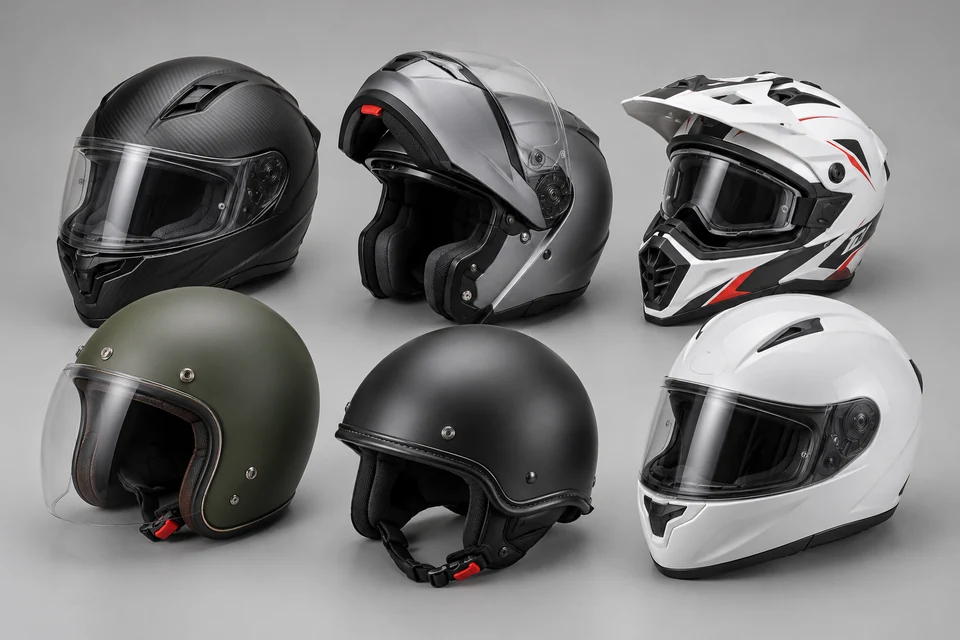
Motorcycle helmets are regulated protective headgear for motorcycle riders and passengers, manufactured to reduce skull fracture, brain injury, facial trauma, penetration injury and ejection risk during road, off road and racing accidents. A complete helmet integrates an outer impact shell, an energy absorbing liner, a comfort liner, a retention system, a visor or goggle interface, ventilation channels, trim components and attachment hardware. Product architectures mainly include full face helmets, open face helmets, modular helmets, off road helmets, dual sport helmets and half helmets, with design differences driven by impact coverage, eye protection, ventilation demand, aerodynamic stability, communication integration and rider posture.
The structural function of a motorcycle helmet is divided between load distribution and impact energy attenuation. The outer shell spreads localized impact forces, resists abrasion and limits penetration, while the expanded polystyrene liner crushes in a controlled manner to manage deceleration of the head. Thermoplastic shells use polycarbonate, ABS or other engineered resins for high volume molding and cost efficient urban and commuter helmets. Composite shells use fiberglass, aramid fiber, carbon fiber or hybrid laminates for lower weight, higher stiffness and stronger performance in premium road, touring and racing products. Visors are typically injection molded polycarbonate with scratch resistant, anti fog, UV filtering or pin lock compatible treatments, while retention systems use D rings, micrometric buckles or ratchet mechanisms attached to the load bearing shell structure.
Industrial production is concentrated in shell molding, composite layup or thermoplastic injection, EPS liner molding, shell trimming, drilling, surface coating, graphic application, visor forming, hardware installation and final assembly. Thermoplastic helmets are produced through injection molding or compression related processes that favor high throughput and repeatability. Composite helmets require fabric cutting, resin impregnation, hand layup or assisted molding, curing, trimming and finishing, with longer cycle times and higher labor content. EPS liners are produced from expanded polystyrene beads in density controlled molds, often with multi density zones to balance impact absorption, ventilation geometry and fit. Finished helmets are configured by shell size, liner size, cheek pad thickness, visor specification, ventilation layout and regional labeling requirement.
The commercial market is governed by mandatory road safety regulations and voluntary performance certifications. DOT refers to the United States FMVSS 218 system. ECE 22.06 is the main European and international road helmet standard used across many regulated markets. Japan uses PSC, SG and JIS T 8133 as core safety and conformity references for domestic road helmets. Snell, FIM and MFJ operate as higher performance or motorsport linked certification systems, with FIM focused on international motorcycle racing and MFJ focused on Japanese motorsport use. These standards define measurable helmet performance around impact attenuation, penetration resistance, retention strength, field of vision, projection limits, visor performance and labeling.
Motorcycle helmets occupy a safety critical segment of the motorcycle protective equipment value chain. Upstream inputs include engineering plastics, EPS beads, composite fibers, resins, coatings, visor grade polycarbonate, textile liners, metal and polymer fasteners and packaging materials. Midstream manufacturers convert these materials into certified head protection products through shell forming, liner molding, finishing and assembly. Downstream channels include motorcycle dealers, powersports retailers, online retailers, racing distributors, riding schools, fleet buyers and regional safety programs. Demand is tied to motorcycle parc, scooter penetration, commuting intensity, helmet laws, replacement cycles, enforcement standards, rider income, racing participation and the shift from basic commuter helmets toward lighter, quieter, better ventilated and communication ready products.
The finished product is defined by the task it performs, its construction and the user interface. Accessories, complete products and repair or subscription services can share a use case while remaining different transaction objects.
What turns activity into demand
Active users, fitted products and replacement cycles connect use to purchases. Accessories, the main product and paid services may be related but should retain distinct transaction boundaries.
The commercial boundary
For Motorcycle Helmets, distinguish the supplied product from its inputs and the complete application. Report types and applications may overlap; retain the selected edition's product definition, geography, period, unit and transaction basis when comparing estimates.
What defines the supplied motorcycle helmets offering?
Motorcycle helmets are regulated protective headgear for motorcycle riders and passengers, manufactured to reduce skull fracture, brain injury, facial trauma, penetration injury and ejection risk during road, off road and racing accidents. Check the actual load, fit, material, service life and interface requirements. Product count, installed stock and replacement activity should be reconciled; a visual resemblance or marketing class does not make products technically equivalent.
Selected research
Market Analysis & Forecast
Global Motorcycle Helmets Market Analysis and Forecast 2026-2032
Market perspective
Motorcycle helmets are regulated protective headgear for motorcycle riders and passengers, manufactured to reduce skull fracture, brain injury, facial trauma, penetration injury and ejection risk during road, off road and racing accidents. A complete helmet integrates an outer impact shell, an energy absorbing liner, a comfort liner, a retention system, a visor or goggle interface, ventilation channels, trim components and attachment hardware. Product architectures mainly include full face helmets, open face helmets, modular helmets, off road helmets, dual sport helmets and half helmets, with design differences driven by impact coverage, eye protection, ventilation demand, aerodynamic stability, communication integration and rider posture.
The structural function of a motorcycle helmet is divided between load distribution and impact energy attenuation. The outer shell spreads localized impact forces, resists abrasion and limits penetration, while the expanded polystyrene liner crushes in a controlled manner to manage deceleration of the head. Thermoplastic shells use polycarbonate, ABS or other engineered resins for high volume molding and cost efficient urban and commuter helmets. Composite shells use fiberglass, aramid fiber, carbon fiber or hybrid laminates for lower weight, higher stiffness and stronger performance in premium road, touring and racing products. Visors are typically injection molded polycarbonate with scratch resistant, anti fog, UV filtering or pin lock compatible treatments, while retention systems use D rings, micrometric buckles or ratchet mechanisms attached to the load bearing shell structure.
Industrial production is concentrated in shell molding, composite layup or thermoplastic injection, EPS liner molding, shell trimming, drilling, surface coating, graphic application, visor forming, hardware installation and final assembly. Thermoplastic helmets are produced through injection molding or compression related processes that favor high throughput and repeatability. Composite helmets require fabric cutting, resin impregnation, hand layup or assisted molding, curing, trimming and finishing, with longer cycle times and higher labor content. EPS liners are produced from expanded polystyrene beads in density controlled molds, often with multi density zones to balance impact absorption, ventilation geometry and fit. Finished helmets are configured by shell size, liner size, cheek pad thickness, visor specification, ventilation layout and regional labeling requirement.
Read the full market overview
The commercial market is governed by mandatory road safety regulations and voluntary performance certifications. DOT refers to the United States FMVSS 218 system. ECE 22.06 is the main European and international road helmet standard used across many regulated markets. Japan uses PSC, SG and JIS T 8133 as core safety and conformity references for domestic road helmets. Snell, FIM and MFJ operate as higher performance or motorsport linked certification systems, with FIM focused on international motorcycle racing and MFJ focused on Japanese motorsport use. These standards define measurable helmet performance around impact attenuation, penetration resistance, retention strength, field of vision, projection limits, visor performance and labeling.
Motorcycle helmets occupy a safety critical segment of the motorcycle protective equipment value chain. Upstream inputs include engineering plastics, EPS beads, composite fibers, resins, coatings, visor grade polycarbonate, textile liners, metal and polymer fasteners and packaging materials. Midstream manufacturers convert these materials into certified head protection products through shell forming, liner molding, finishing and assembly. Downstream channels include motorcycle dealers, powersports retailers, online retailers, racing distributors, riding schools, fleet buyers and regional safety programs. Demand is tied to motorcycle parc, scooter penetration, commuting intensity, helmet laws, replacement cycles, enforcement standards, rider income, racing participation and the shift from basic commuter helmets toward lighter, quieter, better ventilated and communication ready products.
The global Motorcycle Helmets market is projected to grow from US$ million in 2026 to US$ million by 2032, at a Compound Annual Growth Rate (CAGR) of % during the forecast period.
Motorcycle Helmets's global sales reached XX (k units) with a value of US$ XX Million, marking an change of XX% compared to the previous year. This performance has positioned Shoei as the global sales leader, a title it has maintained for several consecutive years. Notably, Shoei's performance in primary markets is also remarkable. In the Chinese market, sales were XX (k units), a change of XX% from the previous year. In Europe, sales were XX (k units), showing a year-on-year of XX%. In the US, sales were XX (k units), a year-on-year change of XX%.
The major global manufacturers in the Motorcycle Helmets market include Shoei, Arai, OGK Kabuto, Bell Helmet, Y’s Gear, Dainese, WINS Japan, Marushin and LEAD, etc. In 2025, the top three vendors accounted for approximately % of the revenue.
In terms of production side, this report researches the Motorcycle Helmets production, growth rate, market share by manufacturers and by region (region level and country level), from 2021 to 2026, and forecast to 2032.
In terms of consumption side, this report focuses on the sales of Motorcycle Helmets by region (region level and country level), by Company, by Type and by Application. from 2021 to 2026 and forecast to 2032.
This report presents an overview of global market for Motorcycle Helmets, capacity, output, revenue and price. Analyses of the global market trends, with historic market revenue or sales data for 2021 - 2025, estimates for 2026, and projections of CAGR through 2032.
This report researches the key producers of Motorcycle Helmets, also provides the consumption of main regions and countries. Of the upcoming market potential for Motorcycle Helmets, and key regions or countries of focus to forecast this market into various segments and sub-segments. Country specific data and market value analysis for the U.S., Canada, Mexico, Brazil, China, Japan, South Korea, Southeast Asia, India, Germany, the U.K., Italy, Middle East, Africa, and Other Countries.
This report focuses on the Motorcycle Helmets sales, revenue, market share and industry ranking of main manufacturers, data from 2021 to 2026. Identification of the major stakeholders in the global Motorcycle Helmets market, and analysis of their competitive landscape and market positioning based on recent developments and segmental revenues. This report will help stakeholders to understand the competitive landscape and gain more insights and position their businesses and market strategies in a better way.
This report analyzes the segments data by Type and by Application, sales, revenue, and price, from 2021 to 2032. Evaluation and forecast the market size for Motorcycle Helmets sales, projected growth trends, production technology, application and end-user industry.
Motorcycle Helmets Segment by Company
Shoei
Arai
OGK Kabuto
Bell Helmet
Y’s Gear
Dainese
WINS Japan
Marushin
LEAD
Shark
HJC
JDS
Studds
Schuberth
YOHE
Nolan Group
YEMA
AGV
Airoh
Pengcheng Helmets
JIX helmets
PT. Tarakusuma Indah
Vega
Steelbird
LAZER
Chin Tong Helmets
Nanhai Xinyuan Helmets
NZI
Suomy
Motorcycle Helmets Segment by Standard and Certification
DOT
ECE 22.06
JIS, PSC & SG
SNELL
FIM
MFJ
Others
Motorcycle Helmets Segment by Application
Road Use
Off Road Use
Racing and Track Use
Commercial and Fleet Use
Others
Motorcycle Helmets Segment by Region
North America
United States
Canada
Mexico
Europe
Germany
France
U.K.
Italy
Russia
Spain
Netherlands
Switzerland
Sweden
Poland
Asia-Pacific
China
Japan
South Korea
India
Australia
Taiwan
Southeast Asia
South America
Brazil
Argentina
Chile
Colombia
Middle East & Africa
Egypt
South Africa
Israel
Türkiye
GCC Countries
Study Objectives
1. To analyze and research the global status and future forecast, involving, production, value, consumption, growth rate (CAGR), market share, historical and forecast.
2. To present the key manufacturers, capacity, production, revenue, market share, and Recent Developments.
3. To split the breakdown data by regions, type, manufacturers, and Application.
4. To analyze the global and key regions market potential and advantage, opportunity and challenge, restraints, and risks.
5. To identify significant trends, drivers, influence factors in global and regions.
6. To analyze competitive developments such as expansions, agreements, new product launches, and acquisitions in the market.
Reasons to Buy This Report
1. This report will help the readers to understand the competition within the industries and strategies for the competitive environment to enhance the potential profit. The report also focuses on the competitive landscape of the global Motorcycle Helmets market, and introduces in detail the market share, industry ranking, competitor ecosystem, market performance, new product development, operation situation, expansion, and acquisition. etc. of the main players, which helps the readers to identify the main competitors and deeply understand the competition pattern of the market.
2. This report will help stakeholders to understand the global industry status and trends of Motorcycle Helmets and provides them with information on key market drivers, restraints, challenges, and opportunities.
3. This report will help stakeholders to understand competitors better and gain more insights to strengthen their position in their businesses. The competitive landscape section includes the market share and rank (in volume and value), competitor ecosystem, new product development, expansion, and acquisition.
4. This report stays updated with novel technology integration, features, and the latest developments in the market.
5. This report helps stakeholders to gain insights into which regions to target globally.
6. This report helps stakeholders to gain insights into the end-user perception concerning the adoption of Motorcycle Helmets.
7. This report helps stakeholders to identify some of the key players in the market and understand their valuable contribution.
Chapter Outline
Chapter 1: Introduces the report scope of the report, executive summary of different market segments (by type and by application, etc), including the market size of each market segment, future development potential, and so on. It offers a high-level view of the current state of the market and its likely evolution in the short to mid-term, and long term.
Chapter 2: Introduces the market dynamics, latest developments of the market, the driving factors and restrictive factors of the market, the challenges and risks faced by manufacturers in the industry, and the analysis of relevant policies in the industry.
Chapter 3: Motorcycle Helmets production/output of global and key producers (regions/countries). It provides a quantitative analysis of the production, and development potential of each producer in the next six years.
Chapter 4: Sales (consumption), revenue of Motorcycle Helmets in global, regional level and country level. It provides a quantitative analysis of the market size and development potential of each region and its main countries and introduces the market development, future development prospects, market space of each country in the world.
Chapter 5: Detailed analysis of Motorcycle Helmets manufacturers competitive landscape, price, sales, revenue, market share and industry ranking, latest development plan, merger, and acquisition information, etc.
Chapter 6: Provides the analysis of various market segments by type, covering the sales, revenue, average price, and development potential of each market segment, to help readers find the blue ocean market in different market segments.
Chapter 7: Provides the analysis of various market segments by application, covering the sales, revenue, average price, and development potential of each market segment, to help readers find the blue ocean market in different downstream markets.
Chapter 8: Provides profiles of key manufacturers, introducing the basic situation of the main companies in the market in detail, including product descriptions and specifications, Motorcycle Helmets sales, revenue, price, gross margin, and recent development, etc.
Chapter 9: North America by type, by application and by country, sales, and revenue for each segment.
Chapter 10: Europe by type, by application and by country, sales, and revenue for each segment.
Chapter 11: China by type, by application, sales, and revenue for each segment.
Chapter 12: Asia (Excluding China) by type, by application and by region, sales, and revenue for each segment.
Chapter 13: South America, Middle East and Africa by type, by application and by country, sales, and revenue for each segment.
Chapter 14: Analysis of industrial chain, sales channel, key raw materials, distributors and customers.
Chapter 15: The main concluding insights of the report.
More report detail
Tables and figures
Scope & coverage.
Types
- DOT
- ECE 22.06
- JIS, PSC & SG
- SNELL
- FIM
- MFJ
- Others
Applications
- Road Use
- Off Road Use
- Racing and Track Use
- Commercial and Fleet Use
- Others
Companies covered
- Shoei
- Arai
- OGK Kabuto
- Bell Helmet
- Y’s Gear
- Dainese
- WINS Japan
- Marushin
- LEAD
- Shark
- HJC
- JDS
- Studds
- Schuberth
- YOHE
- Nolan Group
- YEMA
- AGV
- Airoh
- Pengcheng Helmets
- JIX helmets
- PT. Tarakusuma Indah
- Vega
- Steelbird
- LAZER
- Chin Tong Helmets
- Nanhai Xinyuan Helmets
- NZI
- Suomy
Inside the report.
1 Market Overview
- 1.1 Product Definition
- 1.2 Motorcycle Helmets Market by Standard and Certification
- 1.2.1 Global Motorcycle Helmets Market Size by Standard and Certification, 2021 VS 2025 VS 2032
- 1.2.2 DOT
- 1.2.3 ECE 22.06
- 1.2.4 JIS, PSC & SG
- 1.2.5 SNELL
- 1.2.6 FIM
- 1.2.7 MFJ
- 1.2.8 Others
- 1.3 Motorcycle Helmets Market by Application
- 1.3.1 Global Motorcycle Helmets Market Size by Application, 2021 VS 2025 VS 2032
- 1.3.2 Road Use
- 1.3.3 Off Road Use
- 1.3.4 Racing and Track Use
- 1.3.5 Commercial and Fleet Use
- 1.3.6 Others
- 1.4 Assumptions and Limitations
- 1.5 Study Goals and Objectives
2 Motorcycle Helmets Market Dynamics
- 2.1 Motorcycle Helmets Industry Trends
- 2.2 Motorcycle Helmets Industry Drivers
- 2.3 Motorcycle Helmets Industry Opportunities and Challenges
- 2.4 Motorcycle Helmets Industry Restraints
3 Global Motorcycle Helmets Production Overview
- 3.1 Global Motorcycle Helmets Production Capacity (2021-2032)
- 3.2 Global Motorcycle Helmets Production by Region: 2021 VS 2025 VS 2032
- 3.3 Global Motorcycle Helmets Production by Region
- 3.3.1 Global Motorcycle Helmets Production by Region (2021-2026)
- 3.3.2 Global Motorcycle Helmets Production by Region (2027-2032)
- 3.3.3 Global Motorcycle Helmets Production Market Share by Region (2021-2032)
- 3.4 North America
- 3.5 Europe
- 3.6 China
- 3.7 Japan
- 3.8 South Korea
- 3.9 India
4 Global Market Growth Prospects
- 4.1 Global Motorcycle Helmets Revenue Estimates and Forecasts (2021-2032)
- 4.2 Global Motorcycle Helmets Revenue by Region
- 4.2.1 Global Motorcycle Helmets Revenue by Region: 2021 VS 2025 VS 2032
- 4.2.2 Global Motorcycle Helmets Revenue by Region (2021-2026)
- 4.2.3 Global Motorcycle Helmets Revenue by Region (2027-2032)
- 4.2.4 Global Motorcycle Helmets Revenue Market Share by Region (2021-2032)
- 4.3 Global Motorcycle Helmets Sales Estimates and Forecasts 2021-2032
- 4.4 Global Motorcycle Helmets Sales by Region
- 4.4.1 Global Motorcycle Helmets Sales by Region: 2021 VS 2025 VS 2032
- 4.4.2 Global Motorcycle Helmets Sales by Region (2021-2026)
- 4.4.3 Global Motorcycle Helmets Sales by Region (2027-2032)
- 4.4.4 Global Motorcycle Helmets Sales Market Share by Region (2021-2032)
- 4.5 North America
- 4.6 Europe
- 4.7 China
- 4.8 Asia (Excluding China)
- 4.9 South America, Middle East and Africa
5 Market Competitive Landscape by Manufacturers
- 5.1 Global Motorcycle Helmets Revenue by Manufacturers
- 5.1.1 Global Motorcycle Helmets Revenue by Manufacturers (2021-2026)
- 5.1.2 Global Motorcycle Helmets Revenue Market Share by Manufacturers (2021-2026)
- 5.1.3 Global Motorcycle Helmets Manufacturers Revenue Share Top 10 and Top 5 in 2025
- 5.2 Global Motorcycle Helmets Sales by Manufacturers
- 5.2.1 Global Motorcycle Helmets Sales by Manufacturers (2021-2026)
- 5.2.2 Global Motorcycle Helmets Sales Market Share by Manufacturers (2021-2026)
- 5.2.3 Global Motorcycle Helmets Manufacturers Sales Share Top 10 and Top 5 in 2025
- 5.3 Global Motorcycle Helmets Sales Price by Manufacturers (2021-2026)
- 5.4 Global Motorcycle Helmets Key Manufacturers Ranking, 2024 VS 2025 VS 2026
- 5.5 Global Motorcycle Helmets Key Manufacturers Manufacturing Sites & Headquarters
- 5.6 Global Motorcycle Helmets Manufacturers, Product Type & Application
- 5.7 Global Motorcycle Helmets Manufacturers Commercialization Time
- 5.8 Market Competitive Analysis
- 5.8.1 Global Motorcycle Helmets Market CR5 and HHI
- 5.8.2 2025 Motorcycle Helmets Tier 1, Tier 2, and Tier 3
6 Motorcycle Helmets Market by Standard and Certification
- 6.1 Global Motorcycle Helmets Revenue by Standard and Certification
- 6.1.1 Global Motorcycle Helmets Revenue by Standard and Certification (2021-2032) & (US$ Million)
- 6.1.2 Global Motorcycle Helmets Revenue Market Share by Standard and Certification (2021-2032)
- 6.2 Global Motorcycle Helmets Sales by Standard and Certification
- 6.2.1 Global Motorcycle Helmets Sales by Standard and Certification (2021-2032) & (k units)
- 6.2.2 Global Motorcycle Helmets Sales Market Share by Standard and Certification (2021-2032)
- 6.3 Global Motorcycle Helmets Price by Standard and Certification
7 Motorcycle Helmets Market by Application
- 7.1 Global Motorcycle Helmets Revenue by Application
- 7.1.1 Global Motorcycle Helmets Revenue by Application (2021-2032) & (US$ Million)
- 7.1.2 Global Motorcycle Helmets Revenue Market Share by Application (2021-2032)
- 7.2 Global Motorcycle Helmets Sales by Application
- 7.2.1 Global Motorcycle Helmets Sales by Application (2021-2032) & (k units)
- 7.2.2 Global Motorcycle Helmets Sales Market Share by Application (2021-2032)
- 7.3 Global Motorcycle Helmets Price by Application
8 Company Profiles
- 8.1 Shoei
- 8.1.1 Shoei Company Information
- 8.1.2 Shoei Business Overview
- 8.1.3 Shoei Motorcycle Helmets Sales, Revenue, Price and Gross Margin (2021-2026)
- 8.1.4 Shoei Motorcycle Helmets Product Portfolio
- 8.1.5 Shoei Recent Developments
- 8.2 Arai
- 8.2.1 Arai Company Information
- 8.2.2 Arai Business Overview
- 8.2.3 Arai Motorcycle Helmets Sales, Revenue, Price and Gross Margin (2021-2026)
- 8.2.4 Arai Motorcycle Helmets Product Portfolio
- 8.2.5 Arai Recent Developments
- 8.3 OGK Kabuto
- 8.3.1 OGK Kabuto Company Information
- 8.3.2 OGK Kabuto Business Overview
- 8.3.3 OGK Kabuto Motorcycle Helmets Sales, Revenue, Price and Gross Margin (2021-2026)
- 8.3.4 OGK Kabuto Motorcycle Helmets Product Portfolio
- 8.3.5 OGK Kabuto Recent Developments
- 8.4 Bell Helmet
- 8.4.1 Bell Helmet Company Information
- 8.4.2 Bell Helmet Business Overview
- 8.4.3 Bell Helmet Motorcycle Helmets Sales, Revenue, Price and Gross Margin (2021-2026)
- 8.4.4 Bell Helmet Motorcycle Helmets Product Portfolio
- 8.4.5 Bell Helmet Recent Developments
- 8.5 Y’s Gear
- 8.5.1 Y’s Gear Company Information
- 8.5.2 Y’s Gear Business Overview
- 8.5.3 Y’s Gear Motorcycle Helmets Sales, Revenue, Price and Gross Margin (2021-2026)
- 8.5.4 Y’s Gear Motorcycle Helmets Product Portfolio
- 8.5.5 Y’s Gear Recent Developments
- 8.6 Dainese
- 8.6.1 Dainese Company Information
- 8.6.2 Dainese Business Overview
- 8.6.3 Dainese Motorcycle Helmets Sales, Revenue, Price and Gross Margin (2021-2026)
- 8.6.4 Dainese Motorcycle Helmets Product Portfolio
- 8.6.5 Dainese Recent Developments
- 8.7 WINS Japan
- 8.7.1 WINS Japan Company Information
- 8.7.2 WINS Japan Business Overview
- 8.7.3 WINS Japan Motorcycle Helmets Sales, Revenue, Price and Gross Margin (2021-2026)
- 8.7.4 WINS Japan Motorcycle Helmets Product Portfolio
- 8.7.5 WINS Japan Recent Developments
- 8.8 Marushin
- 8.8.1 Marushin Company Information
- 8.8.2 Marushin Business Overview
- 8.8.3 Marushin Motorcycle Helmets Sales, Revenue, Price and Gross Margin (2021-2026)
- 8.8.4 Marushin Motorcycle Helmets Product Portfolio
- 8.8.5 Marushin Recent Developments
- 8.9 LEAD
- 8.9.1 LEAD Company Information
- 8.9.2 LEAD Business Overview
- 8.9.3 LEAD Motorcycle Helmets Sales, Revenue, Price and Gross Margin (2021-2026)
- 8.9.4 LEAD Motorcycle Helmets Product Portfolio
- 8.9.5 LEAD Recent Developments
- 8.10 Shark
- 8.10.1 Shark Company Information
- 8.10.2 Shark Business Overview
- 8.10.3 Shark Motorcycle Helmets Sales, Revenue, Price and Gross Margin (2021-2026)
- 8.10.4 Shark Motorcycle Helmets Product Portfolio
- 8.10.5 Shark Recent Developments
- 8.11 HJC
- 8.11.1 HJC Company Information
- 8.11.2 HJC Business Overview
- 8.11.3 HJC Motorcycle Helmets Sales, Revenue, Price and Gross Margin (2021-2026)
- 8.11.4 HJC Motorcycle Helmets Product Portfolio
- 8.11.5 HJC Recent Developments
- 8.12 JDS
- 8.12.1 JDS Company Information
- 8.12.2 JDS Business Overview
- 8.12.3 JDS Motorcycle Helmets Sales, Revenue, Price and Gross Margin (2021-2026)
- 8.12.4 JDS Motorcycle Helmets Product Portfolio
- 8.12.5 JDS Recent Developments
- 8.13 Studds
- 8.13.1 Studds Company Information
- 8.13.2 Studds Business Overview
- 8.13.3 Studds Motorcycle Helmets Sales, Revenue, Price and Gross Margin (2021-2026)
- 8.13.4 Studds Motorcycle Helmets Product Portfolio
- 8.13.5 Studds Recent Developments
- 8.14 Schuberth
- 8.14.1 Schuberth Company Information
- 8.14.2 Schuberth Business Overview
- 8.14.3 Schuberth Motorcycle Helmets Sales, Revenue, Price and Gross Margin (2021-2026)
- 8.14.4 Schuberth Motorcycle Helmets Product Portfolio
- 8.14.5 Schuberth Recent Developments
- 8.15 YOHE
- 8.15.1 YOHE Company Information
- 8.15.2 YOHE Business Overview
- 8.15.3 YOHE Motorcycle Helmets Sales, Revenue, Price and Gross Margin (2021-2026)
- 8.15.4 YOHE Motorcycle Helmets Product Portfolio
- 8.15.5 YOHE Recent Developments
- 8.16 Nolan Group
- 8.16.1 Nolan Group Company Information
- 8.16.2 Nolan Group Business Overview
- 8.16.3 Nolan Group Motorcycle Helmets Sales, Revenue, Price and Gross Margin (2021-2026)
- 8.16.4 Nolan Group Motorcycle Helmets Product Portfolio
- 8.16.5 Nolan Group Recent Developments
- 8.17 YEMA
- 8.17.1 YEMA Company Information
- 8.17.2 YEMA Business Overview
- 8.17.3 YEMA Motorcycle Helmets Sales, Revenue, Price and Gross Margin (2021-2026)
- 8.17.4 YEMA Motorcycle Helmets Product Portfolio
- 8.17.5 YEMA Recent Developments
- 8.18 AGV
- 8.18.1 AGV Company Information
- 8.18.2 AGV Business Overview
- 8.18.3 AGV Motorcycle Helmets Sales, Revenue, Price and Gross Margin (2021-2026)
- 8.18.4 AGV Motorcycle Helmets Product Portfolio
- 8.18.5 AGV Recent Developments
- 8.19 Airoh
- 8.19.1 Airoh Company Information
- 8.19.2 Airoh Business Overview
- 8.19.3 Airoh Motorcycle Helmets Sales, Revenue, Price and Gross Margin (2021-2026)
- 8.19.4 Airoh Motorcycle Helmets Product Portfolio
- 8.19.5 Airoh Recent Developments
- 8.20 Pengcheng Helmets
- 8.20.1 Pengcheng Helmets Company Information
- 8.20.2 Pengcheng Helmets Business Overview
- 8.20.3 Pengcheng Helmets Motorcycle Helmets Sales, Revenue, Price and Gross Margin (2021-2026)
- 8.20.4 Pengcheng Helmets Motorcycle Helmets Product Portfolio
- 8.20.5 Pengcheng Helmets Recent Developments
- 8.21 JIX helmets
- 8.21.1 JIX helmets Company Information
- 8.21.2 JIX helmets Business Overview
- 8.21.3 JIX helmets Motorcycle Helmets Sales, Revenue, Price and Gross Margin (2021-2026)
- 8.21.4 JIX helmets Motorcycle Helmets Product Portfolio
- 8.21.5 JIX helmets Recent Developments
- 8.22 PT. Tarakusuma Indah
- 8.22.1 PT. Tarakusuma Indah Company Information
- 8.22.2 PT. Tarakusuma Indah Business Overview
- 8.22.3 PT. Tarakusuma Indah Motorcycle Helmets Sales, Revenue, Price and Gross Margin (2021-2026)
- 8.22.4 PT. Tarakusuma Indah Motorcycle Helmets Product Portfolio
- 8.22.5 PT. Tarakusuma Indah Recent Developments
- 8.23 Vega
- 8.23.1 Vega Company Information
- 8.23.2 Vega Business Overview
- 8.23.3 Vega Motorcycle Helmets Sales, Revenue, Price and Gross Margin (2021-2026)
- 8.23.4 Vega Motorcycle Helmets Product Portfolio
- 8.23.5 Vega Recent Developments
- 8.24 Steelbird
- 8.24.1 Steelbird Company Information
- 8.24.2 Steelbird Business Overview
- 8.24.3 Steelbird Motorcycle Helmets Sales, Revenue, Price and Gross Margin (2021-2026)
- 8.24.4 Steelbird Motorcycle Helmets Product Portfolio
- 8.24.5 Steelbird Recent Developments
- 8.25 LAZER
- 8.25.1 LAZER Company Information
- 8.25.2 LAZER Business Overview
- 8.25.3 LAZER Motorcycle Helmets Sales, Revenue, Price and Gross Margin (2021-2026)
- 8.25.4 LAZER Motorcycle Helmets Product Portfolio
- 8.25.5 LAZER Recent Developments
- 8.26 Chin Tong Helmets
- 8.26.1 Chin Tong Helmets Company Information
- 8.26.2 Chin Tong Helmets Business Overview
- 8.26.3 Chin Tong Helmets Motorcycle Helmets Sales, Revenue, Price and Gross Margin (2021-2026)
- 8.26.4 Chin Tong Helmets Motorcycle Helmets Product Portfolio
- 8.26.5 Chin Tong Helmets Recent Developments
- 8.27 Nanhai Xinyuan Helmets
- 8.27.1 Nanhai Xinyuan Helmets Company Information
- 8.27.2 Nanhai Xinyuan Helmets Business Overview
- 8.27.3 Nanhai Xinyuan Helmets Motorcycle Helmets Sales, Revenue, Price and Gross Margin (2021-2026)
- 8.27.4 Nanhai Xinyuan Helmets Motorcycle Helmets Product Portfolio
- 8.27.5 Nanhai Xinyuan Helmets Recent Developments
- 8.28 NZI
- 8.28.1 NZI Company Information
- 8.28.2 NZI Business Overview
- 8.28.3 NZI Motorcycle Helmets Sales, Revenue, Price and Gross Margin (2021-2026)
- 8.28.4 NZI Motorcycle Helmets Product Portfolio
- 8.28.5 NZI Recent Developments
- 8.29 Suomy
- 8.29.1 Suomy Company Information
- 8.29.2 Suomy Business Overview
- 8.29.3 Suomy Motorcycle Helmets Sales, Revenue, Price and Gross Margin (2021-2026)
- 8.29.4 Suomy Motorcycle Helmets Product Portfolio
- 8.29.5 Suomy Recent Developments
9 North America
- 9.1 North America Motorcycle Helmets Market Size by Standard and Certification
- 9.1.1 North America Motorcycle Helmets Revenue by Standard and Certification (2021-2032)
- 9.1.2 North America Motorcycle Helmets Sales by Standard and Certification (2021-2032)
- 9.1.3 North America Motorcycle Helmets Price by Standard and Certification (2021-2032)
- 9.2 North America Motorcycle Helmets Market Size by Application
- 9.2.1 North America Motorcycle Helmets Revenue by Application (2021-2032)
- 9.2.2 North America Motorcycle Helmets Sales by Application (2021-2032)
- 9.2.3 North America Motorcycle Helmets Price by Application (2021-2032)
- 9.3 North America Motorcycle Helmets Market Size by Country
- 9.3.1 North America Motorcycle Helmets Revenue Grow Rate by Country (2021 VS 2025 VS 2032)
- 9.3.2 North America Motorcycle Helmets Sales by Country (2021 VS 2025 VS 2032)
- 9.3.3 North America Motorcycle Helmets Price by Country (2021-2032)
- 9.3.4 United States
- 9.3.5 Canada
- 9.3.6 Mexico
10 Europe
- 10.1 Europe Motorcycle Helmets Market Size by Standard and Certification
- 10.1.1 Europe Motorcycle Helmets Revenue by Standard and Certification (2021-2032)
- 10.1.2 Europe Motorcycle Helmets Sales by Standard and Certification (2021-2032)
- 10.1.3 Europe Motorcycle Helmets Price by Standard and Certification (2021-2032)
- 10.2 Europe Motorcycle Helmets Market Size by Application
- 10.2.1 Europe Motorcycle Helmets Revenue by Application (2021-2032)
- 10.2.2 Europe Motorcycle Helmets Sales by Application (2021-2032)
- 10.2.3 Europe Motorcycle Helmets Price by Application (2021-2032)
- 10.3 Europe Motorcycle Helmets Market Size by Country
- 10.3.1 Europe Motorcycle Helmets Revenue Grow Rate by Country (2021 VS 2025 VS 2032)
- 10.3.2 Europe Motorcycle Helmets Sales by Country (2021 VS 2025 VS 2032)
- 10.3.3 Europe Motorcycle Helmets Price by Country (2021-2032)
- 10.3.4 Germany
- 10.3.5 France
- 10.3.6 U.K.
- 10.3.7 Italy
- 10.3.8 Russia
- 10.3.9 Spain
- 10.3.10 Netherlands
- 10.3.11 Switzerland
- 10.3.12 Sweden
11 China
- 11.1 China Motorcycle Helmets Market Size by Standard and Certification
- 11.1.1 China Motorcycle Helmets Revenue by Standard and Certification (2021-2032)
- 11.1.2 China Motorcycle Helmets Sales by Standard and Certification (2021-2032)
- 11.1.3 China Motorcycle Helmets Price by Standard and Certification (2021-2032)
- 11.2 China Motorcycle Helmets Market Size by Application
- 11.2.1 China Motorcycle Helmets Revenue by Application (2021-2032)
- 11.2.2 China Motorcycle Helmets Sales by Application (2021-2032)
- 11.2.3 China Motorcycle Helmets Price by Application (2021-2032)
12 Asia (Excluding China)
- 12.1 Asia Motorcycle Helmets Market Size by Standard and Certification
- 12.1.1 Asia Motorcycle Helmets Revenue by Standard and Certification (2021-2032)
- 12.1.2 Asia Motorcycle Helmets Sales by Standard and Certification (2021-2032)
- 12.1.3 Asia Motorcycle Helmets Price by Standard and Certification (2021-2032)
- 12.2 Asia Motorcycle Helmets Market Size by Application
- 12.2.1 Asia Motorcycle Helmets Revenue by Application (2021-2032)
- 12.2.2 Asia Motorcycle Helmets Sales by Application (2021-2032)
- 12.2.3 Asia Motorcycle Helmets Price by Application (2021-2032)
- 12.3 Asia Motorcycle Helmets Market Size by Country
- 12.3.1 Asia Motorcycle Helmets Revenue Grow Rate by Country (2021 VS 2025 VS 2032)
- 12.3.2 Asia Motorcycle Helmets Sales by Country (2021 VS 2025 VS 2032)
- 12.3.3 Asia Motorcycle Helmets Price by Country (2021-2032)
- 12.3.4 Japan
- 12.3.5 South Korea
- 12.3.6 India
- 12.3.7 Australia
- 12.3.8 Taiwan
- 12.3.9 Southeast Asia
13 South America, Middle East and Africa
- 13.1 SAMEA Motorcycle Helmets Market Size by Standard and Certification
- 13.1.1 SAMEA Motorcycle Helmets Revenue by Standard and Certification (2021-2032)
- 13.1.2 SAMEA Motorcycle Helmets Sales by Standard and Certification (2021-2032)
- 13.1.3 SAMEA Motorcycle Helmets Price by Standard and Certification (2021-2032)
- 13.2 SAMEA Motorcycle Helmets Market Size by Application
- 13.2.1 SAMEA Motorcycle Helmets Revenue by Application (2021-2032)
- 13.2.2 SAMEA Motorcycle Helmets Sales by Application (2021-2032)
- 13.2.3 SAMEA Motorcycle Helmets Price by Application (2021-2032)
- 13.3 SAMEA Motorcycle Helmets Market Size by Country
- 13.3.1 SAMEA Motorcycle Helmets Revenue Grow Rate by Country (2021 VS 2025 VS 2032)
- 13.3.2 SAMEA Motorcycle Helmets Sales by Country (2021 VS 2025 VS 2032)
- 13.3.3 SAMEA Motorcycle Helmets Price by Country (2021-2032)
- 13.3.4 Brazil
- 13.3.5 Argentina
- 13.3.6 Chile
- 13.3.7 Colombia
- 13.3.8 Peru
- 13.3.9 Saudi Arabia
- 13.3.10 Israel
- 13.3.11 UAE
- 13.3.12 Turkey
- 13.3.13 Iran
- 13.3.14 Egypt
14 Value Chain and Sales Channels Analysis
- 14.1 Motorcycle Helmets Value Chain Analysis
- 14.1.1 Motorcycle Helmets Key Raw Materials
- 14.1.2 Raw Materials Key Suppliers
- 14.1.3 Manufacturing Cost Structure
- 14.1.4 Motorcycle Helmets Production Mode & Process
- 14.2 Motorcycle Helmets Sales Channels Analysis
- 14.2.1 Direct Comparison with Distribution Share
- 14.2.2 Motorcycle Helmets Distributors
- 14.2.3 Motorcycle Helmets Customers
15 Concluding Insights
16 Appendix
- 16.1 Reasons for Doing This Study
- 16.2 Research Methodology
- 16.3 Research Process
- 16.4 Authors List of This Report
- 16.5 Data Source
- 16.5.1 Secondary Sources
- 16.5.2 Primary Sources
- 16.6 Disclaimer
GET THE RESEARCH
Choose your license.
Choose who needs access.
All options are for this report and research series.
PDF by email within 3–5 working days after payment confirmation.
Talk to an analyst