
APO RESEARCH · REPORT
AC Current Transformers (CT) for Electrical Meters
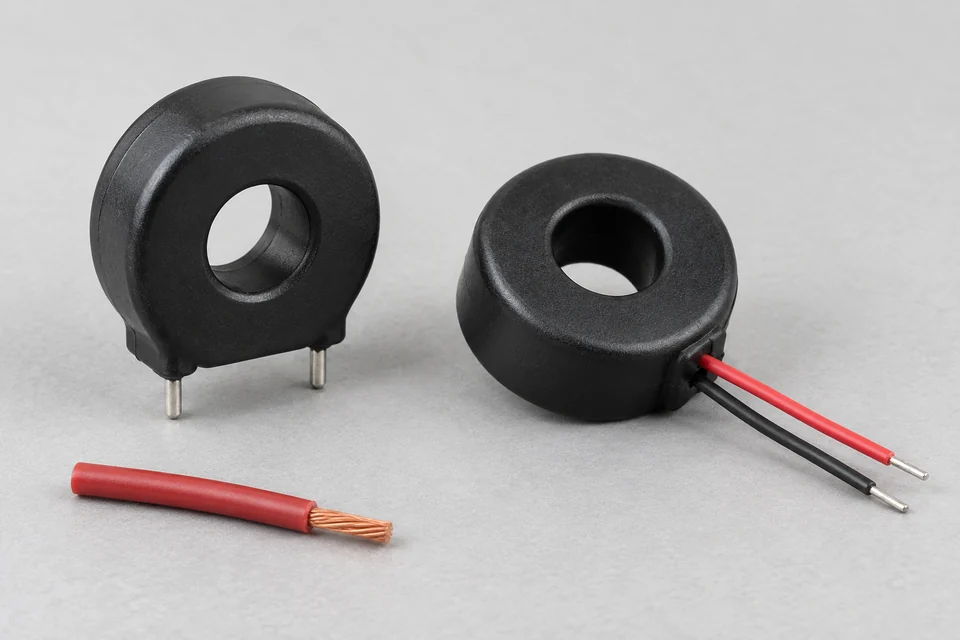
An AC current transformer for an electrical meter is a magnetic sensing component that produces a scaled signal from the alternating current flowing in a primary conductor. A common construction places a many-turn secondary winding around a magnetic core with an aperture for the primary conductor. Encapsulation supports the winding and provides the designed insulation and mechanical interface to the meter assembly.
Product & engineering
Understand the product.
An AC current transformer (CT) is a transformer that is used to produce an alternating current (AC) in its secondary which is proportional to the AC current in its primary. Current transformers, together with voltage transformers (VTs) or potential transformers (PTs), which are designed for measurement, are known as instrument transformers. The Current Transformer (C.T.), is a type of “instrument transformer” that is designed to produce an alternating current in its secondary winding which is proportional to the current being measured in its primary. Current transformers reduce high voltage currents to a much lower value and provide a convenient way of safely monitoring the actual electrical current flowing in an AC transmission line using a standard ammeter. The principal of operation of a basic current transformer is slightly different from that of an ordinary voltage transformer. Unlike the voltage or power transformer, the current transformer consists of only one or very few turns as its primary winding. This primary winding can be of either a single flat turn, a coil of heavy duty wire wrapped around the core or just a conductor or bus bar placed through a central hole. Due to this type of arrangement, the current transformer is often referred to as a “series transformer” as the primary winding, which never has more than a very few turns, is in series with the current carrying conductor supplying a load. The secondary winding however, may have a large number of coil turns wound on a laminated core of low-loss magnetic material. This core has a large cross-sectional area so that the magnetic flux density created is low using much smaller cross-sectional area wire, depending upon how much the current must be stepped down as it tries to output a constant current, independent of the connected load. The secondary winding will supply a current into either a short circuit, in the form of an ammeter, or into a resistive load until the voltage induced in the secondary is big enough to saturate the core or cause failure from excessive voltage breakdown. Unlike a voltage transformer, the primary current of a current transformer is not dependent of the secondary load current but instead is controlled by an external load. The secondary current is usually rated at a standard 1 Ampere or 5 Amperes for larger primary current ratings. When a current is too high to measure directly or the voltage of the circuit is too high, a current transformer can be used to provide an isolated lower current in its secondary which is proportional to the current in the primary circuit. The induced secondary current is then suitable for measuring instruments or processing in electronic equipment. Current transformers also have little effect on the primary circuit. Often, in electronic equipment, the isolation between the primary and secondary circuit is the important characteristic. Current transformers are used in electronic equipment and are widely used for metering and protective relays in the electrical power industry. Like any transformer, a current transformer has a primary winding, a core and a secondary winding, although some transformers, including current transformers, use an air core. In principle, the only difference between a current transformer and a voltage transformer (normal type) is that the former is fed with a 'constant' current while the latter is fed with a 'constant' voltage, where 'constant' has the strict circuit theory meaning. The alternating current in the primary produces an alternating magnetic field in the core, which then induces an alternating current in the secondary. The primary circuit is largely unaffected by the insertion of the CT. Accurate current transformers need close coupling between the primary and secondary to ensure that the secondary current is proportional to the primary current over a wide current range. The current in the secondary is the current in the primary (assuming a single turn primary) divided by the number of turns of the secondary. Typically, current transformers consist of a silicon steel ring core wound with many turns of copper wire. The conductor carrying the primary current is then passed through the ring; the CT's primary therefore consists of a single 'turn'. The primary 'winding' may be a permanent part of the current transformer, with a heavy copper bar to carry current through the core. Window-type current transformers (aka zero sequence current transformers, or ZSCT) are also common, which can have circuit cables run through the middle of an opening in the core to provide a single-turn primary winding. To assist accuracy, the primary conductor should be central in aperture. CTs are specified by their current ratio from primary to secondary. The rated secondary current is normally standardized at 1 or 5 amperes. For example, a 4000:5 CT secondary winding will supply an output current of 5 amperes when the primary winding current is 4000 amperes. The AC Current Transformers (CT) for Electrical Meters market covers Pin, Wire, etc. The typical players include VAC, Falco Electronics, J&D Electronics, Shenke, etc.
Primary current establishes magnetic flux, and the secondary current approximately balances its ampere-turns within the component's operating range. A burden resistor converts the secondary current into a voltage usable by the meter's input circuit. Turns ratio, excitation current, burden and core behavior affect both amplitude and phase error; those errors matter when current is combined with a voltage channel to calculate energy.
Pin and wire describe secondary connection arrangements. Pins can support PCB assembly, while flying leads allow the sensor to sit near the primary conductor and connect elsewhere. Aperture shape, conductor position, insulation spacing, lead routing and available board space must be reviewed together. A compact meter CT should not automatically be specified with the 1 A or 5 A secondary convention used by many larger instrument transformers.
Soft magnetic alloys, including nanocrystalline materials, are used to support linearity and low phase error. Shielding and specified DC-tolerant core designs can address particular interference or waveform conditions. Such features do not make an ordinary AC CT a DC current sensor or establish universal immunity to external magnetic fields. Meter calibration still depends on the assembled current channel and its temperature range.
What turns activity into demand
Compact AC current transformers connect meter current channels to their electronics; pin and wire variants differ in integration while sharing a magnetic sensing principle.
The commercial boundary
The family concerns CT components integrated with electrical metering, including pin and wire connections. Complete meters, shunt resistors, Hall sensors and larger utility measurement packages have different architectures and commercial boundaries.
Selected research
Market Structure
Global AC Current Transformers (CT) for Electrical Meters Market by Size, by Type, by Application, by Region, History and Forecast 2021-2032
Market perspective
An AC current transformer (CT) is a transformer that is used to produce an alternating current (AC) in its secondary which is proportional to the AC current in its primary. Current transformers, together with voltage transformers (VTs) or potential transformers (PTs), which are designed for measurement, are known as instrument transformers. The Current Transformer (C.T.), is a type of “instrument transformer” that is designed to produce an alternating current in its secondary winding which is proportional to the current being measured in its primary. Current transformers reduce high voltage currents to a much lower value and provide a convenient way of safely monitoring the actual electrical current flowing in an AC transmission line using a standard ammeter. The principal of operation of a basic current transformer is slightly different from that of an ordinary voltage transformer. Unlike the voltage or power transformer, the current transformer consists of only one or very few turns as its primary winding. This primary winding can be of either a single flat turn, a coil of heavy duty wire wrapped around the core or just a conductor or bus bar placed through a central hole. Due to this type of arrangement, the current transformer is often referred to as a “series transformer” as the primary winding, which never has more than a very few turns, is in series with the current carrying conductor supplying a load. The secondary winding however, may have a large number of coil turns wound on a laminated core of low-loss magnetic material. This core has a large cross-sectional area so that the magnetic flux density created is low using much smaller cross-sectional area wire, depending upon how much the current must be stepped down as it tries to output a constant current, independent of the connected load. The secondary winding will supply a current into either a short circuit, in the form of an ammeter, or into a resistive load until the voltage induced in the secondary is big enough to saturate the core or cause failure from excessive voltage breakdown. Unlike a voltage transformer, the primary current of a current transformer is not dependent of the secondary load current but instead is controlled by an external load. The secondary current is usually rated at a standard 1 Ampere or 5 Amperes for larger primary current ratings. When a current is too high to measure directly or the voltage of the circuit is too high, a current transformer can be used to provide an isolated lower current in its secondary which is proportional to the current in the primary circuit. The induced secondary current is then suitable for measuring instruments or processing in electronic equipment. Current transformers also have little effect on the primary circuit. Often, in electronic equipment, the isolation between the primary and secondary circuit is the important characteristic. Current transformers are used in electronic equipment and are widely used for metering and protective relays in the electrical power industry. Like any transformer, a current transformer has a primary winding, a core and a secondary winding, although some transformers, including current transformers, use an air core. In principle, the only difference between a current transformer and a voltage transformer (normal type) is that the former is fed with a 'constant' current while the latter is fed with a 'constant' voltage, where 'constant' has the strict circuit theory meaning. The alternating current in the primary produces an alternating magnetic field in the core, which then induces an alternating current in the secondary. The primary circuit is largely unaffected by the insertion of the CT. Accurate current transformers need close coupling between the primary and secondary to ensure that the secondary current is proportional to the primary current over a wide current range. The current in the secondary is the current in the primary (assuming a single turn primary) divided by the number of turns of the secondary. Typically, current transformers consist of a silicon steel ring core wound with many turns of copper wire. The conductor carrying the primary current is then passed through the ring; the CT's primary therefore consists of a single 'turn'. The primary 'winding' may be a permanent part of the current transformer, with a heavy copper bar to carry current through the core. Window-type current transformers (aka zero sequence current transformers, or ZSCT) are also common, which can have circuit cables run through the middle of an opening in the core to provide a single-turn primary winding. To assist accuracy, the primary conductor should be central in aperture. CTs are specified by their current ratio from primary to secondary. The rated secondary current is normally standardized at 1 or 5 amperes. For example, a 4000:5 CT secondary winding will supply an output current of 5 amperes when the primary winding current is 4000 amperes. The AC Current Transformers (CT) for Electrical Meters market covers Pin, Wire, etc. The typical players include VAC, Falco Electronics, J&D Electronics, Shenke, etc.
Global AC Current Transformers (CT) for Electrical Meters key players include Falco Electronics, Accuenergy, VAC, TE Connectivity, Hioki E.E., etc. Global top five manufacturers hold a share about 30%. Asia Pacific is the largest market, with a share about 63%, followed by Europe and America, both have a share about 32 percent. In terms of product, Wire is the largest segment, with a share over 80%. And in terms of application, the largest application is Residential, followed by Industrial, etc.
The report provides an overview of the global AC Current Transformers (CT) for Electrical Meters market in terms of capacity, output, revenue, and price, analyzing global market trends using historical revenue and sales data for 2021-2025, estimates for 2026, and projected CAGRs through 2032.
Read the full market overview
The study covers key producers of AC Current Transformers (CT) for Electrical Meters and consumption patterns in major regions and countries, assesses future market potential, and highlights priority regions and countries for segmenting the market into sub-sectors, with country-specific market value data for the U.S., Canada, Mexico, Brazil, China, Japan, South Korea, Southeast Asia, India, Germany, the U.K., Italy, the Middle East, Africa, and other countries.
The report also presents AC Current Transformers (CT) for Electrical Meters sales, revenue, market share, and industry ranking for the main manufacturers for 2021-2026, identifies the major stakeholders in the global market, and analyzes their competitive landscape and market positioning based on recent developments and segmental revenues.
In addition, the report analyzes segment data by type and application—covering sales, revenue, and price—for 2021-2032, and evaluates and forecasts the AC Current Transformers (CT) for Electrical Meters market size, projected growth trends, production technologies, key applications, and end-use industries.
AC Current Transformers (CT) for Electrical Meters Segment by Company
Falco Electronics
Accuenergy
VAC
TE Connectivity
Hioki E.E.
Nanjing Zeming Electronic
Flex-Core
AutomationDirect
Shenke
Omega Engineering
Oswell
Weschler Instruments
Electrohms
Yuanxing
J&D Electronics
Electromagnetic Industries LLP
Simpson Electric
AC Current Transformers (CT) for Electrical Meters Segment by Type
Pin
Wire
AC Current Transformers (CT) for Electrical Meters Segment by Application
Residential
Industrial
Other
AC Current Transformers (CT) for Electrical Meters Segment by Region
North America
United States
Canada
Mexico
Europe
Germany
France
U.K.
Italy
Russia
Spain
Netherlands
Switzerland
Sweden
Poland
Asia-Pacific
China
Japan
South Korea
India
Australia
Taiwan
Southeast Asia
South America
Brazil
Argentina
Chile
Middle East & Africa
Egypt
South Africa
Israel
Türkiye
GCC Countries
Study Objectives
1. To analyze and research the global status and future forecast, involving, production, value, consumption, growth rate (CAGR), market share, historical and forecast.
2. To present the key manufacturers, capacity, production, revenue, market share, and Recent Developments.
3. To split the breakdown data by regions, type, manufacturers, and Application.
4. To analyze the global and key regions market potential and advantage, opportunity and challenge, restraints, and risks.
5. To identify significant trends, drivers, influence factors in global and regions.
6. To analyze competitive developments such as expansions, agreements, new product launches, and acquisitions in the market.
Reasons to Buy This Report
1. This report will help the readers to understand the competition within the industries and strategies for the competitive environment to enhance the potential profit. The report also focuses on the competitive landscape of the global AC Current Transformers (CT) for Electrical Meters market, and introduces in detail the market share, industry ranking, competitor ecosystem, market performance, new product development, operation situation, expansion, and acquisition. etc. of the main players, which helps the readers to identify the main competitors and deeply understand the competition pattern of the market.
2. This report will help stakeholders to understand the global industry status and trends of AC Current Transformers (CT) for Electrical Meters and provides them with information on key market drivers, restraints, challenges, and opportunities.
3. This report will help stakeholders to understand competitors better and gain more insights to strengthen their position in their businesses. The competitive landscape section includes the market share and rank (in volume and value), competitor ecosystem, new product development, expansion, and acquisition.
4. This report stays updated with novel technology integration, features, and the latest developments in the market.
5. This report helps stakeholders to gain insights into which regions to target globally.
6. This report helps stakeholders to gain insights into the end-user perception concerning the adoption of AC Current Transformers (CT) for Electrical Meters.
7. This report helps stakeholders to identify some of the key players in the market and understand their valuable contribution.
Chapter Outline
Chapter 1: Provides an overview of the AC Current Transformers (CT) for Electrical Meters market, including product definition, global market growth prospects, production value, capacity, and average price forecasts (2021-2032).
Chapter 2: Analysis key trends, drivers, challenges, and opportunities within the global AC Current Transformers (CT) for Electrical Meters industry.
Chapter 3: Detailed analysis of AC Current Transformers (CT) for Electrical Meters market competition landscape. Including AC Current Transformers (CT) for Electrical Meters manufacturers' output value, output and average price from 2021 to 2026, as well as competition analysis indicators such as origin, product type, application, merger and acquisition information, etc.
Chapter 4: Provides the analysis of various market segments by type, covering the market size and development potential of each market segment, to help readers find the blue ocean market in different market segments.
Chapter 5: Provides the analysis of various market segments by application, covering the market size and development potential of each market segment, to help readers find the blue ocean market in different downstream markets.
Chapter 6: Provides profiles of key players, introducing the basic situation of the main companies in the market in detail, including product production/output, value, price, gross margin, product introduction, recent development, etc.
Chapter 7: Production/Production Value of AC Current Transformers (CT) for Electrical Meters by region. It provides a quantitative analysis of the market size and development potential of each region in the next six years.
Chapter 8: Consumption of AC Current Transformers (CT) for Electrical Meters in regional level and country level. It provides a quantitative analysis of the market size and development potential of each region and its main countries and introduces the market development, future development prospects, market space, and production of each country in the world.
Chapter 9: Analysis of industrial chain, including the upstream and downstream of the industry.
Chapter 10: Concluding Insights of the report.
More report detail
Tables and figures
Scope & coverage.
Types
- Pin
- Wire
Applications
- Residential
- Industrial
- Other
Companies covered
- Falco Electronics
- Accuenergy
- VAC
- TE Connectivity
- Hioki E.E.
- Nanjing Zeming Electronic
- Flex-Core
- AutomationDirect
- Shenke
- Omega Engineering
- Oswell
- Weschler Instruments
- Electrohms
- Yuanxing
- J&D Electronics
- Electromagnetic Industries LLP
- Simpson Electric
Inside the report.
1 Market Overview
- 1.1 Product Definition
- 1.2 Global Market Growth Prospects
- 1.2.1 Global AC Current Transformers (CT) for Electrical Meters Production Value Estimates and Forecasts (2021-2032)
- 1.2.2 Global AC Current Transformers (CT) for Electrical Meters Production Capacity Estimates and Forecasts (2021-2032)
- 1.2.3 Global AC Current Transformers (CT) for Electrical Meters Production Estimates and Forecasts (2021-2032)
- 1.2.4 Global AC Current Transformers (CT) for Electrical Meters Market Average Price (2021-2032)
- 1.3 Assumptions and Limitations
- 1.4 Study Goals and Objectives
2 Global AC Current Transformers (CT) for Electrical Meters Market Dynamics
- 2.1 AC Current Transformers (CT) for Electrical Meters Industry Trends
- 2.2 AC Current Transformers (CT) for Electrical Meters Industry Drivers
- 2.3 AC Current Transformers (CT) for Electrical Meters Industry Opportunities and Challenges
- 2.4 AC Current Transformers (CT) for Electrical Meters Industry Restraints
3 AC Current Transformers (CT) for Electrical Meters Market by Manufacturers
- 3.1 Global AC Current Transformers (CT) for Electrical Meters Production Value by Manufacturers (2021-2026)
- 3.2 Global AC Current Transformers (CT) for Electrical Meters Production by Manufacturers (2021-2026)
- 3.3 Global AC Current Transformers (CT) for Electrical Meters Average Price by Manufacturers (2021-2026)
- 3.4 Global AC Current Transformers (CT) for Electrical Meters Industry Manufacturers Ranking, 2024 VS 2025 VS 2026
- 3.5 Global AC Current Transformers (CT) for Electrical Meters Key Manufacturers Manufacturing Sites & Headquarters
- 3.6 Global AC Current Transformers (CT) for Electrical Meters Manufacturers, Product Type & Application
- 3.7 Global AC Current Transformers (CT) for Electrical Meters Manufacturers Established Date
- 3.8 Market Competitive Analysis
- 3.8.1 Global AC Current Transformers (CT) for Electrical Meters Market CR5 and HHI
- 3.8.2 Global Top 5 and 10 AC Current Transformers (CT) for Electrical Meters Players Market Share by Production Value in 2025
- 3.8.3 2025 AC Current Transformers (CT) for Electrical Meters Tier 1, Tier 2, and Tier 3
4 AC Current Transformers (CT) for Electrical Meters Market by Type
- 4.1 AC Current Transformers (CT) for Electrical Meters Type Introduction
- 4.1.1 Pin
- 4.1.2 Wire
- 4.2 Global AC Current Transformers (CT) for Electrical Meters Production by Type
- 4.2.1 Global AC Current Transformers (CT) for Electrical Meters Production by Type (2021 VS 2025 VS 2032)
- 4.2.2 Global AC Current Transformers (CT) for Electrical Meters Production by Type (2021-2032)
- 4.2.3 Global AC Current Transformers (CT) for Electrical Meters Production Market Share by Type (2021-2032)
- 4.3 Global AC Current Transformers (CT) for Electrical Meters Production Value by Type
- 4.3.1 Global AC Current Transformers (CT) for Electrical Meters Production Value by Type (2021 VS 2025 VS 2032)
- 4.3.2 Global AC Current Transformers (CT) for Electrical Meters Production Value by Type (2021-2032)
- 4.3.3 Global AC Current Transformers (CT) for Electrical Meters Production Value Market Share by Type (2021-2032)
5 AC Current Transformers (CT) for Electrical Meters Market by Application
- 5.1 AC Current Transformers (CT) for Electrical Meters Application Introduction
- 5.1.1 Residential
- 5.1.2 Industrial
- 5.1.3 Other
- 5.2 Global AC Current Transformers (CT) for Electrical Meters Production by Application
- 5.2.1 Global AC Current Transformers (CT) for Electrical Meters Production by Application (2021 VS 2025 VS 2032)
- 5.2.2 Global AC Current Transformers (CT) for Electrical Meters Production by Application (2021-2032)
- 5.2.3 Global AC Current Transformers (CT) for Electrical Meters Production Market Share by Application (2021-2032)
- 5.3 Global AC Current Transformers (CT) for Electrical Meters Production Value by Application
- 5.3.1 Global AC Current Transformers (CT) for Electrical Meters Production Value by Application (2021 VS 2025 VS 2032)
- 5.3.2 Global AC Current Transformers (CT) for Electrical Meters Production Value by Application (2021-2032)
- 5.3.3 Global AC Current Transformers (CT) for Electrical Meters Production Value Market Share by Application (2021-2032)
6 Company Profiles
- 6.1 Falco Electronics
- 6.1.1 Falco Electronics Company Information
- 6.1.2 Falco Electronics Business Overview
- 6.1.3 Falco Electronics AC Current Transformers (CT) for Electrical Meters Production, Value and Gross Margin (2021-2026)
- 6.1.4 Falco Electronics AC Current Transformers (CT) for Electrical Meters Product Portfolio
- 6.1.5 Falco Electronics Recent Developments
- 6.2 Accuenergy
- 6.2.1 Accuenergy Company Information
- 6.2.2 Accuenergy Business Overview
- 6.2.3 Accuenergy AC Current Transformers (CT) for Electrical Meters Production, Value and Gross Margin (2021-2026)
- 6.2.4 Accuenergy AC Current Transformers (CT) for Electrical Meters Product Portfolio
- 6.2.5 Accuenergy Recent Developments
- 6.3 VAC
- 6.3.1 VAC Company Information
- 6.3.2 VAC Business Overview
- 6.3.3 VAC AC Current Transformers (CT) for Electrical Meters Production, Value and Gross Margin (2021-2026)
- 6.3.4 VAC AC Current Transformers (CT) for Electrical Meters Product Portfolio
- 6.3.5 VAC Recent Developments
- 6.4 TE Connectivity
- 6.4.1 TE Connectivity Company Information
- 6.4.2 TE Connectivity Business Overview
- 6.4.3 TE Connectivity AC Current Transformers (CT) for Electrical Meters Production, Value and Gross Margin (2021-2026)
- 6.4.4 TE Connectivity AC Current Transformers (CT) for Electrical Meters Product Portfolio
- 6.4.5 TE Connectivity Recent Developments
- 6.5 Hioki E.E.
- 6.5.1 Hioki E.E. Company Information
- 6.5.2 Hioki E.E. Business Overview
- 6.5.3 Hioki E.E. AC Current Transformers (CT) for Electrical Meters Production, Value and Gross Margin (2021-2026)
- 6.5.4 Hioki E.E. AC Current Transformers (CT) for Electrical Meters Product Portfolio
- 6.5.5 Hioki E.E. Recent Developments
- 6.6 Nanjing Zeming Electronic
- 6.6.1 Nanjing Zeming Electronic Company Information
- 6.6.2 Nanjing Zeming Electronic Business Overview
- 6.6.3 Nanjing Zeming Electronic AC Current Transformers (CT) for Electrical Meters Production, Value and Gross Margin (2021-2026)
- 6.6.4 Nanjing Zeming Electronic AC Current Transformers (CT) for Electrical Meters Product Portfolio
- 6.6.5 Nanjing Zeming Electronic Recent Developments
- 6.7 Flex-Core
- 6.7.1 Flex-Core Company Information
- 6.7.2 Flex-Core Business Overview
- 6.7.3 Flex-Core AC Current Transformers (CT) for Electrical Meters Production, Value and Gross Margin (2021-2026)
- 6.7.4 Flex-Core AC Current Transformers (CT) for Electrical Meters Product Portfolio
- 6.7.5 Flex-Core Recent Developments
- 6.8 AutomationDirect
- 6.8.1 AutomationDirect Company Information
- 6.8.2 AutomationDirect Business Overview
- 6.8.3 AutomationDirect AC Current Transformers (CT) for Electrical Meters Production, Value and Gross Margin (2021-2026)
- 6.8.4 AutomationDirect AC Current Transformers (CT) for Electrical Meters Product Portfolio
- 6.8.5 AutomationDirect Recent Developments
- 6.9 Shenke
- 6.9.1 Shenke Company Information
- 6.9.2 Shenke Business Overview
- 6.9.3 Shenke AC Current Transformers (CT) for Electrical Meters Production, Value and Gross Margin (2021-2026)
- 6.9.4 Shenke AC Current Transformers (CT) for Electrical Meters Product Portfolio
- 6.9.5 Shenke Recent Developments
- 6.10 Omega Engineering
- 6.10.1 Omega Engineering Company Information
- 6.10.2 Omega Engineering Business Overview
- 6.10.3 Omega Engineering AC Current Transformers (CT) for Electrical Meters Production, Value and Gross Margin (2021-2026)
- 6.10.4 Omega Engineering AC Current Transformers (CT) for Electrical Meters Product Portfolio
- 6.10.5 Omega Engineering Recent Developments
- 6.11 Oswell
- 6.11.1 Oswell Company Information
- 6.11.2 Oswell Business Overview
- 6.11.3 Oswell AC Current Transformers (CT) for Electrical Meters Production, Value and Gross Margin (2021-2026)
- 6.11.4 Oswell AC Current Transformers (CT) for Electrical Meters Product Portfolio
- 6.11.5 Oswell Recent Developments
- 6.12 Weschler Instruments
- 6.12.1 Weschler Instruments Company Information
- 6.12.2 Weschler Instruments Business Overview
- 6.12.3 Weschler Instruments AC Current Transformers (CT) for Electrical Meters Production, Value and Gross Margin (2021-2026)
- 6.12.4 Weschler Instruments AC Current Transformers (CT) for Electrical Meters Product Portfolio
- 6.12.5 Weschler Instruments Recent Developments
- 6.13 Electrohms
- 6.13.1 Electrohms Company Information
- 6.13.2 Electrohms Business Overview
- 6.13.3 Electrohms AC Current Transformers (CT) for Electrical Meters Production, Value and Gross Margin (2021-2026)
- 6.13.4 Electrohms AC Current Transformers (CT) for Electrical Meters Product Portfolio
- 6.13.5 Electrohms Recent Developments
- 6.14 Yuanxing
- 6.14.1 Yuanxing Company Information
- 6.14.2 Yuanxing Business Overview
- 6.14.3 Yuanxing AC Current Transformers (CT) for Electrical Meters Production, Value and Gross Margin (2021-2026)
- 6.14.4 Yuanxing AC Current Transformers (CT) for Electrical Meters Product Portfolio
- 6.14.5 Yuanxing Recent Developments
- 6.15 J&D Electronics
- 6.15.1 J&D Electronics Company Information
- 6.15.2 J&D Electronics Business Overview
- 6.15.3 J&D Electronics AC Current Transformers (CT) for Electrical Meters Production, Value and Gross Margin (2021-2026)
- 6.15.4 J&D Electronics AC Current Transformers (CT) for Electrical Meters Product Portfolio
- 6.15.5 J&D Electronics Recent Developments
- 6.16 Electromagnetic Industries LLP
- 6.16.1 Electromagnetic Industries LLP Company Information
- 6.16.2 Electromagnetic Industries LLP Business Overview
- 6.16.3 Electromagnetic Industries LLP AC Current Transformers (CT) for Electrical Meters Production, Value and Gross Margin (2021-2026)
- 6.16.4 Electromagnetic Industries LLP AC Current Transformers (CT) for Electrical Meters Product Portfolio
- 6.16.5 Electromagnetic Industries LLP Recent Developments
- 6.17 Simpson Electric
- 6.17.1 Simpson Electric Company Information
- 6.17.2 Simpson Electric Business Overview
- 6.17.3 Simpson Electric AC Current Transformers (CT) for Electrical Meters Production, Value and Gross Margin (2021-2026)
- 6.17.4 Simpson Electric AC Current Transformers (CT) for Electrical Meters Product Portfolio
- 6.17.5 Simpson Electric Recent Developments
7 Global AC Current Transformers (CT) for Electrical Meters Production by Region
- 7.1 Global AC Current Transformers (CT) for Electrical Meters Production by Region: 2021 VS 2025 VS 2032
- 7.2 Global AC Current Transformers (CT) for Electrical Meters Production by Region (2021-2032)
- 7.2.1 Global AC Current Transformers (CT) for Electrical Meters Production by Region (2021-2026)
- 7.2.2 Global AC Current Transformers (CT) for Electrical Meters Production Forecast by Region (2027-2032)
- 7.3 Global AC Current Transformers (CT) for Electrical Meters Production by Region: 2021 VS 2025 VS 2032
- 7.4 Global AC Current Transformers (CT) for Electrical Meters Production Value by Region (2021-2032)
- 7.4.1 Global AC Current Transformers (CT) for Electrical Meters Production Value by Region (2021-2026)
- 7.4.2 Global AC Current Transformers (CT) for Electrical Meters Production Value by Region (2027-2032)
- 7.5 Global AC Current Transformers (CT) for Electrical Meters Market Price Analysis by Region (2021-2032)
- 7.6 Regional Production Value Trends (2021-2032)
- 7.6.1 North America AC Current Transformers (CT) for Electrical Meters Production Value (2021-2032)
- 7.6.2 Europe AC Current Transformers (CT) for Electrical Meters Production Value (2021-2032)
- 7.6.3 Asia-Pacific AC Current Transformers (CT) for Electrical Meters Production Value (2021-2032)
- 7.6.4 South America AC Current Transformers (CT) for Electrical Meters Production Value (2021-2032)
- 7.6.5 Middle East & Africa AC Current Transformers (CT) for Electrical Meters Production Value (2021-2032)
8 Global AC Current Transformers (CT) for Electrical Meters Consumption by Region
- 8.1 Global AC Current Transformers (CT) for Electrical Meters Consumption by Region: 2021 VS 2025 VS 2032
- 8.2 Global AC Current Transformers (CT) for Electrical Meters Consumption by Region (2021-2032)
- 8.2.1 Global AC Current Transformers (CT) for Electrical Meters Consumption by Region (2021-2026)
- 8.2.2 Global AC Current Transformers (CT) for Electrical Meters Consumption by Region (2027-2032)
- 8.3 North America
- 8.3.1 North America AC Current Transformers (CT) for Electrical Meters Consumption Growth Rate by Country: 2021 VS 2025 VS 2032
- 8.3.2 North America AC Current Transformers (CT) for Electrical Meters Consumption by Country (2021-2032)
- 8.3.3 U.S.
- 8.3.4 Canada
- 8.3.5 Mexico
- 8.4 Europe
- 8.4.1 Europe AC Current Transformers (CT) for Electrical Meters Consumption Growth Rate by Country: 2021 VS 2025 VS 2032
- 8.4.2 Europe AC Current Transformers (CT) for Electrical Meters Consumption by Country (2021-2032)
- 8.4.3 Germany
- 8.4.4 France
- 8.4.5 U.K.
- 8.4.6 Italy
- 8.4.7 Netherlands
- 8.5 Asia Pacific
- 8.5.1 Asia Pacific AC Current Transformers (CT) for Electrical Meters Consumption Growth Rate by Country: 2021 VS 2025 VS 2032
- 8.5.2 Asia Pacific AC Current Transformers (CT) for Electrical Meters Consumption by Country (2021-2032)
- 8.5.3 China
- 8.5.4 Japan
- 8.5.5 South Korea
- 8.5.6 Southeast Asia
- 8.5.7 India
- 8.5.8 Australia
- 8.6 South America
- 8.6.1 South America AC Current Transformers (CT) for Electrical Meters Consumption Growth Rate by Country: 2021 VS 2025 VS 2032
- 8.6.2 South America AC Current Transformers (CT) for Electrical Meters Consumption by Country (2021-2032)
- 8.6.3 Brazil
- 8.6.4 Argentina
- 8.6.5 Chile
- 8.6.6 Colombia
- 8.7 Middle East & Africa
- 8.7.1 Middle East & Africa AC Current Transformers (CT) for Electrical Meters Consumption Growth Rate by Country: 2021 VS 2025 VS 2032
- 8.7.2 Middle East & Africa AC Current Transformers (CT) for Electrical Meters Consumption by Country (2021-2032)
- 8.7.3 Egypt
- 8.7.4 South Africa
- 8.7.5 Israel
- 8.7.6 Türkiye
- 8.7.7 GCC Countries
9 Value Chain and Sales Channels Analysis
- 9.1 AC Current Transformers (CT) for Electrical Meters Value Chain Analysis
- 9.1.1 AC Current Transformers (CT) for Electrical Meters Key Raw Materials
- 9.1.2 Raw Materials Key Suppliers
- 9.1.3 Manufacturing Cost Structure
- 9.1.4 AC Current Transformers (CT) for Electrical Meters Production Mode & Process
- 9.2 AC Current Transformers (CT) for Electrical Meters Sales Channels Analysis
- 9.2.1 Direct Comparison with Distribution Share
- 9.2.2 AC Current Transformers (CT) for Electrical Meters Distributors
- 9.2.3 AC Current Transformers (CT) for Electrical Meters Customers
10 Concluding Insights
11 Appendix
- 11.1 Reasons for Doing This Study
- 11.2 Research Methodology
- 11.3 Research Process
- 11.4 Authors List of This Report
- 11.5 Data Source
- 11.5.1 Secondary Sources
- 11.5.2 Primary Sources
- 11.6 Disclaimer
GET THE RESEARCH
Choose your license.
Choose who needs access.
All options are for this report and research series.
PDF by email within 3–5 working days after payment confirmation.
Talk to an analyst