APO RESEARCH · REPORT
Beryllium Copper Alloy
Beryllium copper alloy, commonly written CuBe or BeCu, is a copper-based precipitation-hardening alloy family in which beryllium is the principal strengthening element, typically in the low-single-digit weight-percent range (roughly 0.2 to 2.0 wt% Be depending on grade), sometimes combined with nickel, cobalt, or both to tune conductivity, stress-relaxation resistance, and aging response.
Product & engineering
Understand the product.
Beryllium copper alloy, commonly written CuBe or BeCu, is a copper-based precipitation-hardening alloy family in which beryllium is the principal strengthening element, typically in the low-single-digit weight-percent range (roughly 0.2 to 2.0 wt% Be depending on grade), sometimes combined with nickel, cobalt, or both to tune conductivity, stress-relaxation resistance, and aging response. The defining feature is a deliberately age-hardenable copper matrix: after solution treatment and quenching, controlled aging precipitates Be-rich phases from a supersaturated copper solid solution, producing a property set that is difficult to reach with other copper alloys—high elastic strength and fatigue resistance at useful conductivity, with stable spring force retention and good corrosion performance, plus practical attributes such as non-magnetic behavior and spark-resistant service in many conditions.
Compositionally, CuBe is best understood as two mainstream product families plus related variants. High-strength grades use higher Be content within the commercial range and are optimized for maximum strength, hardness, and spring performance; free-machining variants may include small lead additions to improve chip formation without changing the core precipitation-hardening mechanism. High-conductivity grades use lower Be and often add Ni, Co, or both (Cu Ni Be, Cu Co Be, Cu Co Ni Be families) to raise electrical and thermal conductivity while retaining an elevated strength level relative to most copper alloys, and to improve stress-relaxation behavior in electrical contact and connector duty. In addition to wrought grades, there are casting-oriented CuBe compositions designed for fluidity, feeding, and heat-treatable strength in near-net-shape parts.
Key parameters vary strongly with grade and temper because CuBe is a heat-treatable, cold-work-sensitive system rather than a single fixed material. Electrical conductivity typically spans the broad band from about the low-20s to roughly 60–70% IACS across the family as composition and aging state shift from strength-biased to conductivity-biased products. Peak mechanical properties are reached by combining cold work with age hardening; in that condition, high-strength strip and wire products can reach tensile strength on the order of 1.4–1.6 GPa, with hardness commonly in the high-300s HV and, in heavily cold-worked peak-aged conditions, approaching the low-400s HV. The practical engineering value comes from the combination of elevated yield strength, high elastic limit, and resistance to stress relaxation relative to most copper alloys, while maintaining meaningful electrical and thermal conductivity for current-carrying spring contacts and high-cycle components.
A manufacturing route for wrought CuBe starts with controlled melting and alloying, casting to billet or slab, hot working, and staged cold reduction (rolling or drawing) with intermediate anneals as needed for formability. Final properties are developed by solution annealing to dissolve strengthening constituents, quenching to retain a supersaturated copper matrix, optional cold work to raise dislocation density and elastic strength, and artificial aging (typically in the few-hundred-degree-C range) to precipitate Be-rich phases and lock in the target strength–conductivity balance. Casting routes deliver the alloy as near-net-shape parts by pouring into molds and then applying solution treatment and aging, with machining used mainly for finishing rather than for creating the entire geometry. Across both routes, beryllium chemistry imposes strict control of fumes and dust during melting, hot work, grinding, and machining; this is a process reality of the material family rather than a product “spec.”
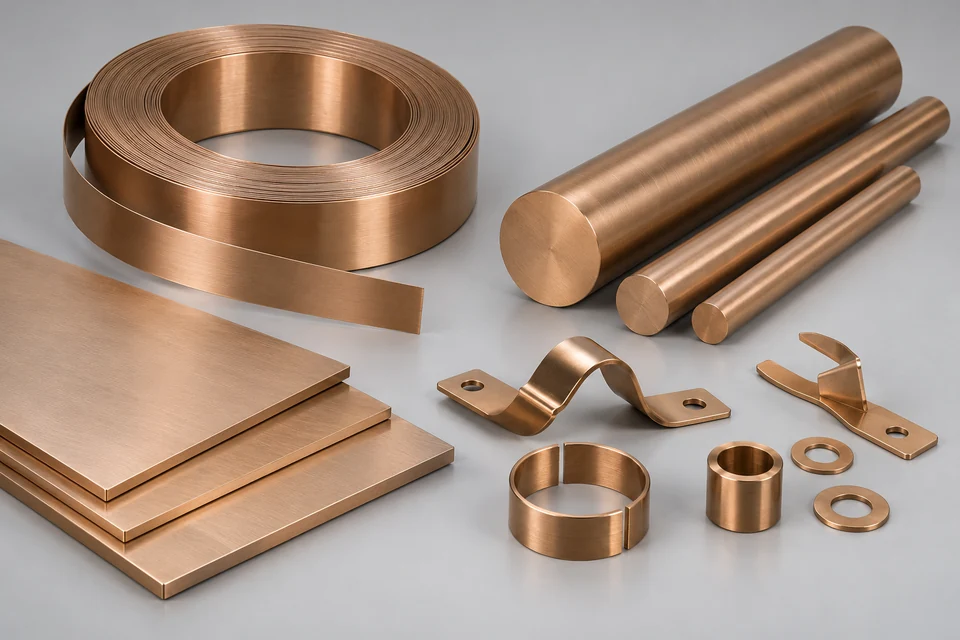
For classification in a non-overlapping “sold-as delivery form” market view, CuBe products are commonly segmented as Strip and Foil; Sheet and Plate; Rod and Bar; Wire; Tube; Forgings; Castings; Extrusions; and Others (reserved narrowly for machined blanks and non-standard cut pieces that cannot be cleanly mapped back to the primary forms). Application segmentation typically concentrates in electronics and telecommunications (connectors, contact springs, relays, switches, and precision current-carrying elastic elements), automotive (electrical connectors, sensor and power interconnects, spring contacts, wear components), aerospace and defense (high-reliability spring and contact elements, bushings, wear and guide parts), industrial equipment (tooling components, non-sparking elements, precision wear parts), energy including oil and gas and nuclear service (non-sparking and corrosion-resistant components, electrical contact and spring elements in harsh environments), and medical devices where compact, repeatable spring performance and corrosion resistance are valued.
Composition, supplied form and processing history determine the usable material. Evaluate the property required by the actual application with the specified test method; a chemistry name alone does not define a finished grade.
What turns activity into demand
Qualified formulation or component output creates material purchases through loading, process yield and the supplied mass basis. Raw material, formulated blend and finished-part revenues describe separate transaction stages.
The commercial boundary
For Beryllium Copper Alloy, distinguish the supplied product from its inputs and the complete application. Report types and applications may overlap; retain the selected edition's product definition, geography, period, unit and transaction basis when comparing estimates.
Which conditions determine usable beryllium copper alloy performance?
Beryllium copper alloy, commonly written CuBe or BeCu, is a copper-based precipitation-hardening alloy family in which beryllium is the principal strengthening element, typically in the low-single-digit weight-percent range (roughly 0.2 to 2.0 wt% Be depending on grade), sometimes combined with nickel, cobalt, or both to tune conductivity, stress-relaxation resistance, and aging response. Match formulation and impurity limits to the converting process, then verify the property after processing or curing. Compare like-for-like dry or as-supplied quantities; a finished component and its raw material represent different transaction stages.
Selected research
Market Analysis & Forecast
Global Beryllium Copper Alloy Market Analysis and Forecast 2026-2032
Market perspective
Beryllium copper alloy, commonly written CuBe or BeCu, is a copper-based precipitation-hardening alloy family in which beryllium is the principal strengthening element, typically in the low-single-digit weight-percent range (roughly 0.2 to 2.0 wt% Be depending on grade), sometimes combined with nickel, cobalt, or both to tune conductivity, stress-relaxation resistance, and aging response. The defining feature is a deliberately age-hardenable copper matrix: after solution treatment and quenching, controlled aging precipitates Be-rich phases from a supersaturated copper solid solution, producing a property set that is difficult to reach with other copper alloys—high elastic strength and fatigue resistance at useful conductivity, with stable spring force retention and good corrosion performance, plus practical attributes such as non-magnetic behavior and spark-resistant service in many conditions.
Compositionally, CuBe is best understood as two mainstream product families plus related variants. High-strength grades use higher Be content within the commercial range and are optimized for maximum strength, hardness, and spring performance; free-machining variants may include small lead additions to improve chip formation without changing the core precipitation-hardening mechanism. High-conductivity grades use lower Be and often add Ni, Co, or both (Cu Ni Be, Cu Co Be, Cu Co Ni Be families) to raise electrical and thermal conductivity while retaining an elevated strength level relative to most copper alloys, and to improve stress-relaxation behavior in electrical contact and connector duty. In addition to wrought grades, there are casting-oriented CuBe compositions designed for fluidity, feeding, and heat-treatable strength in near-net-shape parts.
Key parameters vary strongly with grade and temper because CuBe is a heat-treatable, cold-work-sensitive system rather than a single fixed material. Electrical conductivity typically spans the broad band from about the low-20s to roughly 60–70% IACS across the family as composition and aging state shift from strength-biased to conductivity-biased products. Peak mechanical properties are reached by combining cold work with age hardening; in that condition, high-strength strip and wire products can reach tensile strength on the order of 1.4–1.6 GPa, with hardness commonly in the high-300s HV and, in heavily cold-worked peak-aged conditions, approaching the low-400s HV. The practical engineering value comes from the combination of elevated yield strength, high elastic limit, and resistance to stress relaxation relative to most copper alloys, while maintaining meaningful electrical and thermal conductivity for current-carrying spring contacts and high-cycle components.
Read the full market overview
A manufacturing route for wrought CuBe starts with controlled melting and alloying, casting to billet or slab, hot working, and staged cold reduction (rolling or drawing) with intermediate anneals as needed for formability. Final properties are developed by solution annealing to dissolve strengthening constituents, quenching to retain a supersaturated copper matrix, optional cold work to raise dislocation density and elastic strength, and artificial aging (typically in the few-hundred-degree-C range) to precipitate Be-rich phases and lock in the target strength–conductivity balance. Casting routes deliver the alloy as near-net-shape parts by pouring into molds and then applying solution treatment and aging, with machining used mainly for finishing rather than for creating the entire geometry. Across both routes, beryllium chemistry imposes strict control of fumes and dust during melting, hot work, grinding, and machining; this is a process reality of the material family rather than a product “spec.”
For classification in a non-overlapping “sold-as delivery form” market view, CuBe products are commonly segmented as Strip and Foil; Sheet and Plate; Rod and Bar; Wire; Tube; Forgings; Castings; Extrusions; and Others (reserved narrowly for machined blanks and non-standard cut pieces that cannot be cleanly mapped back to the primary forms). Application segmentation typically concentrates in electronics and telecommunications (connectors, contact springs, relays, switches, and precision current-carrying elastic elements), automotive (electrical connectors, sensor and power interconnects, spring contacts, wear components), aerospace and defense (high-reliability spring and contact elements, bushings, wear and guide parts), industrial equipment (tooling components, non-sparking elements, precision wear parts), energy including oil and gas and nuclear service (non-sparking and corrosion-resistant components, electrical contact and spring elements in harsh environments), and medical devices where compact, repeatable spring performance and corrosion resistance are valued.
The global beryllium copper alloy market expanded materially in value over 2021-2025 despite a mid-cycle volume correction after the 2022 peak. Market size increased from 783.44 million USD in 2021 to 1,064.96 million USD in 2025, while sales volume rose from 17,509.98 tons to 19,387.34 tons and average price increased from 44.74 thousand USD per ton to 54.93 thousand USD per ton, yielding CAGRs of 7.98% for market size, 2.58% for volume, and 5.26% for price for 2021-2025. The 2023-2025 period confirms that price and product mix became the main support for value, as tonnage softened while pricing remained elevated. The market is expected to re-enter a stronger expansion phase in 2026, with sales recovering to 20,702,86 tons and market size reaching 1,160.71 million USD, and is projected to reach 1,982.69 million USD by 2032, yielding CAGRs of 9.33% for market size, 4.03% for volume, and 5.10% for price for 2026-2032.
Industry structure remains technically concentrated and regionally polarized. In 2025, Materion accounted for about 48.43% of global sales volume, and Materion plus NGK Insulators represented about 64.14%, confirming a top-heavy competitive structure in qualified high-performance grades. North America remained the largest value market in 2025 at 533.87 million USD, equal to about 50.13% of global market size, followed by Europe at 297.02 million USD and China at 104.26 million USD. Regional pricing dispersion remains a core feature of the market, with North America and Europe operating at clear premiums versus China and other lower-priced regions. Looking forward, North America remains the largest absolute value pool, while China is the fastest-growing major region by value, with market size projected to rise to 249.37 million USD by 2032, yielding a 2026-2032 CAGR of 14.00%, indicating a meaningful shift toward higher-value product mix and price realization.
By product form, Strip and Foil remains the commercial backbone of the industry, reaching 366.98 million USD in 2025 and projected to increase to 702.07 million USD by 2032, yielding a 2026-2032 CAGR of 9.81%. Forgings remains the highest-priced major form, while Wires shows the strongest forward growth among the main forms. By application, Electronics and Telecom is the largest demand center, increasing from 311.40 million USD in 2025 to 649.33 million USD by 2032, yielding a 2026-2032 CAGR of 10.98%, while Aerospace remains a high-value segment with persistent pricing premium and strong long-term expansion. Overall, the market outlook supports a premiumization-led growth path in which recovered tonnage, sustained price escalation, and a richer electronics, aerospace, and defense mix drive value creation through 2032.
This report presents an overview of global market for Beryllium Copper Alloy, capacity, output, revenue and price. Analyses of the global market trends, with historic market revenue or sales data for 2021 - 2025, estimates for 2026, and projections of CAGR through 2032.
This report researches the key producers of Beryllium Copper Alloy, also provides the consumption of main regions and countries. Of the upcoming market potential for Beryllium Copper Alloy, and key regions or countries of focus to forecast this market into various segments and sub-segments. Country specific data and market value analysis for the U.S., Canada, Mexico, Brazil, China, Japan, South Korea, Southeast Asia, India, Germany, the U.K., Italy, Middle East, Africa, and Other Countries.
This report focuses on the Beryllium Copper Alloy sales, revenue, market share and industry ranking of main manufacturers, data from 2021 to 2026. Identification of the major stakeholders in the global Beryllium Copper Alloy market, and analysis of their competitive landscape and market positioning based on recent developments and segmental revenues. This report will help stakeholders to understand the competitive landscape and gain more insights and position their businesses and market strategies in a better way.
This report analyzes the segments data by Type and by Application, sales, revenue, and price, from 2021 to 2032. Evaluation and forecast the market size for Beryllium Copper Alloy sales, projected growth trends, production technology, application and end-user industry.
Beryllium Copper Alloy Segment by Company
Materion
NGK Insulators
Wieland Group
Lebronze Alloys
China Minmetals Beryllium
Xinjiang Non-Ferrous Metal Industry
Ampco Metal
IBC Advanced Alloys
Kazatomprom
CNMC Ningxia Orient Group
Suzhou Kaifeng Copper
Beryllium Copper Alloy Segment by Type
Strip & Foil
Rod & Bar
Sheet & Plate
Wires
Tubes
Forgings
Castings
Extrusions
Others
Beryllium Copper Alloy Segment by Application
Electronics and Telecom
Industrial
Aerospace
Automotive
Energy
Defense
Medical
Others
Beryllium Copper Alloy Segment by Region
North America
United States
Canada
Mexico
Europe
Germany
France
U.K.
Italy
Russia
Spain
Netherlands
Switzerland
Sweden
Poland
Asia-Pacific
China
Japan
South Korea
India
Australia
Taiwan
Southeast Asia
South America
Brazil
Argentina
Chile
Colombia
Middle East & Africa
Egypt
South Africa
Israel
Türkiye
GCC Countries
Study Objectives
1. To analyze and research the global status and future forecast, involving, production, value, consumption, growth rate (CAGR), market share, historical and forecast.
2. To present the key manufacturers, capacity, production, revenue, market share, and Recent Developments.
3. To split the breakdown data by regions, type, manufacturers, and Application.
4. To analyze the global and key regions market potential and advantage, opportunity and challenge, restraints, and risks.
5. To identify significant trends, drivers, influence factors in global and regions.
6. To analyze competitive developments such as expansions, agreements, new product launches, and acquisitions in the market.
Reasons to Buy This Report
1. This report will help the readers to understand the competition within the industries and strategies for the competitive environment to enhance the potential profit. The report also focuses on the competitive landscape of the global Beryllium Copper Alloy market, and introduces in detail the market share, industry ranking, competitor ecosystem, market performance, new product development, operation situation, expansion, and acquisition. etc. of the main players, which helps the readers to identify the main competitors and deeply understand the competition pattern of the market.
2. This report will help stakeholders to understand the global industry status and trends of Beryllium Copper Alloy and provides them with information on key market drivers, restraints, challenges, and opportunities.
3. This report will help stakeholders to understand competitors better and gain more insights to strengthen their position in their businesses. The competitive landscape section includes the market share and rank (in volume and value), competitor ecosystem, new product development, expansion, and acquisition.
4. This report stays updated with novel technology integration, features, and the latest developments in the market.
5. This report helps stakeholders to gain insights into which regions to target globally.
6. This report helps stakeholders to gain insights into the end-user perception concerning the adoption of Beryllium Copper Alloy.
7. This report helps stakeholders to identify some of the key players in the market and understand their valuable contribution.
Chapter Outline
Chapter 1: Introduces the report scope of the report, executive summary of different market segments (by type and by application, etc), including the market size of each market segment, future development potential, and so on. It offers a high-level view of the current state of the market and its likely evolution in the short to mid-term, and long term.
Chapter 2: Introduces the market dynamics, latest developments of the market, the driving factors and restrictive factors of the market, the challenges and risks faced by manufacturers in the industry, and the analysis of relevant policies in the industry.
Chapter 3: Beryllium Copper Alloy production/output of global and key producers (regions/countries). It provides a quantitative analysis of the production, and development potential of each producer in the next six years.
Chapter 4: Sales (consumption), revenue of Beryllium Copper Alloy in global, regional level and country level. It provides a quantitative analysis of the market size and development potential of each region and its main countries and introduces the market development, future development prospects, market space of each country in the world.
Chapter 5: Detailed analysis of Beryllium Copper Alloy manufacturers competitive landscape, price, sales, revenue, market share and industry ranking, latest development plan, merger, and acquisition information, etc.
Chapter 6: Provides the analysis of various market segments by type, covering the sales, revenue, average price, and development potential of each market segment, to help readers find the blue ocean market in different market segments.
Chapter 7: Provides the analysis of various market segments by application, covering the sales, revenue, average price, and development potential of each market segment, to help readers find the blue ocean market in different downstream markets.
Chapter 8: Provides profiles of key manufacturers, introducing the basic situation of the main companies in the market in detail, including product descriptions and specifications, Beryllium Copper Alloy sales, revenue, price, gross margin, and recent development, etc.
Chapter 9: North America by type, by application and by country, sales, and revenue for each segment.
Chapter 10: Europe by type, by application and by country, sales, and revenue for each segment.
Chapter 11: China by type, by application, sales, and revenue for each segment.
Chapter 12: Asia (Excluding China) by type, by application and by region, sales, and revenue for each segment.
Chapter 13: South America, Middle East and Africa by type, by application and by country, sales, and revenue for each segment.
Chapter 14: Analysis of industrial chain, sales channel, key raw materials, distributors and customers.
Chapter 15: The main concluding insights of the report.
More report detail
Tables and figures
Scope & coverage.
Types
- Strip & Foil
- Rod & Bar
- Sheet & Plate
- Wires
- Tubes
- Forgings
- Castings
- Extrusions
- Others
Applications
- Electronics and Telecom
- Industrial
- Aerospace
- Automotive
- Energy
- Defense
- Medical
- Others
Companies covered
- Materion
- NGK Insulators
- Wieland Group
- Lebronze Alloys
- China Minmetals Beryllium
- Xinjiang Non-Ferrous Metal Industry
- Ampco Metal
- IBC Advanced Alloys
- Kazatomprom
- CNMC Ningxia Orient Group
- Suzhou Kaifeng Copper
Inside the report.
1 Market Overview
- 1.1 Product Definition
- 1.2 Beryllium Copper Alloy Market by Type
- 1.2.1 Global Beryllium Copper Alloy Market Size by Type, 2021 VS 2025 VS 2032
- 1.2.2 Strip & Foil
- 1.2.3 Rod & Bar
- 1.2.4 Sheet & Plate
- 1.2.5 Wires
- 1.2.6 Tubes
- 1.2.7 Forgings
- 1.2.8 Castings
- 1.2.9 Extrusions
- 1.2.10 Others
- 1.3 Beryllium Copper Alloy Market by Application
- 1.3.1 Global Beryllium Copper Alloy Market Size by Application, 2021 VS 2025 VS 2032
- 1.3.2 Electronics and Telecom
- 1.3.3 Industrial
- 1.3.4 Aerospace
- 1.3.5 Automotive
- 1.3.6 Energy
- 1.3.7 Defense
- 1.3.8 Medical
- 1.3.9 Others
- 1.4 Assumptions and Limitations
- 1.5 Study Goals and Objectives
2 Beryllium Copper Alloy Market Dynamics
- 2.1 Beryllium Copper Alloy Industry Trends
- 2.2 Beryllium Copper Alloy Industry Drivers
- 2.3 Beryllium Copper Alloy Industry Opportunities and Challenges
- 2.4 Beryllium Copper Alloy Industry Restraints
3 Global Beryllium Copper Alloy Production Overview
- 3.1 Global Beryllium Copper Alloy Production Capacity (2021-2032)
- 3.2 Global Beryllium Copper Alloy Production by Region: 2021 VS 2025 VS 2032
- 3.3 Global Beryllium Copper Alloy Production by Region
- 3.3.1 Global Beryllium Copper Alloy Production by Region (2021-2026)
- 3.3.2 Global Beryllium Copper Alloy Production by Region (2027-2032)
- 3.3.3 Global Beryllium Copper Alloy Production Market Share by Region (2021-2032)
- 3.4 North America
- 3.5 Europe
- 3.6 China
- 3.7 Japan
4 Global Market Growth Prospects
- 4.1 Global Beryllium Copper Alloy Revenue Estimates and Forecasts (2021-2032)
- 4.2 Global Beryllium Copper Alloy Revenue by Region
- 4.2.1 Global Beryllium Copper Alloy Revenue by Region: 2021 VS 2025 VS 2032
- 4.2.2 Global Beryllium Copper Alloy Revenue by Region (2021-2026)
- 4.2.3 Global Beryllium Copper Alloy Revenue by Region (2027-2032)
- 4.2.4 Global Beryllium Copper Alloy Revenue Market Share by Region (2021-2032)
- 4.3 Global Beryllium Copper Alloy Sales Estimates and Forecasts 2021-2032
- 4.4 Global Beryllium Copper Alloy Sales by Region
- 4.4.1 Global Beryllium Copper Alloy Sales by Region: 2021 VS 2025 VS 2032
- 4.4.2 Global Beryllium Copper Alloy Sales by Region (2021-2026)
- 4.4.3 Global Beryllium Copper Alloy Sales by Region (2027-2032)
- 4.4.4 Global Beryllium Copper Alloy Sales Market Share by Region (2021-2032)
- 4.5 North America
- 4.6 Europe
- 4.7 China
- 4.8 Asia (Excluding China)
- 4.9 South America, Middle East and Africa
5 Market Competitive Landscape by Manufacturers
- 5.1 Global Beryllium Copper Alloy Revenue by Manufacturers
- 5.1.1 Global Beryllium Copper Alloy Revenue by Manufacturers (2021-2026)
- 5.1.2 Global Beryllium Copper Alloy Revenue Market Share by Manufacturers (2021-2026)
- 5.1.3 Global Beryllium Copper Alloy Manufacturers Revenue Share Top 10 and Top 5 in 2025
- 5.2 Global Beryllium Copper Alloy Sales by Manufacturers
- 5.2.1 Global Beryllium Copper Alloy Sales by Manufacturers (2021-2026)
- 5.2.2 Global Beryllium Copper Alloy Sales Market Share by Manufacturers (2021-2026)
- 5.2.3 Global Beryllium Copper Alloy Manufacturers Sales Share Top 10 and Top 5 in 2025
- 5.3 Global Beryllium Copper Alloy Sales Price by Manufacturers (2021-2026)
- 5.4 Global Beryllium Copper Alloy Key Manufacturers Ranking, 2024 VS 2025 VS 2026
- 5.5 Global Beryllium Copper Alloy Key Manufacturers Manufacturing Sites & Headquarters
- 5.6 Global Beryllium Copper Alloy Manufacturers, Product Type & Application
- 5.7 Global Beryllium Copper Alloy Manufacturers Commercialization Time
- 5.8 Market Competitive Analysis
- 5.8.1 Global Beryllium Copper Alloy Market CR5 and HHI
- 5.8.2 2025 Beryllium Copper Alloy Tier 1, Tier 2, and Tier 3
6 Beryllium Copper Alloy Market by Type
- 6.1 Global Beryllium Copper Alloy Revenue by Type
- 6.1.1 Global Beryllium Copper Alloy Revenue by Type (2021-2032) & (US$ Million)
- 6.1.2 Global Beryllium Copper Alloy Revenue Market Share by Type (2021-2032)
- 6.2 Global Beryllium Copper Alloy Sales by Type
- 6.2.1 Global Beryllium Copper Alloy Sales by Type (2021-2032) & (t)
- 6.2.2 Global Beryllium Copper Alloy Sales Market Share by Type (2021-2032)
- 6.3 Global Beryllium Copper Alloy Price by Type
7 Beryllium Copper Alloy Market by Application
- 7.1 Global Beryllium Copper Alloy Revenue by Application
- 7.1.1 Global Beryllium Copper Alloy Revenue by Application (2021-2032) & (US$ Million)
- 7.1.2 Global Beryllium Copper Alloy Revenue Market Share by Application (2021-2032)
- 7.2 Global Beryllium Copper Alloy Sales by Application
- 7.2.1 Global Beryllium Copper Alloy Sales by Application (2021-2032) & (t)
- 7.2.2 Global Beryllium Copper Alloy Sales Market Share by Application (2021-2032)
- 7.3 Global Beryllium Copper Alloy Price by Application
8 Company Profiles
- 8.1 Materion
- 8.1.1 Materion Company Information
- 8.1.2 Materion Business Overview
- 8.1.3 Materion Beryllium Copper Alloy Sales, Revenue, Price and Gross Margin (2021-2026)
- 8.1.4 Materion Beryllium Copper Alloy Product Portfolio
- 8.1.5 Materion Recent Developments
- 8.2 NGK Insulators
- 8.2.1 NGK Insulators Company Information
- 8.2.2 NGK Insulators Business Overview
- 8.2.3 NGK Insulators Beryllium Copper Alloy Sales, Revenue, Price and Gross Margin (2021-2026)
- 8.2.4 NGK Insulators Beryllium Copper Alloy Product Portfolio
- 8.2.5 NGK Insulators Recent Developments
- 8.3 Wieland Group
- 8.3.1 Wieland Group Company Information
- 8.3.2 Wieland Group Business Overview
- 8.3.3 Wieland Group Beryllium Copper Alloy Sales, Revenue, Price and Gross Margin (2021-2026)
- 8.3.4 Wieland Group Beryllium Copper Alloy Product Portfolio
- 8.3.5 Wieland Group Recent Developments
- 8.4 Lebronze Alloys
- 8.4.1 Lebronze Alloys Company Information
- 8.4.2 Lebronze Alloys Business Overview
- 8.4.3 Lebronze Alloys Beryllium Copper Alloy Sales, Revenue, Price and Gross Margin (2021-2026)
- 8.4.4 Lebronze Alloys Beryllium Copper Alloy Product Portfolio
- 8.4.5 Lebronze Alloys Recent Developments
- 8.5 China Minmetals Beryllium
- 8.5.1 China Minmetals Beryllium Company Information
- 8.5.2 China Minmetals Beryllium Business Overview
- 8.5.3 China Minmetals Beryllium Beryllium Copper Alloy Sales, Revenue, Price and Gross Margin (2021-2026)
- 8.5.4 China Minmetals Beryllium Beryllium Copper Alloy Product Portfolio
- 8.5.5 China Minmetals Beryllium Recent Developments
- 8.6 Xinjiang Non-Ferrous Metal Industry
- 8.6.1 Xinjiang Non-Ferrous Metal Industry Company Information
- 8.6.2 Xinjiang Non-Ferrous Metal Industry Business Overview
- 8.6.3 Xinjiang Non-Ferrous Metal Industry Beryllium Copper Alloy Sales, Revenue, Price and Gross Margin (2021-2026)
- 8.6.4 Xinjiang Non-Ferrous Metal Industry Beryllium Copper Alloy Product Portfolio
- 8.6.5 Xinjiang Non-Ferrous Metal Industry Recent Developments
- 8.7 Ampco Metal
- 8.7.1 Ampco Metal Company Information
- 8.7.2 Ampco Metal Business Overview
- 8.7.3 Ampco Metal Beryllium Copper Alloy Sales, Revenue, Price and Gross Margin (2021-2026)
- 8.7.4 Ampco Metal Beryllium Copper Alloy Product Portfolio
- 8.7.5 Ampco Metal Recent Developments
- 8.8 IBC Advanced Alloys
- 8.8.1 IBC Advanced Alloys Company Information
- 8.8.2 IBC Advanced Alloys Business Overview
- 8.8.3 IBC Advanced Alloys Beryllium Copper Alloy Sales, Revenue, Price and Gross Margin (2021-2026)
- 8.8.4 IBC Advanced Alloys Beryllium Copper Alloy Product Portfolio
- 8.8.5 IBC Advanced Alloys Recent Developments
- 8.9 Kazatomprom
- 8.9.1 Kazatomprom Company Information
- 8.9.2 Kazatomprom Business Overview
- 8.9.3 Kazatomprom Beryllium Copper Alloy Sales, Revenue, Price and Gross Margin (2021-2026)
- 8.9.4 Kazatomprom Beryllium Copper Alloy Product Portfolio
- 8.9.5 Kazatomprom Recent Developments
- 8.10 CNMC Ningxia Orient Group
- 8.10.1 CNMC Ningxia Orient Group Company Information
- 8.10.2 CNMC Ningxia Orient Group Business Overview
- 8.10.3 CNMC Ningxia Orient Group Beryllium Copper Alloy Sales, Revenue, Price and Gross Margin (2021-2026)
- 8.10.4 CNMC Ningxia Orient Group Beryllium Copper Alloy Product Portfolio
- 8.10.5 CNMC Ningxia Orient Group Recent Developments
- 8.11 Suzhou Kaifeng Copper
- 8.11.1 Suzhou Kaifeng Copper Company Information
- 8.11.2 Suzhou Kaifeng Copper Business Overview
- 8.11.3 Suzhou Kaifeng Copper Beryllium Copper Alloy Sales, Revenue, Price and Gross Margin (2021-2026)
- 8.11.4 Suzhou Kaifeng Copper Beryllium Copper Alloy Product Portfolio
- 8.11.5 Suzhou Kaifeng Copper Recent Developments
9 North America
- 9.1 North America Beryllium Copper Alloy Market Size by Type
- 9.1.1 North America Beryllium Copper Alloy Revenue by Type (2021-2032)
- 9.1.2 North America Beryllium Copper Alloy Sales by Type (2021-2032)
- 9.1.3 North America Beryllium Copper Alloy Price by Type (2021-2032)
- 9.2 North America Beryllium Copper Alloy Market Size by Application
- 9.2.1 North America Beryllium Copper Alloy Revenue by Application (2021-2032)
- 9.2.2 North America Beryllium Copper Alloy Sales by Application (2021-2032)
- 9.2.3 North America Beryllium Copper Alloy Price by Application (2021-2032)
- 9.3 North America Beryllium Copper Alloy Market Size by Country
- 9.3.1 North America Beryllium Copper Alloy Revenue Grow Rate by Country (2021 VS 2025 VS 2032)
- 9.3.2 North America Beryllium Copper Alloy Sales by Country (2021 VS 2025 VS 2032)
- 9.3.3 North America Beryllium Copper Alloy Price by Country (2021-2032)
- 9.3.4 United States
- 9.3.5 Canada
- 9.3.6 Mexico
10 Europe
- 10.1 Europe Beryllium Copper Alloy Market Size by Type
- 10.1.1 Europe Beryllium Copper Alloy Revenue by Type (2021-2032)
- 10.1.2 Europe Beryllium Copper Alloy Sales by Type (2021-2032)
- 10.1.3 Europe Beryllium Copper Alloy Price by Type (2021-2032)
- 10.2 Europe Beryllium Copper Alloy Market Size by Application
- 10.2.1 Europe Beryllium Copper Alloy Revenue by Application (2021-2032)
- 10.2.2 Europe Beryllium Copper Alloy Sales by Application (2021-2032)
- 10.2.3 Europe Beryllium Copper Alloy Price by Application (2021-2032)
- 10.3 Europe Beryllium Copper Alloy Market Size by Country
- 10.3.1 Europe Beryllium Copper Alloy Revenue Grow Rate by Country (2021 VS 2025 VS 2032)
- 10.3.2 Europe Beryllium Copper Alloy Sales by Country (2021 VS 2025 VS 2032)
- 10.3.3 Europe Beryllium Copper Alloy Price by Country (2021-2032)
- 10.3.4 Germany
- 10.3.5 France
- 10.3.6 U.K.
- 10.3.7 Italy
- 10.3.8 Russia
- 10.3.9 Spain
- 10.3.10 Netherlands
- 10.3.11 Switzerland
- 10.3.12 Sweden
11 China
- 11.1 China Beryllium Copper Alloy Market Size by Type
- 11.1.1 China Beryllium Copper Alloy Revenue by Type (2021-2032)
- 11.1.2 China Beryllium Copper Alloy Sales by Type (2021-2032)
- 11.1.3 China Beryllium Copper Alloy Price by Type (2021-2032)
- 11.2 China Beryllium Copper Alloy Market Size by Application
- 11.2.1 China Beryllium Copper Alloy Revenue by Application (2021-2032)
- 11.2.2 China Beryllium Copper Alloy Sales by Application (2021-2032)
- 11.2.3 China Beryllium Copper Alloy Price by Application (2021-2032)
12 Asia (Excluding China)
- 12.1 Asia Beryllium Copper Alloy Market Size by Type
- 12.1.1 Asia Beryllium Copper Alloy Revenue by Type (2021-2032)
- 12.1.2 Asia Beryllium Copper Alloy Sales by Type (2021-2032)
- 12.1.3 Asia Beryllium Copper Alloy Price by Type (2021-2032)
- 12.2 Asia Beryllium Copper Alloy Market Size by Application
- 12.2.1 Asia Beryllium Copper Alloy Revenue by Application (2021-2032)
- 12.2.2 Asia Beryllium Copper Alloy Sales by Application (2021-2032)
- 12.2.3 Asia Beryllium Copper Alloy Price by Application (2021-2032)
- 12.3 Asia Beryllium Copper Alloy Market Size by Country
- 12.3.1 Asia Beryllium Copper Alloy Revenue Grow Rate by Country (2021 VS 2025 VS 2032)
- 12.3.2 Asia Beryllium Copper Alloy Sales by Country (2021 VS 2025 VS 2032)
- 12.3.3 Asia Beryllium Copper Alloy Price by Country (2021-2032)
- 12.3.4 Japan
- 12.3.5 South Korea
- 12.3.6 India
- 12.3.7 Australia
- 12.3.8 Taiwan
- 12.3.9 Southeast Asia
13 South America, Middle East and Africa
- 13.1 SAMEA Beryllium Copper Alloy Market Size by Type
- 13.1.1 SAMEA Beryllium Copper Alloy Revenue by Type (2021-2032)
- 13.1.2 SAMEA Beryllium Copper Alloy Sales by Type (2021-2032)
- 13.1.3 SAMEA Beryllium Copper Alloy Price by Type (2021-2032)
- 13.2 SAMEA Beryllium Copper Alloy Market Size by Application
- 13.2.1 SAMEA Beryllium Copper Alloy Revenue by Application (2021-2032)
- 13.2.2 SAMEA Beryllium Copper Alloy Sales by Application (2021-2032)
- 13.2.3 SAMEA Beryllium Copper Alloy Price by Application (2021-2032)
- 13.3 SAMEA Beryllium Copper Alloy Market Size by Country
- 13.3.1 SAMEA Beryllium Copper Alloy Revenue Grow Rate by Country (2021 VS 2025 VS 2032)
- 13.3.2 SAMEA Beryllium Copper Alloy Sales by Country (2021 VS 2025 VS 2032)
- 13.3.3 SAMEA Beryllium Copper Alloy Price by Country (2021-2032)
- 13.3.4 Brazil
- 13.3.5 Argentina
- 13.3.6 Chile
- 13.3.7 Colombia
- 13.3.8 Peru
- 13.3.9 Saudi Arabia
- 13.3.10 Israel
- 13.3.11 UAE
- 13.3.12 Turkey
- 13.3.13 Iran
- 13.3.14 Egypt
14 Value Chain and Sales Channels Analysis
- 14.1 Beryllium Copper Alloy Value Chain Analysis
- 14.1.1 Beryllium Copper Alloy Key Raw Materials
- 14.1.2 Raw Materials Key Suppliers
- 14.1.3 Manufacturing Cost Structure
- 14.1.4 Beryllium Copper Alloy Production Mode & Process
- 14.2 Beryllium Copper Alloy Sales Channels Analysis
- 14.2.1 Direct Comparison with Distribution Share
- 14.2.2 Beryllium Copper Alloy Distributors
- 14.2.3 Beryllium Copper Alloy Customers
15 Concluding Insights
16 Appendix
- 16.1 Reasons for Doing This Study
- 16.2 Research Methodology
- 16.3 Research Process
- 16.4 Authors List of This Report
- 16.5 Data Source
- 16.5.1 Secondary Sources
- 16.5.2 Primary Sources
- 16.6 Disclaimer
GET THE RESEARCH
Choose your license.
Choose who needs access.
All options are for this report and research series.
PDF by email within 3–5 working days after payment confirmation.
Talk to an analyst