
SU-8 Photoresist Industry Research Report 2026
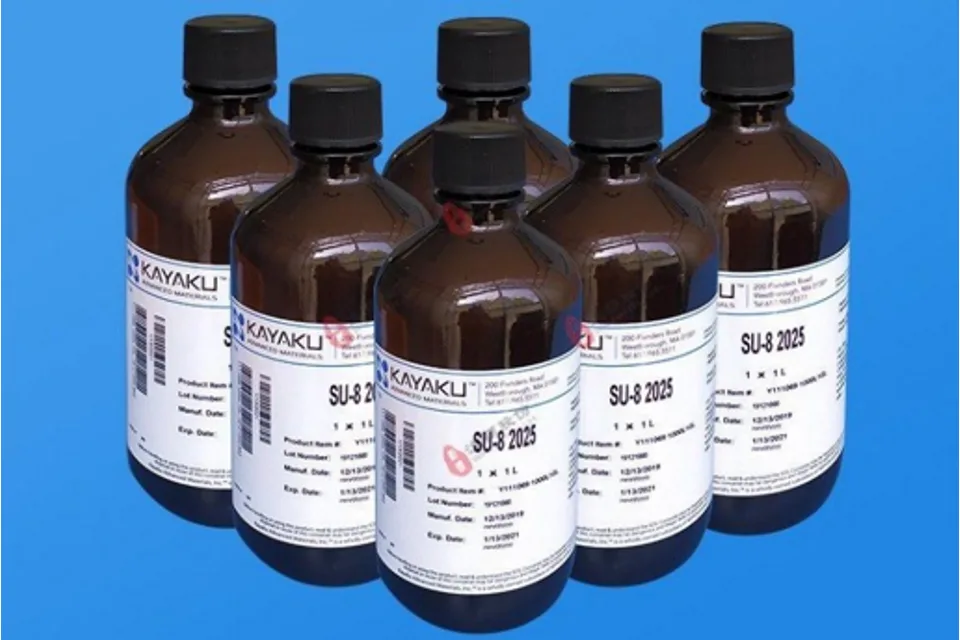
SU 8 Photoresist is a chemically amplified, negative tone, epoxy resin photoresist used in photolithographic fabrication of three dimensional microstructures, particularly where substantial film thickness, high aspect ratios, dimensional precision, and permanent structural functionality are required. Its principal resin chemistry consists of multifunctional epoxy novolac oligomers containing multiple reactive glycidyl groups, combined with a photoacid generator, an organic solvent system, and formulation additives that regulate viscosity, coating uniformity, adhesion, and curing behavior. Conventional formulations commonly employ onium salt photoacid generators, including triarylsulfonium salts, while specialized formulations use alternative initiator chemistries to meet material purity and compatibility requirements. Exposure to near ultraviolet radiation, typically at the 365 nm mercury i line, generates a strong acid within illuminated regions. Subsequent thermal treatment initiates acid catalyzed cationic ring opening polymerization of epoxy groups, forming a densely crosslinked three dimensional thermoset network. The exposed and cured regions become insoluble in organic developers, while uncrosslinked material is selectively dissolved, transferring the optical mask pattern into a mechanically stable polymer structure. High optical transmission at wavelengths above approximately 360 nm permits radiation penetration through relatively thick coatings, enabling substantial crosslinking depth, high aspect ratio pattern formation, and nearly vertical feature sidewalls. Commercial formulations accommodate film thicknesses from a few micrometers to more than 200 μm, depending on resin concentration, viscosity, coating method, and exposure conditions. Liquid formulations are commonly deposited by spin coating, while dry film formulations are laminated onto substrates and can be stacked to fabricate multilayer structures. Processing typically includes substrate preparation, coating or lamination, solvent removal where applicable, patterned exposure, post exposure baking, solvent development, and optional thermal curing. Feature resolution, sidewall geometry, residual stress, and dimensional stability are governed by optical absorption, exposure dose distribution, photoacid generation and diffusion, epoxy conversion, solvent evaporation, thermal history, and adhesion at the substrate interface.
Crosslinked SU 8 exhibits high mechanical rigidity, substantial chemical resistance, electrical insulation, and thermal stability, allowing patterned structures to remain as functional components within completed microelectronic and microsystem devices. Its applications include microelectromechanical systems (MEMS), microfluidic channels and chambers, microsensors, microactuators, microoptical elements, optical waveguides, inkjet nozzle structures, biological microdevices, and precision molds for electroforming and replication processes. In semiconductor and electronic packaging, SU 8 formulations are used to fabricate permanent structural walls, insulating layers, protective features, cavity structures, and wafer level packaging components, including structures associated with surface acoustic wave and bulk acoustic wave filters. Its use as an electroforming mold allows complex metal microstructures to be produced through patterned deposition of nickel, copper, or other electroplatable metals, followed by mold removal where required. Fully crosslinked SU 8 is difficult to dissolve using conventional resist stripping chemistry, making removal processes dependent on substrate compatibility, release layers, plasma treatment, or specialized stripping methods. Polymerization shrinkage, thermal expansion mismatch, residual solvent, interfacial stress, and moisture exposure can cause cracking, warpage, delamination, or dimensional drift, particularly in thick coatings and multilayer structures. Commercial formulations therefore differ in epoxy molecular structure, solvent composition, solids content, viscosity, photosensitivity, achievable coating thickness, adhesion characteristics, crosslink density, mechanical properties, ionic contamination, and thermal processing requirements. Specialized low halogen and antimony free formulations address contamination and corrosion constraints in sensitive electronic packaging applications, while optimized thick film and dry film products enable greater structural thickness, cavity formation, and controlled integration with established wafer fabrication processes.
Product & engineering
Understand the product.
SU 8 Photoresist is a chemically amplified, negative tone, epoxy resin photoresist used in photolithographic fabrication of three dimensional microstructures, particularly where substantial film thickness, high aspect ratios, dimensional precision, and permanent structural functionality are required. Its principal resin chemistry consists of multifunctional epoxy novolac oligomers containing multiple reactive glycidyl groups, combined with a photoacid generator, an organic solvent system, and formulation additives that regulate viscosity, coating uniformity, adhesion, and curing behavior. Conventional formulations commonly employ onium salt photoacid generators, including triarylsulfonium salts, while specialized formulations use alternative initiator chemistries to meet material purity and compatibility requirements. Exposure to near ultraviolet radiation, typically at the 365 nm mercury i line, generates a strong acid within illuminated regions. Subsequent thermal treatment initiates acid catalyzed cationic ring opening polymerization of epoxy groups, forming a densely crosslinked three dimensional thermoset network. The exposed and cured regions become insoluble in organic developers, while uncrosslinked material is selectively dissolved, transferring the optical mask pattern into a mechanically stable polymer structure. High optical transmission at wavelengths above approximately 360 nm permits radiation penetration through relatively thick coatings, enabling substantial crosslinking depth, high aspect ratio pattern formation, and nearly vertical feature sidewalls. Commercial formulations accommodate film thicknesses from a few micrometers to more than 200 μm, depending on resin concentration, viscosity, coating method, and exposure conditions. Liquid formulations are commonly deposited by spin coating, while dry film formulations are laminated onto substrates and can be stacked to fabricate multilayer structures. Processing typically includes substrate preparation, coating or lamination, solvent removal where applicable, patterned exposure, post exposure baking, solvent development, and optional thermal curing. Feature resolution, sidewall geometry, residual stress, and dimensional stability are governed by optical absorption, exposure dose distribution, photoacid generation and diffusion, epoxy conversion, solvent evaporation, thermal history, and adhesion at the substrate interface.
Crosslinked SU 8 exhibits high mechanical rigidity, substantial chemical resistance, electrical insulation, and thermal stability, allowing patterned structures to remain as functional components within completed microelectronic and microsystem devices. Its applications include microelectromechanical systems (MEMS), microfluidic channels and chambers, microsensors, microactuators, microoptical elements, optical waveguides, inkjet nozzle structures, biological microdevices, and precision molds for electroforming and replication processes. In semiconductor and electronic packaging, SU 8 formulations are used to fabricate permanent structural walls, insulating layers, protective features, cavity structures, and wafer level packaging components, including structures associated with surface acoustic wave and bulk acoustic wave filters. Its use as an electroforming mold allows complex metal microstructures to be produced through patterned deposition of nickel, copper, or other electroplatable metals, followed by mold removal where required. Fully crosslinked SU 8 is difficult to dissolve using conventional resist stripping chemistry, making removal processes dependent on substrate compatibility, release layers, plasma treatment, or specialized stripping methods. Polymerization shrinkage, thermal expansion mismatch, residual solvent, interfacial stress, and moisture exposure can cause cracking, warpage, delamination, or dimensional drift, particularly in thick coatings and multilayer structures. Commercial formulations therefore differ in epoxy molecular structure, solvent composition, solids content, viscosity, photosensitivity, achievable coating thickness, adhesion characteristics, crosslink density, mechanical properties, ionic contamination, and thermal processing requirements. Specialized low halogen and antimony free formulations address contamination and corrosion constraints in sensitive electronic packaging applications, while optimized thick film and dry film products enable greater structural thickness, cavity formation, and controlled integration with established wafer fabrication processes.
Selected research
Industry Research
SU-8 Photoresist Industry Research Report 2026
MARKET AT A GLANCE
Scale & outlook
- 2025
- 29.58USD million
- 2032
- 48.43USD million
Select a bar to inspect its value.
Source: APO Research, Inc.
Market perspective
According to APO Research, Inc, the global SU-8 Photoresist market was valued at USD 29.58 million in 2025 and is estimated to reach USD 31.52 million in 2026 and USD 48.43 million by 2032, representing a CAGR of 7.42% from 2026 to 2032. The projected USD 16.91 million revenue increase is primarily associated with higher consumption of photosensitive epoxy materials in microelectromechanical systems (MEMS), microfluidic devices, semiconductor packaging, acoustic wave filter cavities, and precision microstructures. Material consumption is determined by substrate dimensions, target film thickness, coating efficiency, and the number of lithographic processing cycles. Kayaku Advanced Materials manufactures liquid photoresists in Westborough, Massachusetts, and offers SU-8 3000 for single coat thicknesses of 2 to 50 μm and SU-8 XFT for approximately 50 to more than 200 μm. These formulations address different structural requirements in microfluidic molds, electroforming, optical components, and MEMS fabrication, where thicker coatings increase material consumption per substrate and require tighter control of solvent removal, residual stress, adhesion, and pattern uniformity.
Japan and other East Asian electronics manufacturing centers represent important sources of incremental demand, particularly in acoustic wave devices, MEMS packaging, and permanent polymer cavity structures. Nippon Kayaku supplies SU-8 3000CF dry film photoresists in nominal thicknesses of 20, 30, and 45 μm, with standard rolls measuring 244 mm in width and 25 m in length. The formulation contains less than 900 ppm total chlorine and is antimony free, addressing material compatibility requirements in semiconductor and radio frequency device packaging. Dry film lamination provides uniform thickness and enables cavity walls and caps to be patterned without liquid resist flowing into underlying structures. Nippon Kayaku disclosed a JPY 850 million investment in dry film resist manufacturing equipment at its Fukuyama plant in Hiroshima Prefecture, scheduled for completion in April 2028. The investment covers the company's wider dry film resist business and represents additional manufacturing capability relevant to future SU-8 dry film supply. Downstream production is geographically concentrated in specialized electronic component manufacturing locations, including Skyworks Solutions' acoustic wave filter wafer processing operations in Osaka, Japan, and filter packaging facilities in Singapore. These manufacturing activities illustrate the industrial requirements for precisely patterned cavities and permanent polymer structures used in acoustic device packaging.
In China, Suntific Materials in Weifang has disclosed independently developed SU-8 thick film photoresists for microelectronic applications, providing a domestic manufacturing option for customers pursuing material localization. European specialty demand is addressed in part by Switzerland's Gersteltec, whose GM series accommodates thick film microfabrication, while KemLab in the United States offers SQ series epoxy photoresists covering approximately 2 to 100 μm for MEMS, microfluidics, and microelectronics. Product demand above 50 μm is particularly sensitive to the fabrication of tall structural features, microfluidic masters, and electroforming molds, while thinner formulations address optical structures, insulating features, and fine patterning requirements. Commercial pricing depends on epoxy resin purity, photoacid chemistry, ionic contamination, coating reproducibility, packaging format, and qualified manufacturing yields. Once a resist formulation has been incorporated into an established production process, changes in exposure conditions, curing behavior, dimensional stability, and substrate adhesion create additional qualification requirements, influencing supplier substitution and the pricing of specialized grades.
Full market overview
Report Scope
This report quantifies the global SU-8 Photoresist market in revenue (US$ million) and, where applicable, sales volume (L), using 2025 as the base year and providing annual historical and forecast data for 2021–2032.
It standardizes definitions of types and applications, harmonizes vendor attribution, and presents comparable time series by company, type, application, and region/country, including indicative price bands (US$/L) and concentration ratios (CR5/CR10).
The outputs are intended to support strategy development, budgeting, and performance benchmarking for manufacturers, new entrants, channel partners, and investors; the report also reviews technology shifts and notable product introductions relevant to SU-8 Photoresist.
Key Companies & Market Share Insights
This section profiles leading manufacturers, combining 2021–2025 results with a 2026–2032 outlook. It reports revenue, market share, price bands, product and application mix, regional and channel mix, and key developments (M&A, capacity additions, certifications). It also provides global revenue, average price, and—where applicable—sales volume by manufacturer, and calculates CR5/CR10 and rank changes to support comparative benchmarking.
SU-8 Photoresist Market by Company
- Kayaku Advanced Materials
- Gersteltec
- KemLab
- Suntific Materials
- Allresist
- DJ MicroLaminates
- Tokyo Ohka Kogyo
- Nagase ChemteX America
SU-8 Photoresist Segment by Thickness
- ≤10 μm
- >10 to 50 μm
- >50 to 200 μm
- >200 μm
SU-8 Photoresist Segment by Application
- MEMS
- Microfluidics
- Semiconductor Packaging
- Microoptics
- Display
- Others
SU-8 Photoresist Segment by Region
- North America
- United States
- Canada
- Mexico
- Europe
- Germany
- France
- U.K.
- Italy
- Russia
- Spain
- Netherlands
- Switzerland
- Sweden
- Poland
- Asia-Pacific
- China
- Japan
- South Korea
- India
- Australia
- Taiwan
- Southeast Asia
- South America
- Brazil
- Argentina
- Chile
- Colombia
- Middle East & Africa
- Egypt
- South Africa
- Israel
- Türkiye
- GCC Countries
Key Drivers & Barriers
High-impact rendering factors and drivers have been studied in this report to aid the readers to understand the general development. Moreover, the report includes restraints and challenges that may act as stumbling blocks on the way of the players. This will assist the users to be attentive and make informed decisions related to business. Specialists have also laid their focus on the upcoming business prospects.
Reasons to Buy This Report
- This report will help the readers to understand the competition within the industries and strategies for the competitive environment to enhance the potential profit. The report also focuses on the competitive landscape of the global SU-8 Photoresist market, and introduces in detail the market share, industry ranking, competitor ecosystem, market performance, new product development, operation situation, expansion, and acquisition. etc. of the main players, which helps the readers to identify the main competitors and deeply understand the competition pattern of the market.
- This report will help stakeholders to understand the global industry status and trends of SU-8 Photoresist and provides them with information on key market drivers, restraints, challenges, and opportunities.
- This report will help stakeholders to understand competitors better and gain more insights to strengthen their position in their businesses. The competitive landscape section includes the market share and rank (in volume and value), competitor ecosystem, new product development, expansion, and acquisition.
- This report stays updated with novel technology integration, features, and the latest developments in the market
- This report helps stakeholders to gain insights into which regions to target globally
- This report helps stakeholders to gain insights into the end-user perception concerning the adoption of SU-8 Photoresist.
- This report helps stakeholders to identify some of the key players in the market and understand their valuable contribution.
Chapter Outline
- Chapter 1: Research objectives, research methods, data sources, data cross-validation;
- Chapter 2: Introduces the report scope of the report, executive summary of different market segments (by region, product type, application, etc), including the market size of each market segment, future development potential, and so on. It offers a high-level view of the current state of the market and its likely evolution in the short to mid-term, and long term.
- Chapter 3: Detailed analysis of SU-8 Photoresist manufacturers competitive landscape, price, production and value market share, latest development plan, merger, and acquisition information, etc.
- Chapter 4: Provides profiles of key players, introducing the basic situation of the main companies in the market in detail, including product production/output, value, price, gross margin, product introduction, recent development, etc.
- Chapter 5: Production/output, value of SU-8 Photoresist by region/country. It provides a quantitative analysis of the market size and development potential of each region in the next six years.
- Chapter 6: Consumption of SU-8 Photoresist in regional level and country level. It provides a quantitative analysis of the market size and development potential of each region and its main countries and introduces the market development, future development prospects, market space, and production of each country in the world.
- Chapter 7: Provides the analysis of various market segments by thickness, covering the market size and development potential of each market segment, to help readers find the blue ocean market in different market segments.
- Chapter 8: Provides the analysis of various market segments by application, covering the market size and development potential of each market segment, to help readers find the blue ocean market in different downstream markets.
- Chapter 9: Analysis of industrial chain, including the upstream and downstream of the industry.
- Chapter 10: Introduces the market dynamics, latest developments of the market, the driving factors and restrictive factors of the market, the challenges and risks faced by manufacturers in the industry, and the analysis of relevant policies in the industry.
- Chapter 11: The main points and conclusions of the report.
More report detail
Tables and figures
List of Tables
- Table 1. Secondary Sources
- Table 2. Primary Sources
- Table 3. Market Value Comparison by Thickness (2021 VS 2025 VS 2032) & (US$ Million)
- Table 4. Market Value Comparison by Application (2021 VS 2025 VS 2032) & (US$ Million)
- Table 5. Global SU-8 Photoresist Production by Manufacturers (L) & (2021-2026)
- Table 6. Global SU-8 Photoresist Production Market Share by Manufacturers
- Table 7. Global SU-8 Photoresist Production Value by Manufacturers (US$ Million) & (2021-2026)
- Table 8. Global SU-8 Photoresist Production Value Market Share by Manufacturers (2021-2026)
- Table 9. Global SU-8 Photoresist Average Price (USD/L) of Manufacturers (2021-2026)
- Table 10. Global SU-8 Photoresist Industry Manufacturers Ranking, 2024 VS 2025 VS 2026
- Table 11. Global SU-8 Photoresist Key Manufacturers, Manufacturing Sites & Headquarters
- Table 12. Global SU-8 Photoresist Manufacturers, Product Type & Application
- Table 13. Global SU-8 Photoresist Manufacturers Established Date
- Table 14. Global Manufacturers Market Concentration Ratio (CR5 and HHI)
- Table 15. Global SU-8 Photoresist by Manufacturers Type (Tier 1, Tier 2, and Tier 3) & (based on the Production Value of 2025)
- Table 16. Manufacturers Mergers & Acquisitions, Expansion Plans
- Table 17. Kayaku Advanced Materials Company Information
- Table 18. Kayaku Advanced Materials Business Overview
- Table 19. Kayaku Advanced Materials SU-8 Photoresist Production (L), Value (US$ Million), Price (USD/L) and Gross Margin (2021-2026)
- Table 20. Kayaku Advanced Materials SU-8 Photoresist Product Portfolio
- Table 21. Kayaku Advanced Materials Recent Development
- Table 22. Gersteltec Company Information
- Table 23. Gersteltec Business Overview
- Table 24. Gersteltec SU-8 Photoresist Production (L), Value (US$ Million), Price (USD/L) and Gross Margin (2021-2026)
- Table 25. Gersteltec SU-8 Photoresist Product Portfolio
- Table 26. Gersteltec Recent Development
- Table 27. KemLab Company Information
- Table 28. KemLab Business Overview
- Table 29. KemLab SU-8 Photoresist Production (L), Value (US$ Million), Price (USD/L) and Gross Margin (2021-2026)
- Table 30. KemLab SU-8 Photoresist Product Portfolio
- Table 31. KemLab Recent Development
- Table 32. Suntific Materials Company Information
- Table 33. Suntific Materials Business Overview
- Table 34. Suntific Materials SU-8 Photoresist Production (L), Value (US$ Million), Price (USD/L) and Gross Margin (2021-2026)
- Table 35. Suntific Materials SU-8 Photoresist Product Portfolio
- Table 36. Suntific Materials Recent Development
- Table 37. Allresist Company Information
- Table 38. Allresist Business Overview
- Table 39. Allresist SU-8 Photoresist Production (L), Value (US$ Million), Price (USD/L) and Gross Margin (2021-2026)
- Table 40. Allresist SU-8 Photoresist Product Portfolio
- Table 41. Allresist Recent Development
- Table 42. DJ MicroLaminates Company Information
- Table 43. DJ MicroLaminates Business Overview
- Table 44. DJ MicroLaminates SU-8 Photoresist Production (L), Value (US$ Million), Price (USD/L) and Gross Margin (2021-2026)
- Table 45. DJ MicroLaminates SU-8 Photoresist Product Portfolio
- Table 46. DJ MicroLaminates Recent Development
- Table 47. Tokyo Ohka Kogyo Company Information
- Table 48. Tokyo Ohka Kogyo Business Overview
- Table 49. Tokyo Ohka Kogyo SU-8 Photoresist Production (L), Value (US$ Million), Price (USD/L) and Gross Margin (2021-2026)
- Table 50. Tokyo Ohka Kogyo SU-8 Photoresist Product Portfolio
- Table 51. Tokyo Ohka Kogyo Recent Development
- Table 52. Nagase ChemteX America Company Information
- Table 53. Nagase ChemteX America Business Overview
- Table 54. Nagase ChemteX America SU-8 Photoresist Production (L), Value (US$ Million), Price (USD/L) and Gross Margin (2021-2026)
- Table 55. Nagase ChemteX America SU-8 Photoresist Product Portfolio
- Table 56. Nagase ChemteX America Recent Development
- Table 57. Global SU-8 Photoresist Production Comparison by Region: 2021 VS 2025 VS 2032 (L)
- Table 58. Global SU-8 Photoresist Production by Region (2021-2026) & (L)
- Table 59. Global SU-8 Photoresist Production Market Share by Region (2021-2026)
- Table 60. Global SU-8 Photoresist Production Forecast by Region (2027-2032) & (L)
- Table 61. Global SU-8 Photoresist Production Market Share Forecast by Region (2027-2032)
- Table 62. Global SU-8 Photoresist Production Value Comparison by Region: 2021 VS 2025 VS 2032 (US$ Million)
- Table 63. Global SU-8 Photoresist Production Value by Region (2021-2026) & (US$ Million)
- Table 64. Global SU-8 Photoresist Production Value Market Share by Region (2021-2026)
- Table 65. Global SU-8 Photoresist Production Value Forecast by Region (2027-2032) & (US$ Million)
- Table 66. Global SU-8 Photoresist Market Average Price (USD/L) by Region (2021-2026)
- Table 67. Global SU-8 Photoresist Market Average Price (USD/L) by Region (2027-2032)
- Table 68. Global SU-8 Photoresist Consumption Comparison by Region: 2021 VS 2025 VS 2032 (L)
- Table 69. Global SU-8 Photoresist Consumption by Region (2021-2026) & (L)
- Table 70. Global SU-8 Photoresist Consumption Market Share by Region (2021-2026)
- Table 71. Global SU-8 Photoresist Forecasted Consumption by Region (2027-2032) & (L)
- Table 72. Global SU-8 Photoresist Forecasted Consumption Market Share by Region (2027-2032)
- Table 73. North America SU-8 Photoresist Consumption Growth Rate by Country: 2021 VS 2025 VS 2032 (L)
- Table 74. North America SU-8 Photoresist Consumption by Country (2021-2026) & (L)
- Table 75. North America SU-8 Photoresist Consumption by Country (2027-2032) & (L)
- Table 76. Europe SU-8 Photoresist Consumption Growth Rate by Country: 2021 VS 2025 VS 2032 (L)
- Table 77. Europe SU-8 Photoresist Consumption by Country (2021-2026) & (L)
- Table 78. Europe SU-8 Photoresist Consumption by Country (2027-2032) & (L)
- Table 79. Asia Pacific SU-8 Photoresist Consumption Growth Rate by Country: 2021 VS 2025 VS 2032 (L)
- Table 80. Asia Pacific SU-8 Photoresist Consumption by Country (2021-2026) & (L)
- Table 81. Asia Pacific SU-8 Photoresist Consumption by Country (2027-2032) & (L)
- Table 82. South America, Middle East & Africa SU-8 Photoresist Consumption Growth Rate by Country: 2021 VS 2025 VS 2032 (L)
- Table 83. South America, Middle East & Africa SU-8 Photoresist Consumption by Country (2021-2026) & (L)
- Table 84. South America, Middle East & Africa SU-8 Photoresist Consumption by Country (2027-2032) & (L)
- Table 85. Global SU-8 Photoresist Production by Thickness (2021-2026) & (L)
- Table 86. Global SU-8 Photoresist Production by Thickness (2027-2032) & (L)
- Table 87. Global SU-8 Photoresist Production Market Share by Thickness (2021-2026)
- Table 88. Global SU-8 Photoresist Production Market Share by Thickness (2027-2032)
- Table 89. Global SU-8 Photoresist Production Value by Thickness (2021-2026) & (US$ Million)
- Table 90. Global SU-8 Photoresist Production Value by Thickness (2027-2032) & (US$ Million)
- Table 91. Global SU-8 Photoresist Production Value Market Share by Thickness (2021-2026)
- Table 92. Global SU-8 Photoresist Production Value Market Share by Thickness (2027-2032)
- Table 93. Global SU-8 Photoresist Price by Thickness (2021-2026) & (USD/L)
- Table 94. Global SU-8 Photoresist Price by Thickness (2027-2032) & (USD/L)
- Table 95. Global SU-8 Photoresist Production by Application (2021-2026) & (L)
- Table 96. Global SU-8 Photoresist Production by Application (2027-2032) & (L)
- Table 97. Global SU-8 Photoresist Production Market Share by Application (2021-2026)
- Table 98. Global SU-8 Photoresist Production Market Share by Application (2027-2032)
- Table 99. Global SU-8 Photoresist Production Value by Application (2021-2026) & (US$ Million)
- Table 100. Global SU-8 Photoresist Production Value by Application (2027-2032) & (US$ Million)
- Table 101. Global SU-8 Photoresist Production Value Market Share by Application (2021-2026)
- Table 102. Global SU-8 Photoresist Production Value Market Share by Application (2027-2032)
- Table 103. Global SU-8 Photoresist Price by Application (2021-2026) & (USD/L)
- Table 104. Global SU-8 Photoresist Price by Application (2027-2032) & (USD/L)
- Table 105. Key Raw Materials
- Table 106. Raw Materials Key Suppliers
- Table 107. SU-8 Photoresist Distributors List
- Table 108. SU-8 Photoresist Customers List
- Table 109. SU-8 Photoresist Industry Trends
- Table 110. SU-8 Photoresist Industry Drivers
- Table 111. SU-8 Photoresist Industry Restraints
- Table 112. Authors List of This Report
List of Figures
- Figure 1. Research Methodology
- Figure 2. Research Process
- Figure 3. Key Executives Interviewed
- Figure 4. SU-8 Photoresist Product Image
- Figure 5. Market Value Comparison by Thickness (2021 VS 2025 VS 2032) & (US$ Million)
- Figure 6. ≤10 μm Product Image
- Figure 7. >10 to 50 μm Product Image
- Figure 8. >50 to 200 μm Product Image
- Figure 9. >200 μm Product Image
- Figure 10. MEMS Product Image
- Figure 11. Microfluidics Product Image
- Figure 12. Semiconductor Packaging Product Image
- Figure 13. Microoptics Product Image
- Figure 14. Display Product Image
- Figure 15. Others Product Image
- Figure 16. Global SU-8 Photoresist Production Value (US$ Million), 2021 VS 2025 VS 2032
- Figure 17. Global SU-8 Photoresist Production Value (2021-2032) & (US$ Million)
- Figure 18. Global SU-8 Photoresist Production Capacity (2021-2032) & (L)
- Figure 19. Global SU-8 Photoresist Production (2021-2032) & (L)
- Figure 20. Global SU-8 Photoresist Average Price (USD/L) & (2021-2032)
- Figure 21. Global SU-8 Photoresist Key Manufacturers, Manufacturing Sites & Headquarters
- Figure 22. Global Top 5 and 10 SU-8 Photoresist Players Market Share by Production Value in 2025
- Figure 23. Manufacturers Type (Tier 1, Tier 2, and Tier 3): 2021 VS 2025
- Figure 24. Global SU-8 Photoresist Production Comparison by Region: 2021 VS 2025 VS 2032 (L)
- Figure 25. Global SU-8 Photoresist Production Market Share by Region: 2021 VS 2025 VS 2032
- Figure 26. Global SU-8 Photoresist Production Value Comparison by Region: 2021 VS 2025 VS 2032 (US$ Million)
- Figure 27. Global SU-8 Photoresist Production Value Market Share by Region: 2021 VS 2025 VS 2032
- Figure 28. North America SU-8 Photoresist Production Value (US$ Million) Growth Rate (2021-2032)
- Figure 29. Europe SU-8 Photoresist Production Value (US$ Million) Growth Rate (2021-2032)
- Figure 30. China SU-8 Photoresist Production Value (US$ Million) Growth Rate (2021-2032)
- Figure 31. Japan SU-8 Photoresist Production Value (US$ Million) Growth Rate (2021-2032)
- Figure 32. Global SU-8 Photoresist Consumption Comparison by Region: 2021 VS 2025 VS 2032 (L)
- Figure 33. Global SU-8 Photoresist Consumption Market Share by Region: 2021 VS 2025 VS 2032
- Figure 34. North America SU-8 Photoresist Consumption and Growth Rate (2021-2032) & (L)
- Figure 35. North America SU-8 Photoresist Consumption Market Share by Country (2021-2032)
- Figure 36. United States SU-8 Photoresist Consumption and Growth Rate (2021-2032) & (L)
- Figure 37. United States SU-8 Photoresist Consumption and Growth Rate (2021-2032) & (L)
- Figure 38. Canada SU-8 Photoresist Consumption and Growth Rate (2021-2032) & (L)
- Figure 39. Mexico SU-8 Photoresist Consumption and Growth Rate (2021-2032) & (L)
- Figure 40. Europe SU-8 Photoresist Consumption and Growth Rate (2021-2032) & (L)
- Figure 41. Europe SU-8 Photoresist Consumption Market Share by Country (2021-2032)
- Figure 42. Germany SU-8 Photoresist Consumption and Growth Rate (2021-2032) & (L)
- Figure 43. France SU-8 Photoresist Consumption and Growth Rate (2021-2032) & (L)
- Figure 44. U.K. SU-8 Photoresist Consumption and Growth Rate (2021-2032) & (L)
- Figure 45. Italy SU-8 Photoresist Consumption and Growth Rate (2021-2032) & (L)
- Figure 46. Russia SU-8 Photoresist Consumption and Growth Rate (2021-2032) & (L)
- Figure 47. Spain SU-8 Photoresist Consumption and Growth Rate (2021-2032) & (L)
- Figure 48. Netherlands SU-8 Photoresist Consumption and Growth Rate (2021-2032) & (L)
- Figure 49. Switzerland SU-8 Photoresist Consumption and Growth Rate (2021-2032) & (L)
- Figure 50. Sweden SU-8 Photoresist Consumption and Growth Rate (2021-2032) & (L)
- Figure 51. Poland SU-8 Photoresist Consumption and Growth Rate (2021-2032) & (L)
- Figure 52. Asia Pacific SU-8 Photoresist Consumption and Growth Rate (2021-2032) & (L)
- Figure 53. Asia Pacific SU-8 Photoresist Consumption Market Share by Country (2021-2032)
- Figure 54. China SU-8 Photoresist Consumption and Growth Rate (2021-2032) & (L)
- Figure 55. Japan SU-8 Photoresist Consumption and Growth Rate (2021-2032) & (L)
- Figure 56. South Korea SU-8 Photoresist Consumption and Growth Rate (2021-2032) & (L)
- Figure 57. India SU-8 Photoresist Consumption and Growth Rate (2021-2032) & (L)
- Figure 58. Australia SU-8 Photoresist Consumption and Growth Rate (2021-2032) & (L)
- Figure 59. Taiwan SU-8 Photoresist Consumption and Growth Rate (2021-2032) & (L)
- Figure 60. Southeast Asia SU-8 Photoresist Consumption and Growth Rate (2021-2032) & (L)
- Figure 61. South America, Middle East & Africa SU-8 Photoresist Consumption and Growth Rate (2021-2032) & (L)
- Figure 62. South America, Middle East & Africa SU-8 Photoresist Consumption Market Share by Country (2021-2032)
- Figure 63. Brazil SU-8 Photoresist Consumption and Growth Rate (2021-2032) & (L)
- Figure 64. Argentina SU-8 Photoresist Consumption and Growth Rate (2021-2032) & (L)
- Figure 65. Chile SU-8 Photoresist Consumption and Growth Rate (2021-2032) & (L)
- Figure 66. Turkey SU-8 Photoresist Consumption and Growth Rate (2021-2032) & (L)
- Figure 67. GCC Countries SU-8 Photoresist Consumption and Growth Rate (2021-2032) & (L)
- Figure 68. Global SU-8 Photoresist Production Market Share by Thickness (2021-2032)
- Figure 69. Global SU-8 Photoresist Production Value Market Share by Thickness (2021-2032)
- Figure 70. Global SU-8 Photoresist Price (USD/L) by Thickness (2021-2032)
- Figure 71. Global SU-8 Photoresist Production Market Share by Application (2021-2032)
- Figure 72. Global SU-8 Photoresist Production Value Market Share by Application (2021-2032)
- Figure 73. Global SU-8 Photoresist Price (USD/L) by Application (2021-2032)
- Figure 74. SU-8 Photoresist Value Chain
- Figure 75. SU-8 Photoresist Production Mode & Process
- Figure 76. Direct Comparison with Distribution Share
- Figure 77. Distributors Profiles
- Figure 78. SU-8 Photoresist Industry Opportunities and Challenges
Scope & coverage.
By Type
- ≤10 μm
- >10 to 50 μm
- >50 to 200 μm
- >200 μm
By Application
- MEMS
- Microfluidics
- Semiconductor Packaging
- Microoptics
- Display
- Others
Companies covered
- Kayaku Advanced Materials
- Gersteltec
- KemLab
- Suntific Materials
- Allresist
- DJ MicroLaminates
- Tokyo Ohka Kogyo
- Nagase ChemteX America
Inside the report.
1 Preface
- 1.1 Scope of Report
- 1.2 Reasons for Doing This Study
- 1.3 Research Methodology
- 1.4 Research Process
- 1.5 Data Source
- 1.5.1 Secondary Sources
- 1.5.2 Primary Sources
2 Market Overview
- 2.1 Product Definition
- 2.2 SU-8 Photoresist by Thickness
- 2.2.1 Market Value Comparison by Thickness (2021 VS 2025 VS 2032) & (US$ Million)
- 2.2.2 ≤10 μm
- 2.2.3 >10 to 50 μm
- 2.2.4 >50 to 200 μm
- 2.2.5 >200 μm
- 2.3 SU-8 Photoresist by Application
- 2.3.1 Market Value Comparison by Application (2021 VS 2025 VS 2032) & (US$ Million)
- 2.3.2 MEMS
- 2.3.3 Microfluidics
- 2.3.4 Semiconductor Packaging
- 2.3.5 Microoptics
- 2.3.6 Display
- 2.3.7 Others
- 2.4 Global Market Growth Prospects
- 2.4.1 Global SU-8 Photoresist Production Value Estimates and Forecasts (2021-2032)
- 2.4.2 Global SU-8 Photoresist Production Capacity Estimates and Forecasts (2021-2032)
- 2.4.3 Global SU-8 Photoresist Production Estimates and Forecasts (2021-2032)
- 2.4.4 Global SU-8 Photoresist Market Average Price (2021-2032)
3 Market Competitive Landscape by Manufacturers
- 3.1 Global SU-8 Photoresist Production by Manufacturers (2021-2026)
- 3.2 Global SU-8 Photoresist Production Value by Manufacturers (2021-2026)
- 3.3 Global SU-8 Photoresist Average Price by Manufacturers (2021-2026)
- 3.4 Global SU-8 Photoresist Industry Manufacturers Ranking, 2024 VS 2025 VS 2026
- 3.5 Global SU-8 Photoresist Key Manufacturers, Manufacturing Sites & Headquarters
- 3.6 Global SU-8 Photoresist Manufacturers, Product Type & Application
- 3.7 Global SU-8 Photoresist Manufacturers Established Date
- 3.8 Global SU-8 Photoresist Market CR5 and HHI
- 3.9 Global Manufacturers Mergers & Acquisition
4 Manufacturers Profiled
- 4.1 Kayaku Advanced Materials
- 4.1.1 Kayaku Advanced Materials SU-8 Photoresist Company Information
- 4.1.2 Kayaku Advanced Materials SU-8 Photoresist Business Overview
- 4.1.3 Kayaku Advanced Materials SU-8 Photoresist Production Capacity, Value and Gross Margin (2021-2026)
- 4.1.4 Kayaku Advanced Materials Product Portfolio
- 4.1.5 Kayaku Advanced Materials Recent Developments
- 4.2 Gersteltec
- 4.2.1 Gersteltec SU-8 Photoresist Company Information
- 4.2.2 Gersteltec SU-8 Photoresist Business Overview
- 4.2.3 Gersteltec SU-8 Photoresist Production Capacity, Value and Gross Margin (2021-2026)
- 4.2.4 Gersteltec Product Portfolio
- 4.2.5 Gersteltec Recent Developments
- 4.3 KemLab
- 4.3.1 KemLab SU-8 Photoresist Company Information
- 4.3.2 KemLab SU-8 Photoresist Business Overview
- 4.3.3 KemLab SU-8 Photoresist Production Capacity, Value and Gross Margin (2021-2026)
- 4.3.4 KemLab Product Portfolio
- 4.3.5 KemLab Recent Developments
- 4.4 Suntific Materials
- 4.4.1 Suntific Materials SU-8 Photoresist Company Information
- 4.4.2 Suntific Materials SU-8 Photoresist Business Overview
- 4.4.3 Suntific Materials SU-8 Photoresist Production Capacity, Value and Gross Margin (2021-2026)
- 4.4.4 Suntific Materials Product Portfolio
- 4.4.5 Suntific Materials Recent Developments
- 4.5 Allresist
- 4.5.1 Allresist SU-8 Photoresist Company Information
- 4.5.2 Allresist SU-8 Photoresist Business Overview
- 4.5.3 Allresist SU-8 Photoresist Production Capacity, Value and Gross Margin (2021-2026)
- 4.5.4 Allresist Product Portfolio
- 4.5.5 Allresist Recent Developments
- 4.6 DJ MicroLaminates
- 4.6.1 DJ MicroLaminates SU-8 Photoresist Company Information
- 4.6.2 DJ MicroLaminates SU-8 Photoresist Business Overview
- 4.6.3 DJ MicroLaminates SU-8 Photoresist Production Capacity, Value and Gross Margin (2021-2026)
- 4.6.4 DJ MicroLaminates Product Portfolio
- 4.6.5 DJ MicroLaminates Recent Developments
- 4.7 Tokyo Ohka Kogyo
- 4.7.1 Tokyo Ohka Kogyo SU-8 Photoresist Company Information
- 4.7.2 Tokyo Ohka Kogyo SU-8 Photoresist Business Overview
- 4.7.3 Tokyo Ohka Kogyo SU-8 Photoresist Production Capacity, Value and Gross Margin (2021-2026)
- 4.7.4 Tokyo Ohka Kogyo Product Portfolio
- 4.7.5 Tokyo Ohka Kogyo Recent Developments
- 4.8 Nagase ChemteX America
- 4.8.1 Nagase ChemteX America SU-8 Photoresist Company Information
- 4.8.2 Nagase ChemteX America SU-8 Photoresist Business Overview
- 4.8.3 Nagase ChemteX America SU-8 Photoresist Production Capacity, Value and Gross Margin (2021-2026)
- 4.8.4 Nagase ChemteX America Product Portfolio
- 4.8.5 Nagase ChemteX America Recent Developments
5 Global SU-8 Photoresist Production by Region
- 5.1 Global SU-8 Photoresist Production Estimates and Forecasts by Region: 2021 VS 2025 VS 2032
- 5.2 Global SU-8 Photoresist Production by Region: 2021-2032
- 5.2.1 Global SU-8 Photoresist Production by Region: 2021-2026
- 5.2.2 Global SU-8 Photoresist Production Forecast by Region (2027-2032)
- 5.3 Global SU-8 Photoresist Production Value Estimates and Forecasts by Region: 2021 VS 2025 VS 2032
- 5.4 Global SU-8 Photoresist Production Value by Region: 2021-2032
- 5.4.1 Global SU-8 Photoresist Production Value by Region: 2021-2026
- 5.4.2 Global SU-8 Photoresist Production Value Forecast by Region (2027-2032)
- 5.5 Global SU-8 Photoresist Market Price Analysis by Region (2021-2026)
- 5.6 Global SU-8 Photoresist Production and Value, YOY Growth
- 5.6.1 North America SU-8 Photoresist Production Value Estimates and Forecasts (2021-2032)
- 5.6.2 Europe SU-8 Photoresist Production Value Estimates and Forecasts (2021-2032)
- 5.6.3 China SU-8 Photoresist Production Value Estimates and Forecasts (2021-2032)
- 5.6.4 Japan SU-8 Photoresist Production Value Estimates and Forecasts (2021-2032)
6 Global SU-8 Photoresist Consumption by Region
- 6.1 Global SU-8 Photoresist Consumption Estimates and Forecasts by Region: 2021 VS 2025 VS 2032
- 6.2 Global SU-8 Photoresist Consumption by Region (2021-2032)
- 6.2.1 Global SU-8 Photoresist Consumption by Region: 2021-2026
- 6.2.2 Global SU-8 Photoresist Forecasted Consumption by Region (2027-2032)
- 6.3 North America
- 6.3.1 North America SU-8 Photoresist Consumption Growth Rate by Country: 2021 VS 2025 VS 2032
- 6.3.2 North America SU-8 Photoresist Consumption by Country (2021-2032)
- 6.3.3 United States
- 6.3.4 Canada
- 6.3.5 Mexico
- 6.4 Europe
- 6.4.1 Europe SU-8 Photoresist Consumption Growth Rate by Country: 2021 VS 2025 VS 2032
- 6.4.2 Europe SU-8 Photoresist Consumption by Country (2021-2032)
- 6.4.3 Germany
- 6.4.4 France
- 6.4.5 U.K.
- 6.4.6 Italy
- 6.4.7 Russia
- 6.4.8 Spain
- 6.4.9 Netherlands
- 6.4.10 Switzerland
- 6.4.11 Sweden
- 6.4.12 Poland
- 6.5 Asia Pacific
- 6.5.1 Asia Pacific SU-8 Photoresist Consumption Growth Rate by Country: 2021 VS 2025 VS 2032
- 6.5.2 Asia Pacific SU-8 Photoresist Consumption by Country (2021-2032)
- 6.5.3 China
- 6.5.4 Japan
- 6.5.5 South Korea
- 6.5.6 India
- 6.5.7 Australia
- 6.5.8 Taiwan
- 6.5.9 Southeast Asia
- 6.6 South America, Middle East & Africa
- 6.6.1 South America, Middle East & Africa SU-8 Photoresist Consumption Growth Rate by Country: 2021 VS 2025 VS 2032
- 6.6.2 South America, Middle East & Africa SU-8 Photoresist Consumption by Country (2021-2032)
- 6.6.3 Brazil
- 6.6.4 Argentina
- 6.6.5 Chile
- 6.6.6 Turkey
- 6.6.7 GCC Countries
7 Segment by Thickness
- 7.1 Global SU-8 Photoresist Production by Thickness (2021-2032)
- 7.1.1 Global SU-8 Photoresist Production by Thickness (2021-2032) & (L)
- 7.1.2 Global SU-8 Photoresist Production Market Share by Thickness (2021-2032)
- 7.2 Global SU-8 Photoresist Production Value by Thickness (2021-2032)
- 7.2.1 Global SU-8 Photoresist Production Value by Thickness (2021-2032) & (US$ Million)
- 7.2.2 Global SU-8 Photoresist Production Value Market Share by Thickness (2021-2032)
- 7.3 Global SU-8 Photoresist Price by Thickness (2021-2032)
8 Segment by Application
- 8.1 Global SU-8 Photoresist Production by Application (2021-2032)
- 8.1.1 Global SU-8 Photoresist Production by Application (2021-2032) & (L)
- 8.1.2 Global SU-8 Photoresist Production Market Share by Application (2021-2032)
- 8.2 Global SU-8 Photoresist Production Value by Application (2021-2032)
- 8.2.1 Global SU-8 Photoresist Production Value by Application (2021-2032) & (US$ Million)
- 8.2.2 Global SU-8 Photoresist Production Value Market Share by Application (2021-2032)
- 8.3 Global SU-8 Photoresist Price by Application (2021-2032)
9 Value Chain and Sales Channels Analysis of the Market
- 9.1 SU-8 Photoresist Value Chain Analysis
- 9.1.1 SU-8 Photoresist Key Raw Materials
- 9.1.2 Raw Materials Key Suppliers
- 9.1.3 SU-8 Photoresist Production Mode & Process
- 9.2 SU-8 Photoresist Sales Channels Analysis
- 9.2.1 Direct Comparison with Distribution Share
- 9.2.2 SU-8 Photoresist Distributors
- 9.2.3 SU-8 Photoresist Customers
10 Global SU-8 Photoresist Analyzing Market Dynamics
- 10.1 SU-8 Photoresist Industry Trends
- 10.2 SU-8 Photoresist Industry Drivers
- 10.3 SU-8 Photoresist Industry Opportunities and Challenges
- 10.4 SU-8 Photoresist Industry Restraints
11 Report Conclusion
12 Disclaimer
GET THE RESEARCH
Choose your license.
PDF by email within 3–5 working days after payment confirmation.
Talk to an analyst