APO RESEARCH · REPORT
Military Footwear
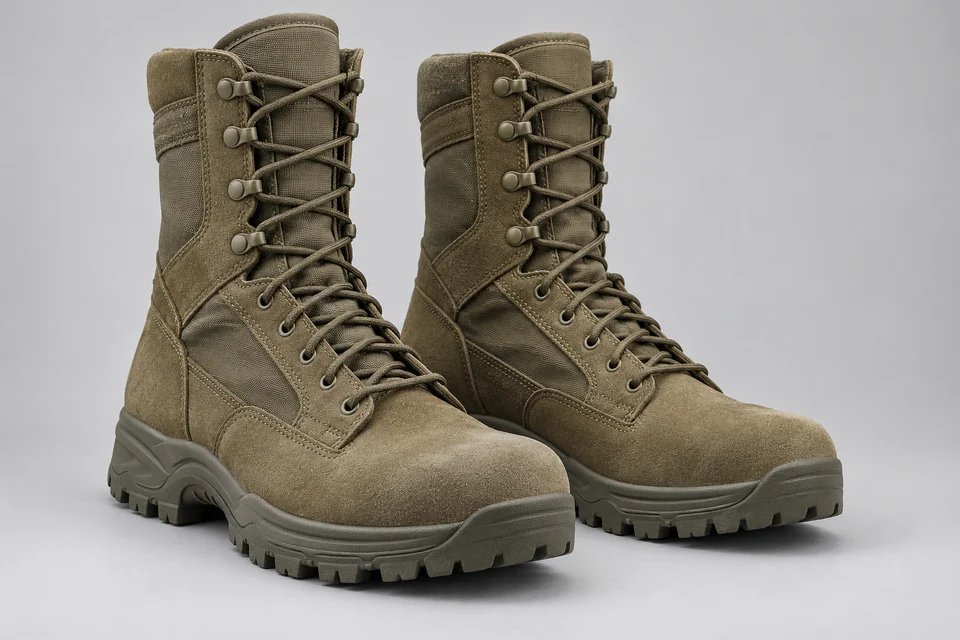
Military Footwear refers to purpose engineered boots and footwear developed for armed forces, military personnel, and associated operational users under field, combat, training, deployment, aviation, maritime, jungle, desert, cold weather, and other mission environments.
Product & engineering
Understand the product.
Military Footwear refers to purpose engineered boots and footwear developed for armed forces, military personnel, and associated operational users under field, combat, training, deployment, aviation, maritime, jungle, desert, cold weather, and other mission environments. The category primarily comprises combat boots, jungle boots, desert and hot weather boots, temperate weather boots, cold weather boots, flight boots, and other mission specific military footwear.
Military footwear integrates the upper, lining, last, insole, midsole, outsole, toe and heel structure, closure system, and protective components into a load bearing footwear system capable of sustained operation under marching, running, climbing, kneeling, load carriage, prolonged standing, and repeated exposure to demanding terrain. Upper constructions commonly use full grain or rough side out leather, textile fabrics, nylon, synthetic materials, or hybrid structures. Soling systems typically combine cushioning midsoles with abrasion resistant and slip resistant rubber outsoles using direct attach, cemented, molded, vulcanized, or other specified constructions. Military specifications may impose requirements for dimensional stability, seam strength, outsole adhesion, flex resistance, abrasion resistance, slip resistance, water resistance, breathability, flame and conductive heat resistance, fuel penetration resistance, weight, fit, durability, and environmental performance. The U.S. Army Temperate Weather Combat Boot, for example, uses moisture resistant rough side out cattle hide and nylon uppers, a waterproof breathable membrane, a shock absorbing soling system, and an abrasion and slip resistant rubber outsole. CPE Ground
Product architecture varies substantially with operational environment. Hot weather and desert footwear emphasizes ventilation, heat management, reduced mass, sand and terrain performance, and durability under high temperature conditions. The current U.S. military specification for Hot Weather Combat Boots explicitly covers wet and dry hot weather environments. QuickSearch Jungle footwear combines ventilation and drainage with traction and resistance to persistent moisture and wet terrain. Temperate weather footwear places greater emphasis on water resistance, breathability, cushioning and multi terrain protection. Cold weather footwear adds thermal insulation, moisture management, cold resistant sole compounds and protective constructions appropriate to low temperature operation. Military inventories can therefore contain multiple footwear configurations for different climates and mission conditions rather than a single universal combat boot. The U.S. Army has documented seven boot styles for different environments and climates. Army
Military footwear is procured through military issue programs, defence procurement contracts and approved commercial channels. Products may be manufactured against government specifications, military standards, tender specific technical requirements or military approved commercial specifications. Commercial tactical appearance alone does not establish a product as military footwear within this category. Product qualification depends on its intended military or operational function, construction and performance characteristics, applicable procurement requirements, and established military or associated professional use.
The finished product is defined by the task it performs, its construction and the user interface. Accessories, complete products and repair or subscription services can share a use case while remaining different transaction objects.
What turns activity into demand
Active users, fitted products and replacement cycles connect use to purchases. Accessories, the main product and paid services may be related but should retain distinct transaction boundaries.
The commercial boundary
For Military Footwear, distinguish the supplied product from its inputs and the complete application. Report types and applications may overlap; retain the selected edition's product definition, geography, period, unit and transaction basis when comparing estimates.
What defines the supplied military footwear offering?
Military Footwear refers to purpose engineered boots and footwear developed for armed forces, military personnel, and associated operational users under field, combat, training, deployment, aviation, maritime, jungle, desert, cold weather, and other mission environments. Check the actual load, fit, material, service life and interface requirements. Product count, installed stock and replacement activity should be reconciled; a visual resemblance or marketing class does not make products technically equivalent.
Selected research
Industry Growth & Trends
Global Military Footwear Industry Growth and Trends Forecast to 2032
Market perspective
According to APO Research, Inc, the global Military Footwear market was valued at USD 4,723.86 million in 2025 and is expected to reach USD 4,970.73 million in 2026 and USD 6,469.47 million by 2032, representing a CAGR of 4.49% from 2026 to 2032. Global sales volume is estimated at 67.84 million pairs in 2025 and 69.93 million pairs in 2026, rising to approximately 80.22 million pairs by 2032. The corresponding weighted ex factory net price increases from USD 69.63 per pair in 2025 to USD 71.08 per pair in 2026 and approximately USD 80.65 per pair in 2032. Volume growth of approximately 2.31% annually and unit value growth of approximately 2.13% annually jointly account for the USD 1,498.74 million increase in annual market value between 2026 and 2032.
North America remains a major value market, led by United States military procurement, replacement of issued combat footwear, and commercial military purchases by service personnel. Europe contributes increasing incremental demand as armed forces replenish individual equipment inventories and increase procurement of combat, cold weather, wet weather, and mission specific footwear. Germany, the United Kingdom, France, Italy, Spain, the Czech Republic, and other European defence markets sustain demand across domestic and regional suppliers. Asia Pacific accounts for a substantial physical production and consumption base through China, India, and other countries with large armed forces and recurring footwear replacement requirements. China also retains significant manufacturing capacity through Jihua Group and other large footwear producers. Turkey has developed a sizeable military footwear manufacturing base led by YDS and related technical footwear suppliers, while Israel and India maintain established military footwear supply chains through Noga Einat, Rahman Group, Liberty Shoes, and other defence suppliers.
The competitive structure combines specialized military footwear manufacturers with larger professional footwear groups. Belleville, McRae Industries, Rocky Brands, Weinbrenner, Wolverine World Wide through Bates, and LaCrosse Footwear through Danner retain established positions in the United States market. HAIX, LOWA, Meindl, Altberg, AKU, Garmont, Crispi, Jolly Scarpe, ITURRI, YDS, and PRABOS supply European and international military, police, security, and professional users. Jihua Group represents one of the largest integrated footwear manufacturing systems in China, with multiple affiliated factories producing leather footwear, rubber footwear, military boots, and related military supplies. Competition therefore remains fragmented by national procurement systems, technical specifications, climatic requirements, domestic manufacturing policies, and approved supplier lists. Government qualification, product testing, delivery reliability, manufacturing scale, and the ability to produce multiple climate specific configurations remain material competitive variables.
Read the full market overview
By product type, Combat Boots account for the largest underlying demand base because they cover general field duty, training, deployment, and routine replacement across major armed forces. Jungle Boots and Desert Boots address hot, humid, sandy, and high temperature operating environments, while Cold Weather Boots carry higher material content and unit value due to insulation, waterproofing, low temperature outsole compounds, and additional moisture control requirements. Product mix is gradually shifting toward lighter constructions, improved cushioning, water resistant and breathable structures, higher traction, heat and flame protection, and more specialized climate performance. These changes raise average material and processing content per pair and contribute to the increase in weighted selling price.
Armed Forces remain the principal application segment and determine the majority of base volume through initial issue, replacement cycles, reserve inventories, training consumption, deployment requirements, and climate specific equipment allocation. Law Enforcement and Security represents a smaller professional segment with comparatively frequent individual replacement and a higher share of commercial procurement. Military footwear replacement is structurally recurring because outsole wear, upper fatigue, moisture exposure, terrain abrasion, loss of cushioning, and operational hygiene limit usable service life. A single service member may also require several footwear configurations for temperate, hot weather, jungle, desert, cold weather, aviation, maritime, or other mission conditions.
Report Scope
This report provides a structured, data-driven view of the global Military Footwear market, combining harmonized quantitative metrics with targeted qualitative insight to support business and growth strategy, market positioning, and capital allocation.
The Military Footwear market size, estimates, and forecasts are presented in terms of sales volume (k units) and revenue (US$ million), with 2025 as the base year and historical and forecast data for 2021-2032. The report segments the global Military Footwear market by Type, Application, region/country, and company, provides regional market sizes at the segment level, profiles the competitive landscape and key players and their market ranks, and reviews technology trends and new product developments relevant to Military Footwear.
Key Companies & Market Share Insights
This section analyzes the strategies and performance of leading manufacturers in the global Military Footwear market, including portfolio focus, innovation and product development, mergers and acquisitions, collaborations, and geographic expansion used to sustain or enhance competitive positions. It also summarizes recent corporate developments and key financial indicators and provides global revenue, price, and sales volume data by manufacturer for 2020-2025, enabling benchmarking of scale, pricing, and market share and supporting assessment of market concentration through indicators such as CR5 and CR10.
Military Footwear Market by Company
Belleville Shoe Manufacturing
McRae Industries
Rocky Brands
Weinbrenner Shoe
Wolverine World Wide
LaCrosse Footwear
HAIX
LOWA
Meindl
Altberg
AKU
Garmont
Crispi
Jolly Scarpe
ITURRI
YDS
PRABOS
Noga Einat Shoe Industries
Rahman Group
Liberty Shoes
AGS Safety
LYRA
Mantis
Jihua Group
Yangzhou Kaifeng Shoes
SAICOU Footwear
Milforce Equipment
Military Footwear Segment by Type
Combat Boots
Jungle Boots
Desert Boots
Cold Weather Boots
Others
Military Footwear Segment by Application
Armed Forces
Law Enforcement & Security
Others
Military Footwear Segment by Region
North America
United States
Canada
Mexico
Europe
Germany
France
U.K.
Italy
Russia
Spain
Netherlands
Switzerland
Sweden
Poland
Asia-Pacific
China
Japan
South Korea
India
Australia
Taiwan
Southeast Asia
South America
Brazil
Argentina
Chile
Colombia
Middle East & Africa
Egypt
South Africa
Israel
Türkiye
GCC Countries
Key Drivers & Barriers
High-impact rendering factors and drivers have been studied in this report to aid the readers to understand the general development. Moreover, the report includes restraints and challenges that may act as stumbling blocks on the way of the players. This will assist the users to be attentive and make informed decisions related to business. Specialists have also laid their focus on the upcoming business prospects.
Reasons to Buy This Report
1. This report will help the readers to understand the competition within the industries and strategies for the competitive environment to enhance the potential profit. The report also focuses on the competitive landscape of the global Military Footwear market, and introduces in detail the market share, industry ranking, competitor ecosystem, market performance, new product development, operation situation, expansion, and acquisition. etc. of the main players, which helps the readers to identify the main competitors and deeply understand the competition pattern of the market.
2. This report will help stakeholders to understand the global industry status and trends of Military Footwear and provides them with information on key market drivers, restraints, challenges, and opportunities.
3. This report will help stakeholders to understand competitors better and gain more insights to strengthen their position in their businesses. The competitive landscape section includes the market share and rank (in volume and value), competitor ecosystem, new product development, expansion, and acquisition.
4. This report stays updated with novel technology integration, features, and the latest developments in the market.
5. This report helps stakeholders to gain insights into which regions to target globally.
6. This report helps stakeholders to gain insights into the end-user perception concerning the adoption of Military Footwear.
7. This report helps stakeholders to identify some of the key players in the market and understand their valuable contribution.
Chapter Outline
Chapter 1: Introduces the study scope of this report, executive summary of market segments by type, market size segments for North America, Europe, Asia Pacific, South America, Middle East & Africa.
Chapter 2: Introduces the market dynamics, latest developments of the market, the driving factors and restrictive factors of the market, the challenges and risks faced by manufacturers in the industry, and the analysis of relevant policies in the industry.
Chapter 3: Detailed analysis of Military Footwear manufacturers competitive landscape, price, sales, revenue, market share and ranking, latest development plan, merger, and acquisition information, etc.
Chapter 4: Sales, revenue of Military Footwear in regional level. It provides a quantitative analysis of the market size and development potential of each region and introduces the future development prospects, and market space in the world.
Chapter 5: Introduces market segments by application, market size segment for North America, Europe, Asia Pacific, South America, Middle East & Africa.
Chapter 6: Provides profiles of key players, introducing the basic situation of the main companies in the market in detail, including product sales, revenue, price, gross margin, product introduction, recent development, etc.
Chapter 7, 8, 9, 10 and 11: North America, Europe, Asia Pacific, South America, Middle East & Africa, sales and revenue by country.
Chapter 12: Analysis of industrial chain, key raw materials, manufacturing cost, and market dynamics.
Chapter 13: Concluding Insights of the report.
More report detail
Tables and figures
Scope & coverage.
Types
- Combat Boots
- Jungle Boots
- Desert Boots
- Cold Weather Boots
- Others
Applications
- Armed Forces
- Law Enforcement & Security
- Others
Companies covered
- Belleville Shoe Manufacturing
- McRae Industries
- Rocky Brands
- Weinbrenner Shoe
- Wolverine World Wide
- LaCrosse Footwear
- HAIX
- LOWA
- Meindl
- Altberg
- AKU
- Garmont
- Crispi
- Jolly Scarpe
- ITURRI
- YDS
- PRABOS
- Noga Einat Shoe Industries
- Rahman Group
- Liberty Shoes
- AGS Safety
- LYRA
- Mantis
- Jihua Group
- Yangzhou Kaifeng Shoes
- SAICOU Footwear
- Milforce Equipment
Inside the report.
1 Market Overview
- 1.1 Product Definition
- 1.2 Global Market Growth Prospects
- 1.2.1 Global Military Footwear Market Size Estimates and Forecasts (2021-2032)
- 1.2.2 Global Military Footwear Sales Estimates and Forecasts (2021-2032)
- 1.3 Military Footwear Market by Type
- 1.3.1 Combat Boots
- 1.3.2 Jungle Boots
- 1.3.3 Desert Boots
- 1.3.4 Cold Weather Boots
- 1.3.5 Others
- 1.4 Global Military Footwear Market Size by Type
- 1.4.1 Global Military Footwear Market Size Overview by Type (2021-2032)
- 1.4.2 Global Military Footwear Historic Market Size Review by Type (2021-2026)
- 1.4.3 Global Military Footwear Forecasted Market Size by Type (2027-2032)
- 1.5 Key Regions Market Size by Type
- 1.5.1 North America Military Footwear Sales Breakdown by Type (2021-2026)
- 1.5.2 Europe Military Footwear Sales Breakdown by Type (2021-2026)
- 1.5.3 Asia-Pacific Military Footwear Sales Breakdown by Type (2021-2026)
- 1.5.4 South America Military Footwear Sales Breakdown by Type (2021-2026)
- 1.5.5 Middle East and Africa Military Footwear Sales Breakdown by Type (2021-2026)
2 Global Market Dynamics
- 2.1 Military Footwear Industry Trends
- 2.2 Military Footwear Industry Drivers
- 2.3 Military Footwear Industry Opportunities and Challenges
- 2.4 Military Footwear Industry Restraints
3 Market Competitive Landscape by Company
- 3.1 Global Top Players by Military Footwear Revenue (2021-2026)
- 3.2 Global Top Players by Military Footwear Sales (2021-2026)
- 3.3 Global Top Players by Military Footwear Price (2021-2026)
- 3.4 Global Military Footwear Industry Company Ranking, 2024 VS 2025 VS 2026
- 3.5 Global Military Footwear Major Company Production Sites & Headquarters
- 3.6 Global Military Footwear Company, Product Type & Application
- 3.7 Global Military Footwear Company Establishment Date
- 3.8 Market Competitive Analysis
- 3.8.1 Global Military Footwear Market CR5 and HHI
- 3.8.2 Global Top 5 and 10 Military Footwear Players Market Share by Revenue in 2025
- 3.8.3 2025 Military Footwear Tier 1, Tier 2, and Tier 3
4 Military Footwear Regional Status and Outlook
- 4.1 Global Military Footwear Market Size and CAGR by Region: 2021 VS 2025 VS 2032
- 4.2 Global Military Footwear Historic Market Size by Region
- 4.2.1 Global Military Footwear Sales in Volume by Region (2021-2026)
- 4.2.2 Global Military Footwear Sales in Value by Region (2021-2026)
- 4.2.3 Global Military Footwear Sales (Volume & Value), Price and Gross Margin (2021-2026)
- 4.3 Global Military Footwear Forecasted Market Size by Region
- 4.3.1 Global Military Footwear Sales in Volume by Region (2027-2032)
- 4.3.2 Global Military Footwear Sales in Value by Region (2027-2032)
- 4.3.3 Global Military Footwear Sales (Volume & Value), Price and Gross Margin (2027-2032)
5 Military Footwear by Application
- 5.1 Military Footwear Market by Application
- 5.1.1 Armed Forces
- 5.1.2 Law Enforcement & Security
- 5.1.3 Others
- 5.2 Global Military Footwear Market Size by Application
- 5.2.1 Global Military Footwear Market Size Overview by Application (2021-2032)
- 5.2.2 Global Military Footwear Historic Market Size Review by Application (2021-2026)
- 5.2.3 Global Military Footwear Forecasted Market Size by Application (2027-2032)
- 5.3 Key Regions Market Size by Application
- 5.3.1 North America Military Footwear Sales Breakdown by Application (2021-2026)
- 5.3.2 Europe Military Footwear Sales Breakdown by Application (2021-2026)
- 5.3.3 Asia-Pacific Military Footwear Sales Breakdown by Application (2021-2026)
- 5.3.4 South America Military Footwear Sales Breakdown by Application (2021-2026)
- 5.3.5 Middle East and Africa Military Footwear Sales Breakdown by Application (2021-2026)
6 Company Profiles
- 6.1 Belleville Shoe Manufacturing
- 6.1.1 Belleville Shoe Manufacturing Company Information
- 6.1.2 Belleville Shoe Manufacturing Business Overview
- 6.1.3 Belleville Shoe Manufacturing Military Footwear Sales, Revenue and Gross Margin (2021-2026)
- 6.1.4 Belleville Shoe Manufacturing Military Footwear Product Portfolio
- 6.1.5 Belleville Shoe Manufacturing Recent Developments
- 6.2 McRae Industries
- 6.2.1 McRae Industries Company Information
- 6.2.2 McRae Industries Business Overview
- 6.2.3 McRae Industries Military Footwear Sales, Revenue and Gross Margin (2021-2026)
- 6.2.4 McRae Industries Military Footwear Product Portfolio
- 6.2.5 McRae Industries Recent Developments
- 6.3 Rocky Brands
- 6.3.1 Rocky Brands Company Information
- 6.3.2 Rocky Brands Business Overview
- 6.3.3 Rocky Brands Military Footwear Sales, Revenue and Gross Margin (2021-2026)
- 6.3.4 Rocky Brands Military Footwear Product Portfolio
- 6.3.5 Rocky Brands Recent Developments
- 6.4 Weinbrenner Shoe
- 6.4.1 Weinbrenner Shoe Company Information
- 6.4.2 Weinbrenner Shoe Business Overview
- 6.4.3 Weinbrenner Shoe Military Footwear Sales, Revenue and Gross Margin (2021-2026)
- 6.4.4 Weinbrenner Shoe Military Footwear Product Portfolio
- 6.4.5 Weinbrenner Shoe Recent Developments
- 6.5 Wolverine World Wide
- 6.5.1 Wolverine World Wide Company Information
- 6.5.2 Wolverine World Wide Business Overview
- 6.5.3 Wolverine World Wide Military Footwear Sales, Revenue and Gross Margin (2021-2026)
- 6.5.4 Wolverine World Wide Military Footwear Product Portfolio
- 6.5.5 Wolverine World Wide Recent Developments
- 6.6 LaCrosse Footwear
- 6.6.1 LaCrosse Footwear Company Information
- 6.6.2 LaCrosse Footwear Business Overview
- 6.6.3 LaCrosse Footwear Military Footwear Sales, Revenue and Gross Margin (2021-2026)
- 6.6.4 LaCrosse Footwear Military Footwear Product Portfolio
- 6.6.5 LaCrosse Footwear Recent Developments
- 6.7 HAIX
- 6.7.1 HAIX Company Information
- 6.7.2 HAIX Business Overview
- 6.7.3 HAIX Military Footwear Sales, Revenue and Gross Margin (2021-2026)
- 6.7.4 HAIX Military Footwear Product Portfolio
- 6.7.5 HAIX Recent Developments
- 6.8 LOWA
- 6.8.1 LOWA Company Information
- 6.8.2 LOWA Business Overview
- 6.8.3 LOWA Military Footwear Sales, Revenue and Gross Margin (2021-2026)
- 6.8.4 LOWA Military Footwear Product Portfolio
- 6.8.5 LOWA Recent Developments
- 6.9 Meindl
- 6.9.1 Meindl Company Information
- 6.9.2 Meindl Business Overview
- 6.9.3 Meindl Military Footwear Sales, Revenue and Gross Margin (2021-2026)
- 6.9.4 Meindl Military Footwear Product Portfolio
- 6.9.5 Meindl Recent Developments
- 6.10 Altberg
- 6.10.1 Altberg Company Information
- 6.10.2 Altberg Business Overview
- 6.10.3 Altberg Military Footwear Sales, Revenue and Gross Margin (2021-2026)
- 6.10.4 Altberg Military Footwear Product Portfolio
- 6.10.5 Altberg Recent Developments
- 6.11 AKU
- 6.11.1 AKU Company Information
- 6.11.2 AKU Business Overview
- 6.11.3 AKU Military Footwear Sales, Revenue and Gross Margin (2021-2026)
- 6.11.4 AKU Military Footwear Product Portfolio
- 6.11.5 AKU Recent Developments
- 6.12 Garmont
- 6.12.1 Garmont Company Information
- 6.12.2 Garmont Business Overview
- 6.12.3 Garmont Military Footwear Sales, Revenue and Gross Margin (2021-2026)
- 6.12.4 Garmont Military Footwear Product Portfolio
- 6.12.5 Garmont Recent Developments
- 6.13 Crispi
- 6.13.1 Crispi Company Information
- 6.13.2 Crispi Business Overview
- 6.13.3 Crispi Military Footwear Sales, Revenue and Gross Margin (2021-2026)
- 6.13.4 Crispi Military Footwear Product Portfolio
- 6.13.5 Crispi Recent Developments
- 6.14 Jolly Scarpe
- 6.14.1 Jolly Scarpe Company Information
- 6.14.2 Jolly Scarpe Business Overview
- 6.14.3 Jolly Scarpe Military Footwear Sales, Revenue and Gross Margin (2021-2026)
- 6.14.4 Jolly Scarpe Military Footwear Product Portfolio
- 6.14.5 Jolly Scarpe Recent Developments
- 6.15 ITURRI
- 6.15.1 ITURRI Company Information
- 6.15.2 ITURRI Business Overview
- 6.15.3 ITURRI Military Footwear Sales, Revenue and Gross Margin (2021-2026)
- 6.15.4 ITURRI Military Footwear Product Portfolio
- 6.15.5 ITURRI Recent Developments
- 6.16 YDS
- 6.16.1 YDS Company Information
- 6.16.2 YDS Business Overview
- 6.16.3 YDS Military Footwear Sales, Revenue and Gross Margin (2021-2026)
- 6.16.4 YDS Military Footwear Product Portfolio
- 6.16.5 YDS Recent Developments
- 6.17 PRABOS
- 6.17.1 PRABOS Company Information
- 6.17.2 PRABOS Business Overview
- 6.17.3 PRABOS Military Footwear Sales, Revenue and Gross Margin (2021-2026)
- 6.17.4 PRABOS Military Footwear Product Portfolio
- 6.17.5 PRABOS Recent Developments
- 6.18 Noga Einat Shoe Industries
- 6.18.1 Noga Einat Shoe Industries Company Information
- 6.18.2 Noga Einat Shoe Industries Business Overview
- 6.18.3 Noga Einat Shoe Industries Military Footwear Sales, Revenue and Gross Margin (2021-2026)
- 6.18.4 Noga Einat Shoe Industries Military Footwear Product Portfolio
- 6.18.5 Noga Einat Shoe Industries Recent Developments
- 6.19 Rahman Group
- 6.19.1 Rahman Group Company Information
- 6.19.2 Rahman Group Business Overview
- 6.19.3 Rahman Group Military Footwear Sales, Revenue and Gross Margin (2021-2026)
- 6.19.4 Rahman Group Military Footwear Product Portfolio
- 6.19.5 Rahman Group Recent Developments
- 6.20 Liberty Shoes
- 6.20.1 Liberty Shoes Company Information
- 6.20.2 Liberty Shoes Business Overview
- 6.20.3 Liberty Shoes Military Footwear Sales, Revenue and Gross Margin (2021-2026)
- 6.20.4 Liberty Shoes Military Footwear Product Portfolio
- 6.20.5 Liberty Shoes Recent Developments
- 6.21 AGS Safety
- 6.21.1 AGS Safety Company Information
- 6.21.2 AGS Safety Business Overview
- 6.21.3 AGS Safety Military Footwear Sales, Revenue and Gross Margin (2021-2026)
- 6.21.4 AGS Safety Military Footwear Product Portfolio
- 6.21.5 AGS Safety Recent Developments
- 6.22 LYRA
- 6.22.1 LYRA Company Information
- 6.22.2 LYRA Business Overview
- 6.22.3 LYRA Military Footwear Sales, Revenue and Gross Margin (2021-2026)
- 6.22.4 LYRA Military Footwear Product Portfolio
- 6.22.5 LYRA Recent Developments
- 6.23 Mantis
- 6.23.1 Mantis Company Information
- 6.23.2 Mantis Business Overview
- 6.23.3 Mantis Military Footwear Sales, Revenue and Gross Margin (2021-2026)
- 6.23.4 Mantis Military Footwear Product Portfolio
- 6.23.5 Mantis Recent Developments
- 6.24 Jihua Group
- 6.24.1 Jihua Group Company Information
- 6.24.2 Jihua Group Business Overview
- 6.24.3 Jihua Group Military Footwear Sales, Revenue and Gross Margin (2021-2026)
- 6.24.4 Jihua Group Military Footwear Product Portfolio
- 6.24.5 Jihua Group Recent Developments
- 6.25 Yangzhou Kaifeng Shoes
- 6.25.1 Yangzhou Kaifeng Shoes Company Information
- 6.25.2 Yangzhou Kaifeng Shoes Business Overview
- 6.25.3 Yangzhou Kaifeng Shoes Military Footwear Sales, Revenue and Gross Margin (2021-2026)
- 6.25.4 Yangzhou Kaifeng Shoes Military Footwear Product Portfolio
- 6.25.5 Yangzhou Kaifeng Shoes Recent Developments
- 6.26 SAICOU Footwear
- 6.26.1 SAICOU Footwear Company Information
- 6.26.2 SAICOU Footwear Business Overview
- 6.26.3 SAICOU Footwear Military Footwear Sales, Revenue and Gross Margin (2021-2026)
- 6.26.4 SAICOU Footwear Military Footwear Product Portfolio
- 6.26.5 SAICOU Footwear Recent Developments
- 6.27 Milforce Equipment
- 6.27.1 Milforce Equipment Company Information
- 6.27.2 Milforce Equipment Business Overview
- 6.27.3 Milforce Equipment Military Footwear Sales, Revenue and Gross Margin (2021-2026)
- 6.27.4 Milforce Equipment Military Footwear Product Portfolio
- 6.27.5 Milforce Equipment Recent Developments
7 North America by Country
- 7.1 North America Military Footwear Sales by Country
- 7.1.1 North America Military Footwear Sales Growth Rate (CAGR) by Country: 2021 VS 2025 VS 2032
- 7.1.2 North America Military Footwear Sales by Country (2021-2026)
- 7.1.3 North America Military Footwear Sales Forecast by Country (2027-2032)
- 7.2 North America Military Footwear Market Size by Country
- 7.2.1 North America Military Footwear Market Size Growth Rate (CAGR) by Country: 2021 VS 2025 VS 2032
- 7.2.2 North America Military Footwear Market Size by Country (2021-2026)
- 7.2.3 North America Military Footwear Market Size Forecast by Country (2027-2032)
8 Europe by Country
- 8.1 Europe Military Footwear Sales by Country
- 8.1.1 Europe Military Footwear Sales Growth Rate (CAGR) by Country: 2021 VS 2025 VS 2032
- 8.1.2 Europe Military Footwear Sales by Country (2021-2026)
- 8.1.3 Europe Military Footwear Sales Forecast by Country (2027-2032)
- 8.2 Europe Military Footwear Market Size by Country
- 8.2.1 Europe Military Footwear Market Size Growth Rate (CAGR) by Country: 2021 VS 2025 VS 2032
- 8.2.2 Europe Military Footwear Market Size by Country (2021-2026)
- 8.2.3 Europe Military Footwear Market Size Forecast by Country (2027-2032)
9 Asia-Pacific by Country
- 9.1 Asia-Pacific Military Footwear Sales by Country
- 9.1.1 Asia-Pacific Military Footwear Sales Growth Rate (CAGR) by Country: 2021 VS 2025 VS 2032
- 9.1.2 Asia-Pacific Military Footwear Sales by Country (2021-2026)
- 9.1.3 Asia-Pacific Military Footwear Sales Forecast by Country (2027-2032)
- 9.2 Asia-Pacific Military Footwear Market Size by Country
- 9.2.1 Asia-Pacific Military Footwear Market Size Growth Rate (CAGR) by Country: 2021 VS 2025 VS 2032
- 9.2.2 Asia-Pacific Military Footwear Market Size by Country (2021-2026)
- 9.2.3 Asia-Pacific Military Footwear Market Size Forecast by Country (2027-2032)
10 South America by Country
- 10.1 South America Military Footwear Sales by Country
- 10.1.1 South America Military Footwear Sales Growth Rate (CAGR) by Country: 2021 VS 2025 VS 2032
- 10.1.2 South America Military Footwear Sales by Country (2021-2026)
- 10.1.3 South America Military Footwear Sales Forecast by Country (2027-2032)
- 10.2 South America Military Footwear Market Size by Country
- 10.2.1 South America Military Footwear Market Size Growth Rate (CAGR) by Country: 2021 VS 2025 VS 2032
- 10.2.2 South America Military Footwear Market Size by Country (2021-2026)
- 10.2.3 South America Military Footwear Market Size Forecast by Country (2027-2032)
11 Middle East and Africa by Country
- 11.1 Middle East and Africa Military Footwear Sales by Country
- 11.1.1 Middle East and Africa Military Footwear Sales Growth Rate (CAGR) by Country: 2021 VS 2025 VS 2032
- 11.1.2 Middle East and Africa Military Footwear Sales by Country (2021-2026)
- 11.1.3 Middle East and Africa Military Footwear Sales Forecast by Country (2027-2032)
- 11.2 Middle East and Africa Military Footwear Market Size by Country
- 11.2.1 Middle East and Africa Military Footwear Market Size Growth Rate (CAGR) by Country: 2021 VS 2025 VS 2032
- 11.2.2 Middle East and Africa Military Footwear Market Size by Country (2021-2026)
- 11.2.3 Middle East and Africa Military Footwear Market Size Forecast by Country (2027-2032)
12 Value Chain and Sales Channels Analysis
- 12.1 Military Footwear Value Chain Analysis
- 12.1.1 Military Footwear Key Raw Materials
- 12.1.2 Key Raw Materials Price
- 12.1.3 Raw Materials Key Suppliers
- 12.1.4 Manufacturing Cost Structure
- 12.1.5 Military Footwear Production Mode & Process
- 12.2 Military Footwear Sales Channels Analysis
- 12.2.1 Direct Comparison with Distribution Share
- 12.2.2 Military Footwear Distributors
- 12.2.3 Military Footwear Customers
13 Concluding Insights
14 Appendix
- 14.1 Reasons for Doing This Study
- 14.2 Research Methodology
- 14.3 Research Process
- 14.4 Authors List of This Report
- 14.5 Data Source
- 14.5.1 Secondary Sources
- 14.5.2 Primary Sources
- 14.6 Disclaimer
GET THE RESEARCH
Choose your license.
Choose who needs access.
All options are for this report and research series.
PDF by email within 3–5 working days after payment confirmation.
Talk to an analyst