APO RESEARCH · REPORT
Heavy Lift Drone
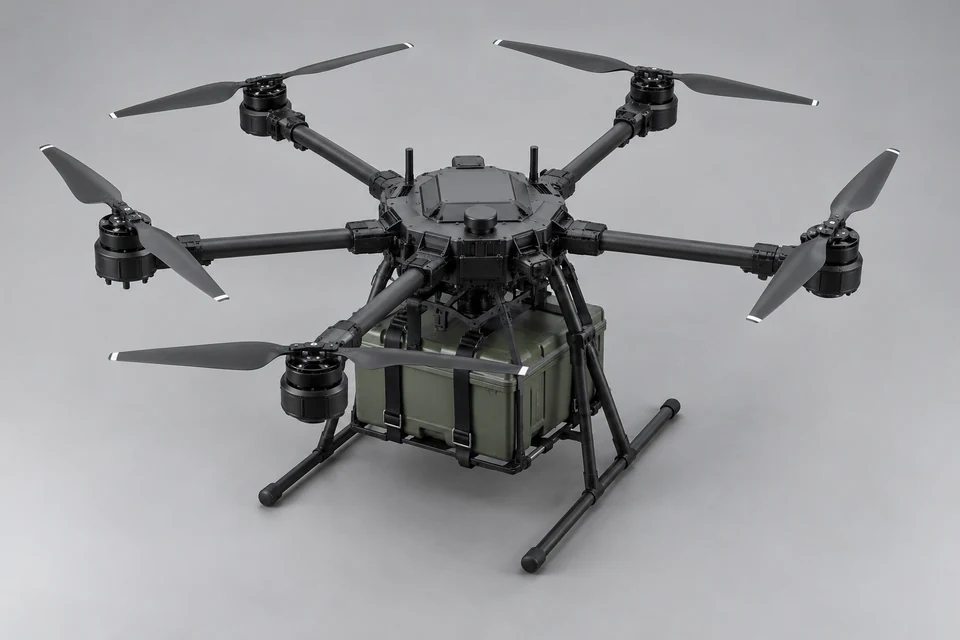
Heavy Lift Drone refers to an unmanned aircraft in which payload mass constitutes a primary aircraft sizing parameter and directly determines propulsion power, rotor or propeller area, structural load path, energy storage, flight control authority, thermal capacity, landing structure, payload attachment and operating envelope.
Product & engineering
Understand the product.
Heavy Lift Drone refers to an unmanned aircraft in which payload mass constitutes a primary aircraft sizing parameter and directly determines propulsion power, rotor or propeller area, structural load path, energy storage, flight control authority, thermal capacity, landing structure, payload attachment and operating envelope. Commercial configurations include multirotor aircraft, coaxial rotor aircraft, unmanned helicopters, VTOL aircraft and cargo UAVs. The aircraft mass budget consists of the airframe, propulsion units, motors or engines, motor controllers or transmission system, batteries or fuel, avionics, communication equipment, landing gear, payload handling equipment and carried payload. Usable payload is the portion of maximum takeoff weight remaining after aircraft operating mass, energy mass and installed mission equipment have been accounted for. Payload therefore changes whenever battery quantity, fuel quantity, winch installation, cargo frame, sensor package or other installed equipment changes. DJI FlyCart 100 provides a direct commercial example. Maximum takeoff weight reaches 170 kg. Payload reaches 85 kg with two batteries and 100 kg in the specified single battery configuration. Aircraft weight excluding payload is 55.2 kg with the lifting system or 60.2 kg with the winch system before battery related items specified by DJI are added.
Lift originates at the rotor disk and terminates through a continuous mechanical load path at the payload attachment point. In a multirotor aircraft, battery direct current passes through the power distribution system and electronic motor controllers, which commutate the brushless motors and convert electrical power into rotor torque. Motor torque turns the propellers, blade aerodynamic loading produces rotor thrust, rotor thrust enters the motor mounts and arms, and arm loads converge into the center frame or fuselage. Payload force enters through a cargo floor, hardpoint, hook, sling attachment, winch frame or dedicated carrier and closes through the same center structure. Arms therefore carry combined bending, torsion and vibration loads. Motor mounts carry rotor thrust and reaction torque. The center frame carries combined payload, propulsion and landing loads. Payload attachment hardware also experiences dynamic amplification during acceleration, braking, gust response, load pickup and load release. DJI FlyCart 100 illustrates the component scale required at the upper end of current electric cargo multirotors. It uses a coaxial four axis arrangement with eight rotors, 62 inch carbon fiber composite propellers, motors with a 155 mm by 16 mm stator and a KV value of 60 rpm per volt. Its DB2160 battery has 41 Ah capacity, 52 V nominal voltage and approximately 14.7 kg mass. The newer DB2212 remains a 41 Ah, 52 V unit at approximately 15 kg. Two such batteries therefore contribute about 30 kg before cargo is loaded. The corresponding charging system reaches 12,000 W output and can recharge from 30 percent to 95 percent in nine minutes under the stated conditions.
Rotor area, total thrust and installed shaft power determine the basic lifting ceiling. Ideal hover induced power scales approximately with aircraft weight to the power of 1.5 at constant total rotor disk area. Payload additions therefore impose a disproportionately large hover power requirement when rotor area remains unchanged. Available thrust above the amount required to balance gross weight forms the reserve used for vertical acceleration, attitude control, gust rejection and failure recovery. A heavy aircraft operating close to maximum gross weight can consequently retain much less maneuvering margin than the same aircraft at partial payload. Malloy Aeronautics T150 demonstrates this relationship with unusually transparent physical data. The aircraft uses eight electric motors and a coaxial rotor arrangement, carries up to 68 kg, has a maximum takeoff mass of 123 kg, and produces approximately 240 kg equivalent total thrust according to the UK Air Accidents Investigation Branch. Current manufacturer specifications give a maximum payload of 68 kg, maximum speed of 30 m per second and stated range from 13 km to 37.5 km depending on operating configuration. The thrust capability is therefore substantially above static gross weight, leaving control and climb authority that would disappear if propulsion sizing followed hover weight alone.
Disk loading and power loading materially separate heavy lift designs that carry similar nominal payloads. Larger rotor disk area reduces induced velocity and hover power for a given gross weight. Larger rotors also increase blade bending loads, rotor inertia, airframe dimensions and ground clearance requirements. Compact aircraft can recover packaging efficiency through coaxial or stacked rotor arrangements, with aerodynamic interaction between upper and lower rotors introducing additional induced losses. FlyingBasket FB3 uses eight rotors in a push pull arrangement, four removable lithium ion batteries, approximately 70 kg empty mass and a 100 kg maximum payload. Its current manufacturer data specify a maximum speed of 30 m per second and approximately 7 km range at 100 kg payload under the published reference conditions. The same aircraft reaches approximately 25 km at a 5 kg payload. The resulting payload and range curve shows the energy consequence directly. Increasing carried mass raises required lift throughout the complete mission while the installed battery energy remains finite.
Electrical heavy lift propulsion is governed by energy capacity and instantaneous power capacity simultaneously. Cell specific energy determines how much flight energy can be carried for a given battery mass. Cell discharge capability, internal resistance, bus voltage, conductor cross section, connector rating, motor controller current limit and motor winding temperature determine how rapidly that energy can be converted into thrust. Copper loss rises with the square of current, making electrical architecture increasingly important as propulsion power moves into the tens of kilowatts. Griff 60 provides a commercial example at this scale. It uses eight propulsion units rated at about 7.4 kW each, giving approximately 59 kW of installed motor power, together with a 6 kWh battery system. Maximum payload is 60 kg. The manufacturer specifies approximately 14 minutes with a 60 kg payload and up to 33 minutes of flight time under lighter operating conditions. The aircraft also uses removable batteries and a wireless cargo hook incorporating a load cell.
Battery installation also changes payload directly because energy storage constitutes a large fraction of takeoff mass. Redundant battery arrangements improve fault tolerance and can increase mission energy, while their mass consumes part of the aircraft gross weight allowance. DJI FlyCart 100 shows this interaction clearly. Its dual battery configuration carries up to 85 kg, while the specified single battery configuration reaches 100 kg payload. At a 149.9 kg takeoff weight, DJI states 12 minutes maximum hover endurance and 14 minutes maximum flight time with two batteries under its reference test conditions. The same gross weight with one battery gives 6 minutes hover endurance and 7 minutes maximum flight time. Battery count therefore changes both available payload and available energy. A payload number separated from battery configuration has limited engineering meaning.
Suspended cargo adds a second moving body beneath the aircraft. The hook, cable and payload create a pendulum whose motion couples into aircraft translation and attitude. Cable length determines pendulum natural frequency. Payload mass determines the forces transmitted into the attachment structure. Aircraft horizontal acceleration initiates swing, and aggressive deceleration can reverse and amplify that swing. Wind acting on a large external load generates additional drag and yawing moment. Flight control therefore requires enough differential rotor thrust to stabilize the aircraft while the load moves independently beneath it. Load position estimation, acceleration limiting, automatic balance control and active winch logic can reduce this coupling. DJI FlyCart 100 offers two commercial payload mechanisms. Its flagship winch has a cable length up to 30 m, a retraction speed up to 1.2 m per second, real time weighing, electrically controlled hook operation and emergency cable release. Its lifting system provides weighing, automatic balance control and an emergency cable cutting function. FlyingBasket FB3 uses a remotely controlled load hook for external loads up to 100 kg. Griff integrates a wireless quick release hook with a load cell and manual lockout. These components form part of the aircraft load control system because suspended payload motion directly changes aircraft dynamics.
Flight control operates under a mass and inertia condition that changes every time the cargo changes. Added mass reduces translational acceleration for a given excess thrust. Payload position changes longitudinal and lateral center of gravity. External cargo changes yaw inertia, pitch inertia and roll inertia. An offset load produces a continuous moment that must be balanced by differential rotor thrust or aerodynamic control. Flight controllers therefore combine inertial measurement units, GNSS, barometric altitude, magnetic heading and increasingly radar, LiDAR and vision inputs with mass estimation, attitude control, position control and propulsion management. The DJI FC100 safety sensor set includes forward millimeter wave radar, rear radar, downward radar, LiDAR and multiple vision sensors. RTK enabled hovering accuracy is specified at 10 cm horizontally and vertically under the stated GNSS conditions. The system also carries an integrated parachute whose specified touchdown speed is no more than 7 m per second under DJI test conditions at maximum takeoff weight.
Propulsion redundancy has direct mathematical consequences for heavy lift aircraft. Loss of one propulsion unit transfers its required thrust to the surviving units. The remaining motors, controllers, batteries and propellers must retain enough continuous or transient capability to arrest descent and preserve attitude. FlyingBasket states that FB3 propulsion redundancy addresses motor controller, motor, battery and short circuit failures. Malloy T150 uses eight electric motors and is already operated by military users. Heavy lift redundancy therefore extends beyond duplicate navigation sensors. Power distribution segmentation, motor controller isolation, independent battery paths, communications redundancy, flight termination equipment and emergency payload release can determine whether a single component fault remains controllable.
Internal combustion unmanned helicopters represent a materially different heavy lift architecture. Yamaha FAZER R G2 uses a 390 cc gasoline engine, a conventional main rotor and tail rotor arrangement, and a 3115 mm main rotor in its standard configuration. The dedicated large rotor cargo configuration increases main rotor diameter to 3600 mm and maximum payload to 50 kg under Yamaha's stated reference condition of 20 degrees Celsius and one atmosphere. Yamaha also publishes flight endurance up to approximately 100 minutes and long range capability for FAZER R G2 configurations. Energy is stored as liquid fuel, engine shaft power passes through the helicopter transmission to the rotor system, and endurance benefits from the much higher gravimetric energy content of fuel. Engine output, transmission rating, rotor aerodynamic limit, fuel mass and cooling condition then replace battery discharge capability as major payload constraints. Yamaha has also documented actual use of its industrial unmanned helicopters for transport work in mountainous power infrastructure operations, confirming this architecture as an operating commercial heavy lift system.
Maximum payload therefore has meaning only together with maximum takeoff weight, propulsion configuration, energy configuration, payload mounting method, altitude, atmospheric temperature, wind, range and required reserve. DJI specifies that FC100 payload capability decreases as takeoff altitude increases and gives 6000 m as the aircraft maximum flight altitude under a no payload condition with two batteries and takeoff from 4500 m. Yamaha explicitly conditions the FAZER R G2 large rotor 50 kg payload figure on atmospheric conditions. Commercial specifications from FlyingBasket also publish separate payload and range points instead of one unrestricted range figure. These data describe the physical boundary of Heavy Lift Drone operation: the aircraft is a coupled mass, lift, power, energy, structure and control system whose usable lifting capability changes continuously with mission gross weight and operating environment.
Equipment converts a defined input into a required mechanical or process result. Usable capacity depends on duty, auxiliaries, control, loading and maintenance, rather than an isolated maximum nameplate value.
What turns activity into demand
Production or operating duty leads to purchases when capacity, qualification and replacement requirements match the supplied machine or component. Site output alone does not determine equipment orders without the installed capacity and duty.
The commercial boundary
For Heavy Lift Drone, distinguish the supplied product from its inputs and the complete application. Report types and applications may overlap; retain the selected edition's product definition, geography, period, unit and transaction basis when comparing estimates.
Which conditions determine usable heavy lift drone performance?
Heavy Lift Drone refers to an unmanned aircraft in which payload mass constitutes a primary aircraft sizing parameter and directly determines propulsion power, rotor or propeller area, structural load path, energy storage, flight control authority, thermal capacity, landing structure, payload attachment and operating envelope. Compare the complete supplied assembly under the same operating conditions, including upstream and downstream interfaces, energy use and service requirements. Separate machine hardware, installed process line and maintenance revenue when defining the research boundary.
Selected research
Market Outlook & Growth Opportunities
Global Heavy Lift Drone Market Outlook and Growth Opportunities 2026
Market perspective
According to APO Research, Inc, the global Heavy Lift Drone market reached USD 73.96 million in 2025, is projected to increase to USD 164.18 million in 2026, and is forecast to reach USD 1,106.14 million by 2032, representing a CAGR of 37.43% from 2026 to 2032. Global sales volume is estimated at approximately 1.73 k units in 2025 and 4.12 k units in 2026, rising to about 25.60 k units by 2032. The corresponding weighted ex factory net price is approximately USD 42,750.00 per unit in 2025, USD 39,850.00 per unit in 2026, and USD 43,208.59 per unit in 2032. Effective production capacity is estimated at 3.05 k units, 6.35 k units, and 31.10 k units respectively, with utilization increasing from 56.72% in 2025 to 64.88% in 2026 and 82.32% in 2032. The sharp increase in 2026 reflects the transition of several heavy payload systems from limited commercial deployment to fleet procurement, while subsequent market expansion is increasingly tied to repeat orders, larger operating fleets, higher annual mission cycles, and greater availability of commercially mature aircraft.
Asia Pacific accounts for the largest incremental volume through 2032, led by China, where the industrial drone manufacturing chain combines electric propulsion, lithium battery systems, composite structures, flight control electronics, winches, cargo interfaces and large scale final assembly. Europe contributes a smaller unit base with comparatively high system values, particularly in industrial lifting, construction, energy infrastructure and specialized cargo transport. North America adds demand from logistics, industrial operations, emergency response and defense applications. DJI, FlyingBasket, Malloy Aeronautics and Griff Aviation represent established commercial participants across the lower and middle payload classes, while manufacturers entering the 200 kg and above class increase average system value through larger airframes, higher propulsion power, redundant flight control architectures and more complex certification requirements.
By maximum payload, the 50 kg to 100 kg class is expected to remain the principal commercial volume segment during the forecast period because current aircraft in this range provide sufficient lifting capability for construction materials, equipment, supplies and site logistics while retaining practical electric propulsion economics and field deployment flexibility. The 100 kg to 200 kg class gains share as industrial lifting and point to point cargo missions move toward heavier single trip loads. The 200 kg and above class remains lower in unit volume, although its contribution to market value rises as cargo aircraft, unmanned helicopters and large multirotor systems enter commercial operation. The up to 50 kg class contributes higher unit volumes at lower average prices and overlaps with demanding logistics, agriculture and utility missions where conventional commercial drones reach their payload limits.
Read the full market overview
Cargo and logistics is expected to generate the largest absolute increase in market value through 2032, followed by industrial lifting. Agriculture contributes through heavy input transport, spraying and material movement, while emergency response and defense sustain demand for aircraft capable of transporting supplies and mission equipment where ground access is constrained. Installed fleet expansion also increases replacement demand for batteries, propellers, electric motors, electronic speed controllers, winches and other high cycle components. Carbon fiber composites, aluminum alloys, high strength mechanical structures, high power electric motors and lithium battery packs remain major cost inputs. Composite fabrication, precision machining, propulsion integration, flight control redundancy, final assembly and flight testing determine manufacturing throughput and capital efficiency. As output rises, fixed manufacturing costs are distributed across larger production runs, while increasing payload, endurance and system redundancy place upward pressure on component value. This combination explains the decline in weighted unit price during the initial volume ramp and its subsequent gradual recovery through 2032.
This report provides an overview of the global Heavy Lift Drone market in terms of sales, revenue, and price, analyzing global market trends using historical revenue and sales data for 2021-2025, estimates for 2026, and projected CAGRs through 2032.
The study covers key producers of Heavy Lift Drone and sales in major regions and countries, assesses future market potential, and highlights priority regions and countries for segmenting the market into sub-sectors, with country-specific market value data for the U.S., Canada, Mexico, Brazil, China, Japan, South Korea, Southeast Asia, India, Germany, the U.K., Italy, the Middle East, Africa, and other countries.
The report also presents Heavy Lift Drone sales, revenue, market share, and industry ranking for the main manufacturers for 2021-2026, identifies the major stakeholders in the global market, and analyzes their competitive landscape and market positioning based on recent developments and segmental revenues.
In addition, the report analyzes segment data by Type and Application—covering sales, revenue, and price—for 2021-2032, and evaluates and forecasts the Heavy Lift Drone market size, projected growth trends, production technologies, key applications, and end-use industries.
Heavy Lift Drone Segment by Company
DJI
XAG
JOUAV
EHang
AutoFlight
Shenzhen Eagle Brother UAV Innovation
Aerospace Times Feipeng
Ursa Aeronautical Technology
United Aircraft
FlyingBasket
Malloy Aeronautics
Griff Aviation
Draganfly
Harris Aerial
DRONE VOLT
PRODRONE
Yamaha Motor
Windracers
Freefly Systems
SkyDrive
Aero Systems West
Velos Rotors
Schiebel
Garuda Aerospace
MMC UAV
Aurelia Aerospace
Inspired Flight Technologies
Watts Innovations
Acecore Technologies
Pyka
Hylio
Heavy Lift Drone Segment by Max Payload
50 to 100 kg
Above 100 to 200 kg
Above 200 kg
Heavy Lift Drone Segment by Application
Cargo & Logistics
Industrial Lifting
Agriculture
Emergency Response
Heavy Lift Drone Segment by Region
North America
United States
Canada
Mexico
Europe
Germany
France
U.K.
Italy
Russia
Spain
Netherlands
Switzerland
Sweden
Poland
Asia-Pacific
China
Japan
South Korea
India
Australia
Taiwan
Southeast Asia
South America
Brazil
Argentina
Chile
Colombia
Middle East & Africa
Egypt
South Africa
Israel
Türkiye
GCC Countries
Study Objectives
1. To analyze and research the global Heavy Lift Drone status and future forecast, involving, sales, revenue, growth rate (CAGR), market share, historical and forecast.
2. To present the key manufacturers, sales, revenue, market share, and Recent Developments.
3. To split the breakdown data by regions, type, manufacturers, and Application.
4. To analyze the global and key regions Heavy Lift Drone market potential and advantage, opportunity and challenge, restraints, and risks.
5. To identify Heavy Lift Drone significant trends, drivers, influence factors in global and regions.
6. To analyze Heavy Lift Drone competitive developments such as expansions, agreements, new product launches, and acquisitions in the market.
Reasons to Buy This Report
1. This report will help the readers to understand the competition within the industries and strategies for the competitive environment to enhance the potential profit. The report also focuses on the competitive landscape of the global Heavy Lift Drone market, and introduces in detail the market share, industry ranking, competitor ecosystem, market performance, new product development, operation situation, expansion, and acquisition. etc. of the main players, which helps the readers to identify the main competitors and deeply understand the competition pattern of the market.
2. This report will help stakeholders to understand the global industry status and trends of Heavy Lift Drone and provides them with information on key market drivers, restraints, challenges, and opportunities.
3. This report will help stakeholders to understand competitors better and gain more insights to strengthen their position in their businesses. The competitive landscape section includes the market share and rank (in sales and value), competitor ecosystem, new product development, expansion, and acquisition.
4. This report stays updated with novel technology integration, features, and the latest developments in the market.
5. This report helps stakeholders to gain insights into which regions to target globally.
6. This report helps stakeholders to gain insights into the end-user perception concerning the adoption of Heavy Lift Drone.
7. This report helps stakeholders to identify some of the key players in the market and understand their valuable contribution.
Chapter Outline
Chapter 1: Provides an overview of the Heavy Lift Drone market, including product definition, global market growth prospects, sales value, sales volume, and average price forecasts (2021-2032).
Chapter 2: Analysis key trends, drivers, challenges, and opportunities within the global Heavy Lift Drone industry.
Chapter 3: Detailed analysis of Heavy Lift Drone manufacturers competitive landscape, price, sales and revenue market share, latest development plan, merger, and acquisition information, etc.
Chapter 4: Provides the analysis of various market segments by type, covering the market size and development potential of each market segment, to help readers find the blue ocean market in different market segments.
Chapter 5: Provides the analysis of various market segments by application, covering the market size and development potential of each market segment, to help readers find the blue ocean market in different downstream markets.
Chapter 6: Sales and value of Heavy Lift Drone in regional level. It provides a quantitative analysis of the market size and development potential of each region and introduces the market development, future development prospects, market space, and market size of each country in the world.
Chapter 7: Sales and value of Heavy Lift Drone in country level. It provides sigmate data by type, and by application for each country/region.
Chapter 8: Provides profiles of key players, introducing the basic situation of the main companies in the market in detail, including product sales, revenue, price, gross margin, product introduction, recent development, etc.
Chapter 9: Analysis of industrial chain, including the upstream and downstream of the industry.
Chapter 10: Concluding Insights.
More report detail
Tables and figures
Scope & coverage.
Types
- 50 to 100 kg
- Above 100 to 200 kg
- Above 200 kg
Applications
- Cargo & Logistics
- Industrial Lifting
- Agriculture
- Emergency Response
Companies covered
- DJI
- XAG
- JOUAV
- EHang
- AutoFlight
- Shenzhen Eagle Brother UAV Innovation
- Aerospace Times Feipeng
- Ursa Aeronautical Technology
- United Aircraft
- FlyingBasket
- Malloy Aeronautics
- Griff Aviation
- Draganfly
- Harris Aerial
- DRONE VOLT
- PRODRONE
- Yamaha Motor
- Windracers
- Freefly Systems
- SkyDrive
- Aero Systems West
- Velos Rotors
- Schiebel
- Garuda Aerospace
- MMC UAV
- Aurelia Aerospace
- Inspired Flight Technologies
- Watts Innovations
- Acecore Technologies
- Pyka
- Hylio
Inside the report.
1 Market Overview
- 1.1 Product Definition
- 1.2 Global Market Growth Prospects
- 1.2.1 Global Heavy Lift Drone Sales Value (2021-2032)
- 1.2.2 Global Heavy Lift Drone Sales Volume (2021-2032)
- 1.2.3 Global Heavy Lift Drone Sales Average Price (2021-2032)
- 1.3 Assumptions and Limitations
- 1.4 Study Goals and Objectives
2 Heavy Lift Drone Market Dynamics
- 2.1 Heavy Lift Drone Industry Trends
- 2.2 Heavy Lift Drone Industry Drivers
- 2.3 Heavy Lift Drone Industry Opportunities and Challenges
- 2.4 Heavy Lift Drone Industry Restraints
3 Heavy Lift Drone Market by Company
- 3.1 Global Heavy Lift Drone Company Revenue Ranking in 2025
- 3.2 Global Heavy Lift Drone Revenue by Company (2021-2026)
- 3.3 Global Heavy Lift Drone Sales Volume by Company (2021-2026)
- 3.4 Global Heavy Lift Drone Average Price by Company (2021-2026)
- 3.5 Global Heavy Lift Drone Company Ranking (2024-2026)
- 3.6 Global Heavy Lift Drone Company Manufacturing Base and Headquarters
- 3.7 Global Heavy Lift Drone Company Product Type and Application
- 3.8 Global Heavy Lift Drone Company Establishment Date
- 3.9 Market Competitive Analysis
- 3.9.1 Global Heavy Lift Drone Market Concentration Ratio (CR5 and HHI)
- 3.9.2 Global Top 5 and 10 Company Market Share by Revenue in 2025
- 3.9.3 2025 Heavy Lift Drone Tier 1, Tier 2, and Tier 3 Companies
- 3.10 Mergers and Acquisitions Expansion
4 Heavy Lift Drone Market by Type
- 4.1 Heavy Lift Drone Type Introduction
- 4.1.1 50 to 100 kg
- 4.1.2 Above 100 to 200 kg
- 4.1.3 Above 200 kg
- 4.2 Global Heavy Lift Drone Sales Volume by Type
- 4.2.1 Global Heavy Lift Drone Sales Volume by Type (2021 VS 2025 VS 2032)
- 4.2.2 Global Heavy Lift Drone Sales Volume by Type (2021-2032)
- 4.2.3 Global Heavy Lift Drone Sales Volume Share by Type (2021-2032)
- 4.3 Global Heavy Lift Drone Sales Value by Type
- 4.3.1 Global Heavy Lift Drone Sales Value by Type (2021 VS 2025 VS 2032)
- 4.3.2 Global Heavy Lift Drone Sales Value by Type (2021-2032)
- 4.3.3 Global Heavy Lift Drone Sales Value Share by Type (2021-2032)
5 Heavy Lift Drone Market by Application
- 5.1 Heavy Lift Drone Application Introduction
- 5.1.1 Cargo & Logistics
- 5.1.2 Industrial Lifting
- 5.1.3 Agriculture
- 5.1.4 Emergency Response
- 5.2 Global Heavy Lift Drone Sales Volume by Application
- 5.2.1 Global Heavy Lift Drone Sales Volume by Application (2021 VS 2025 VS 2032)
- 5.2.2 Global Heavy Lift Drone Sales Volume by Application (2021-2032)
- 5.2.3 Global Heavy Lift Drone Sales Volume Share by Application (2021-2032)
- 5.3 Global Heavy Lift Drone Sales Value by Application
- 5.3.1 Global Heavy Lift Drone Sales Value by Application (2021 VS 2025 VS 2032)
- 5.3.2 Global Heavy Lift Drone Sales Value by Application (2021-2032)
- 5.3.3 Global Heavy Lift Drone Sales Value Share by Application (2021-2032)
6 Heavy Lift Drone Regional Sales and Value Analysis
- 6.1 Global Heavy Lift Drone Sales by Region: 2021 VS 2025 VS 2032
- 6.2 Global Heavy Lift Drone Sales by Region (2021-2032)
- 6.2.1 Global Heavy Lift Drone Sales by Region: 2021-2026
- 6.2.2 Global Heavy Lift Drone Sales by Region (2027-2032)
- 6.3 Global Heavy Lift Drone Sales Value by Region: 2021 VS 2025 VS 2032
- 6.4 Global Heavy Lift Drone Sales Value by Region (2021-2032)
- 6.4.1 Global Heavy Lift Drone Sales Value by Region: 2021-2026
- 6.4.2 Global Heavy Lift Drone Sales Value by Region (2027-2032)
- 6.5 Global Heavy Lift Drone Market Price Analysis by Region (2021-2026)
- 6.6 North America
- 6.6.1 North America Heavy Lift Drone Sales Value (2021-2032)
- 6.6.2 North America Heavy Lift Drone Sales Value Share by Country, 2025 VS 2032
- 6.7 Europe
- 6.7.1 Europe Heavy Lift Drone Sales Value (2021-2032)
- 6.7.2 Europe Heavy Lift Drone Sales Value Share by Country, 2025 VS 2032
- 6.8 Asia-Pacific
- 6.8.1 Asia-Pacific Heavy Lift Drone Sales Value (2021-2032)
- 6.8.2 Asia-Pacific Heavy Lift Drone Sales Value Share by Country, 2025 VS 2032
- 6.9 South America
- 6.9.1 South America Heavy Lift Drone Sales Value (2021-2032)
- 6.9.2 South America Heavy Lift Drone Sales Value Share by Country, 2025 VS 2032
- 6.10 Middle East & Africa
- 6.10.1 Middle East & Africa Heavy Lift Drone Sales Value (2021-2032)
- 6.10.2 Middle East & Africa Heavy Lift Drone Sales Value Share by Country, 2025 VS 2032
7 Heavy Lift Drone Country-level Sales and Value Analysis
- 7.1 Global Heavy Lift Drone Sales by Country: 2021 VS 2025 VS 2032
- 7.2 Global Heavy Lift Drone Sales Value by Country: 2021 VS 2025 VS 2032
- 7.3 Global Heavy Lift Drone Sales by Country (2021-2032)
- 7.3.1 Global Heavy Lift Drone Sales by Country (2021-2026)
- 7.3.2 Global Heavy Lift Drone Sales by Country (2027-2032)
- 7.4 Global Heavy Lift Drone Sales Value by Country (2021-2032)
- 7.4.1 Global Heavy Lift Drone Sales Value by Country (2021-2026)
- 7.4.2 Global Heavy Lift Drone Sales Value by Country (2027-2032)
- 7.5 USA
- 7.5.1 USA Heavy Lift Drone Sales Value Growth Rate (2021-2032)
- 7.5.2 USA Heavy Lift Drone Sales Value Share by Type, 2025 VS 2032
- 7.5.3 USA Heavy Lift Drone Sales Value Share by Application, 2025 VS 2032
- 7.6 Canada
- 7.6.1 Canada Heavy Lift Drone Sales Value Growth Rate (2021-2032)
- 7.6.2 Canada Heavy Lift Drone Sales Value Share by Type, 2025 VS 2032
- 7.6.3 Canada Heavy Lift Drone Sales Value Share by Application, 2025 VS 2032
- 7.7 Mexico
- 7.6.1 Mexico Heavy Lift Drone Sales Value Growth Rate (2021-2032)
- 7.6.2 Mexico Heavy Lift Drone Sales Value Share by Type, 2025 VS 2032
- 7.6.3 Mexico Heavy Lift Drone Sales Value Share by Application, 2025 VS 2032
- 7.8 Germany
- 7.8.1 Germany Heavy Lift Drone Sales Value Growth Rate (2021-2032)
- 7.8.2 Germany Heavy Lift Drone Sales Value Share by Type, 2025 VS 2032
- 7.8.3 Germany Heavy Lift Drone Sales Value Share by Application, 2025 VS 2032
- 7.9 France
- 7.9.1 France Heavy Lift Drone Sales Value Growth Rate (2021-2032)
- 7.9.2 France Heavy Lift Drone Sales Value Share by Type, 2025 VS 2032
- 7.9.3 France Heavy Lift Drone Sales Value Share by Application, 2025 VS 2032
- 7.10 U.K.
- 7.10.1 U.K. Heavy Lift Drone Sales Value Growth Rate (2021-2032)
- 7.10.2 U.K. Heavy Lift Drone Sales Value Share by Type, 2025 VS 2032
- 7.10.3 U.K. Heavy Lift Drone Sales Value Share by Application, 2025 VS 2032
- 7.11 Italy
- 7.11.1 Italy Heavy Lift Drone Sales Value Growth Rate (2021-2032)
- 7.11.2 Italy Heavy Lift Drone Sales Value Share by Type, 2025 VS 2032
- 7.11.3 Italy Heavy Lift Drone Sales Value Share by Application, 2025 VS 2032
- 7.12 Spain
- 7.12.1 Spain Heavy Lift Drone Sales Value Growth Rate (2021-2032)
- 7.12.2 Spain Heavy Lift Drone Sales Value Share by Type, 2025 VS 2032
- 7.12.3 Spain Heavy Lift Drone Sales Value Share by Application, 2025 VS 2032
- 7.13 Russia
- 7.13.1 Russia Heavy Lift Drone Sales Value Growth Rate (2021-2032)
- 7.13.2 Russia Heavy Lift Drone Sales Value Share by Type, 2025 VS 2032
- 7.13.3 Russia Heavy Lift Drone Sales Value Share by Application, 2025 VS 2032
- 7.14 Netherlands
- 7.14.1 Netherlands Heavy Lift Drone Sales Value Growth Rate (2021-2032)
- 7.14.2 Netherlands Heavy Lift Drone Sales Value Share by Type, 2025 VS 2032
- 7.14.3 Netherlands Heavy Lift Drone Sales Value Share by Application, 2025 VS 2032
- 7.15 Nordic Countries
- 7.15.1 Nordic Countries Heavy Lift Drone Sales Value Growth Rate (2021-2032)
- 7.15.2 Nordic Countries Heavy Lift Drone Sales Value Share by Type, 2025 VS 2032
- 7.15.3 Nordic Countries Heavy Lift Drone Sales Value Share by Application, 2025 VS 2032
- 7.16 China
- 7.16.1 China Heavy Lift Drone Sales Value Growth Rate (2021-2032)
- 7.16.2 China Heavy Lift Drone Sales Value Share by Type, 2025 VS 2032
- 7.16.3 China Heavy Lift Drone Sales Value Share by Application, 2025 VS 2032
- 7.17 Japan
- 7.17.1 Japan Heavy Lift Drone Sales Value Growth Rate (2021-2032)
- 7.17.2 Japan Heavy Lift Drone Sales Value Share by Type, 2025 VS 2032
- 7.17.3 Japan Heavy Lift Drone Sales Value Share by Application, 2025 VS 2032
- 7.18 South Korea
- 7.18.1 South Korea Heavy Lift Drone Sales Value Growth Rate (2021-2032)
- 7.18.2 South Korea Heavy Lift Drone Sales Value Share by Type, 2025 VS 2032
- 7.18.3 South Korea Heavy Lift Drone Sales Value Share by Application, 2025 VS 2032
- 7.19 India
- 7.19.1 India Heavy Lift Drone Sales Value Growth Rate (2021-2032)
- 7.19.2 India Heavy Lift Drone Sales Value Share by Type, 2025 VS 2032
- 7.19.3 India Heavy Lift Drone Sales Value Share by Application, 2025 VS 2032
- 7.20 Australia
- 7.20.1 Australia Heavy Lift Drone Sales Value Growth Rate (2021-2032)
- 7.20.2 Australia Heavy Lift Drone Sales Value Share by Type, 2025 VS 2032
- 7.20.3 Australia Heavy Lift Drone Sales Value Share by Application, 2025 VS 2032
- 7.21 Southeast Asia
- 7.21.1 Southeast Asia Heavy Lift Drone Sales Value Growth Rate (2021-2032)
- 7.21.2 Southeast Asia Heavy Lift Drone Sales Value Share by Type, 2025 VS 2032
- 7.21.3 Southeast Asia Heavy Lift Drone Sales Value Share by Application, 2025 VS 2032
- 7.22 Brazil
- 7.22.1 Brazil Heavy Lift Drone Sales Value Growth Rate (2021-2032)
- 7.22.2 Brazil Heavy Lift Drone Sales Value Share by Type, 2025 VS 2032
- 7.22.3 Brazil Heavy Lift Drone Sales Value Share by Application, 2025 VS 2032
- 7.23 Argentina
- 7.23.1 Argentina Heavy Lift Drone Sales Value Growth Rate (2021-2032)
- 7.23.2 Argentina Heavy Lift Drone Sales Value Share by Type, 2025 VS 2032
- 7.23.3 Argentina Heavy Lift Drone Sales Value Share by Application, 2025 VS 2032
- 7.24 Chile
- 7.24.1 Chile Heavy Lift Drone Sales Value Growth Rate (2021-2032)
- 7.24.2 Chile Heavy Lift Drone Sales Value Share by Type, 2025 VS 2032
- 7.24.3 Chile Heavy Lift Drone Sales Value Share by Application, 2025 VS 2032
- 7.25 Colombia
- 7.25.1 Colombia Heavy Lift Drone Sales Value Growth Rate (2021-2032)
- 7.25.2 Colombia Heavy Lift Drone Sales Value Share by Type, 2025 VS 2032
- 7.25.3 Colombia Heavy Lift Drone Sales Value Share by Application, 2025 VS 2032
- 7.26 Peru
- 7.26.1 Peru Heavy Lift Drone Sales Value Growth Rate (2021-2032)
- 7.26.2 Peru Heavy Lift Drone Sales Value Share by Type, 2025 VS 2032
- 7.26.3 Peru Heavy Lift Drone Sales Value Share by Application, 2025 VS 2032
- 7.27 Saudi Arabia
- 7.27.1 Saudi Arabia Heavy Lift Drone Sales Value Growth Rate (2021-2032)
- 7.27.2 Saudi Arabia Heavy Lift Drone Sales Value Share by Type, 2025 VS 2032
- 7.27.3 Saudi Arabia Heavy Lift Drone Sales Value Share by Application, 2025 VS 2032
- 7.28 Israel
- 7.28.1 Israel Heavy Lift Drone Sales Value Growth Rate (2021-2032)
- 7.28.2 Israel Heavy Lift Drone Sales Value Share by Type, 2025 VS 2032
- 7.28.3 Israel Heavy Lift Drone Sales Value Share by Application, 2025 VS 2032
- 7.29 UAE
- 7.29.1 UAE Heavy Lift Drone Sales Value Growth Rate (2021-2032)
- 7.29.2 UAE Heavy Lift Drone Sales Value Share by Type, 2025 VS 2032
- 7.29.3 UAE Heavy Lift Drone Sales Value Share by Application, 2025 VS 2032
- 7.30 Turkey
- 7.30.1 Turkey Heavy Lift Drone Sales Value Growth Rate (2021-2032)
- 7.30.2 Turkey Heavy Lift Drone Sales Value Share by Type, 2025 VS 2032
- 7.30.3 Turkey Heavy Lift Drone Sales Value Share by Application, 2025 VS 2032
- 7.31 Iran
- 7.31.1 Iran Heavy Lift Drone Sales Value Growth Rate (2021-2032)
- 7.31.2 Iran Heavy Lift Drone Sales Value Share by Type, 2025 VS 2032
- 7.31.3 Iran Heavy Lift Drone Sales Value Share by Application, 2025 VS 2032
- 7.32 Egypt
- 7.32.1 Egypt Heavy Lift Drone Sales Value Growth Rate (2021-2032)
- 7.32.2 Egypt Heavy Lift Drone Sales Value Share by Type, 2025 VS 2032
- 7.32.3 Egypt Heavy Lift Drone Sales Value Share by Application, 2025 VS 2032
8 Company Profiles
- 8.1 DJI
- 8.1.1 DJI Company Information
- 8.1.2 DJI Business Overview
- 8.1.3 DJI Heavy Lift Drone Sales, Value and Gross Margin (2021-2026)
- 8.1.4 DJI Heavy Lift Drone Product Portfolio
- 8.1.5 DJI Recent Developments
- 8.2 XAG
- 8.2.1 XAG Company Information
- 8.2.2 XAG Business Overview
- 8.2.3 XAG Heavy Lift Drone Sales, Value and Gross Margin (2021-2026)
- 8.2.4 XAG Heavy Lift Drone Product Portfolio
- 8.2.5 XAG Recent Developments
- 8.3 JOUAV
- 8.3.1 JOUAV Company Information
- 8.3.2 JOUAV Business Overview
- 8.3.3 JOUAV Heavy Lift Drone Sales, Value and Gross Margin (2021-2026)
- 8.3.4 JOUAV Heavy Lift Drone Product Portfolio
- 8.3.5 JOUAV Recent Developments
- 8.4 EHang
- 8.4.1 EHang Company Information
- 8.4.2 EHang Business Overview
- 8.4.3 EHang Heavy Lift Drone Sales, Value and Gross Margin (2021-2026)
- 8.4.4 EHang Heavy Lift Drone Product Portfolio
- 8.4.5 EHang Recent Developments
- 8.5 AutoFlight
- 8.5.1 AutoFlight Company Information
- 8.5.2 AutoFlight Business Overview
- 8.5.3 AutoFlight Heavy Lift Drone Sales, Value and Gross Margin (2021-2026)
- 8.5.4 AutoFlight Heavy Lift Drone Product Portfolio
- 8.5.5 AutoFlight Recent Developments
- 8.6 Shenzhen Eagle Brother UAV Innovation
- 8.6.1 Shenzhen Eagle Brother UAV Innovation Company Information
- 8.6.2 Shenzhen Eagle Brother UAV Innovation Business Overview
- 8.6.3 Shenzhen Eagle Brother UAV Innovation Heavy Lift Drone Sales, Value and Gross Margin (2021-2026)
- 8.6.4 Shenzhen Eagle Brother UAV Innovation Heavy Lift Drone Product Portfolio
- 8.6.5 Shenzhen Eagle Brother UAV Innovation Recent Developments
- 8.7 Aerospace Times Feipeng
- 8.7.1 Aerospace Times Feipeng Company Information
- 8.7.2 Aerospace Times Feipeng Business Overview
- 8.7.3 Aerospace Times Feipeng Heavy Lift Drone Sales, Value and Gross Margin (2021-2026)
- 8.7.4 Aerospace Times Feipeng Heavy Lift Drone Product Portfolio
- 8.7.5 Aerospace Times Feipeng Recent Developments
- 8.8 Ursa Aeronautical Technology
- 8.8.1 Ursa Aeronautical Technology Company Information
- 8.8.2 Ursa Aeronautical Technology Business Overview
- 8.8.3 Ursa Aeronautical Technology Heavy Lift Drone Sales, Value and Gross Margin (2021-2026)
- 8.8.4 Ursa Aeronautical Technology Heavy Lift Drone Product Portfolio
- 8.8.5 Ursa Aeronautical Technology Recent Developments
- 8.9 United Aircraft
- 8.9.1 United Aircraft Company Information
- 8.9.2 United Aircraft Business Overview
- 8.9.3 United Aircraft Heavy Lift Drone Sales, Value and Gross Margin (2021-2026)
- 8.9.4 United Aircraft Heavy Lift Drone Product Portfolio
- 8.9.5 United Aircraft Recent Developments
- 8.10 FlyingBasket
- 8.10.1 FlyingBasket Company Information
- 8.10.2 FlyingBasket Business Overview
- 8.10.3 FlyingBasket Heavy Lift Drone Sales, Value and Gross Margin (2021-2026)
- 8.10.4 FlyingBasket Heavy Lift Drone Product Portfolio
- 8.10.5 FlyingBasket Recent Developments
- 8.11 Malloy Aeronautics
- 8.11.1 Malloy Aeronautics Company Information
- 8.11.2 Malloy Aeronautics Business Overview
- 8.11.3 Malloy Aeronautics Heavy Lift Drone Sales, Value and Gross Margin (2021-2026)
- 8.11.4 Malloy Aeronautics Heavy Lift Drone Product Portfolio
- 8.11.5 Malloy Aeronautics Recent Developments
- 8.12 Griff Aviation
- 8.12.1 Griff Aviation Company Information
- 8.12.2 Griff Aviation Business Overview
- 8.12.3 Griff Aviation Heavy Lift Drone Sales, Value and Gross Margin (2021-2026)
- 8.12.4 Griff Aviation Heavy Lift Drone Product Portfolio
- 8.12.5 Griff Aviation Recent Developments
- 8.13 Draganfly
- 8.13.1 Draganfly Company Information
- 8.13.2 Draganfly Business Overview
- 8.13.3 Draganfly Heavy Lift Drone Sales, Value and Gross Margin (2021-2026)
- 8.13.4 Draganfly Heavy Lift Drone Product Portfolio
- 8.13.5 Draganfly Recent Developments
- 8.14 Harris Aerial
- 8.14.1 Harris Aerial Company Information
- 8.14.2 Harris Aerial Business Overview
- 8.14.3 Harris Aerial Heavy Lift Drone Sales, Value and Gross Margin (2021-2026)
- 8.14.4 Harris Aerial Heavy Lift Drone Product Portfolio
- 8.14.5 Harris Aerial Recent Developments
- 8.15 DRONE VOLT
- 8.15.1 DRONE VOLT Company Information
- 8.15.2 DRONE VOLT Business Overview
- 8.15.3 DRONE VOLT Heavy Lift Drone Sales, Value and Gross Margin (2021-2026)
- 8.15.4 DRONE VOLT Heavy Lift Drone Product Portfolio
- 8.15.5 DRONE VOLT Recent Developments
- 8.16 PRODRONE
- 8.16.1 PRODRONE Company Information
- 8.16.2 PRODRONE Business Overview
- 8.16.3 PRODRONE Heavy Lift Drone Sales, Value and Gross Margin (2021-2026)
- 8.16.4 PRODRONE Heavy Lift Drone Product Portfolio
- 8.16.5 PRODRONE Recent Developments
- 8.17 Yamaha Motor
- 8.17.1 Yamaha Motor Company Information
- 8.17.2 Yamaha Motor Business Overview
- 8.17.3 Yamaha Motor Heavy Lift Drone Sales, Value and Gross Margin (2021-2026)
- 8.17.4 Yamaha Motor Heavy Lift Drone Product Portfolio
- 8.17.5 Yamaha Motor Recent Developments
- 8.18 Windracers
- 8.18.1 Windracers Company Information
- 8.18.2 Windracers Business Overview
- 8.18.3 Windracers Heavy Lift Drone Sales, Value and Gross Margin (2021-2026)
- 8.18.4 Windracers Heavy Lift Drone Product Portfolio
- 8.18.5 Windracers Recent Developments
- 8.19 Freefly Systems
- 8.19.1 Freefly Systems Company Information
- 8.19.2 Freefly Systems Business Overview
- 8.19.3 Freefly Systems Heavy Lift Drone Sales, Value and Gross Margin (2021-2026)
- 8.19.4 Freefly Systems Heavy Lift Drone Product Portfolio
- 8.19.5 Freefly Systems Recent Developments
- 8.20 SkyDrive
- 8.20.1 SkyDrive Company Information
- 8.20.2 SkyDrive Business Overview
- 8.20.3 SkyDrive Heavy Lift Drone Sales, Value and Gross Margin (2021-2026)
- 8.20.4 SkyDrive Heavy Lift Drone Product Portfolio
- 8.20.5 SkyDrive Recent Developments
- 8.21 Aero Systems West
- 8.21.1 Aero Systems West Company Information
- 8.21.2 Aero Systems West Business Overview
- 8.21.3 Aero Systems West Heavy Lift Drone Sales, Value and Gross Margin (2021-2026)
- 8.21.4 Aero Systems West Heavy Lift Drone Product Portfolio
- 8.21.5 Aero Systems West Recent Developments
- 8.22 Velos Rotors
- 8.22.1 Velos Rotors Company Information
- 8.22.2 Velos Rotors Business Overview
- 8.22.3 Velos Rotors Heavy Lift Drone Sales, Value and Gross Margin (2021-2026)
- 8.22.4 Velos Rotors Heavy Lift Drone Product Portfolio
- 8.22.5 Velos Rotors Recent Developments
- 8.23 Schiebel
- 8.23.1 Schiebel Company Information
- 8.23.2 Schiebel Business Overview
- 8.23.3 Schiebel Heavy Lift Drone Sales, Value and Gross Margin (2021-2026)
- 8.23.4 Schiebel Heavy Lift Drone Product Portfolio
- 8.23.5 Schiebel Recent Developments
- 8.24 Garuda Aerospace
- 8.24.1 Garuda Aerospace Company Information
- 8.24.2 Garuda Aerospace Business Overview
- 8.24.3 Garuda Aerospace Heavy Lift Drone Sales, Value and Gross Margin (2021-2026)
- 8.24.4 Garuda Aerospace Heavy Lift Drone Product Portfolio
- 8.24.5 Garuda Aerospace Recent Developments
- 8.25 MMC UAV
- 8.25.1 MMC UAV Company Information
- 8.25.2 MMC UAV Business Overview
- 8.25.3 MMC UAV Heavy Lift Drone Sales, Value and Gross Margin (2021-2026)
- 8.25.4 MMC UAV Heavy Lift Drone Product Portfolio
- 8.25.5 MMC UAV Recent Developments
- 8.26 Aurelia Aerospace
- 8.26.1 Aurelia Aerospace Company Information
- 8.26.2 Aurelia Aerospace Business Overview
- 8.26.3 Aurelia Aerospace Heavy Lift Drone Sales, Value and Gross Margin (2021-2026)
- 8.26.4 Aurelia Aerospace Heavy Lift Drone Product Portfolio
- 8.26.5 Aurelia Aerospace Recent Developments
- 8.27 Inspired Flight Technologies
- 8.27.1 Inspired Flight Technologies Company Information
- 8.27.2 Inspired Flight Technologies Business Overview
- 8.27.3 Inspired Flight Technologies Heavy Lift Drone Sales, Value and Gross Margin (2021-2026)
- 8.27.4 Inspired Flight Technologies Heavy Lift Drone Product Portfolio
- 8.27.5 Inspired Flight Technologies Recent Developments
- 8.28 Watts Innovations
- 8.28.1 Watts Innovations Company Information
- 8.28.2 Watts Innovations Business Overview
- 8.28.3 Watts Innovations Heavy Lift Drone Sales, Value and Gross Margin (2021-2026)
- 8.28.4 Watts Innovations Heavy Lift Drone Product Portfolio
- 8.28.5 Watts Innovations Recent Developments
- 8.29 Acecore Technologies
- 8.29.1 Acecore Technologies Company Information
- 8.29.2 Acecore Technologies Business Overview
- 8.29.3 Acecore Technologies Heavy Lift Drone Sales, Value and Gross Margin (2021-2026)
- 8.29.4 Acecore Technologies Heavy Lift Drone Product Portfolio
- 8.29.5 Acecore Technologies Recent Developments
- 8.30 Pyka
- 8.30.1 Pyka Company Information
- 8.30.2 Pyka Business Overview
- 8.30.3 Pyka Heavy Lift Drone Sales, Value and Gross Margin (2021-2026)
- 8.30.4 Pyka Heavy Lift Drone Product Portfolio
- 8.30.5 Pyka Recent Developments
- 8.31 Hylio
- 8.31.1 Hylio Company Information
- 8.31.2 Hylio Business Overview
- 8.31.3 Hylio Heavy Lift Drone Sales, Value and Gross Margin (2021-2026)
- 8.31.4 Hylio Heavy Lift Drone Product Portfolio
- 8.31.5 Hylio Recent Developments
9 Value Chain and Sales Channels Analysis
- 9.1 Heavy Lift Drone Value Chain Analysis
- 9.1.1 Heavy Lift Drone Key Raw Materials
- 9.1.2 Raw Materials Key Suppliers
- 9.1.3 Manufacturing Cost Structure
- 9.1.4 Heavy Lift Drone Sales Mode & Process
- 9.2 Heavy Lift Drone Sales Channels Analysis
- 9.2.1 Direct Comparison with Distribution Share
- 9.2.2 Heavy Lift Drone Distributors
- 9.2.3 Heavy Lift Drone Customers
10 Concluding Insights
11 Appendix
- 11.1 Reasons for Doing This Study
- 11.2 Research Methodology
- 11.3 Research Process
- 11.4 Authors List of This Report
- 11.5 Data Source
- 11.5.1 Secondary Sources
- 11.5.2 Primary Sources
GET THE RESEARCH
Choose your license.
Choose who needs access.
All options are for this report and research series.
PDF by email within 3–5 working days after payment confirmation.
Talk to an analyst