
Global Biomimetic Cryoprotectants Market by Size, by Type, by Application, by Region, History and Forecast 2021-2032
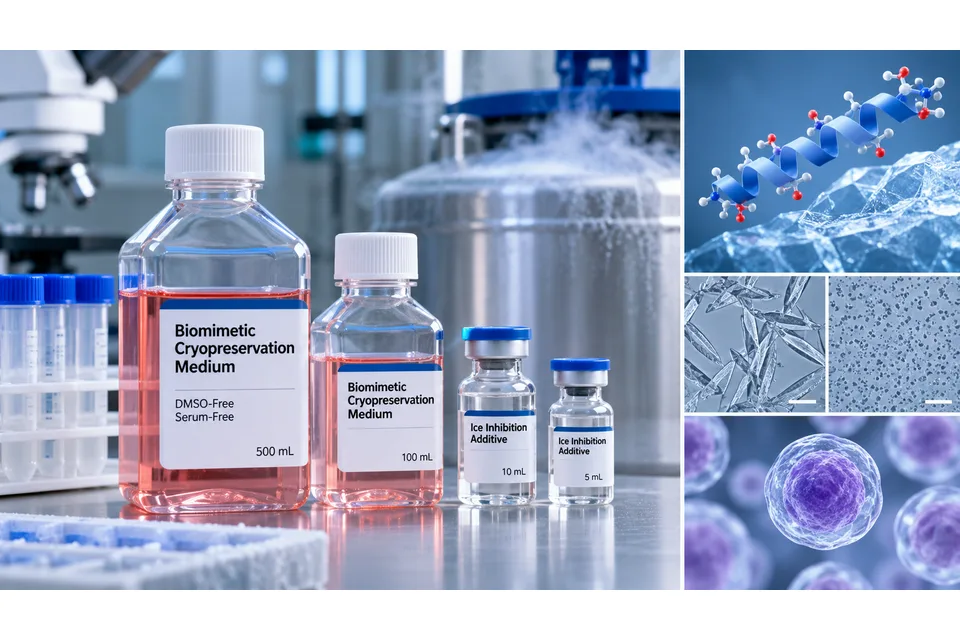
Biomimetic cryoprotectants are specialized chemical formulations that regulate ice nucleation, crystal growth, morphology, and recrystallization during the freezing, cryogenic storage, and thawing of living cells and biological tissues. Their active components reproduce selected ice regulating functions of natural antifreeze proteins and other cold adapted biological systems through molecular structures engineered to interact with ice surfaces and the surrounding aqueous phase. Commercially relevant materials include synthetic antifreeze peptoids, ice recrystallization inhibiting small molecules, modified polyvinyl alcohol, amphiphilic polymers, and polyampholytes such as carboxylated polylysine. Depending on molecular chemistry and formulation, these compounds modify ice nucleation behavior, inhibit crystal growth, restrict recrystallization during thermal fluctuations and warming, or suppress residual ice formation in vitrification systems. Their interactions at the ice and water interface can limit mechanical injury to cellular membranes, reduce damage associated with extracellular ice growth and osmotic stress, and preserve cellular integrity and functional recovery after thawing. Commercial products are supplied primarily as ready to use aqueous cryopreservation media and concentrated cryoprotectant additives, incorporating ice regulating molecules with selected buffers, electrolytes, sugars, polyols, and other formulation components. Certain formulations eliminate dimethyl sulfoxide (DMSO), serum, and animal derived proteins, while others combine biomimetic ice control agents with conventional permeating cryoprotectants to address complementary mechanisms of freezing injury. The defining technical characteristic is the demonstrated ice regulating function of the active formulation, which distinguishes these products from conventional preservation solutions relying exclusively on freezing point depression, osmotic adjustment, or increased solution viscosity. Commercial applications include cryopreservation of hematopoietic stem cells, mesenchymal stem cells, induced pluripotent stem cells, immune cells, engineered cellular therapeutics, reproductive cells, embryos, and biological specimens maintained in research and biobanking operations. Additional applications involve reproductive medicine, livestock breeding, tissue engineering, and experimental preservation of complex tissues and organs. Clinical cell manufacturing and laboratory biobanking constitute established commercial use environments, while whole organ cryopreservation remains at an earlier stage of technical development and commercialization.
Product & engineering
Understand the product.
Biomimetic cryoprotectants are specialized chemical formulations that regulate ice nucleation, crystal growth, morphology, and recrystallization during the freezing, cryogenic storage, and thawing of living cells and biological tissues. Their active components reproduce selected ice regulating functions of natural antifreeze proteins and other cold adapted biological systems through molecular structures engineered to interact with ice surfaces and the surrounding aqueous phase. Commercially relevant materials include synthetic antifreeze peptoids, ice recrystallization inhibiting small molecules, modified polyvinyl alcohol, amphiphilic polymers, and polyampholytes such as carboxylated polylysine. Depending on molecular chemistry and formulation, these compounds modify ice nucleation behavior, inhibit crystal growth, restrict recrystallization during thermal fluctuations and warming, or suppress residual ice formation in vitrification systems. Their interactions at the ice and water interface can limit mechanical injury to cellular membranes, reduce damage associated with extracellular ice growth and osmotic stress, and preserve cellular integrity and functional recovery after thawing. Commercial products are supplied primarily as ready to use aqueous cryopreservation media and concentrated cryoprotectant additives, incorporating ice regulating molecules with selected buffers, electrolytes, sugars, polyols, and other formulation components. Certain formulations eliminate dimethyl sulfoxide (DMSO), serum, and animal derived proteins, while others combine biomimetic ice control agents with conventional permeating cryoprotectants to address complementary mechanisms of freezing injury. The defining technical characteristic is the demonstrated ice regulating function of the active formulation, which distinguishes these products from conventional preservation solutions relying exclusively on freezing point depression, osmotic adjustment, or increased solution viscosity. Commercial applications include cryopreservation of hematopoietic stem cells, mesenchymal stem cells, induced pluripotent stem cells, immune cells, engineered cellular therapeutics, reproductive cells, embryos, and biological specimens maintained in research and biobanking operations. Additional applications involve reproductive medicine, livestock breeding, tissue engineering, and experimental preservation of complex tissues and organs. Clinical cell manufacturing and laboratory biobanking constitute established commercial use environments, while whole organ cryopreservation remains at an earlier stage of technical development and commercialization.
Selected research
Market Structure
Global Biomimetic Cryoprotectants Market by Size, by Type, by Application, by Region, History and Forecast 2021-2032
MARKET AT A GLANCE
Scale & outlook
- 2026
- 4.58USD million
- 2032
- 15.2USD million
Select a bar to inspect its value.
Source: APO Research, Inc.
Market perspective
According to APO Research, Inc, the global biomimetic cryoprotectants market was valued at approximately USD 3.46 million in 2025 and is projected to reach USD 4.58 million in 2026 and USD 15.2 million by 2032, representing a compound annual growth rate of 22.13% from 2026 to 2032. Market expansion is primarily associated with the commercial adoption of ice regulating cryopreservation formulations in cell therapy manufacturing, stem cell banking, immune cell processing, and biological sample preservation. Unlike conventional formulations dependent primarily on permeating cryoprotectants, biomimetic systems employ synthetic ice regulating molecules to control crystal growth and recrystallization during freezing and warming. Commercial sales comprise formulated cryopreservation media and separately supplied ice inhibiting additives. Consumption depends on the number of manufacturing and banking batches, preservation volume per batch, and frequency of freezing operations. Revenue is influenced by formulation complexity, the concentration of specialized active ingredients, manufacturing requirements, and the proportion of qualified products supplied for clinical manufacturing applications.
The United States and China are important centers of commercial product development and manufacturing. X-Therma received FDA acceptance of a Drug Master File for its XT-Thrive cryopreservation medium in April 2024 and announced GMP commercial readiness at its Hercules, California, manufacturing facility in May 2024. The company's synthetic peptoid technology enables chemically defined formulations without DMSO, serum, or proteins, addressing the processing and formulation requirements of cell therapy developers. In China, CellStore Biotechnology operates manufacturing facilities in Beijing and Dongguan, including a reported 1,000 m² GMP manufacturing workshop. Its ice controlling formulations cover stem cells, immune cells, and biological specimens. The CS-AT-D2 immune cell medium combines 10% DMSO with ice controlling materials, illustrating the continued commercial relevance of formulations that integrate conventional cryoprotectants with molecular ice regulation. Product selection depends on cell type, functional recovery after thawing, manufacturing compatibility, and the qualification requirements of individual customers.
Industry commercialization remains dependent on product specific development and customer adoption. BioLife Solutions acquired PanTHERA CryoSolutions in April 2025, gaining access to KryoAegis ice recrystallization inhibitor technology introduced in March 2024. Repligen completed its acquisition of BioLife Solutions in October 2026, expanding the commercial resources available to the combined biopreservation business. PanTHERA's second generation ice recrystallization inhibitor technology remained under development in 2026, with commercial contribution dependent on subsequent qualification and adoption. In Japan, BMG supplies StemCell Keep for research applications involving embryonic and induced pluripotent stem cells, reflecting the established but relatively specialized demand for advanced vitrification formulations. Through 2032, incremental market revenue is expected to arise principally from increased cell manufacturing activity, repeated purchases of qualified cryopreservation media, and broader adoption of specialized formulations in research and biobanking. Clinical process validation, formulation costs, and established DMSO based alternatives will continue to constrain the pace of substitution. Complex tissue and whole organ cryopreservation are expected to remain smaller commercial applications during the forecast period.
Full market overview
This report provides an overview of the global Biomimetic Cryoprotectants market in terms of sales, revenue, and price, analyzing global market trends using historical revenue and sales data for 2021-2025, estimates for 2026, and projected CAGRs through 2032.
The study covers key producers of Biomimetic Cryoprotectants and sales in major regions and countries, assesses future market potential, and highlights priority regions and countries for segmenting the market into sub-sectors, with country-specific market value data for the U.S., Canada, Mexico, Brazil, China, Japan, South Korea, Southeast Asia, India, Germany, the U.K., Italy, the Middle East, Africa, and other countries.
The report also presents Biomimetic Cryoprotectants sales, revenue, market share, and industry ranking for the main manufacturers for 2021-2026, identifies the major stakeholders in the global market, and analyzes their competitive landscape and market positioning based on recent developments and segmental revenues.
In addition, the report analyzes segment data by Type and Application—covering sales, revenue, and price—for 2021-2032, and evaluates and forecasts the Biomimetic Cryoprotectants market size, projected growth trends, production technologies, key applications, and end-use industries.
Biomimetic Cryoprotectants Segment by Company
- CellStore Biotechnology
- X-Therma
- Repligen
- BMG
- 21st Century Medicine
Biomimetic Cryoprotectants Segment by Type
- Cryopreservation Media
- Cryoprotectant Additives
Biomimetic Cryoprotectants Segment by Application
- Cell Therapy
- Research & Biobanking
- Assisted Reproduction
- Tissue & Organ Preservation
- Livestock Breeding
Biomimetic Cryoprotectants Segment by Region
- North America
- United States
- Canada
- Mexico
- Europe
- Germany
- France
- U.K.
- Italy
- Russia
- Spain
- Netherlands
- Switzerland
- Sweden
- Poland
- Asia-Pacific
- China
- Japan
- South Korea
- India
- Australia
- Taiwan
- Southeast Asia
- South America
- Brazil
- Argentina
- Chile
- Colombia
- Middle East & Africa
- Egypt
- South Africa
- Israel
- Türkiye
- GCC Countries
Study Objectives
- To analyze and research the global status and future forecast, involving, production, value, consumption, growth rate (CAGR), market share, historical and forecast.
- To present the key manufacturers, capacity, production, revenue, market share, and Recent Developments.
- To split the breakdown data by regions, type, manufacturers, and Application.
- To analyze the global and key regions market potential and advantage, opportunity and challenge, restraints, and risks.
- To identify significant trends, drivers, influence factors in global and regions.
- To analyze competitive developments such as expansions, agreements, new product launches, and acquisitions in the market.
Reasons to Buy This Report
- This report will help the readers to understand the competition within the industries and strategies for the competitive environment to enhance the potential profit. The report also focuses on the competitive landscape of the global Biomimetic Cryoprotectants market, and introduces in detail the market share, industry ranking, competitor ecosystem, market performance, new product development, operation situation, expansion, and acquisition. etc. of the main players, which helps the readers to identify the main competitors and deeply understand the competition pattern of the market.
- This report will help stakeholders to understand the global industry status and trends of Biomimetic Cryoprotectants and provides them with information on key market drivers, restraints, challenges, and opportunities.
- This report will help stakeholders to understand competitors better and gain more insights to strengthen their position in their businesses. The competitive landscape section includes the market share and rank (in volume and value), competitor ecosystem, new product development, expansion, and acquisition.
- This report stays updated with novel technology integration, features, and the latest developments in the market.
- This report helps stakeholders to gain insights into which regions to target globally.
- This report helps stakeholders to gain insights into the end-user perception concerning the adoption of Biomimetic Cryoprotectants.
- This report helps stakeholders to identify some of the key players in the market and understand their valuable contribution.
Chapter Outline
- Chapter 1: Provides an overview of the Biomimetic Cryoprotectants market, including product definition, global market growth prospects, market size, sales, and average price forecasts (2021-2032).
- Chapter 2: Provides the market dynamics, latest developments of the market, the driving factors and restrictive factors of the market, the challenges and risks faced by manufacturers in the industry, and the analysis of relevant policies in the industry.
- Chapter 3: Detailed analysis of Biomimetic Cryoprotectants manufacturers competitive landscape, price, sales and revenue market share, latest development plan, merger, etc.
- Chapter 4: Provides the analysis of various market segments by Type, covering the market size and development potential of each market segment, to help readers find the blue ocean market in different market segments.
- Chapter 5: Provides the analysis of various market segments by Application, covering the market size and development potential of each market segment, to help readers find the blue ocean market in different downstream markets.
- Chapter 6: Sales of Biomimetic Cryoprotectants in regional level. It provides a quantitative analysis of the market size and development potential of each region and introduces the market development, future development prospects, market space of each country in the world.
- Chapter 7: Revenue of Biomimetic Cryoprotectants in regional level. It provides a quantitative analysis of the market size and development potential of each region and introduces the market development, future development prospects, market space of each country in the world.
- Chapter 8: Provides profiles of key players, introducing the basic situation of the main companies in the market in detail, including product sales, revenue, price, gross margin, product introduction, recent development, etc.
- Chapter 9: Analysis of industrial chain, including the upstream and downstream of the industry.
- Chapter 10: Concluding Insights of the report
More report detail
Tables and figures
List of Tables
- Table 1. Biomimetic Cryoprotectants Industry Trends
- Table 2. Biomimetic Cryoprotectants Industry Drivers
- Table 3. Biomimetic Cryoprotectants Industry Opportunities and Challenges
- Table 4. Biomimetic Cryoprotectants Industry Restraints
- Table 5. Global Biomimetic Cryoprotectants Revenue by Manufacturers (US$ Million) & (2021-2026)
- Table 6. Global Biomimetic Cryoprotectants Revenue Market Share by Manufacturers (2021-2026)
- Table 7. Global Biomimetic Cryoprotectants Sales by Manufacturers (L) & (2021-2026)
- Table 8. Global Biomimetic Cryoprotectants Sales Market Share by Manufacturers
- Table 9. Global Biomimetic Cryoprotectants Average Sales Price (USD/L) of Manufacturers (2021-2026)
- Table 10. Global Biomimetic Cryoprotectants Industry Manufacturers Ranking, 2024 VS 2025 VS 2026
- Table 11. Global Biomimetic Cryoprotectants Key Manufacturers Manufacturing Sites & Headquarters
- Table 12. Global Biomimetic Cryoprotectants Manufacturers, Product Type & Application
- Table 13. Global Biomimetic Cryoprotectants Manufacturers Establishment Date
- Table 14. Global Manufacturers Market Concentration Ratio (CR5 and HHI)
- Table 15. Global Biomimetic Cryoprotectants by Manufacturers Type (Tier 1, Tier 2, and Tier 3) & (based on the Revenue of 2025)
- Table 16. Major Manufacturers of Cryopreservation Media
- Table 17. Major Manufacturers of Cryoprotectant Additives
- Table 18. Global Biomimetic Cryoprotectants Sales by Type 2021 VS 2025 VS 2032 (L)
- Table 19. Global Biomimetic Cryoprotectants Sales by Type (2021-2026) & (L)
- Table 20. Global Biomimetic Cryoprotectants Sales by Type (2027-2032) & (L)
- Table 21. Global Biomimetic Cryoprotectants Sales Market Share by Type (2021-2026)
- Table 22. Global Biomimetic Cryoprotectants Sales Market Share by Type (2027-2032)
- Table 23. Global Biomimetic Cryoprotectants Revenue by Type 2021 VS 2025 VS 2032 (L)
- Table 24. Global Biomimetic Cryoprotectants Revenue by Type (2021-2026) & (L)
- Table 25. Global Biomimetic Cryoprotectants Revenue by Type (2027-2032) & (L)
- Table 26. Global Biomimetic Cryoprotectants Revenue Market Share by Type (2021-2026)
- Table 27. Global Biomimetic Cryoprotectants Revenue Market Share by Type (2027-2032)
- Table 28. Major Manufacturers of Cell Therapy
- Table 29. Major Manufacturers of Research & Biobanking
- Table 30. Major Manufacturers of Assisted Reproduction
- Table 31. Major Manufacturers of Tissue & Organ Preservation
- Table 32. Major Manufacturers of Livestock Breeding
- Table 33. Global Biomimetic Cryoprotectants Sales by Application 2021 VS 2025 VS 2032 (L)
- Table 34. Global Biomimetic Cryoprotectants Sales by Application (2021-2026) & (L)
- Table 35. Global Biomimetic Cryoprotectants Sales by Application (2027-2032) & (L)
- Table 36. Global Biomimetic Cryoprotectants Sales Market Share by Application (2021-2026)
- Table 37. Global Biomimetic Cryoprotectants Sales Market Share by Application (2027-2032)
- Table 38. Global Biomimetic Cryoprotectants Revenue by Application 2021 VS 2025 VS 2032 (L)
- Table 39. Global Biomimetic Cryoprotectants Revenue by Application (2021-2026) & (L)
- Table 40. Global Biomimetic Cryoprotectants Revenue by Application (2027-2032) & (L)
- Table 41. Global Biomimetic Cryoprotectants Revenue Market Share by Application (2021-2026)
- Table 42. Global Biomimetic Cryoprotectants Revenue Market Share by Application (2027-2032)
- Table 43. Global Biomimetic Cryoprotectants Sales by Region: 2021 VS 2025 VS 2032 (L)
- Table 44. Global Biomimetic Cryoprotectants Sales by Region (2021-2026) & (L)
- Table 45. Global Biomimetic Cryoprotectants Sales Market Share by Region (2021-2026)
- Table 46. Global Biomimetic Cryoprotectants Sales Forecasted by Region (2027-2032) & (L)
- Table 47. Global Biomimetic Cryoprotectants Sales Forecasted Market Share by Region (2027-2032)
- Table 48. North America Biomimetic Cryoprotectants Sales Growth Rate by Country: 2021 VS 2025 VS 2032 (L)
- Table 49. North America Biomimetic Cryoprotectants Sales by Country (2021-2026) & (L)
- Table 50. North America Biomimetic Cryoprotectants Sales by Country (2027-2032) & (L)
- Table 51. Europe Biomimetic Cryoprotectants Sales Growth Rate by Country: 2021 VS 2025 VS 2032 (L)
- Table 52. Europe Biomimetic Cryoprotectants Sales by Country (2021-2026) & (L)
- Table 53. Europe Biomimetic Cryoprotectants Sales by Country (2027-2032) & (L)
- Table 54. Asia Pacific Biomimetic Cryoprotectants Sales Growth Rate by Country: 2021 VS 2025 VS 2032 (L)
- Table 55. Asia Pacific Biomimetic Cryoprotectants Sales by Country (2021-2026) & (L)
- Table 56. Asia Pacific Biomimetic Cryoprotectants Sales by Country (2027-2032) & (L)
- Table 57. South America, Middle East and Africa Biomimetic Cryoprotectants Sales Growth Rate by Country: 2021 VS 2025 VS 2032 (L)
- Table 58. South America, Middle East and Africa Biomimetic Cryoprotectants Sales by Country (2021-2026) & (L)
- Table 59. South America, Middle East and Africa Biomimetic Cryoprotectants Sales by Country (2027-2032) & (L)
- Table 60. Global Biomimetic Cryoprotectants Revenue Grow Rate (CAGR) by Region: 2021 VS 2025 VS 2032 (US$ Million)
- Table 61. Global Biomimetic Cryoprotectants Revenue by Region (2021-2026) & (US$ Million)
- Table 62. Global Biomimetic Cryoprotectants Revenue by Region (2027-2032) & (US$ Million)
- Table 63. Global Biomimetic Cryoprotectants Revenue Market Share by Region (2021-2026)
- Table 64. Global Biomimetic Cryoprotectants Revenue Market Share by Region (2027-2032)
- Table 65. CellStore Biotechnology Company Information
- Table 66. CellStore Biotechnology Business Overview
- Table 67. CellStore Biotechnology Biomimetic Cryoprotectants Sales (L), Price (USD/L), Revenue (US$ Million) and Gross Margin (2021-2026)
- Table 68. CellStore Biotechnology Biomimetic Cryoprotectants Product Portfolio
- Table 69. CellStore Biotechnology Recent Development
- Table 70. X-Therma Company Information
- Table 71. X-Therma Business Overview
- Table 72. X-Therma Biomimetic Cryoprotectants Sales (L), Price (USD/L), Revenue (US$ Million) and Gross Margin (2021-2026)
- Table 73. X-Therma Biomimetic Cryoprotectants Product Portfolio
- Table 74. X-Therma Recent Development
- Table 75. Repligen Company Information
- Table 76. Repligen Business Overview
- Table 77. Repligen Biomimetic Cryoprotectants Sales (L), Price (USD/L), Revenue (US$ Million) and Gross Margin (2021-2026)
- Table 78. Repligen Biomimetic Cryoprotectants Product Portfolio
- Table 79. Repligen Recent Development
- Table 80. BMG Company Information
- Table 81. BMG Business Overview
- Table 82. BMG Biomimetic Cryoprotectants Sales (L), Price (USD/L), Revenue (US$ Million) and Gross Margin (2021-2026)
- Table 83. BMG Biomimetic Cryoprotectants Product Portfolio
- Table 84. BMG Recent Development
- Table 85. 21st Century Medicine Company Information
- Table 86. 21st Century Medicine Business Overview
- Table 87. 21st Century Medicine Biomimetic Cryoprotectants Sales (L), Price (USD/L), Revenue (US$ Million) and Gross Margin (2021-2026)
- Table 88. 21st Century Medicine Biomimetic Cryoprotectants Product Portfolio
- Table 89. 21st Century Medicine Recent Development
- Table 90. Key Raw Materials
- Table 91. Raw Materials Key Suppliers
- Table 92. Biomimetic Cryoprotectants Distributors List
- Table 93. Biomimetic Cryoprotectants Customers List
- Table 94. Research Programs/Design for This Report
- Table 95. Authors List of This Report
- Table 96. Secondary Sources
- Table 97. Primary Sources
List of Figures
- Figure 1. Biomimetic Cryoprotectants Product Image
- Figure 2. Global Biomimetic Cryoprotectants Market Size (US$ Million), 2021 VS 2025 VS 2032
- Figure 3. Global Biomimetic Cryoprotectants Market Size (2021-2032) & (US$ Million)
- Figure 4. Global Biomimetic Cryoprotectants Sales (2021-2032) & (L)
- Figure 5. Global Biomimetic Cryoprotectants Average Price (USD/L) & (2021-2032)
- Figure 6. Global Top 5 and 10 Biomimetic Cryoprotectants Players Market Share by Revenue in 2025
- Figure 7. Manufacturers Type (Tier 1, Tier 2, and Tier 3): 2021 VS 2025
- Figure 8. Cryopreservation Media Image
- Figure 9. Cryoprotectant Additives Image
- Figure 10. Global Biomimetic Cryoprotectants Sales by Type (2021 VS 2025 VS 2032) & (L)
- Figure 11. Global Biomimetic Cryoprotectants Sales Market Share 2021 VS 2025 VS 2032
- Figure 12. Global Biomimetic Cryoprotectants Sales Market Share by Type (2021-2032)
- Figure 13. Global Biomimetic Cryoprotectants Revenue by Type (2021 VS 2025 VS 2032) & (L)
- Figure 14. Global Biomimetic Cryoprotectants Revenue Market Share 2021 VS 2025 VS 2032
- Figure 15. Global Biomimetic Cryoprotectants Revenue Market Share by Type (2021-2032)
- Figure 16. Cell Therapy Image
- Figure 17. Research & Biobanking Image
- Figure 18. Assisted Reproduction Image
- Figure 19. Tissue & Organ Preservation Image
- Figure 20. Livestock Breeding Image
- Figure 21. Global Biomimetic Cryoprotectants Sales by Application (2021 VS 2025 VS 2032) & (L)
- Figure 22. Global Biomimetic Cryoprotectants Sales Market Share 2021 VS 2025 VS 2032
- Figure 23. Global Biomimetic Cryoprotectants Sales Market Share by Application (2021-2032)
- Figure 24. Global Biomimetic Cryoprotectants Revenue by Application (2021 VS 2025 VS 2032) & (L)
- Figure 25. Global Biomimetic Cryoprotectants Revenue Market Share 2021 VS 2025 VS 2032
- Figure 26. Global Biomimetic Cryoprotectants Revenue Market Share by Application (2021-2032)
- Figure 27. North America Biomimetic Cryoprotectants Sales and Growth Rate (2021-2032) & (L)
- Figure 28. North America Biomimetic Cryoprotectants Sales Market Share by Country (2021-2032)
- Figure 29. U.S. Biomimetic Cryoprotectants Sales and Growth Rate (2021-2032) & (L)
- Figure 30. Canada Biomimetic Cryoprotectants Sales and Growth Rate (2021-2032) & (L)
- Figure 31. Mexico Biomimetic Cryoprotectants Sales and Growth Rate (2021-2032) & (L)
- Figure 32. Europe Biomimetic Cryoprotectants Sales and Growth Rate (2021-2032) & (L)
- Figure 33. Europe Biomimetic Cryoprotectants Sales Market Share by Country (2021-2032)
- Figure 34. Germany Biomimetic Cryoprotectants Sales and Growth Rate (2021-2032) & (L)
- Figure 35. France Biomimetic Cryoprotectants Sales and Growth Rate (2021-2032) & (L)
- Figure 36. U.K. Biomimetic Cryoprotectants Sales and Growth Rate (2021-2032) & (L)
- Figure 37. Italy Biomimetic Cryoprotectants Sales and Growth Rate (2021-2032) & (L)
- Figure 38. Netherlands Biomimetic Cryoprotectants Sales and Growth Rate (2021-2032) & (L)
- Figure 39. Asia Pacific Biomimetic Cryoprotectants Sales and Growth Rate (2021-2032) & (L)
- Figure 40. Asia Pacific Biomimetic Cryoprotectants Sales Market Share by Country (2021-2032)
- Figure 41. China Biomimetic Cryoprotectants Sales and Growth Rate (2021-2032) & (L)
- Figure 42. Japan Biomimetic Cryoprotectants Sales and Growth Rate (2021-2032) & (L)
- Figure 43. South Korea Biomimetic Cryoprotectants Sales and Growth Rate (2021-2032) & (L)
- Figure 44. Southeast Asia Biomimetic Cryoprotectants Sales and Growth Rate (2021-2032) & (L)
- Figure 45. India Biomimetic Cryoprotectants Sales and Growth Rate (2021-2032) & (L)
- Figure 46. Australia Biomimetic Cryoprotectants Sales and Growth Rate (2021-2032) & (L)
- Figure 47. South America, Middle East and Africa Biomimetic Cryoprotectants Sales and Growth Rate (2021-2032) & (L)
- Figure 48. South America, Middle East and Africa Biomimetic Cryoprotectants Sales Market Share by Country (2021-2032)
- Figure 49. Brazil Biomimetic Cryoprotectants Sales and Growth Rate (2021-2032) & (L)
- Figure 50. South Africa Biomimetic Cryoprotectants Sales and Growth Rate (2021-2032) & (L)
- Figure 51. Saudi Arabia Biomimetic Cryoprotectants Sales and Growth Rate (2021-2032) & (L)
- Figure 52. Turkey Biomimetic Cryoprotectants Sales and Growth Rate (2021-2032) & (L)
- Figure 53. Argentina Biomimetic Cryoprotectants Sales and Growth Rate (2021-2032) & (L)
- Figure 54. UAE Biomimetic Cryoprotectants Sales and Growth Rate (2021-2032) & (L)
- Figure 55. Egypt Biomimetic Cryoprotectants Sales and Growth Rate (2021-2032) & (L)
- Figure 56. Chile Biomimetic Cryoprotectants Sales and Growth Rate (2021-2032) & (L)
- Figure 57. Global Biomimetic Cryoprotectants Revenue (CAGR) by Region: 2021 VS 2025 VS 2032 (US$ Million)
- Figure 58. Global Biomimetic Cryoprotectants Revenue Market Share by Region in Percentage: 2025 Versus 2032
- Figure 59. North America Biomimetic Cryoprotectants Revenue (2021-2032) & (US$ Million)
- Figure 60. North America Biomimetic Cryoprotectants Revenue Share by Country: 2021 VS 2025 VS 2032
- Figure 61. Europe Biomimetic Cryoprotectants Revenue (2021-2032) & (US$ Million)
- Figure 62. Europe Biomimetic Cryoprotectants Revenue Share by Country: 2021 VS 2025 VS 2032
- Figure 63. Asia-Pacific Biomimetic Cryoprotectants Revenue (2021-2032) & (US$ Million)
- Figure 64. Asia-Pacific Biomimetic Cryoprotectants Revenue Share by Country: 2021 VS 2025 VS 2032
- Figure 65. South America, Middle East and Africa Biomimetic Cryoprotectants Revenue (2021-2032) & (US$ Million)
- Figure 66. South America, Middle East and Africa Biomimetic Cryoprotectants Revenue Share by Country: 2021 VS 2025 VS 2032
- Figure 67. Biomimetic Cryoprotectants Value Chain
- Figure 68. Manufacturing Cost Structure
- Figure 69. Biomimetic Cryoprotectants Production Mode & Process
- Figure 70. Direct Comparison with Distribution Share
- Figure 71. Distributors Profiles
- Figure 72. Years Considered
- Figure 73. Research Process
- Figure 74. Key Executives Interviewed
Scope & coverage.
By Type
- Cryopreservation Media
- Cryoprotectant Additives
By Application
- Cell Therapy
- Research & Biobanking
- Assisted Reproduction
- Tissue & Organ Preservation
- Livestock Breeding
Companies covered
- CellStore Biotechnology
- X-Therma
- Repligen
- BMG
- 21st Century Medicine
Inside the report.
1 Market Overview
- 1.1 Product Definition
- 1.2 Global Biomimetic Cryoprotectants Market Size, 2021 VS 2025 VS 2032
- 1.3 Global Biomimetic Cryoprotectants Market Size Estimates and Forecasts (2021-2032)
- 1.4 Global Biomimetic Cryoprotectants Sales Estimates and Forecasts (2021-2032)
- 1.5 Global Biomimetic Cryoprotectants Market Average Price (2021-2032)
- 1.6 Assumptions and Limitations
- 1.7 Study Goals and Objectives
2 Global Biomimetic Cryoprotectants Market Dynamics
- 2.1 Biomimetic Cryoprotectants Industry Trends
- 2.2 Biomimetic Cryoprotectants Industry Drivers
- 2.3 Biomimetic Cryoprotectants Industry Opportunities and Challenges
- 2.4 Biomimetic Cryoprotectants Industry Restraints
3 Biomimetic Cryoprotectants Market by Manufacturers
- 3.1 Global Biomimetic Cryoprotectants Revenue by Manufacturers (2021-2026)
- 3.2 Global Biomimetic Cryoprotectants Sales by Manufacturers (2021-2026)
- 3.3 Global Biomimetic Cryoprotectants Average Sales Price by Manufacturers (2021-2026)
- 3.4 Global Biomimetic Cryoprotectants Industry Manufacturers Ranking, 2024 VS 2025 VS 2026
- 3.5 Global Biomimetic Cryoprotectants Key Manufacturers Manufacturing Sites & Headquarters
- 3.6 Global Biomimetic Cryoprotectants Manufacturers, Product Type & Application
- 3.7 Global Biomimetic Cryoprotectants Manufacturers Establishment Date
- 3.8 Market Competitive Analysis
- 3.8.1 Global Biomimetic Cryoprotectants Market CR5 and HHI
- 3.8.2 Global Top 5 and 10 Biomimetic Cryoprotectants Players Market Share by Revenue in 2025
- 3.8.3 2025 Biomimetic Cryoprotectants Tier 1, Tier 2, and Tier 3
4 Biomimetic Cryoprotectants Market by Type
- 4.1 Biomimetic Cryoprotectants Type Introduction
- 4.1.1 Cryopreservation Media
- 4.1.2 Cryoprotectant Additives
- 4.2 Global Biomimetic Cryoprotectants Sales by Type
- 4.2.1 Global Biomimetic Cryoprotectants Sales by Type (2021 VS 2025 VS 2032)
- 4.2.2 Global Biomimetic Cryoprotectants Sales by Type (2021-2032)
- 4.2.3 Global Biomimetic Cryoprotectants Sales Market Share by Type (2021-2032)
- 4.3 Global Biomimetic Cryoprotectants Revenue by Type
- 4.3.1 Global Biomimetic Cryoprotectants Revenue by Type (2021 VS 2025 VS 2032)
- 4.3.2 Global Biomimetic Cryoprotectants Revenue by Type (2021-2032)
- 4.3.3 Global Biomimetic Cryoprotectants Revenue Market Share by Type (2021-2032)
5 Biomimetic Cryoprotectants Market by Application
- 5.1 Biomimetic Cryoprotectants Application Introduction
- 5.1.1 Cell Therapy
- 5.1.2 Research & Biobanking
- 5.1.3 Assisted Reproduction
- 5.1.4 Tissue & Organ Preservation
- 5.1.5 Livestock Breeding
- 5.2 Global Biomimetic Cryoprotectants Sales by Application
- 5.2.1 Global Biomimetic Cryoprotectants Sales by Application (2021 VS 2025 VS 2032)
- 5.2.2 Global Biomimetic Cryoprotectants Sales by Application (2021-2032)
- 5.2.3 Global Biomimetic Cryoprotectants Sales Market Share by Application (2021-2032)
- 5.3 Global Biomimetic Cryoprotectants Revenue by Application
- 5.3.1 Global Biomimetic Cryoprotectants Revenue by Application (2021 VS 2025 VS 2032)
- 5.3.2 Global Biomimetic Cryoprotectants Revenue by Application (2021-2032)
- 5.3.3 Global Biomimetic Cryoprotectants Revenue Market Share by Application (2021-2032)
6 Global Biomimetic Cryoprotectants Sales by Region
- 6.1 Global Biomimetic Cryoprotectants Sales by Region: 2021 VS 2025 VS 2032
- 6.2 Global Biomimetic Cryoprotectants Sales by Region (2021-2032)
- 6.2.1 Global Biomimetic Cryoprotectants Sales by Region (2021-2026)
- 6.2.2 Global Biomimetic Cryoprotectants Sales Forecasted by Region (2027-2032)
- 6.3 North America
- 6.3.1 North America Biomimetic Cryoprotectants Sales Growth Rate by Country: 2021 VS 2025 VS 2032
- 6.3.2 North America Biomimetic Cryoprotectants Sales by Country (2021-2032)
- 6.3.3 U.S.
- 6.3.4 Canada
- 6.3.5 Mexico
- 6.4 Europe
- 6.4.1 Europe Biomimetic Cryoprotectants Sales Growth Rate by Country: 2021 VS 2025 VS 2032
- 6.4.2 Europe Biomimetic Cryoprotectants Sales by Country (2021-2032)
- 6.4.3 Germany
- 6.4.4 France
- 6.4.5 U.K.
- 6.4.6 Italy
- 6.4.7 Netherlands
- 6.5 Asia Pacific
- 6.5.1 Asia Pacific Biomimetic Cryoprotectants Sales Growth Rate by Country: 2021 VS 2025 VS 2032
- 6.5.2 Asia Pacific Biomimetic Cryoprotectants Sales by Country (2021-2032)
- 6.5.3 China
- 6.5.4 Japan
- 6.5.5 South Korea
- 6.5.6 Southeast Asia
- 6.5.7 India
- 6.5.8 Australia
- 6.6 South America, Middle East and Africa
- 6.6.1 South America, Middle East and Africa Biomimetic Cryoprotectants Sales Growth Rate by Country: 2021 VS 2025 VS 2032
- 6.6.2 South America, Middle East and Africa Biomimetic Cryoprotectants Sales by Country (2021-2032)
- 6.6.3 Brazil
- 6.6.4 South Africa
- 6.6.5 Saudi Arabia
- 6.6.6 Turkey
- 6.6.7 Argentina
- 6.6.8 UAE
- 6.6.9 Egypt
- 6.6.10 Chile
7 Global Biomimetic Cryoprotectants Revenue by Region
- 7.1 Global Biomimetic Cryoprotectants Revenue by Region
- 7.1.1 Global Biomimetic Cryoprotectants Revenue by Region: 2021 VS 2025 VS 2032
- 7.1.2 Global Biomimetic Cryoprotectants Revenue by Region (2021-2026)
- 7.1.3 Global Biomimetic Cryoprotectants Revenue by Region (2027-2032)
- 7.1.4 Global Biomimetic Cryoprotectants Revenue Market Share by Region (2021-2032)
- 7.2 North America
- 7.2.1 North America Biomimetic Cryoprotectants Revenue (2021-2032)
- 7.2.2 North America Biomimetic Cryoprotectants Revenue Share by Country: 2021 VS 2025 VS 2032
- 7.3 Europe
- 7.3.1 Europe Biomimetic Cryoprotectants Revenue (2021-2032)
- 7.3.2 Europe Biomimetic Cryoprotectants Revenue Share by Country: 2021 VS 2025 VS 2032
- 7.4 Asia-Pacific
- 7.4.1 Asia-Pacific Biomimetic Cryoprotectants Revenue (2021-2032)
- 7.4.2 Asia-Pacific Biomimetic Cryoprotectants Revenue Share by Country: 2021 VS 2025 VS 2032
- 7.5 South America, Middle East and Africa
- 7.5.1 South America, Middle East and Africa Biomimetic Cryoprotectants Revenue (2021-2032)
- 7.5.2 South America, Middle East and Africa Biomimetic Cryoprotectants Revenue Share by Country: 2021 VS 2025 VS 2032
8 Company Profiles
- 8.1 CellStore Biotechnology
- 8.1.1 CellStore Biotechnology Company Information
- 8.1.2 CellStore Biotechnology Business Overview
- 8.1.3 CellStore Biotechnology Biomimetic Cryoprotectants Sales, Price, Revenue and Gross Margin (2021-2026)
- 8.1.4 CellStore Biotechnology Biomimetic Cryoprotectants Product Portfolio
- 8.1.5 CellStore Biotechnology Recent Developments
- 8.2 X-Therma
- 8.2.1 X-Therma Company Information
- 8.2.2 X-Therma Business Overview
- 8.2.3 X-Therma Biomimetic Cryoprotectants Sales, Price, Revenue and Gross Margin (2021-2026)
- 8.2.4 X-Therma Biomimetic Cryoprotectants Product Portfolio
- 8.2.5 X-Therma Recent Developments
- 8.3 Repligen
- 8.3.1 Repligen Company Information
- 8.3.2 Repligen Business Overview
- 8.3.3 Repligen Biomimetic Cryoprotectants Sales, Price, Revenue and Gross Margin (2021-2026)
- 8.3.4 Repligen Biomimetic Cryoprotectants Product Portfolio
- 8.3.5 Repligen Recent Developments
- 8.4 BMG
- 8.4.1 BMG Company Information
- 8.4.2 BMG Business Overview
- 8.4.3 BMG Biomimetic Cryoprotectants Sales, Price, Revenue and Gross Margin (2021-2026)
- 8.4.4 BMG Biomimetic Cryoprotectants Product Portfolio
- 8.4.5 BMG Recent Developments
- 8.5 21st Century Medicine
- 8.5.1 21st Century Medicine Company Information
- 8.5.2 21st Century Medicine Business Overview
- 8.5.3 21st Century Medicine Biomimetic Cryoprotectants Sales, Price, Revenue and Gross Margin (2021-2026)
- 8.5.4 21st Century Medicine Biomimetic Cryoprotectants Product Portfolio
- 8.5.5 21st Century Medicine Recent Developments
9 Value Chain and Sales Channels Analysis
- 9.1 Biomimetic Cryoprotectants Value Chain Analysis
- 9.1.1 Biomimetic Cryoprotectants Key Raw Materials
- 9.1.2 Raw Materials Key Suppliers
- 9.1.3 Manufacturing Cost Structure
- 9.1.4 Biomimetic Cryoprotectants Production Mode & Process
- 9.2 Biomimetic Cryoprotectants Sales Channels Analysis
- 9.2.1 Direct Comparison with Distribution Share
- 9.2.2 Biomimetic Cryoprotectants Distributors
- 9.2.3 Biomimetic Cryoprotectants Customers
10 Concluding Insights
11 Appendix
- 11.1 Reasons for Doing This Study
- 11.2 Research Methodology
- 11.3 Research Process
- 11.4 Authors List of This Report
- 11.5 Data Source
- 11.5.1 Secondary Sources
- 11.5.2 Primary Sources
- 11.6 Disclaimer
GET THE RESEARCH
Choose your license.
PDF by email within 3–5 working days after payment confirmation.
Talk to an analyst