APO RESEARCH · REPORT
Automotive Jounce Bumper
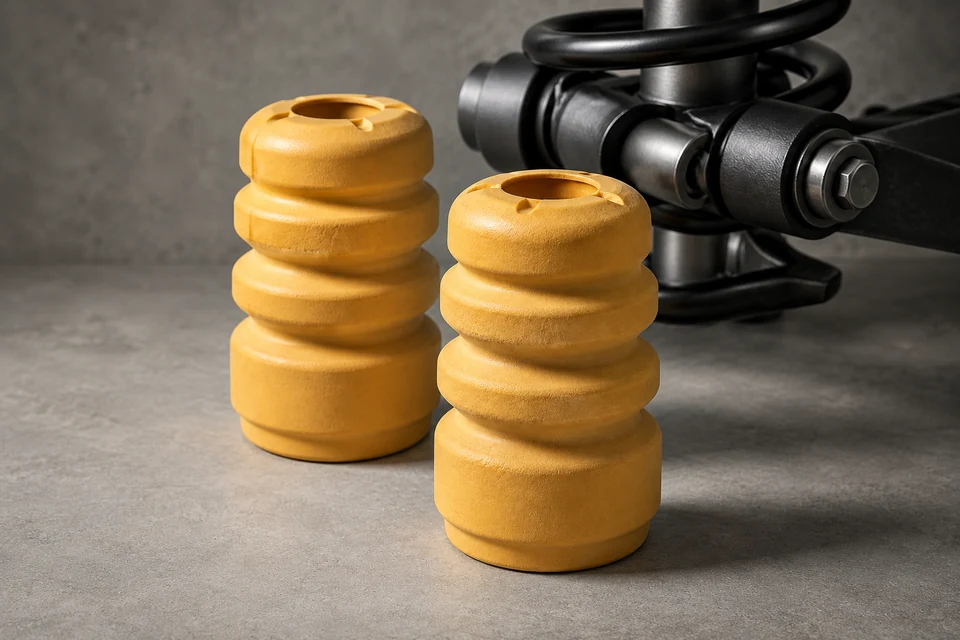
A jounce bumper is a compressible suspension component that controls loads as wheel travel approaches the compression limit.
Product & engineering
Understand the product.
Automotive Jounce Bumper is an elastomeric auxiliary spring and compression travel limiting component integrated into the suspension load path, typically around the damper piston rod, within strut and shock absorber assemblies, or at dedicated axle and suspension stops. Engagement occurs during increasing jounce travel, where the component adds a strongly progressive spring characteristic to the primary suspension and controls terminal compression before mechanical contact or excessive damper travel. The resulting force versus displacement curve is governed by material modulus, cellular structure, apparent density, free height, external contour, internal cavities, effective compressed volume, contact area progression and geometric confinement. These parameters determine engagement point, rate progression, maximum compression, block height, peak force and energy absorption. In chassis calibration, the jounce bumper therefore forms part of the total suspension spring curve and directly influences impact load transfer, damper protection, body acceleration, wheel control and NVH response under large wheel displacement, braking load transfer, cornering, pothole impact and payload variation.
Microcellular polyurethane is the principal material system used in automotive jounce bumpers. Automotive MCU grades combine high volumetric compressibility, limited lateral expansion, controlled cellular collapse and progressive stiffness development under large compressive strain. Representative molded MCU systems used for suspension applications typically operate at apparent densities of approximately 350 to 650 kg per cubic meter with cellular volume fractions of roughly 50 to 70 percent. Polymer chemistry, density, cell size distribution, closed cell content and crosslink structure are adjusted together with component geometry to obtain the specified load curve, rebound response, compression set and fatigue life. BASF Cellasto, Vibracoustic MCU systems, NOK foamed polyurethane products and multiple Asian suspension suppliers use this material architecture at production scale. Rubber remains in use for bound bumpers and related suspension stops, particularly where conventional molded elastomer construction is retained. Thermoplastic elastomer systems are also commercially established, including copolyester ether structures used in hollow jounce bumper and dust protection configurations. Material selection therefore spans cellular polyurethane, molded rubber and thermoplastic elastomer systems, with MCU accounting for the dominant technical architecture in modern passenger vehicle suspension applications.
MCU jounce bumpers are generally manufactured by reactive molding with controlled polyurethane foaming inside closed tooling, where formulation, mold temperature, shot mass, reaction profile and cavity geometry determine apparent density, cellular morphology and dimensional characteristics. Component architecture ranges from single material molded elements to assemblies incorporating support rings, cups, spacers, retainers and dust protection elements. Rubber designs rely on molded compound deformation and geometric strain distribution, while thermoplastic versions can use hollow blow molded structures in which wall thickness, section profile and cavity geometry contribute materially to the progressive compression characteristic. The functional load curve is therefore generated by the combined effects of material constitutive behavior and component geometry. Changes in density, axial length, radial profile, cavity shape or contact sequence can materially alter engagement stiffness and terminal load without changing the nominal suspension interface.
Installation architecture varies with suspension design. Passenger vehicle MacPherson struts and coil spring damper systems commonly place the jounce bumper concentrically around the piston rod or inside the upper damper module, while multi link, rigid axle and commercial vehicle suspensions may use separate axle mounted or body mounted stops. The bumper must accommodate repeated high strain compression while retaining dynamic stiffness, rebound behavior and dimensional stability under temperature cycling, moisture, road contamination and exposure to automotive fluids. Its engineering specification is therefore closely coupled to available wheel travel, damper stroke, spring rate, axle load, target engagement position, allowable peak structural load and vehicle specific ride calibration.
A jounce bumper is a compressible suspension component that controls loads as wheel travel approaches the compression limit. Its geometry and material response shape the force-displacement characteristic and energy absorption. Microcellular polyurethane is one established material route; the catalogue also lists rubber and thermoplastic elastomer products. The bumper works within a suspension assembly with components such as a damper, dust cover, spring isolator and top mount.
What turns activity into demand
Vehicle output is only the starting point. Fitment, force-displacement requirements and the supplier selected for the platform determine a component manufacturer's opportunity. A bumper, a damper assembly and a complete suspension system are different sold items. Keep original-equipment fitment and replacement sales on separate timelines.
The commercial boundary
A bumper, a damper assembly and a complete suspension system are different sold items. Keep original-equipment fitment and replacement sales on separate timelines.
Technical reading
Selected research
Industry Growth & Trends
Global Automotive Jounce Bumper Industry Growth and Trends Forecast to 2032
Market perspective
Automotive Jounce Bumper is an elastomeric auxiliary spring and compression travel limiting component integrated into the suspension load path, typically around the damper piston rod, within strut and shock absorber assemblies, or at dedicated axle and suspension stops. Engagement occurs during increasing jounce travel, where the component adds a strongly progressive spring characteristic to the primary suspension and controls terminal compression before mechanical contact or excessive damper travel. The resulting force versus displacement curve is governed by material modulus, cellular structure, apparent density, free height, external contour, internal cavities, effective compressed volume, contact area progression and geometric confinement. These parameters determine engagement point, rate progression, maximum compression, block height, peak force and energy absorption. In chassis calibration, the jounce bumper therefore forms part of the total suspension spring curve and directly influences impact load transfer, damper protection, body acceleration, wheel control and NVH response under large wheel displacement, braking load transfer, cornering, pothole impact and payload variation.
Microcellular polyurethane is the principal material system used in automotive jounce bumpers. Automotive MCU grades combine high volumetric compressibility, limited lateral expansion, controlled cellular collapse and progressive stiffness development under large compressive strain. Representative molded MCU systems used for suspension applications typically operate at apparent densities of approximately 350 to 650 kg per cubic meter with cellular volume fractions of roughly 50 to 70 percent. Polymer chemistry, density, cell size distribution, closed cell content and crosslink structure are adjusted together with component geometry to obtain the specified load curve, rebound response, compression set and fatigue life. BASF Cellasto, Vibracoustic MCU systems, NOK foamed polyurethane products and multiple Asian suspension suppliers use this material architecture at production scale. Rubber remains in use for bound bumpers and related suspension stops, particularly where conventional molded elastomer construction is retained. Thermoplastic elastomer systems are also commercially established, including copolyester ether structures used in hollow jounce bumper and dust protection configurations. Material selection therefore spans cellular polyurethane, molded rubber and thermoplastic elastomer systems, with MCU accounting for the dominant technical architecture in modern passenger vehicle suspension applications.
MCU jounce bumpers are generally manufactured by reactive molding with controlled polyurethane foaming inside closed tooling, where formulation, mold temperature, shot mass, reaction profile and cavity geometry determine apparent density, cellular morphology and dimensional characteristics. Component architecture ranges from single material molded elements to assemblies incorporating support rings, cups, spacers, retainers and dust protection elements. Rubber designs rely on molded compound deformation and geometric strain distribution, while thermoplastic versions can use hollow blow molded structures in which wall thickness, section profile and cavity geometry contribute materially to the progressive compression characteristic. The functional load curve is therefore generated by the combined effects of material constitutive behavior and component geometry. Changes in density, axial length, radial profile, cavity shape or contact sequence can materially alter engagement stiffness and terminal load without changing the nominal suspension interface.
Read the full market overview
Installation architecture varies with suspension design. Passenger vehicle MacPherson struts and coil spring damper systems commonly place the jounce bumper concentrically around the piston rod or inside the upper damper module, while multi link, rigid axle and commercial vehicle suspensions may use separate axle mounted or body mounted stops. The bumper must accommodate repeated high strain compression while retaining dynamic stiffness, rebound behavior and dimensional stability under temperature cycling, moisture, road contamination and exposure to automotive fluids. Its engineering specification is therefore closely coupled to available wheel travel, damper stroke, spring rate, axle load, target engagement position, allowable peak structural load and vehicle specific ride calibration.
According to APO Research, Inc, the global Automotive Jounce Bumper market was valued at approximately USD 814.22 million in 2025 and is estimated at USD 835.10 million in 2026. Market revenue is forecast to reach about USD 1,010.00 million by 2032, representing a CAGR of 3.22% from 2026 to 2032. Global demand is closely linked to light vehicle and commercial vehicle production, with conventional passenger vehicle suspension architectures commonly using four jounce bumpers per vehicle. Total unit demand is estimated at approximately 400 million pieces in 2025 and 405 million pieces in 2026, with gradual growth toward roughly 445 million to 450 million pieces by 2032. Revenue growth reflects moderate vehicle production expansion, higher load requirements, increasing specification content in suspension systems and gradual improvement in the global product mix and weighted ex factory pricing.
Microcellular polyurethane remains the dominant material system because its progressive compression characteristic, high volumetric deformation capability, low lateral expansion and fatigue resistance are well suited to compact suspension packaging and high strain cyclic loading. Rubber remains established in bound bumpers, axle stops and selected conventional suspension designs, while thermoplastic elastomers have entered commercial applications through hollow and integrated structures. Passenger cars account for the majority of global demand, while commercial vehicles contribute a smaller unit base with generally higher load capacity and component mass. Electrification is increasing vehicle curb weight and axle loads across many passenger vehicle segments, raising required bumper load capacity and energy absorption without materially changing the typical number of components per vehicle. The competitive structure includes BASF Cellasto, Vibracoustic, Sumitomo Riko, NOK, Prospira, Shanghai Carthane, DONGYANG P&C, BASF INOAC Polyurethanes, Trelleborg, AirBoss Engineered Products and several regional Tier 1 suspension component suppliers. OEM annual cost reduction programs, localization of Asian production and mature suspension architectures constrain price expansion, keeping long term market growth in the low single digit range.
Automotive Jounce Bumper Market by Company
BASF
Vibracoustic SE
Trelleborg
Prospira Corporation
Sumitomo Riko
NOK Corporation
Kinugawa Rubber Industrial Holdings
DONGYANG P&C
BASF INOAC Polyurethanes
Shanghai Carthane
Anand Motor Products
AirBoss Engineered Products
Zhuzhou Times New Material Technology
Automotive Jounce Bumper Segment by Type
Polyurethane
Rubber
Thermoplastic Elastomer
Automotive Jounce Bumper Segment by Application
Passenger Cars
Commercial Vehicles
Automotive Jounce Bumper Segment by Region
North America
United States
Canada
Mexico
Europe
Germany
France
U.K.
Italy
Russia
Spain
Netherlands
Switzerland
Sweden
Poland
Asia-Pacific
China
Japan
South Korea
India
Australia
Taiwan
Southeast Asia
South America
Brazil
Argentina
Chile
Colombia
Middle East & Africa
Egypt
South Africa
Israel
Türkiye
GCC Countries
Key Drivers & Barriers
High-impact rendering factors and drivers have been studied in this report to aid the readers to understand the general development. Moreover, the report includes restraints and challenges that may act as stumbling blocks on the way of the players. This will assist the users to be attentive and make informed decisions related to business. Specialists have also laid their focus on the upcoming business prospects.
Reasons to Buy This Report
1. This report will help the readers to understand the competition within the industries and strategies for the competitive environment to enhance the potential profit. The report also focuses on the competitive landscape of the global Automotive Jounce Bumper market, and introduces in detail the market share, industry ranking, competitor ecosystem, market performance, new product development, operation situation, expansion, and acquisition. etc. of the main players, which helps the readers to identify the main competitors and deeply understand the competition pattern of the market.
2. This report will help stakeholders to understand the global industry status and trends of Automotive Jounce Bumper and provides them with information on key market drivers, restraints, challenges, and opportunities.
3. This report will help stakeholders to understand competitors better and gain more insights to strengthen their position in their businesses. The competitive landscape section includes the market share and rank (in volume and value), competitor ecosystem, new product development, expansion, and acquisition.
4. This report stays updated with novel technology integration, features, and the latest developments in the market.
5. This report helps stakeholders to gain insights into which regions to target globally.
6. This report helps stakeholders to gain insights into the end-user perception concerning the adoption of Automotive Jounce Bumper.
7. This report helps stakeholders to identify some of the key players in the market and understand their valuable contribution.
Chapter Outline
Chapter 1: Introduces the study scope of this report, executive summary of market segments by type, market size segments for North America, Europe, Asia Pacific, South America, Middle East & Africa.
Chapter 2: Introduces the market dynamics, latest developments of the market, the driving factors and restrictive factors of the market, the challenges and risks faced by manufacturers in the industry, and the analysis of relevant policies in the industry.
Chapter 3: Detailed analysis of Automotive Jounce Bumper manufacturers competitive landscape, price, sales, revenue, market share and ranking, latest development plan, merger, and acquisition information, etc.
Chapter 4: Sales, revenue of Automotive Jounce Bumper in regional level. It provides a quantitative analysis of the market size and development potential of each region and introduces the future development prospects, and market space in the world.
Chapter 5: Introduces market segments by application, market size segment for North America, Europe, Asia Pacific, South America, Middle East & Africa.
Chapter 6: Provides profiles of key players, introducing the basic situation of the main companies in the market in detail, including product sales, revenue, price, gross margin, product introduction, recent development, etc.
Chapter 7, 8, 9, 10 and 11: North America, Europe, Asia Pacific, South America, Middle East & Africa, sales and revenue by country.
Chapter 12: Analysis of industrial chain, key raw materials, manufacturing cost, and market dynamics.
Chapter 13: Concluding Insights of the report.
More report detail
Tables and figures
Scope & coverage.
Types
- Polyurethane
- Rubber
- Thermoplastic Elastomer
Applications
- Passenger Cars
- Commercial Vehicles
Companies covered
- BASF
- Vibracoustic SE
- Trelleborg
- Prospira Corporation
- Sumitomo Riko
- NOK Corporation
- Kinugawa Rubber Industrial Holdings
- DONGYANG P&C
- BASF INOAC Polyurethanes
- Shanghai Carthane
- Anand Motor Products
- AirBoss Engineered Products
- Zhuzhou Times New Material Technology
Inside the report.
1 Market Overview
- 1.1 Product Definition
- 1.2 Global Market Growth Prospects
- 1.2.1 Global Automotive Jounce Bumper Market Size Estimates and Forecasts (2021-2032)
- 1.2.2 Global Automotive Jounce Bumper Sales Estimates and Forecasts (2021-2032)
- 1.3 Automotive Jounce Bumper Market by Type
- 1.3.1 Polyurethane
- 1.3.2 Rubber
- 1.3.3 Thermoplastic Elastomer
- 1.4 Global Automotive Jounce Bumper Market Size by Type
- 1.4.1 Global Automotive Jounce Bumper Market Size Overview by Type (2021-2032)
- 1.4.2 Global Automotive Jounce Bumper Historic Market Size Review by Type (2021-2026)
- 1.4.3 Global Automotive Jounce Bumper Forecasted Market Size by Type (2027-2032)
- 1.5 Key Regions Market Size by Type
- 1.5.1 North America Automotive Jounce Bumper Sales Breakdown by Type (2021-2026)
- 1.5.2 Europe Automotive Jounce Bumper Sales Breakdown by Type (2021-2026)
- 1.5.3 Asia-Pacific Automotive Jounce Bumper Sales Breakdown by Type (2021-2026)
- 1.5.4 South America Automotive Jounce Bumper Sales Breakdown by Type (2021-2026)
- 1.5.5 Middle East and Africa Automotive Jounce Bumper Sales Breakdown by Type (2021-2026)
2 Global Market Dynamics
- 2.1 Automotive Jounce Bumper Industry Trends
- 2.2 Automotive Jounce Bumper Industry Drivers
- 2.3 Automotive Jounce Bumper Industry Opportunities and Challenges
- 2.4 Automotive Jounce Bumper Industry Restraints
3 Market Competitive Landscape by Company
- 3.1 Global Top Players by Automotive Jounce Bumper Revenue (2021-2026)
- 3.2 Global Top Players by Automotive Jounce Bumper Sales (2021-2026)
- 3.3 Global Top Players by Automotive Jounce Bumper Price (2021-2026)
- 3.4 Global Automotive Jounce Bumper Industry Company Ranking, 2024 VS 2025 VS 2026
- 3.5 Global Automotive Jounce Bumper Major Company Production Sites & Headquarters
- 3.6 Global Automotive Jounce Bumper Company, Product Type & Application
- 3.7 Global Automotive Jounce Bumper Company Establishment Date
- 3.8 Market Competitive Analysis
- 3.8.1 Global Automotive Jounce Bumper Market CR5 and HHI
- 3.8.2 Global Top 5 and 10 Automotive Jounce Bumper Players Market Share by Revenue in 2025
- 3.8.3 2025 Automotive Jounce Bumper Tier 1, Tier 2, and Tier 3
4 Automotive Jounce Bumper Regional Status and Outlook
- 4.1 Global Automotive Jounce Bumper Market Size and CAGR by Region: 2021 VS 2025 VS 2032
- 4.2 Global Automotive Jounce Bumper Historic Market Size by Region
- 4.2.1 Global Automotive Jounce Bumper Sales in Volume by Region (2021-2026)
- 4.2.2 Global Automotive Jounce Bumper Sales in Value by Region (2021-2026)
- 4.2.3 Global Automotive Jounce Bumper Sales (Volume & Value), Price and Gross Margin (2021-2026)
- 4.3 Global Automotive Jounce Bumper Forecasted Market Size by Region
- 4.3.1 Global Automotive Jounce Bumper Sales in Volume by Region (2027-2032)
- 4.3.2 Global Automotive Jounce Bumper Sales in Value by Region (2027-2032)
- 4.3.3 Global Automotive Jounce Bumper Sales (Volume & Value), Price and Gross Margin (2027-2032)
5 Automotive Jounce Bumper by Application
- 5.1 Automotive Jounce Bumper Market by Application
- 5.1.1 Passenger Cars
- 5.1.2 Commercial Vehicles
- 5.2 Global Automotive Jounce Bumper Market Size by Application
- 5.2.1 Global Automotive Jounce Bumper Market Size Overview by Application (2021-2032)
- 5.2.2 Global Automotive Jounce Bumper Historic Market Size Review by Application (2021-2026)
- 5.2.3 Global Automotive Jounce Bumper Forecasted Market Size by Application (2027-2032)
- 5.3 Key Regions Market Size by Application
- 5.3.1 North America Automotive Jounce Bumper Sales Breakdown by Application (2021-2026)
- 5.3.2 Europe Automotive Jounce Bumper Sales Breakdown by Application (2021-2026)
- 5.3.3 Asia-Pacific Automotive Jounce Bumper Sales Breakdown by Application (2021-2026)
- 5.3.4 South America Automotive Jounce Bumper Sales Breakdown by Application (2021-2026)
- 5.3.5 Middle East and Africa Automotive Jounce Bumper Sales Breakdown by Application (2021-2026)
6 Company Profiles
- 6.1 BASF
- 6.1.1 BASF Company Information
- 6.1.2 BASF Business Overview
- 6.1.3 BASF Automotive Jounce Bumper Sales, Revenue and Gross Margin (2021-2026)
- 6.1.4 BASF Automotive Jounce Bumper Product Portfolio
- 6.1.5 BASF Recent Developments
- 6.2 Vibracoustic SE
- 6.2.1 Vibracoustic SE Company Information
- 6.2.2 Vibracoustic SE Business Overview
- 6.2.3 Vibracoustic SE Automotive Jounce Bumper Sales, Revenue and Gross Margin (2021-2026)
- 6.2.4 Vibracoustic SE Automotive Jounce Bumper Product Portfolio
- 6.2.5 Vibracoustic SE Recent Developments
- 6.3 Trelleborg
- 6.3.1 Trelleborg Company Information
- 6.3.2 Trelleborg Business Overview
- 6.3.3 Trelleborg Automotive Jounce Bumper Sales, Revenue and Gross Margin (2021-2026)
- 6.3.4 Trelleborg Automotive Jounce Bumper Product Portfolio
- 6.3.5 Trelleborg Recent Developments
- 6.4 Prospira Corporation
- 6.4.1 Prospira Corporation Company Information
- 6.4.2 Prospira Corporation Business Overview
- 6.4.3 Prospira Corporation Automotive Jounce Bumper Sales, Revenue and Gross Margin (2021-2026)
- 6.4.4 Prospira Corporation Automotive Jounce Bumper Product Portfolio
- 6.4.5 Prospira Corporation Recent Developments
- 6.5 Sumitomo Riko
- 6.5.1 Sumitomo Riko Company Information
- 6.5.2 Sumitomo Riko Business Overview
- 6.5.3 Sumitomo Riko Automotive Jounce Bumper Sales, Revenue and Gross Margin (2021-2026)
- 6.5.4 Sumitomo Riko Automotive Jounce Bumper Product Portfolio
- 6.5.5 Sumitomo Riko Recent Developments
- 6.6 NOK Corporation
- 6.6.1 NOK Corporation Company Information
- 6.6.2 NOK Corporation Business Overview
- 6.6.3 NOK Corporation Automotive Jounce Bumper Sales, Revenue and Gross Margin (2021-2026)
- 6.6.4 NOK Corporation Automotive Jounce Bumper Product Portfolio
- 6.6.5 NOK Corporation Recent Developments
- 6.7 Kinugawa Rubber Industrial Holdings
- 6.7.1 Kinugawa Rubber Industrial Holdings Company Information
- 6.7.2 Kinugawa Rubber Industrial Holdings Business Overview
- 6.7.3 Kinugawa Rubber Industrial Holdings Automotive Jounce Bumper Sales, Revenue and Gross Margin (2021-2026)
- 6.7.4 Kinugawa Rubber Industrial Holdings Automotive Jounce Bumper Product Portfolio
- 6.7.5 Kinugawa Rubber Industrial Holdings Recent Developments
- 6.8 DONGYANG P&C
- 6.8.1 DONGYANG P&C Company Information
- 6.8.2 DONGYANG P&C Business Overview
- 6.8.3 DONGYANG P&C Automotive Jounce Bumper Sales, Revenue and Gross Margin (2021-2026)
- 6.8.4 DONGYANG P&C Automotive Jounce Bumper Product Portfolio
- 6.8.5 DONGYANG P&C Recent Developments
- 6.9 BASF INOAC Polyurethanes
- 6.9.1 BASF INOAC Polyurethanes Company Information
- 6.9.2 BASF INOAC Polyurethanes Business Overview
- 6.9.3 BASF INOAC Polyurethanes Automotive Jounce Bumper Sales, Revenue and Gross Margin (2021-2026)
- 6.9.4 BASF INOAC Polyurethanes Automotive Jounce Bumper Product Portfolio
- 6.9.5 BASF INOAC Polyurethanes Recent Developments
- 6.10 Shanghai Carthane
- 6.10.1 Shanghai Carthane Company Information
- 6.10.2 Shanghai Carthane Business Overview
- 6.10.3 Shanghai Carthane Automotive Jounce Bumper Sales, Revenue and Gross Margin (2021-2026)
- 6.10.4 Shanghai Carthane Automotive Jounce Bumper Product Portfolio
- 6.10.5 Shanghai Carthane Recent Developments
- 6.11 Anand Motor Products
- 6.11.1 Anand Motor Products Company Information
- 6.11.2 Anand Motor Products Business Overview
- 6.11.3 Anand Motor Products Automotive Jounce Bumper Sales, Revenue and Gross Margin (2021-2026)
- 6.11.4 Anand Motor Products Automotive Jounce Bumper Product Portfolio
- 6.11.5 Anand Motor Products Recent Developments
- 6.12 AirBoss Engineered Products
- 6.12.1 AirBoss Engineered Products Company Information
- 6.12.2 AirBoss Engineered Products Business Overview
- 6.12.3 AirBoss Engineered Products Automotive Jounce Bumper Sales, Revenue and Gross Margin (2021-2026)
- 6.12.4 AirBoss Engineered Products Automotive Jounce Bumper Product Portfolio
- 6.12.5 AirBoss Engineered Products Recent Developments
- 6.13 Zhuzhou Times New Material Technology
- 6.13.1 Zhuzhou Times New Material Technology Company Information
- 6.13.2 Zhuzhou Times New Material Technology Business Overview
- 6.13.3 Zhuzhou Times New Material Technology Automotive Jounce Bumper Sales, Revenue and Gross Margin (2021-2026)
- 6.13.4 Zhuzhou Times New Material Technology Automotive Jounce Bumper Product Portfolio
- 6.13.5 Zhuzhou Times New Material Technology Recent Developments
7 North America by Country
- 7.1 North America Automotive Jounce Bumper Sales by Country
- 7.1.1 North America Automotive Jounce Bumper Sales Growth Rate (CAGR) by Country: 2021 VS 2025 VS 2032
- 7.1.2 North America Automotive Jounce Bumper Sales by Country (2021-2026)
- 7.1.3 North America Automotive Jounce Bumper Sales Forecast by Country (2027-2032)
- 7.2 North America Automotive Jounce Bumper Market Size by Country
- 7.2.1 North America Automotive Jounce Bumper Market Size Growth Rate (CAGR) by Country: 2021 VS 2025 VS 2032
- 7.2.2 North America Automotive Jounce Bumper Market Size by Country (2021-2026)
- 7.2.3 North America Automotive Jounce Bumper Market Size Forecast by Country (2027-2032)
8 Europe by Country
- 8.1 Europe Automotive Jounce Bumper Sales by Country
- 8.1.1 Europe Automotive Jounce Bumper Sales Growth Rate (CAGR) by Country: 2021 VS 2025 VS 2032
- 8.1.2 Europe Automotive Jounce Bumper Sales by Country (2021-2026)
- 8.1.3 Europe Automotive Jounce Bumper Sales Forecast by Country (2027-2032)
- 8.2 Europe Automotive Jounce Bumper Market Size by Country
- 8.2.1 Europe Automotive Jounce Bumper Market Size Growth Rate (CAGR) by Country: 2021 VS 2025 VS 2032
- 8.2.2 Europe Automotive Jounce Bumper Market Size by Country (2021-2026)
- 8.2.3 Europe Automotive Jounce Bumper Market Size Forecast by Country (2027-2032)
9 Asia-Pacific by Country
- 9.1 Asia-Pacific Automotive Jounce Bumper Sales by Country
- 9.1.1 Asia-Pacific Automotive Jounce Bumper Sales Growth Rate (CAGR) by Country: 2021 VS 2025 VS 2032
- 9.1.2 Asia-Pacific Automotive Jounce Bumper Sales by Country (2021-2026)
- 9.1.3 Asia-Pacific Automotive Jounce Bumper Sales Forecast by Country (2027-2032)
- 9.2 Asia-Pacific Automotive Jounce Bumper Market Size by Country
- 9.2.1 Asia-Pacific Automotive Jounce Bumper Market Size Growth Rate (CAGR) by Country: 2021 VS 2025 VS 2032
- 9.2.2 Asia-Pacific Automotive Jounce Bumper Market Size by Country (2021-2026)
- 9.2.3 Asia-Pacific Automotive Jounce Bumper Market Size Forecast by Country (2027-2032)
10 South America by Country
- 10.1 South America Automotive Jounce Bumper Sales by Country
- 10.1.1 South America Automotive Jounce Bumper Sales Growth Rate (CAGR) by Country: 2021 VS 2025 VS 2032
- 10.1.2 South America Automotive Jounce Bumper Sales by Country (2021-2026)
- 10.1.3 South America Automotive Jounce Bumper Sales Forecast by Country (2027-2032)
- 10.2 South America Automotive Jounce Bumper Market Size by Country
- 10.2.1 South America Automotive Jounce Bumper Market Size Growth Rate (CAGR) by Country: 2021 VS 2025 VS 2032
- 10.2.2 South America Automotive Jounce Bumper Market Size by Country (2021-2026)
- 10.2.3 South America Automotive Jounce Bumper Market Size Forecast by Country (2027-2032)
11 Middle East and Africa by Country
- 11.1 Middle East and Africa Automotive Jounce Bumper Sales by Country
- 11.1.1 Middle East and Africa Automotive Jounce Bumper Sales Growth Rate (CAGR) by Country: 2021 VS 2025 VS 2032
- 11.1.2 Middle East and Africa Automotive Jounce Bumper Sales by Country (2021-2026)
- 11.1.3 Middle East and Africa Automotive Jounce Bumper Sales Forecast by Country (2027-2032)
- 11.2 Middle East and Africa Automotive Jounce Bumper Market Size by Country
- 11.2.1 Middle East and Africa Automotive Jounce Bumper Market Size Growth Rate (CAGR) by Country: 2021 VS 2025 VS 2032
- 11.2.2 Middle East and Africa Automotive Jounce Bumper Market Size by Country (2021-2026)
- 11.2.3 Middle East and Africa Automotive Jounce Bumper Market Size Forecast by Country (2027-2032)
12 Value Chain and Sales Channels Analysis
- 12.1 Automotive Jounce Bumper Value Chain Analysis
- 12.1.1 Automotive Jounce Bumper Key Raw Materials
- 12.1.2 Key Raw Materials Price
- 12.1.3 Raw Materials Key Suppliers
- 12.1.4 Manufacturing Cost Structure
- 12.1.5 Automotive Jounce Bumper Production Mode & Process
- 12.2 Automotive Jounce Bumper Sales Channels Analysis
- 12.2.1 Direct Comparison with Distribution Share
- 12.2.2 Automotive Jounce Bumper Distributors
- 12.2.3 Automotive Jounce Bumper Customers
13 Concluding Insights
14 Appendix
- 14.1 Reasons for Doing This Study
- 14.2 Research Methodology
- 14.3 Research Process
- 14.4 Authors List of This Report
- 14.5 Data Source
- 14.5.1 Secondary Sources
- 14.5.2 Primary Sources
- 14.6 Disclaimer
GET THE RESEARCH
Choose your license.
Choose who needs access.
All options are for this report and research series.
PDF by email within 3–5 working days after payment confirmation.
Talk to an analyst