APO RESEARCH · REPORT
Wet Pet Food Packaging
Wet Pet Food Packaging refers to primary packaging used for high moisture dog and cat food sold as complete meals, complementary foods, meal toppers, gravies, pâtés, mousses, chunks in sauce, shreds in jelly, minced formats and other retorted or pasteurized wet formulations.
Product & engineering
Understand the product.
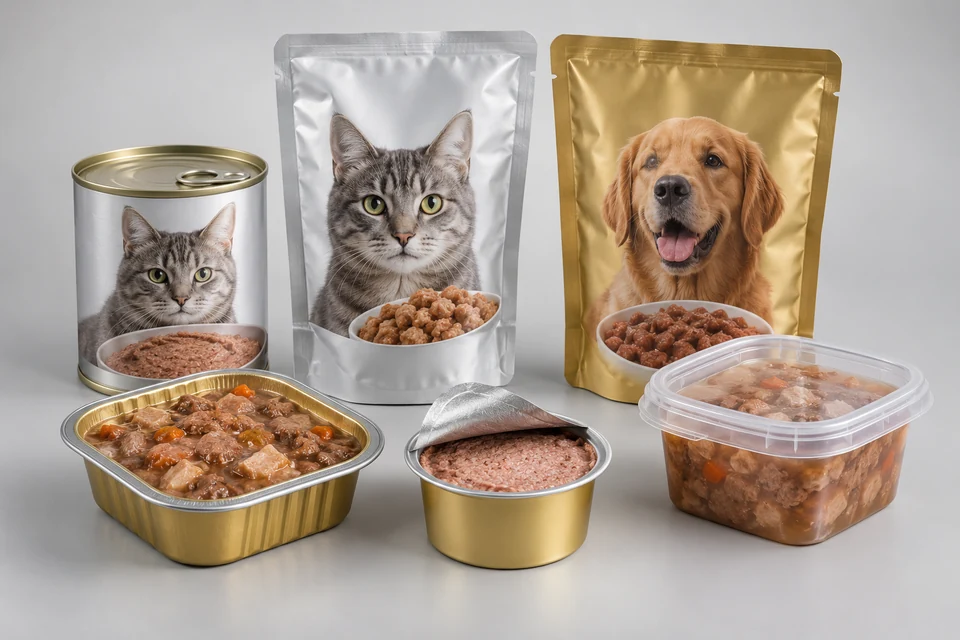
Wet Pet Food Packaging refers to primary packaging used for high moisture dog and cat food sold as complete meals, complementary foods, meal toppers, gravies, pâtés, mousses, chunks in sauce, shreds in jelly, minced formats and other retorted or pasteurized wet formulations. The category is defined by direct food contact, hermetic sealing, barrier performance, thermal process resistance and portion control. Commercial pack formats are concentrated in metal cans, retort pouches, plastic tubs, plastic cups, trays and lidded containers. Small packs below 100 g or 100 ml are heavily associated with cat food, single serve portions, premium textures, variety multipacks and trial formats, while larger trays and cans retain stronger relevance in dog food and value meal formats.
The technical requirement of wet pet food packaging is materially different from dry pet food bags and treat packs because the filled product contains high water activity, fats, proteins, minerals, flavor systems and visible solid inclusions that must remain stable during filling, sealing, sterilization, distribution and shelf storage. Shelf stable wet pet food is packed before thermal treatment or processed in a sealed container, which makes retort stability, seal integrity, oxygen barrier, corrosion resistance, delamination resistance and internal coating compatibility central to package performance. Chilled wet pet food uses a shorter preservation chain and a different temperature profile, yet still relies on tight barrier control, clean opening performance and stable lidding behavior.
Metal cans remain the established format for conventional wet pet food because tinplate and aluminum containers provide high mechanical strength, excellent oxygen and light barrier, fast filling line compatibility and long shelf life after retort processing. Internal lacquer systems protect the metal surface from fat, salt, organic acids and protein rich formulations, while easy open ends improve consumer handling. Cans are widely used for pâté, loaf, chunks, stews and gravy based products, with pack sizes ranging from small cat portions to large dog food cans.
Retort pouches are the dominant flexible format in small and mid sized wet pet food packs. They combine lightweight structure, compact shelf presentation, rapid heat transfer during retort processing and strong compatibility with premium cat food, portioned dog food, toppers and gravy rich products. Typical pouch structures use polyester, aluminum foil or aluminum free barrier layers, nylon, polypropylene and heat seal layers depending on the required shelf life, retort temperature, puncture resistance and visual appearance. Pouches are frequently used in 50 g to 100 g cat food packs and in larger dog food portions, with strong penetration in multipack retail formats.
Plastic tubs, cups and trays are used where spoonable texture, portion control, easy opening and premium meal presentation are commercially important. These formats commonly use polypropylene based thermoformed or injection molded containers with peelable lidding films, and may incorporate oxygen barrier layers such as EVOH when shelf life and retort exposure require higher barrier performance. Aluminum trays remain relevant in selected markets and product tiers because they combine thermal stability, shape retention and strong barrier properties. Cups and trays are heavily used for mousse, pâté, minced products, small breed dog portions and cat meal portions.
The food texture split has direct packaging relevance. Products with visible particles, including chunks, shreds, flakes and meat pieces in sauce, require packages and filling systems that tolerate particulate flow, abrasion, headspace control and sealing contamination risk. Products without visible particles, including mousse, pâté and smooth loaf, place greater emphasis on shape retention, controlled filling weight, clean release, surface appearance and lid peel behavior. The distinction affects pouch thickness, tray rigidity, lidding film selection, retort cycle behavior and secondary packaging stability.
The industry value chain begins with resin, film, foil, tinplate, aluminum, coating, ink and adhesive suppliers, then moves into can making, flexible laminate conversion, thermoforming, injection molding, lidding film production, printing and food contact package manufacturing. Wet pet food producers integrate packaging selection with recipe viscosity, particle size, sterilization profile, filling speed, shelf life target, brand tier, retail channel and logistics cost. Packaging accounts for a meaningful share of the finished product cost in small wet pet food packs because the unit package is small, barrier requirements are high and multipack presentation adds carton, sleeve, tray or wrap material.
Wet Pet Food Packaging is therefore a defined packaging subcategory covering the direct containment of high moisture pet food under retort, pasteurized or chilled distribution conditions. Its commercial structure is governed by pack type, animal type, food texture and pack size. The most practical type segmentation is pouches, metal cans, tubs and trays, cups and others. Pouches and sachets should be treated as one flexible pack family in wet pet food because the commercial boundary between the two terms overlaps in small portion soft packs.
Packaging performance arises from the material, converted geometry, closure and filling or handling process. Material shipments, empty packs and filled-product sales are different objects and must be measured separately.
What turns activity into demand
Accepted filled packs create packaging demand through material per pack, converting yield and filling losses. The package, packaging material and the product it contains are different transaction objects.
The commercial boundary
For Wet Pet Food Packaging, distinguish the supplied product from its inputs and the complete application. Report types and applications may overlap; retain the selected edition's product definition, geography, period, unit and transaction basis when comparing estimates.
Which conditions determine usable wet pet food packaging performance?
Wet Pet Food Packaging refers to primary packaging used for high moisture dog and cat food sold as complete meals, complementary foods, meal toppers, gravies, pâtés, mousses, chunks in sauce, shreds in jelly, minced formats and other retorted or pasteurized wet formulations. Verify barrier, sealing and mechanical requirements against the specified contents and handling duty. Relate accepted pack count to material intensity, converting yield and line loss; a material name alone does not establish pack performance.
Selected research
Market Outlook & Growth Opportunities
Global Wet Pet Food Packaging Market Outlook and Growth Opportunities 2026
Market perspective
Wet Pet Food Packaging refers to primary packaging used for high moisture dog and cat food sold as complete meals, complementary foods, meal toppers, gravies, pâtés, mousses, chunks in sauce, shreds in jelly, minced formats and other retorted or pasteurized wet formulations. The category is defined by direct food contact, hermetic sealing, barrier performance, thermal process resistance and portion control. Commercial pack formats are concentrated in metal cans, retort pouches, plastic tubs, plastic cups, trays and lidded containers. Small packs below 100 g or 100 ml are heavily associated with cat food, single serve portions, premium textures, variety multipacks and trial formats, while larger trays and cans retain stronger relevance in dog food and value meal formats.
The technical requirement of wet pet food packaging is materially different from dry pet food bags and treat packs because the filled product contains high water activity, fats, proteins, minerals, flavor systems and visible solid inclusions that must remain stable during filling, sealing, sterilization, distribution and shelf storage. Shelf stable wet pet food is packed before thermal treatment or processed in a sealed container, which makes retort stability, seal integrity, oxygen barrier, corrosion resistance, delamination resistance and internal coating compatibility central to package performance. Chilled wet pet food uses a shorter preservation chain and a different temperature profile, yet still relies on tight barrier control, clean opening performance and stable lidding behavior.
Metal cans remain the established format for conventional wet pet food because tinplate and aluminum containers provide high mechanical strength, excellent oxygen and light barrier, fast filling line compatibility and long shelf life after retort processing. Internal lacquer systems protect the metal surface from fat, salt, organic acids and protein rich formulations, while easy open ends improve consumer handling. Cans are widely used for pâté, loaf, chunks, stews and gravy based products, with pack sizes ranging from small cat portions to large dog food cans.
Read the full market overview
Retort pouches are the dominant flexible format in small and mid sized wet pet food packs. They combine lightweight structure, compact shelf presentation, rapid heat transfer during retort processing and strong compatibility with premium cat food, portioned dog food, toppers and gravy rich products. Typical pouch structures use polyester, aluminum foil or aluminum free barrier layers, nylon, polypropylene and heat seal layers depending on the required shelf life, retort temperature, puncture resistance and visual appearance. Pouches are frequently used in 50 g to 100 g cat food packs and in larger dog food portions, with strong penetration in multipack retail formats.
Plastic tubs, cups and trays are used where spoonable texture, portion control, easy opening and premium meal presentation are commercially important. These formats commonly use polypropylene based thermoformed or injection molded containers with peelable lidding films, and may incorporate oxygen barrier layers such as EVOH when shelf life and retort exposure require higher barrier performance. Aluminum trays remain relevant in selected markets and product tiers because they combine thermal stability, shape retention and strong barrier properties. Cups and trays are heavily used for mousse, pâté, minced products, small breed dog portions and cat meal portions.
The food texture split has direct packaging relevance. Products with visible particles, including chunks, shreds, flakes and meat pieces in sauce, require packages and filling systems that tolerate particulate flow, abrasion, headspace control and sealing contamination risk. Products without visible particles, including mousse, pâté and smooth loaf, place greater emphasis on shape retention, controlled filling weight, clean release, surface appearance and lid peel behavior. The distinction affects pouch thickness, tray rigidity, lidding film selection, retort cycle behavior and secondary packaging stability.
The industry value chain begins with resin, film, foil, tinplate, aluminum, coating, ink and adhesive suppliers, then moves into can making, flexible laminate conversion, thermoforming, injection molding, lidding film production, printing and food contact package manufacturing. Wet pet food producers integrate packaging selection with recipe viscosity, particle size, sterilization profile, filling speed, shelf life target, brand tier, retail channel and logistics cost. Packaging accounts for a meaningful share of the finished product cost in small wet pet food packs because the unit package is small, barrier requirements are high and multipack presentation adds carton, sleeve, tray or wrap material.
Wet Pet Food Packaging is therefore a defined packaging subcategory covering the direct containment of high moisture pet food under retort, pasteurized or chilled distribution conditions. Its commercial structure is governed by pack type, animal type, food texture and pack size. The most practical type segmentation is pouches, metal cans, tubs and trays, cups and others. Pouches and sachets should be treated as one flexible pack family in wet pet food because the commercial boundary between the two terms overlaps in small portion soft packs.
The global Wet Pet Food Packaging market was valued at US$ million in 2026 and is projected to reach US$ million by 2032, implying a compound annual growth rate (CAGR) of % over 2026-2032.
The North America market for Wet Pet Food Packaging is projected to increase from US$ million in 2026 to US$ million by 2032, at a CAGR of % over 2026-2032.
The Europe market for Wet Pet Food Packaging is projected to increase from US$ million in 2026 to US$ million by 2032, at a CAGR of % over 2026-2032.
The Asia Pacific market for Wet Pet Food Packaging is projected to increase from US$ million in 2026 to US$ million by 2032, at a CAGR of % over 2026-2032.
In China, the Wet Pet Food Packaging market is projected to increase from US$ million in 2026 to US$ million by 2032, at a CAGR of % over 2026-2032.
Major global companies in the Wet Pet Food Packaging market include Tetra Pak, Amcor, Huhtamaki, Sonoco, Aluflexpack, ProAmpac, Constantia Flexibles, Mondi Group and Logos Packaging, among others. In 2025, the top three vendors together accounted for approximately % of global revenue.
This report provides an overview of the global Wet Pet Food Packaging market in terms of sales, revenue, and price, analyzing global market trends using historical revenue and sales data for 2021-2025, estimates for 2026, and projected CAGRs through 2032.
The study covers key producers of Wet Pet Food Packaging and sales in major regions and countries, assesses future market potential, and highlights priority regions and countries for segmenting the market into sub-sectors, with country-specific market value data for the U.S., Canada, Mexico, Brazil, China, Japan, South Korea, Southeast Asia, India, Germany, the U.K., Italy, the Middle East, Africa, and other countries.
The report also presents Wet Pet Food Packaging sales, revenue, market share, and industry ranking for the main manufacturers for 2021-2026, identifies the major stakeholders in the global market, and analyzes their competitive landscape and market positioning based on recent developments and segmental revenues.
In addition, the report analyzes segment data by Type and Application—covering sales, revenue, and price—for 2021-2032, and evaluates and forecasts the Wet Pet Food Packaging market size, projected growth trends, production technologies, key applications, and end-use industries.
Wet Pet Food Packaging Segment by Company
Tetra Pak
Amcor
Huhtamaki
Sonoco
Aluflexpack
ProAmpac
Constantia Flexibles
Mondi Group
Logos Packaging
KM Packaging
Trivium Packaging
Printpack
Winpak
St. Johns Packaging
PakFactory
Sealed Air
Crown Holdings
Silgan Containers
Wet Pet Food Packaging Segment by Pack Type
Cans
Tubs
Pouches
Cups and Trays
Others
Wet Pet Food Packaging Segment by Animal
Dog
Cat
Wet Pet Food Packaging Segment by Region
North America
United States
Canada
Mexico
Europe
Germany
France
U.K.
Italy
Russia
Spain
Netherlands
Switzerland
Sweden
Poland
Asia-Pacific
China
Japan
South Korea
India
Australia
Taiwan
Southeast Asia
South America
Brazil
Argentina
Chile
Colombia
Middle East & Africa
Egypt
South Africa
Israel
Türkiye
GCC Countries
Study Objectives
1. To analyze and research the global Wet Pet Food Packaging status and future forecast, involving, sales, revenue, growth rate (CAGR), market share, historical and forecast.
2. To present the key manufacturers, sales, revenue, market share, and Recent Developments.
3. To split the breakdown data by regions, type, manufacturers, and Application.
4. To analyze the global and key regions Wet Pet Food Packaging market potential and advantage, opportunity and challenge, restraints, and risks.
5. To identify Wet Pet Food Packaging significant trends, drivers, influence factors in global and regions.
6. To analyze Wet Pet Food Packaging competitive developments such as expansions, agreements, new product launches, and acquisitions in the market.
Reasons to Buy This Report
1. This report will help the readers to understand the competition within the industries and strategies for the competitive environment to enhance the potential profit. The report also focuses on the competitive landscape of the global Wet Pet Food Packaging market, and introduces in detail the market share, industry ranking, competitor ecosystem, market performance, new product development, operation situation, expansion, and acquisition. etc. of the main players, which helps the readers to identify the main competitors and deeply understand the competition pattern of the market.
2. This report will help stakeholders to understand the global industry status and trends of Wet Pet Food Packaging and provides them with information on key market drivers, restraints, challenges, and opportunities.
3. This report will help stakeholders to understand competitors better and gain more insights to strengthen their position in their businesses. The competitive landscape section includes the market share and rank (in sales and value), competitor ecosystem, new product development, expansion, and acquisition.
4. This report stays updated with novel technology integration, features, and the latest developments in the market.
5. This report helps stakeholders to gain insights into which regions to target globally.
6. This report helps stakeholders to gain insights into the end-user perception concerning the adoption of Wet Pet Food Packaging.
7. This report helps stakeholders to identify some of the key players in the market and understand their valuable contribution.
Chapter Outline
Chapter 1: Provides an overview of the Wet Pet Food Packaging market, including product definition, global market growth prospects, sales value, sales volume, and average price forecasts (2021-2032).
Chapter 2: Analysis key trends, drivers, challenges, and opportunities within the global Wet Pet Food Packaging industry.
Chapter 3: Detailed analysis of Wet Pet Food Packaging manufacturers competitive landscape, price, sales and revenue market share, latest development plan, merger, and acquisition information, etc.
Chapter 4: Provides the analysis of various market segments by type, covering the market size and development potential of each market segment, to help readers find the blue ocean market in different market segments.
Chapter 5: Provides the analysis of various market segments by application, covering the market size and development potential of each market segment, to help readers find the blue ocean market in different downstream markets.
Chapter 6: Sales and value of Wet Pet Food Packaging in regional level. It provides a quantitative analysis of the market size and development potential of each region and introduces the market development, future development prospects, market space, and market size of each country in the world.
Chapter 7: Sales and value of Wet Pet Food Packaging in country level. It provides sigmate data by type, and by application for each country/region.
Chapter 8: Provides profiles of key players, introducing the basic situation of the main companies in the market in detail, including product sales, revenue, price, gross margin, product introduction, recent development, etc.
Chapter 9: Analysis of industrial chain, including the upstream and downstream of the industry.
Chapter 10: Concluding Insights.
More report detail
Tables and figures
Scope & coverage.
Types
- Cans
- Tubs
- Pouches
- Cups and Trays
- Others
Applications
- Dog
- Cat
Companies covered
- Tetra Pak
- Amcor
- Huhtamaki
- Sonoco
- Aluflexpack
- ProAmpac
- Constantia Flexibles
- Mondi Group
- Logos Packaging
- KM Packaging
- Trivium Packaging
- Printpack
- Winpak
- St. Johns Packaging
- PakFactory
- Sealed Air
- Crown Holdings
- Silgan Containers
Inside the report.
1 Market Overview
- 1.1 Product Definition
- 1.2 Global Market Growth Prospects
- 1.2.1 Global Wet Pet Food Packaging Sales Value (2021-2032)
- 1.2.2 Global Wet Pet Food Packaging Sales Volume (2021-2032)
- 1.2.3 Global Wet Pet Food Packaging Sales Average Price (2021-2032)
- 1.3 Assumptions and Limitations
- 1.4 Study Goals and Objectives
2 Wet Pet Food Packaging Market Dynamics
- 2.1 Wet Pet Food Packaging Industry Trends
- 2.2 Wet Pet Food Packaging Industry Drivers
- 2.3 Wet Pet Food Packaging Industry Opportunities and Challenges
- 2.4 Wet Pet Food Packaging Industry Restraints
3 Wet Pet Food Packaging Market by Company
- 3.1 Global Wet Pet Food Packaging Company Revenue Ranking in 2025
- 3.2 Global Wet Pet Food Packaging Revenue by Company (2021-2026)
- 3.3 Global Wet Pet Food Packaging Sales Volume by Company (2021-2026)
- 3.4 Global Wet Pet Food Packaging Average Price by Company (2021-2026)
- 3.5 Global Wet Pet Food Packaging Company Ranking (2024-2026)
- 3.6 Global Wet Pet Food Packaging Company Manufacturing Base and Headquarters
- 3.7 Global Wet Pet Food Packaging Company Product Type and Application
- 3.8 Global Wet Pet Food Packaging Company Establishment Date
- 3.9 Market Competitive Analysis
- 3.9.1 Global Wet Pet Food Packaging Market Concentration Ratio (CR5 and HHI)
- 3.9.2 Global Top 5 and 10 Company Market Share by Revenue in 2025
- 3.9.3 2025 Wet Pet Food Packaging Tier 1, Tier 2, and Tier 3 Companies
- 3.10 Mergers and Acquisitions Expansion
4 Wet Pet Food Packaging Market by Type
- 4.1 Wet Pet Food Packaging Type Introduction
- 4.1.1 Cans
- 4.1.2 Tubs
- 4.1.3 Pouches
- 4.1.4 Cups and Trays
- 4.1.5 Others
- 4.2 Global Wet Pet Food Packaging Sales Volume by Type
- 4.2.1 Global Wet Pet Food Packaging Sales Volume by Type (2021 VS 2025 VS 2032)
- 4.2.2 Global Wet Pet Food Packaging Sales Volume by Type (2021-2032)
- 4.2.3 Global Wet Pet Food Packaging Sales Volume Share by Type (2021-2032)
- 4.3 Global Wet Pet Food Packaging Sales Value by Type
- 4.3.1 Global Wet Pet Food Packaging Sales Value by Type (2021 VS 2025 VS 2032)
- 4.3.2 Global Wet Pet Food Packaging Sales Value by Type (2021-2032)
- 4.3.3 Global Wet Pet Food Packaging Sales Value Share by Type (2021-2032)
5 Wet Pet Food Packaging Market by Application
- 5.1 Wet Pet Food Packaging Application Introduction
- 5.1.1 Dog
- 5.1.2 Cat
- 5.2 Global Wet Pet Food Packaging Sales Volume by Application
- 5.2.1 Global Wet Pet Food Packaging Sales Volume by Application (2021 VS 2025 VS 2032)
- 5.2.2 Global Wet Pet Food Packaging Sales Volume by Application (2021-2032)
- 5.2.3 Global Wet Pet Food Packaging Sales Volume Share by Application (2021-2032)
- 5.3 Global Wet Pet Food Packaging Sales Value by Application
- 5.3.1 Global Wet Pet Food Packaging Sales Value by Application (2021 VS 2025 VS 2032)
- 5.3.2 Global Wet Pet Food Packaging Sales Value by Application (2021-2032)
- 5.3.3 Global Wet Pet Food Packaging Sales Value Share by Application (2021-2032)
6 Wet Pet Food Packaging Regional Sales and Value Analysis
- 6.1 Global Wet Pet Food Packaging Sales by Region: 2021 VS 2025 VS 2032
- 6.2 Global Wet Pet Food Packaging Sales by Region (2021-2032)
- 6.2.1 Global Wet Pet Food Packaging Sales by Region: 2021-2026
- 6.2.2 Global Wet Pet Food Packaging Sales by Region (2027-2032)
- 6.3 Global Wet Pet Food Packaging Sales Value by Region: 2021 VS 2025 VS 2032
- 6.4 Global Wet Pet Food Packaging Sales Value by Region (2021-2032)
- 6.4.1 Global Wet Pet Food Packaging Sales Value by Region: 2021-2026
- 6.4.2 Global Wet Pet Food Packaging Sales Value by Region (2027-2032)
- 6.5 Global Wet Pet Food Packaging Market Price Analysis by Region (2021-2026)
- 6.6 North America
- 6.6.1 North America Wet Pet Food Packaging Sales Value (2021-2032)
- 6.6.2 North America Wet Pet Food Packaging Sales Value Share by Country, 2025 VS 2032
- 6.7 Europe
- 6.7.1 Europe Wet Pet Food Packaging Sales Value (2021-2032)
- 6.7.2 Europe Wet Pet Food Packaging Sales Value Share by Country, 2025 VS 2032
- 6.8 Asia-Pacific
- 6.8.1 Asia-Pacific Wet Pet Food Packaging Sales Value (2021-2032)
- 6.8.2 Asia-Pacific Wet Pet Food Packaging Sales Value Share by Country, 2025 VS 2032
- 6.9 South America
- 6.9.1 South America Wet Pet Food Packaging Sales Value (2021-2032)
- 6.9.2 South America Wet Pet Food Packaging Sales Value Share by Country, 2025 VS 2032
- 6.10 Middle East & Africa
- 6.10.1 Middle East & Africa Wet Pet Food Packaging Sales Value (2021-2032)
- 6.10.2 Middle East & Africa Wet Pet Food Packaging Sales Value Share by Country, 2025 VS 2032
7 Wet Pet Food Packaging Country-level Sales and Value Analysis
- 7.1 Global Wet Pet Food Packaging Sales by Country: 2021 VS 2025 VS 2032
- 7.2 Global Wet Pet Food Packaging Sales Value by Country: 2021 VS 2025 VS 2032
- 7.3 Global Wet Pet Food Packaging Sales by Country (2021-2032)
- 7.3.1 Global Wet Pet Food Packaging Sales by Country (2021-2026)
- 7.3.2 Global Wet Pet Food Packaging Sales by Country (2027-2032)
- 7.4 Global Wet Pet Food Packaging Sales Value by Country (2021-2032)
- 7.4.1 Global Wet Pet Food Packaging Sales Value by Country (2021-2026)
- 7.4.2 Global Wet Pet Food Packaging Sales Value by Country (2027-2032)
- 7.5 USA
- 7.5.1 USA Wet Pet Food Packaging Sales Value Growth Rate (2021-2032)
- 7.5.2 USA Wet Pet Food Packaging Sales Value Share by Type, 2025 VS 2032
- 7.5.3 USA Wet Pet Food Packaging Sales Value Share by Application, 2025 VS 2032
- 7.6 Canada
- 7.6.1 Canada Wet Pet Food Packaging Sales Value Growth Rate (2021-2032)
- 7.6.2 Canada Wet Pet Food Packaging Sales Value Share by Type, 2025 VS 2032
- 7.6.3 Canada Wet Pet Food Packaging Sales Value Share by Application, 2025 VS 2032
- 7.7 Mexico
- 7.6.1 Mexico Wet Pet Food Packaging Sales Value Growth Rate (2021-2032)
- 7.6.2 Mexico Wet Pet Food Packaging Sales Value Share by Type, 2025 VS 2032
- 7.6.3 Mexico Wet Pet Food Packaging Sales Value Share by Application, 2025 VS 2032
- 7.8 Germany
- 7.8.1 Germany Wet Pet Food Packaging Sales Value Growth Rate (2021-2032)
- 7.8.2 Germany Wet Pet Food Packaging Sales Value Share by Type, 2025 VS 2032
- 7.8.3 Germany Wet Pet Food Packaging Sales Value Share by Application, 2025 VS 2032
- 7.9 France
- 7.9.1 France Wet Pet Food Packaging Sales Value Growth Rate (2021-2032)
- 7.9.2 France Wet Pet Food Packaging Sales Value Share by Type, 2025 VS 2032
- 7.9.3 France Wet Pet Food Packaging Sales Value Share by Application, 2025 VS 2032
- 7.10 U.K.
- 7.10.1 U.K. Wet Pet Food Packaging Sales Value Growth Rate (2021-2032)
- 7.10.2 U.K. Wet Pet Food Packaging Sales Value Share by Type, 2025 VS 2032
- 7.10.3 U.K. Wet Pet Food Packaging Sales Value Share by Application, 2025 VS 2032
- 7.11 Italy
- 7.11.1 Italy Wet Pet Food Packaging Sales Value Growth Rate (2021-2032)
- 7.11.2 Italy Wet Pet Food Packaging Sales Value Share by Type, 2025 VS 2032
- 7.11.3 Italy Wet Pet Food Packaging Sales Value Share by Application, 2025 VS 2032
- 7.12 Spain
- 7.12.1 Spain Wet Pet Food Packaging Sales Value Growth Rate (2021-2032)
- 7.12.2 Spain Wet Pet Food Packaging Sales Value Share by Type, 2025 VS 2032
- 7.12.3 Spain Wet Pet Food Packaging Sales Value Share by Application, 2025 VS 2032
- 7.13 Russia
- 7.13.1 Russia Wet Pet Food Packaging Sales Value Growth Rate (2021-2032)
- 7.13.2 Russia Wet Pet Food Packaging Sales Value Share by Type, 2025 VS 2032
- 7.13.3 Russia Wet Pet Food Packaging Sales Value Share by Application, 2025 VS 2032
- 7.14 Netherlands
- 7.14.1 Netherlands Wet Pet Food Packaging Sales Value Growth Rate (2021-2032)
- 7.14.2 Netherlands Wet Pet Food Packaging Sales Value Share by Type, 2025 VS 2032
- 7.14.3 Netherlands Wet Pet Food Packaging Sales Value Share by Application, 2025 VS 2032
- 7.15 Nordic Countries
- 7.15.1 Nordic Countries Wet Pet Food Packaging Sales Value Growth Rate (2021-2032)
- 7.15.2 Nordic Countries Wet Pet Food Packaging Sales Value Share by Type, 2025 VS 2032
- 7.15.3 Nordic Countries Wet Pet Food Packaging Sales Value Share by Application, 2025 VS 2032
- 7.16 China
- 7.16.1 China Wet Pet Food Packaging Sales Value Growth Rate (2021-2032)
- 7.16.2 China Wet Pet Food Packaging Sales Value Share by Type, 2025 VS 2032
- 7.16.3 China Wet Pet Food Packaging Sales Value Share by Application, 2025 VS 2032
- 7.17 Japan
- 7.17.1 Japan Wet Pet Food Packaging Sales Value Growth Rate (2021-2032)
- 7.17.2 Japan Wet Pet Food Packaging Sales Value Share by Type, 2025 VS 2032
- 7.17.3 Japan Wet Pet Food Packaging Sales Value Share by Application, 2025 VS 2032
- 7.18 South Korea
- 7.18.1 South Korea Wet Pet Food Packaging Sales Value Growth Rate (2021-2032)
- 7.18.2 South Korea Wet Pet Food Packaging Sales Value Share by Type, 2025 VS 2032
- 7.18.3 South Korea Wet Pet Food Packaging Sales Value Share by Application, 2025 VS 2032
- 7.19 India
- 7.19.1 India Wet Pet Food Packaging Sales Value Growth Rate (2021-2032)
- 7.19.2 India Wet Pet Food Packaging Sales Value Share by Type, 2025 VS 2032
- 7.19.3 India Wet Pet Food Packaging Sales Value Share by Application, 2025 VS 2032
- 7.20 Australia
- 7.20.1 Australia Wet Pet Food Packaging Sales Value Growth Rate (2021-2032)
- 7.20.2 Australia Wet Pet Food Packaging Sales Value Share by Type, 2025 VS 2032
- 7.20.3 Australia Wet Pet Food Packaging Sales Value Share by Application, 2025 VS 2032
- 7.21 Southeast Asia
- 7.21.1 Southeast Asia Wet Pet Food Packaging Sales Value Growth Rate (2021-2032)
- 7.21.2 Southeast Asia Wet Pet Food Packaging Sales Value Share by Type, 2025 VS 2032
- 7.21.3 Southeast Asia Wet Pet Food Packaging Sales Value Share by Application, 2025 VS 2032
- 7.22 Brazil
- 7.22.1 Brazil Wet Pet Food Packaging Sales Value Growth Rate (2021-2032)
- 7.22.2 Brazil Wet Pet Food Packaging Sales Value Share by Type, 2025 VS 2032
- 7.22.3 Brazil Wet Pet Food Packaging Sales Value Share by Application, 2025 VS 2032
- 7.23 Argentina
- 7.23.1 Argentina Wet Pet Food Packaging Sales Value Growth Rate (2021-2032)
- 7.23.2 Argentina Wet Pet Food Packaging Sales Value Share by Type, 2025 VS 2032
- 7.23.3 Argentina Wet Pet Food Packaging Sales Value Share by Application, 2025 VS 2032
- 7.24 Chile
- 7.24.1 Chile Wet Pet Food Packaging Sales Value Growth Rate (2021-2032)
- 7.24.2 Chile Wet Pet Food Packaging Sales Value Share by Type, 2025 VS 2032
- 7.24.3 Chile Wet Pet Food Packaging Sales Value Share by Application, 2025 VS 2032
- 7.25 Colombia
- 7.25.1 Colombia Wet Pet Food Packaging Sales Value Growth Rate (2021-2032)
- 7.25.2 Colombia Wet Pet Food Packaging Sales Value Share by Type, 2025 VS 2032
- 7.25.3 Colombia Wet Pet Food Packaging Sales Value Share by Application, 2025 VS 2032
- 7.26 Peru
- 7.26.1 Peru Wet Pet Food Packaging Sales Value Growth Rate (2021-2032)
- 7.26.2 Peru Wet Pet Food Packaging Sales Value Share by Type, 2025 VS 2032
- 7.26.3 Peru Wet Pet Food Packaging Sales Value Share by Application, 2025 VS 2032
- 7.27 Saudi Arabia
- 7.27.1 Saudi Arabia Wet Pet Food Packaging Sales Value Growth Rate (2021-2032)
- 7.27.2 Saudi Arabia Wet Pet Food Packaging Sales Value Share by Type, 2025 VS 2032
- 7.27.3 Saudi Arabia Wet Pet Food Packaging Sales Value Share by Application, 2025 VS 2032
- 7.28 Israel
- 7.28.1 Israel Wet Pet Food Packaging Sales Value Growth Rate (2021-2032)
- 7.28.2 Israel Wet Pet Food Packaging Sales Value Share by Type, 2025 VS 2032
- 7.28.3 Israel Wet Pet Food Packaging Sales Value Share by Application, 2025 VS 2032
- 7.29 UAE
- 7.29.1 UAE Wet Pet Food Packaging Sales Value Growth Rate (2021-2032)
- 7.29.2 UAE Wet Pet Food Packaging Sales Value Share by Type, 2025 VS 2032
- 7.29.3 UAE Wet Pet Food Packaging Sales Value Share by Application, 2025 VS 2032
- 7.30 Turkey
- 7.30.1 Turkey Wet Pet Food Packaging Sales Value Growth Rate (2021-2032)
- 7.30.2 Turkey Wet Pet Food Packaging Sales Value Share by Type, 2025 VS 2032
- 7.30.3 Turkey Wet Pet Food Packaging Sales Value Share by Application, 2025 VS 2032
- 7.31 Iran
- 7.31.1 Iran Wet Pet Food Packaging Sales Value Growth Rate (2021-2032)
- 7.31.2 Iran Wet Pet Food Packaging Sales Value Share by Type, 2025 VS 2032
- 7.31.3 Iran Wet Pet Food Packaging Sales Value Share by Application, 2025 VS 2032
- 7.32 Egypt
- 7.32.1 Egypt Wet Pet Food Packaging Sales Value Growth Rate (2021-2032)
- 7.32.2 Egypt Wet Pet Food Packaging Sales Value Share by Type, 2025 VS 2032
- 7.32.3 Egypt Wet Pet Food Packaging Sales Value Share by Application, 2025 VS 2032
8 Company Profiles
- 8.1 Tetra Pak
- 8.1.1 Tetra Pak Company Information
- 8.1.2 Tetra Pak Business Overview
- 8.1.3 Tetra Pak Wet Pet Food Packaging Sales, Value and Gross Margin (2021-2026)
- 8.1.4 Tetra Pak Wet Pet Food Packaging Product Portfolio
- 8.1.5 Tetra Pak Recent Developments
- 8.2 Amcor
- 8.2.1 Amcor Company Information
- 8.2.2 Amcor Business Overview
- 8.2.3 Amcor Wet Pet Food Packaging Sales, Value and Gross Margin (2021-2026)
- 8.2.4 Amcor Wet Pet Food Packaging Product Portfolio
- 8.2.5 Amcor Recent Developments
- 8.3 Huhtamaki
- 8.3.1 Huhtamaki Company Information
- 8.3.2 Huhtamaki Business Overview
- 8.3.3 Huhtamaki Wet Pet Food Packaging Sales, Value and Gross Margin (2021-2026)
- 8.3.4 Huhtamaki Wet Pet Food Packaging Product Portfolio
- 8.3.5 Huhtamaki Recent Developments
- 8.4 Sonoco
- 8.4.1 Sonoco Company Information
- 8.4.2 Sonoco Business Overview
- 8.4.3 Sonoco Wet Pet Food Packaging Sales, Value and Gross Margin (2021-2026)
- 8.4.4 Sonoco Wet Pet Food Packaging Product Portfolio
- 8.4.5 Sonoco Recent Developments
- 8.5 Aluflexpack
- 8.5.1 Aluflexpack Company Information
- 8.5.2 Aluflexpack Business Overview
- 8.5.3 Aluflexpack Wet Pet Food Packaging Sales, Value and Gross Margin (2021-2026)
- 8.5.4 Aluflexpack Wet Pet Food Packaging Product Portfolio
- 8.5.5 Aluflexpack Recent Developments
- 8.6 ProAmpac
- 8.6.1 ProAmpac Company Information
- 8.6.2 ProAmpac Business Overview
- 8.6.3 ProAmpac Wet Pet Food Packaging Sales, Value and Gross Margin (2021-2026)
- 8.6.4 ProAmpac Wet Pet Food Packaging Product Portfolio
- 8.6.5 ProAmpac Recent Developments
- 8.7 Constantia Flexibles
- 8.7.1 Constantia Flexibles Company Information
- 8.7.2 Constantia Flexibles Business Overview
- 8.7.3 Constantia Flexibles Wet Pet Food Packaging Sales, Value and Gross Margin (2021-2026)
- 8.7.4 Constantia Flexibles Wet Pet Food Packaging Product Portfolio
- 8.7.5 Constantia Flexibles Recent Developments
- 8.8 Mondi Group
- 8.8.1 Mondi Group Company Information
- 8.8.2 Mondi Group Business Overview
- 8.8.3 Mondi Group Wet Pet Food Packaging Sales, Value and Gross Margin (2021-2026)
- 8.8.4 Mondi Group Wet Pet Food Packaging Product Portfolio
- 8.8.5 Mondi Group Recent Developments
- 8.9 Logos Packaging
- 8.9.1 Logos Packaging Company Information
- 8.9.2 Logos Packaging Business Overview
- 8.9.3 Logos Packaging Wet Pet Food Packaging Sales, Value and Gross Margin (2021-2026)
- 8.9.4 Logos Packaging Wet Pet Food Packaging Product Portfolio
- 8.9.5 Logos Packaging Recent Developments
- 8.10 KM Packaging
- 8.10.1 KM Packaging Company Information
- 8.10.2 KM Packaging Business Overview
- 8.10.3 KM Packaging Wet Pet Food Packaging Sales, Value and Gross Margin (2021-2026)
- 8.10.4 KM Packaging Wet Pet Food Packaging Product Portfolio
- 8.10.5 KM Packaging Recent Developments
- 8.11 Trivium Packaging
- 8.11.1 Trivium Packaging Company Information
- 8.11.2 Trivium Packaging Business Overview
- 8.11.3 Trivium Packaging Wet Pet Food Packaging Sales, Value and Gross Margin (2021-2026)
- 8.11.4 Trivium Packaging Wet Pet Food Packaging Product Portfolio
- 8.11.5 Trivium Packaging Recent Developments
- 8.12 Printpack
- 8.12.1 Printpack Company Information
- 8.12.2 Printpack Business Overview
- 8.12.3 Printpack Wet Pet Food Packaging Sales, Value and Gross Margin (2021-2026)
- 8.12.4 Printpack Wet Pet Food Packaging Product Portfolio
- 8.12.5 Printpack Recent Developments
- 8.13 Winpak
- 8.13.1 Winpak Company Information
- 8.13.2 Winpak Business Overview
- 8.13.3 Winpak Wet Pet Food Packaging Sales, Value and Gross Margin (2021-2026)
- 8.13.4 Winpak Wet Pet Food Packaging Product Portfolio
- 8.13.5 Winpak Recent Developments
- 8.14 St. Johns Packaging
- 8.14.1 St. Johns Packaging Company Information
- 8.14.2 St. Johns Packaging Business Overview
- 8.14.3 St. Johns Packaging Wet Pet Food Packaging Sales, Value and Gross Margin (2021-2026)
- 8.14.4 St. Johns Packaging Wet Pet Food Packaging Product Portfolio
- 8.14.5 St. Johns Packaging Recent Developments
- 8.15 PakFactory
- 8.15.1 PakFactory Company Information
- 8.15.2 PakFactory Business Overview
- 8.15.3 PakFactory Wet Pet Food Packaging Sales, Value and Gross Margin (2021-2026)
- 8.15.4 PakFactory Wet Pet Food Packaging Product Portfolio
- 8.15.5 PakFactory Recent Developments
- 8.16 Sealed Air
- 8.16.1 Sealed Air Company Information
- 8.16.2 Sealed Air Business Overview
- 8.16.3 Sealed Air Wet Pet Food Packaging Sales, Value and Gross Margin (2021-2026)
- 8.16.4 Sealed Air Wet Pet Food Packaging Product Portfolio
- 8.16.5 Sealed Air Recent Developments
- 8.17 Crown Holdings
- 8.17.1 Crown Holdings Company Information
- 8.17.2 Crown Holdings Business Overview
- 8.17.3 Crown Holdings Wet Pet Food Packaging Sales, Value and Gross Margin (2021-2026)
- 8.17.4 Crown Holdings Wet Pet Food Packaging Product Portfolio
- 8.17.5 Crown Holdings Recent Developments
- 8.18 Silgan Containers
- 8.18.1 Silgan Containers Company Information
- 8.18.2 Silgan Containers Business Overview
- 8.18.3 Silgan Containers Wet Pet Food Packaging Sales, Value and Gross Margin (2021-2026)
- 8.18.4 Silgan Containers Wet Pet Food Packaging Product Portfolio
- 8.18.5 Silgan Containers Recent Developments
9 Value Chain and Sales Channels Analysis
- 9.1 Wet Pet Food Packaging Value Chain Analysis
- 9.1.1 Wet Pet Food Packaging Key Raw Materials
- 9.1.2 Raw Materials Key Suppliers
- 9.1.3 Manufacturing Cost Structure
- 9.1.4 Wet Pet Food Packaging Sales Mode & Process
- 9.2 Wet Pet Food Packaging Sales Channels Analysis
- 9.2.1 Direct Comparison with Distribution Share
- 9.2.2 Wet Pet Food Packaging Distributors
- 9.2.3 Wet Pet Food Packaging Customers
10 Concluding Insights
11 Appendix
- 11.1 Reasons for Doing This Study
- 11.2 Research Methodology
- 11.3 Research Process
- 11.4 Authors List of This Report
- 11.5 Data Source
- 11.5.1 Secondary Sources
- 11.5.2 Primary Sources
GET THE RESEARCH
Choose your license.
Choose who needs access.
All options are for this report and research series.
PDF by email within 3–5 working days after payment confirmation.
Talk to an analyst