APO RESEARCH · REPORT
Refractory
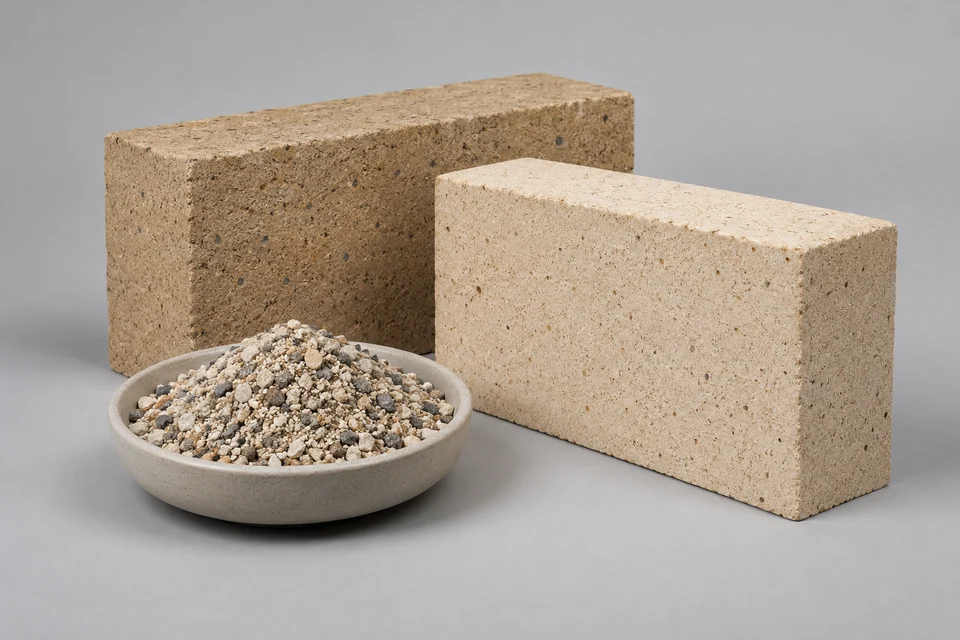
Refractory is an inorganic, nonmetallic material formulated to retain its physical integrity, mechanical strength, dimensional stability and chemical resistance during prolonged exposure to high temperatures, molten metals, slags, hot gases, thermal cycling, abrasion and mechanical load.
Product & engineering
Understand the product.
Refractories are inorganic, nonmetallic materials and engineered components used inside furnaces, kilns, reactors, converters, ladles, tundishes, smelters, glass tanks and other high temperature process equipment. They separate the process environment from the structural shell while retaining sufficient strength, dimensional stability and chemical resistance during exposure to molten metal, slag, glass, clinker, hot gas, ash and reactive vapors. Their economic function is determined by the ability to maintain containment, control heat transfer and preserve process geometry for a defined operating campaign.
Refractory performance depends on mineral chemistry, phase composition, purity, porosity, grain size distribution, bonding system, density and thermal expansion. Magnesia, doloma, alumina, bauxite, silica, zircon, graphite, silicon carbide and related engineered phases are selected according to temperature, atmosphere and contact chemistry. Basic slags require chemically compatible basic refractories such as magnesia based systems. Molten glass requires materials with low dissolution rates and controlled interaction with the glass phase. Carbon containing materials reduce slag wetting and improve thermal shock resistance in many steelmaking applications. Silicon carbide provides high thermal conductivity, abrasion resistance and chemical stability in selected industrial environments.
Refractory consumption originates from progressive material loss during operation. Chemical dissolution, slag and metal penetration, oxidation, thermal shock, structural spalling, abrasion, erosion and mechanical impact reduce the effective lining thickness. Local temperature gradients and repeated heating cycles generate internal stress. Penetrating liquids can alter the original mineral phases and weaken the refractory matrix. A lining is repaired or replaced when residual thickness, wear variability, heat loss, product quality or equipment risk reaches the operator's acceptable limit. Service life therefore depends on operating temperature, process chemistry, throughput, furnace design, maintenance practice, installation quality and refractory formulation.
Shaped refractories are manufactured as bricks, blocks and functional components with controlled dimensions before installation. Unshaped refractories are supplied as castables, gunning mixes, ramming materials, mortars and related formulations that form the lining at the customer site. Functional refractory products include nozzles, slide gate components, stopper systems and other flow control parts used where geometry and material behavior directly affect process stability. The relative use of these product forms changes with furnace design, repair practice, campaign targets and customer operating requirements.
Refractories are consumed as part of the operating life of high temperature industrial assets. Steelmaking generates frequent replacement demand because several vessels and casting components are exposed during each production sequence. Cement kilns and glass furnaces operate through longer lining campaigns. Nonferrous smelters face severe chemical attack from metal and slag systems. Refractory demand therefore follows downstream output, installed furnace capacity, operating hours, process route, unit refractory consumption, maintenance intensity, campaign life and new furnace construction.
Composition, supplied form and processing history determine the usable material. Evaluate the property required by the actual application with the specified test method; a chemistry name alone does not define a finished grade.
What turns activity into demand
Qualified formulation or component output creates material purchases through loading, process yield and the supplied mass basis. Raw material, formulated blend and finished-part revenues describe separate transaction stages.
The commercial boundary
For Refractory, distinguish the supplied product from its inputs and the complete application. Report types and applications may overlap; retain the selected edition's product definition, geography, period, unit and transaction basis when comparing estimates.
Which conditions determine usable refractory performance?
Refractory is an inorganic, nonmetallic material formulated to retain its physical integrity, mechanical strength, dimensional stability and chemical resistance during prolonged exposure to high temperatures, molten metals, slags, hot gases, thermal cycling, abrasion and mechanical load. Match formulation and impurity limits to the converting process, then verify the property after processing or curing. Compare like-for-like dry or as-supplied quantities; a finished component and its raw material represent different transaction stages.
Selected research
Market Analysis & Forecast
Global Refractory Market Analysis and Forecast 2026-2032
Market perspective
The global refractories market was US$33.97 billion in 2025, with finished refractory production of 34.82 million tonnes and an average price of US$975.75 per tonne. Production declined by 3.73 million tonnes from 2021. Iron and Steel accounted for 2.44 million tonnes of this reduction, Cement and Lime for 0.73 million tonnes and Other Industries for 0.65 million tonnes. Nonferrous Metals and Glass added approximately 0.09 million tonnes during the same period. The physical contraction was therefore generated principally inside the large, mature steel and cement furnace base. Average price increased from US$859.89 per tonne in 2021 to US$1,030.96 in 2023 and declined to US$975.75 in 2025. Magnesia, alumina, bauxite, graphite, zircon containing materials, silicon carbide, metallic additives and binders account for a substantial portion of refractory manufacturing cost. Electric melting, high temperature firing, drying and tempering add electricity and fuel exposure. The 2022 and 2023 increase in raw material, energy and conversion costs moved through refractory selling prices. Lower input costs and weaker furnace demand reduced part of that increase during 2024 and 2025.
Iron and Steel consumed 24.20 million tonnes of refractories in 2025, equal to 69.50% of global refractory volume. Refractory consumption occurs repeatedly through the steelmaking sequence. Blast furnaces, basic oxygen furnaces, electric arc furnaces, ladles, RH vessels, tundishes and continuous casting systems expose their working linings to molten metal, slag penetration, chemical dissolution, oxidation, thermal cycling and mechanical erosion. Steel output determines the number of heats processed. Furnace route determines which refractory systems receive those heats. Campaign life determines how frequently a lining is replaced. Gunning, fettling, slag repair and local monolithic maintenance extend campaign life and reduce the quantity of new brick required for each tonne of steel. Higher performance magnesia carbon linings, improved installation control and better furnace operating practice have reduced specific refractory consumption over time. The audited steel refractory volume declines from 26.64 million tonnes in 2021 to 24.20 million tonnes in 2025 even with continuing steel capacity additions in selected emerging markets.
China remains the largest physical variable inside steel refractory demand. Its refractory consumption falls from 19.72 million tonnes in 2025 to 18.42 million tonnes in 2032 across all applications. Mature steel capacity, lower utilization in parts of the furnace fleet, improvements in lining life and declining refractory consumption per tonne reduce replacement tonnage. India moves from 1.78 million tonnes to 2.73 million tonnes during the same period. Indonesia increases from 0.56 million tonnes to 0.85 million tonnes and Vietnam from 0.33 million tonnes to 0.47 million tonnes. New steel capacity in these countries requires an initial furnace lining at commissioning and creates a recurring replacement base after operation begins. China, Japan and South Korea contain substantially larger installed furnace fleets, so reductions in their production and specific refractory consumption absorb a large portion of the tonnage created by new Asian capacity.
Read the full market overview
Changes in steelmaking route also change refractory consumption without producing a one for one change in crude steel output. Electric arc furnaces eliminate several refractory consuming stages associated with an integrated blast furnace route. The EAF itself requires magnesia carbon working linings, gunning mixes, hearth materials and taphole products. DRI charged electric furnaces can impose higher refractory wear in selected zones because slag practice, iron oxide content, temperature and furnace operating conditions differ from scrap melting. Secondary metallurgy and continuous casting create another refractory demand layer through ladles, purging systems, slide gates, stopper rods, submerged entry nozzles and tundish systems. These products carry much higher value per tonne than bulk furnace linings because dimensional control, thermal shock resistance, erosion resistance and casting reliability affect steel cleanliness and continuous casting stability. The steel refractory market therefore remains close to 24 million tonnes through 2032 even as its internal product mix changes.
This report presents an overview of global market for Refractory, capacity, output, revenue and price. Analyses of the global market trends, with historic market revenue or sales data for 2021 - 2025, estimates for 2026, and projections of CAGR through 2032.
This report researches the key producers of Refractory, also provides the consumption of main regions and countries. Of the upcoming market potential for Refractory, and key regions or countries of focus to forecast this market into various segments and sub-segments. Country specific data and market value analysis for the U.S., Canada, Mexico, Brazil, China, Japan, South Korea, Southeast Asia, India, Germany, the U.K., Italy, Middle East, Africa, and Other Countries.
This report focuses on the Refractory sales, revenue, market share and industry ranking of main manufacturers, data from 2021 to 2026. Identification of the major stakeholders in the global Refractory market, and analysis of their competitive landscape and market positioning based on recent developments and segmental revenues. This report will help stakeholders to understand the competitive landscape and gain more insights and position their businesses and market strategies in a better way.
This report analyzes the segments data by Type and by Application, sales, revenue, and price, from 2021 to 2032. Evaluation and forecast the market size for Refractory sales, projected growth trends, production technology, application and end-user industry.
Refractory Segment by Company
RHI Magnesita
Vesuvius plc
Calderys Group
Krosaki Harima
Shinagawa Refra
Refratechnik Group
Ruitai Materials
Puyang Refractories
Beijing LIRR
INTOCAST AG
Saint Gobain SEFPRO
Allied Mineral Products
Magnezit Group
Chosun Refractories
Minerals Technologies
Yingkou Jinlong Refractories
IFGL Refractories
Sinosteel Luonai
Liaoning Qinghua Refractories
TYK Corporation
Yotai Refractories
Jiangsu Sujia Group New Materials New Materials
POSCO Future M
Morgan Advanced Materials plc
Zhejiang Zili High Temperature Technology
AGC Ceramics
Korea Refractories
Wuxi Nanfang Refractories
Carborundum Universal
Wugang Refractory
Dongkuk R&S
Luoyang Kechuang New Material
HASLE Refractories A S
Refractory Segment by Type
Shaped Refractories
Unshaped Refractories
Refractory Segment by Application
Iron and Steel
Cement and Lime
Nonferrous Metals
Glass
Other Industries
Refractory Segment by Region
North America
United States
Canada
Mexico
Europe
Germany
France
U.K.
Italy
Russia
Spain
Netherlands
Switzerland
Sweden
Poland
Asia-Pacific
China
Japan
South Korea
India
Australia
Taiwan
Southeast Asia
South America
Brazil
Argentina
Chile
Colombia
Middle East & Africa
Egypt
South Africa
Israel
Türkiye
GCC Countries
Study Objectives
1. To analyze and research the global status and future forecast, involving, production, value, consumption, growth rate (CAGR), market share, historical and forecast.
2. To present the key manufacturers, capacity, production, revenue, market share, and Recent Developments.
3. To split the breakdown data by regions, type, manufacturers, and Application.
4. To analyze the global and key regions market potential and advantage, opportunity and challenge, restraints, and risks.
5. To identify significant trends, drivers, influence factors in global and regions.
6. To analyze competitive developments such as expansions, agreements, new product launches, and acquisitions in the market.
Reasons to Buy This Report
1. This report will help the readers to understand the competition within the industries and strategies for the competitive environment to enhance the potential profit. The report also focuses on the competitive landscape of the global Refractory market, and introduces in detail the market share, industry ranking, competitor ecosystem, market performance, new product development, operation situation, expansion, and acquisition. etc. of the main players, which helps the readers to identify the main competitors and deeply understand the competition pattern of the market.
2. This report will help stakeholders to understand the global industry status and trends of Refractory and provides them with information on key market drivers, restraints, challenges, and opportunities.
3. This report will help stakeholders to understand competitors better and gain more insights to strengthen their position in their businesses. The competitive landscape section includes the market share and rank (in volume and value), competitor ecosystem, new product development, expansion, and acquisition.
4. This report stays updated with novel technology integration, features, and the latest developments in the market.
5. This report helps stakeholders to gain insights into which regions to target globally.
6. This report helps stakeholders to gain insights into the end-user perception concerning the adoption of Refractory.
7. This report helps stakeholders to identify some of the key players in the market and understand their valuable contribution.
Chapter Outline
Chapter 1: Introduces the report scope of the report, executive summary of different market segments (by type and by application, etc), including the market size of each market segment, future development potential, and so on. It offers a high-level view of the current state of the market and its likely evolution in the short to mid-term, and long term.
Chapter 2: Introduces the market dynamics, latest developments of the market, the driving factors and restrictive factors of the market, the challenges and risks faced by manufacturers in the industry, and the analysis of relevant policies in the industry.
Chapter 3: Refractory production/output of global and key producers (regions/countries). It provides a quantitative analysis of the production, and development potential of each producer in the next six years.
Chapter 4: Sales (consumption), revenue of Refractory in global, regional level and country level. It provides a quantitative analysis of the market size and development potential of each region and its main countries and introduces the market development, future development prospects, market space of each country in the world.
Chapter 5: Detailed analysis of Refractory manufacturers competitive landscape, price, sales, revenue, market share and industry ranking, latest development plan, merger, and acquisition information, etc.
Chapter 6: Provides the analysis of various market segments by type, covering the sales, revenue, average price, and development potential of each market segment, to help readers find the blue ocean market in different market segments.
Chapter 7: Provides the analysis of various market segments by application, covering the sales, revenue, average price, and development potential of each market segment, to help readers find the blue ocean market in different downstream markets.
Chapter 8: Provides profiles of key manufacturers, introducing the basic situation of the main companies in the market in detail, including product descriptions and specifications, Refractory sales, revenue, price, gross margin, and recent development, etc.
Chapter 9: North America by type, by application and by country, sales, and revenue for each segment.
Chapter 10: Europe by type, by application and by country, sales, and revenue for each segment.
Chapter 11: China by type, by application, sales, and revenue for each segment.
Chapter 12: Asia (Excluding China) by type, by application and by region, sales, and revenue for each segment.
Chapter 13: South America, Middle East and Africa by type, by application and by country, sales, and revenue for each segment.
Chapter 14: Analysis of industrial chain, sales channel, key raw materials, distributors and customers.
Chapter 15: The main concluding insights of the report.
More report detail
Tables and figures
Scope & coverage.
Types
- Shaped Refractories
- Unshaped Refractories
Applications
- Iron and Steel
- Cement and Lime
- Nonferrous Metals
- Glass
- Other Industries
Companies covered
- RHI Magnesita
- Vesuvius plc
- Calderys Group
- Krosaki Harima
- Shinagawa Refra
- Refratechnik Group
- Ruitai Materials
- Puyang Refractories
- Beijing LIRR
- INTOCAST AG
- Saint Gobain SEFPRO
- Allied Mineral Products
- Magnezit Group
- Chosun Refractories
- Minerals Technologies
- Yingkou Jinlong Refractories
- IFGL Refractories
- Sinosteel Luonai
- Liaoning Qinghua Refractories
- TYK Corporation
- Yotai Refractories
- Jiangsu Sujia Group New Materials New Materials
- POSCO Future M
- Morgan Advanced Materials plc
- Zhejiang Zili High Temperature Technology
- AGC Ceramics
- Korea Refractories
- Wuxi Nanfang Refractories
- Carborundum Universal
- Wugang Refractory
- Dongkuk R&S
- Luoyang Kechuang New Material
- HASLE Refractories A S
Inside the report.
1 Market Overview
- 1.1 Product Definition
- 1.2 Refractory Market by Type
- 1.2.1 Global Refractory Market Size by Type, 2021 VS 2025 VS 2032
- 1.2.2 Shaped Refractories
- 1.2.3 Unshaped Refractories
- 1.3 Refractory Market by Application
- 1.3.1 Global Refractory Market Size by Application, 2021 VS 2025 VS 2032
- 1.3.2 Iron and Steel
- 1.3.3 Cement and Lime
- 1.3.4 Nonferrous Metals
- 1.3.5 Glass
- 1.3.6 Other Industries
- 1.4 Assumptions and Limitations
- 1.5 Study Goals and Objectives
2 Refractory Market Dynamics
- 2.1 Refractory Industry Trends
- 2.2 Refractory Industry Drivers
- 2.3 Refractory Industry Opportunities and Challenges
- 2.4 Refractory Industry Restraints
3 Global Refractory Production Overview
- 3.1 Global Refractory Production Capacity (2021-2032)
- 3.2 Global Refractory Production by Region: 2021 VS 2025 VS 2032
- 3.3 Global Refractory Production by Region
- 3.3.1 Global Refractory Production by Region (2021-2026)
- 3.3.2 Global Refractory Production by Region (2027-2032)
- 3.3.3 Global Refractory Production Market Share by Region (2021-2032)
- 3.4 North America
- 3.5 Europe
- 3.6 China
- 3.7 Japan
4 Global Market Growth Prospects
- 4.1 Global Refractory Revenue Estimates and Forecasts (2021-2032)
- 4.2 Global Refractory Revenue by Region
- 4.2.1 Global Refractory Revenue by Region: 2021 VS 2025 VS 2032
- 4.2.2 Global Refractory Revenue by Region (2021-2026)
- 4.2.3 Global Refractory Revenue by Region (2027-2032)
- 4.2.4 Global Refractory Revenue Market Share by Region (2021-2032)
- 4.3 Global Refractory Sales Estimates and Forecasts 2021-2032
- 4.4 Global Refractory Sales by Region
- 4.4.1 Global Refractory Sales by Region: 2021 VS 2025 VS 2032
- 4.4.2 Global Refractory Sales by Region (2021-2026)
- 4.4.3 Global Refractory Sales by Region (2027-2032)
- 4.4.4 Global Refractory Sales Market Share by Region (2021-2032)
- 4.5 North America
- 4.6 Europe
- 4.7 China
- 4.8 Asia (Excluding China)
- 4.9 South America, Middle East and Africa
5 Market Competitive Landscape by Manufacturers
- 5.1 Global Refractory Revenue by Manufacturers
- 5.1.1 Global Refractory Revenue by Manufacturers (2021-2026)
- 5.1.2 Global Refractory Revenue Market Share by Manufacturers (2021-2026)
- 5.1.3 Global Refractory Manufacturers Revenue Share Top 10 and Top 5 in 2025
- 5.2 Global Refractory Sales by Manufacturers
- 5.2.1 Global Refractory Sales by Manufacturers (2021-2026)
- 5.2.2 Global Refractory Sales Market Share by Manufacturers (2021-2026)
- 5.2.3 Global Refractory Manufacturers Sales Share Top 10 and Top 5 in 2025
- 5.3 Global Refractory Sales Price by Manufacturers (2021-2026)
- 5.4 Global Refractory Key Manufacturers Ranking, 2024 VS 2025 VS 2026
- 5.5 Global Refractory Key Manufacturers Manufacturing Sites & Headquarters
- 5.6 Global Refractory Manufacturers, Product Type & Application
- 5.7 Global Refractory Manufacturers Commercialization Time
- 5.8 Market Competitive Analysis
- 5.8.1 Global Refractory Market CR5 and HHI
- 5.8.2 2025 Refractory Tier 1, Tier 2, and Tier 3
6 Refractory Market by Type
- 6.1 Global Refractory Revenue by Type
- 6.1.1 Global Refractory Revenue by Type (2021-2032) & (US$ Million)
- 6.1.2 Global Refractory Revenue Market Share by Type (2021-2032)
- 6.2 Global Refractory Sales by Type
- 6.2.1 Global Refractory Sales by Type (2021-2032) & (kt)
- 6.2.2 Global Refractory Sales Market Share by Type (2021-2032)
- 6.3 Global Refractory Price by Type
7 Refractory Market by Application
- 7.1 Global Refractory Revenue by Application
- 7.1.1 Global Refractory Revenue by Application (2021-2032) & (US$ Million)
- 7.1.2 Global Refractory Revenue Market Share by Application (2021-2032)
- 7.2 Global Refractory Sales by Application
- 7.2.1 Global Refractory Sales by Application (2021-2032) & (kt)
- 7.2.2 Global Refractory Sales Market Share by Application (2021-2032)
- 7.3 Global Refractory Price by Application
8 Company Profiles
- 8.1 RHI Magnesita
- 8.1.1 RHI Magnesita Company Information
- 8.1.2 RHI Magnesita Business Overview
- 8.1.3 RHI Magnesita Refractory Sales, Revenue, Price and Gross Margin (2021-2026)
- 8.1.4 RHI Magnesita Refractory Product Portfolio
- 8.1.5 RHI Magnesita Recent Developments
- 8.2 Vesuvius plc
- 8.2.1 Vesuvius plc Company Information
- 8.2.2 Vesuvius plc Business Overview
- 8.2.3 Vesuvius plc Refractory Sales, Revenue, Price and Gross Margin (2021-2026)
- 8.2.4 Vesuvius plc Refractory Product Portfolio
- 8.2.5 Vesuvius plc Recent Developments
- 8.3 Calderys Group
- 8.3.1 Calderys Group Company Information
- 8.3.2 Calderys Group Business Overview
- 8.3.3 Calderys Group Refractory Sales, Revenue, Price and Gross Margin (2021-2026)
- 8.3.4 Calderys Group Refractory Product Portfolio
- 8.3.5 Calderys Group Recent Developments
- 8.4 Krosaki Harima
- 8.4.1 Krosaki Harima Company Information
- 8.4.2 Krosaki Harima Business Overview
- 8.4.3 Krosaki Harima Refractory Sales, Revenue, Price and Gross Margin (2021-2026)
- 8.4.4 Krosaki Harima Refractory Product Portfolio
- 8.4.5 Krosaki Harima Recent Developments
- 8.5 Shinagawa Refra
- 8.5.1 Shinagawa Refra Company Information
- 8.5.2 Shinagawa Refra Business Overview
- 8.5.3 Shinagawa Refra Refractory Sales, Revenue, Price and Gross Margin (2021-2026)
- 8.5.4 Shinagawa Refra Refractory Product Portfolio
- 8.5.5 Shinagawa Refra Recent Developments
- 8.6 Refratechnik Group
- 8.6.1 Refratechnik Group Company Information
- 8.6.2 Refratechnik Group Business Overview
- 8.6.3 Refratechnik Group Refractory Sales, Revenue, Price and Gross Margin (2021-2026)
- 8.6.4 Refratechnik Group Refractory Product Portfolio
- 8.6.5 Refratechnik Group Recent Developments
- 8.7 Ruitai Materials
- 8.7.1 Ruitai Materials Company Information
- 8.7.2 Ruitai Materials Business Overview
- 8.7.3 Ruitai Materials Refractory Sales, Revenue, Price and Gross Margin (2021-2026)
- 8.7.4 Ruitai Materials Refractory Product Portfolio
- 8.7.5 Ruitai Materials Recent Developments
- 8.8 Puyang Refractories
- 8.8.1 Puyang Refractories Company Information
- 8.8.2 Puyang Refractories Business Overview
- 8.8.3 Puyang Refractories Refractory Sales, Revenue, Price and Gross Margin (2021-2026)
- 8.8.4 Puyang Refractories Refractory Product Portfolio
- 8.8.5 Puyang Refractories Recent Developments
- 8.9 Beijing LIRR
- 8.9.1 Beijing LIRR Company Information
- 8.9.2 Beijing LIRR Business Overview
- 8.9.3 Beijing LIRR Refractory Sales, Revenue, Price and Gross Margin (2021-2026)
- 8.9.4 Beijing LIRR Refractory Product Portfolio
- 8.9.5 Beijing LIRR Recent Developments
- 8.10 INTOCAST AG
- 8.10.1 INTOCAST AG Company Information
- 8.10.2 INTOCAST AG Business Overview
- 8.10.3 INTOCAST AG Refractory Sales, Revenue, Price and Gross Margin (2021-2026)
- 8.10.4 INTOCAST AG Refractory Product Portfolio
- 8.10.5 INTOCAST AG Recent Developments
- 8.11 Saint Gobain SEFPRO
- 8.11.1 Saint Gobain SEFPRO Company Information
- 8.11.2 Saint Gobain SEFPRO Business Overview
- 8.11.3 Saint Gobain SEFPRO Refractory Sales, Revenue, Price and Gross Margin (2021-2026)
- 8.11.4 Saint Gobain SEFPRO Refractory Product Portfolio
- 8.11.5 Saint Gobain SEFPRO Recent Developments
- 8.12 Allied Mineral Products
- 8.12.1 Allied Mineral Products Company Information
- 8.12.2 Allied Mineral Products Business Overview
- 8.12.3 Allied Mineral Products Refractory Sales, Revenue, Price and Gross Margin (2021-2026)
- 8.12.4 Allied Mineral Products Refractory Product Portfolio
- 8.12.5 Allied Mineral Products Recent Developments
- 8.13 Magnezit Group
- 8.13.1 Magnezit Group Company Information
- 8.13.2 Magnezit Group Business Overview
- 8.13.3 Magnezit Group Refractory Sales, Revenue, Price and Gross Margin (2021-2026)
- 8.13.4 Magnezit Group Refractory Product Portfolio
- 8.13.5 Magnezit Group Recent Developments
- 8.14 Chosun Refractories
- 8.14.1 Chosun Refractories Company Information
- 8.14.2 Chosun Refractories Business Overview
- 8.14.3 Chosun Refractories Refractory Sales, Revenue, Price and Gross Margin (2021-2026)
- 8.14.4 Chosun Refractories Refractory Product Portfolio
- 8.14.5 Chosun Refractories Recent Developments
- 8.15 Minerals Technologies
- 8.15.1 Minerals Technologies Company Information
- 8.15.2 Minerals Technologies Business Overview
- 8.15.3 Minerals Technologies Refractory Sales, Revenue, Price and Gross Margin (2021-2026)
- 8.15.4 Minerals Technologies Refractory Product Portfolio
- 8.15.5 Minerals Technologies Recent Developments
- 8.16 Yingkou Jinlong Refractories
- 8.16.1 Yingkou Jinlong Refractories Company Information
- 8.16.2 Yingkou Jinlong Refractories Business Overview
- 8.16.3 Yingkou Jinlong Refractories Refractory Sales, Revenue, Price and Gross Margin (2021-2026)
- 8.16.4 Yingkou Jinlong Refractories Refractory Product Portfolio
- 8.16.5 Yingkou Jinlong Refractories Recent Developments
- 8.17 IFGL Refractories
- 8.17.1 IFGL Refractories Company Information
- 8.17.2 IFGL Refractories Business Overview
- 8.17.3 IFGL Refractories Refractory Sales, Revenue, Price and Gross Margin (2021-2026)
- 8.17.4 IFGL Refractories Refractory Product Portfolio
- 8.17.5 IFGL Refractories Recent Developments
- 8.18 Sinosteel Luonai
- 8.18.1 Sinosteel Luonai Company Information
- 8.18.2 Sinosteel Luonai Business Overview
- 8.18.3 Sinosteel Luonai Refractory Sales, Revenue, Price and Gross Margin (2021-2026)
- 8.18.4 Sinosteel Luonai Refractory Product Portfolio
- 8.18.5 Sinosteel Luonai Recent Developments
- 8.19 Liaoning Qinghua Refractories
- 8.19.1 Liaoning Qinghua Refractories Company Information
- 8.19.2 Liaoning Qinghua Refractories Business Overview
- 8.19.3 Liaoning Qinghua Refractories Refractory Sales, Revenue, Price and Gross Margin (2021-2026)
- 8.19.4 Liaoning Qinghua Refractories Refractory Product Portfolio
- 8.19.5 Liaoning Qinghua Refractories Recent Developments
- 8.20 TYK Corporation
- 8.20.1 TYK Corporation Company Information
- 8.20.2 TYK Corporation Business Overview
- 8.20.3 TYK Corporation Refractory Sales, Revenue, Price and Gross Margin (2021-2026)
- 8.20.4 TYK Corporation Refractory Product Portfolio
- 8.20.5 TYK Corporation Recent Developments
- 8.21 Yotai Refractories
- 8.21.1 Yotai Refractories Company Information
- 8.21.2 Yotai Refractories Business Overview
- 8.21.3 Yotai Refractories Refractory Sales, Revenue, Price and Gross Margin (2021-2026)
- 8.21.4 Yotai Refractories Refractory Product Portfolio
- 8.21.5 Yotai Refractories Recent Developments
- 8.22 Jiangsu Sujia Group New Materials New Materials
- 8.22.1 Jiangsu Sujia Group New Materials New Materials Company Information
- 8.22.2 Jiangsu Sujia Group New Materials New Materials Business Overview
- 8.22.3 Jiangsu Sujia Group New Materials New Materials Refractory Sales, Revenue, Price and Gross Margin (2021-2026)
- 8.22.4 Jiangsu Sujia Group New Materials New Materials Refractory Product Portfolio
- 8.22.5 Jiangsu Sujia Group New Materials New Materials Recent Developments
- 8.23 POSCO Future M
- 8.23.1 POSCO Future M Company Information
- 8.23.2 POSCO Future M Business Overview
- 8.23.3 POSCO Future M Refractory Sales, Revenue, Price and Gross Margin (2021-2026)
- 8.23.4 POSCO Future M Refractory Product Portfolio
- 8.23.5 POSCO Future M Recent Developments
- 8.24 Morgan Advanced Materials plc
- 8.24.1 Morgan Advanced Materials plc Company Information
- 8.24.2 Morgan Advanced Materials plc Business Overview
- 8.24.3 Morgan Advanced Materials plc Refractory Sales, Revenue, Price and Gross Margin (2021-2026)
- 8.24.4 Morgan Advanced Materials plc Refractory Product Portfolio
- 8.24.5 Morgan Advanced Materials plc Recent Developments
- 8.25 Zhejiang Zili High Temperature Technology
- 8.25.1 Zhejiang Zili High Temperature Technology Company Information
- 8.25.2 Zhejiang Zili High Temperature Technology Business Overview
- 8.25.3 Zhejiang Zili High Temperature Technology Refractory Sales, Revenue, Price and Gross Margin (2021-2026)
- 8.25.4 Zhejiang Zili High Temperature Technology Refractory Product Portfolio
- 8.25.5 Zhejiang Zili High Temperature Technology Recent Developments
- 8.26 AGC Ceramics
- 8.26.1 AGC Ceramics Company Information
- 8.26.2 AGC Ceramics Business Overview
- 8.26.3 AGC Ceramics Refractory Sales, Revenue, Price and Gross Margin (2021-2026)
- 8.26.4 AGC Ceramics Refractory Product Portfolio
- 8.26.5 AGC Ceramics Recent Developments
- 8.27 Korea Refractories
- 8.27.1 Korea Refractories Company Information
- 8.27.2 Korea Refractories Business Overview
- 8.27.3 Korea Refractories Refractory Sales, Revenue, Price and Gross Margin (2021-2026)
- 8.27.4 Korea Refractories Refractory Product Portfolio
- 8.27.5 Korea Refractories Recent Developments
- 8.28 Wuxi Nanfang Refractories
- 8.28.1 Wuxi Nanfang Refractories Company Information
- 8.28.2 Wuxi Nanfang Refractories Business Overview
- 8.28.3 Wuxi Nanfang Refractories Refractory Sales, Revenue, Price and Gross Margin (2021-2026)
- 8.28.4 Wuxi Nanfang Refractories Refractory Product Portfolio
- 8.28.5 Wuxi Nanfang Refractories Recent Developments
- 8.29 Carborundum Universal
- 8.29.1 Carborundum Universal Company Information
- 8.29.2 Carborundum Universal Business Overview
- 8.29.3 Carborundum Universal Refractory Sales, Revenue, Price and Gross Margin (2021-2026)
- 8.29.4 Carborundum Universal Refractory Product Portfolio
- 8.29.5 Carborundum Universal Recent Developments
- 8.30 Wugang Refractory
- 8.30.1 Wugang Refractory Company Information
- 8.30.2 Wugang Refractory Business Overview
- 8.30.3 Wugang Refractory Refractory Sales, Revenue, Price and Gross Margin (2021-2026)
- 8.30.4 Wugang Refractory Refractory Product Portfolio
- 8.30.5 Wugang Refractory Recent Developments
- 8.31 Dongkuk R&S
- 8.31.1 Dongkuk R&S Company Information
- 8.31.2 Dongkuk R&S Business Overview
- 8.31.3 Dongkuk R&S Refractory Sales, Revenue, Price and Gross Margin (2021-2026)
- 8.31.4 Dongkuk R&S Refractory Product Portfolio
- 8.31.5 Dongkuk R&S Recent Developments
- 8.32 Luoyang Kechuang New Material
- 8.32.1 Luoyang Kechuang New Material Company Information
- 8.32.2 Luoyang Kechuang New Material Business Overview
- 8.32.3 Luoyang Kechuang New Material Refractory Sales, Revenue, Price and Gross Margin (2021-2026)
- 8.32.4 Luoyang Kechuang New Material Refractory Product Portfolio
- 8.32.5 Luoyang Kechuang New Material Recent Developments
- 8.33 HASLE Refractories A S
- 8.33.1 HASLE Refractories A S Company Information
- 8.33.2 HASLE Refractories A S Business Overview
- 8.33.3 HASLE Refractories A S Refractory Sales, Revenue, Price and Gross Margin (2021-2026)
- 8.33.4 HASLE Refractories A S Refractory Product Portfolio
- 8.33.5 HASLE Refractories A S Recent Developments
9 North America
- 9.1 North America Refractory Market Size by Type
- 9.1.1 North America Refractory Revenue by Type (2021-2032)
- 9.1.2 North America Refractory Sales by Type (2021-2032)
- 9.1.3 North America Refractory Price by Type (2021-2032)
- 9.2 North America Refractory Market Size by Application
- 9.2.1 North America Refractory Revenue by Application (2021-2032)
- 9.2.2 North America Refractory Sales by Application (2021-2032)
- 9.2.3 North America Refractory Price by Application (2021-2032)
- 9.3 North America Refractory Market Size by Country
- 9.3.1 North America Refractory Revenue Grow Rate by Country (2021 VS 2025 VS 2032)
- 9.3.2 North America Refractory Sales by Country (2021 VS 2025 VS 2032)
- 9.3.3 North America Refractory Price by Country (2021-2032)
- 9.3.4 United States
- 9.3.5 Canada
- 9.3.6 Mexico
10 Europe
- 10.1 Europe Refractory Market Size by Type
- 10.1.1 Europe Refractory Revenue by Type (2021-2032)
- 10.1.2 Europe Refractory Sales by Type (2021-2032)
- 10.1.3 Europe Refractory Price by Type (2021-2032)
- 10.2 Europe Refractory Market Size by Application
- 10.2.1 Europe Refractory Revenue by Application (2021-2032)
- 10.2.2 Europe Refractory Sales by Application (2021-2032)
- 10.2.3 Europe Refractory Price by Application (2021-2032)
- 10.3 Europe Refractory Market Size by Country
- 10.3.1 Europe Refractory Revenue Grow Rate by Country (2021 VS 2025 VS 2032)
- 10.3.2 Europe Refractory Sales by Country (2021 VS 2025 VS 2032)
- 10.3.3 Europe Refractory Price by Country (2021-2032)
- 10.3.4 Germany
- 10.3.5 France
- 10.3.6 U.K.
- 10.3.7 Italy
- 10.3.8 Russia
- 10.3.9 Spain
- 10.3.10 Netherlands
- 10.3.11 Switzerland
- 10.3.12 Sweden
11 China
- 11.1 China Refractory Market Size by Type
- 11.1.1 China Refractory Revenue by Type (2021-2032)
- 11.1.2 China Refractory Sales by Type (2021-2032)
- 11.1.3 China Refractory Price by Type (2021-2032)
- 11.2 China Refractory Market Size by Application
- 11.2.1 China Refractory Revenue by Application (2021-2032)
- 11.2.2 China Refractory Sales by Application (2021-2032)
- 11.2.3 China Refractory Price by Application (2021-2032)
12 Asia (Excluding China)
- 12.1 Asia Refractory Market Size by Type
- 12.1.1 Asia Refractory Revenue by Type (2021-2032)
- 12.1.2 Asia Refractory Sales by Type (2021-2032)
- 12.1.3 Asia Refractory Price by Type (2021-2032)
- 12.2 Asia Refractory Market Size by Application
- 12.2.1 Asia Refractory Revenue by Application (2021-2032)
- 12.2.2 Asia Refractory Sales by Application (2021-2032)
- 12.2.3 Asia Refractory Price by Application (2021-2032)
- 12.3 Asia Refractory Market Size by Country
- 12.3.1 Asia Refractory Revenue Grow Rate by Country (2021 VS 2025 VS 2032)
- 12.3.2 Asia Refractory Sales by Country (2021 VS 2025 VS 2032)
- 12.3.3 Asia Refractory Price by Country (2021-2032)
- 12.3.4 Japan
- 12.3.5 South Korea
- 12.3.6 India
- 12.3.7 Australia
- 12.3.8 Taiwan
- 12.3.9 Southeast Asia
13 South America, Middle East and Africa
- 13.1 SAMEA Refractory Market Size by Type
- 13.1.1 SAMEA Refractory Revenue by Type (2021-2032)
- 13.1.2 SAMEA Refractory Sales by Type (2021-2032)
- 13.1.3 SAMEA Refractory Price by Type (2021-2032)
- 13.2 SAMEA Refractory Market Size by Application
- 13.2.1 SAMEA Refractory Revenue by Application (2021-2032)
- 13.2.2 SAMEA Refractory Sales by Application (2021-2032)
- 13.2.3 SAMEA Refractory Price by Application (2021-2032)
- 13.3 SAMEA Refractory Market Size by Country
- 13.3.1 SAMEA Refractory Revenue Grow Rate by Country (2021 VS 2025 VS 2032)
- 13.3.2 SAMEA Refractory Sales by Country (2021 VS 2025 VS 2032)
- 13.3.3 SAMEA Refractory Price by Country (2021-2032)
- 13.3.4 Brazil
- 13.3.5 Argentina
- 13.3.6 Chile
- 13.3.7 Colombia
- 13.3.8 Peru
- 13.3.9 Saudi Arabia
- 13.3.10 Israel
- 13.3.11 UAE
- 13.3.12 Turkey
- 13.3.13 Iran
- 13.3.14 Egypt
14 Value Chain and Sales Channels Analysis
- 14.1 Refractory Value Chain Analysis
- 14.1.1 Refractory Key Raw Materials
- 14.1.2 Raw Materials Key Suppliers
- 14.1.3 Manufacturing Cost Structure
- 14.1.4 Refractory Production Mode & Process
- 14.2 Refractory Sales Channels Analysis
- 14.2.1 Direct Comparison with Distribution Share
- 14.2.2 Refractory Distributors
- 14.2.3 Refractory Customers
15 Concluding Insights
16 Appendix
- 16.1 Reasons for Doing This Study
- 16.2 Research Methodology
- 16.3 Research Process
- 16.4 Authors List of This Report
- 16.5 Data Source
- 16.5.1 Secondary Sources
- 16.5.2 Primary Sources
- 16.6 Disclaimer
GET THE RESEARCH
Choose your license.
Choose who needs access.
All options are for this report and research series.
PDF by email within 3–5 working days after payment confirmation.
Talk to an analyst