APO RESEARCH · REPORT
Multiphase Pumps
Multiphase pumping technology represents a sophisticated engineering solution designed to transport the total raw production from oil and gas wells through a single pipeline, bypassing the conventional requirement for preliminary separation of gas, liquid, and solid phases at the wellhead.
Product & engineering
Understand the product.
Multiphase pumping technology represents a sophisticated engineering solution designed to transport the total raw production from oil and gas wells through a single pipeline, bypassing the conventional requirement for preliminary separation of gas, liquid, and solid phases at the wellhead. At its core, a multiphase pump is defined as a versatile hydraulic machine capable of handling a wide range of Gas Volume Fractions (GVF), from 0% to 100%, while maintaining operational stability under the unpredictable conditions of transient slug flow. By boosting the pressure of the untreated wellstream directly from wellheads or gathering points, these systems significantly lower the back-pressure exerted on the reservoir, which directly translates to increased flow rates, accelerated production, and the successful recovery of reserves in marginal fields or mature reservoirs that would otherwise be considered stranded or economically unviable. This "total stream" approach serves as a critical enabler for the efficient exploitation of assets where traditional separation infrastructure is technically or financially prohibitive.
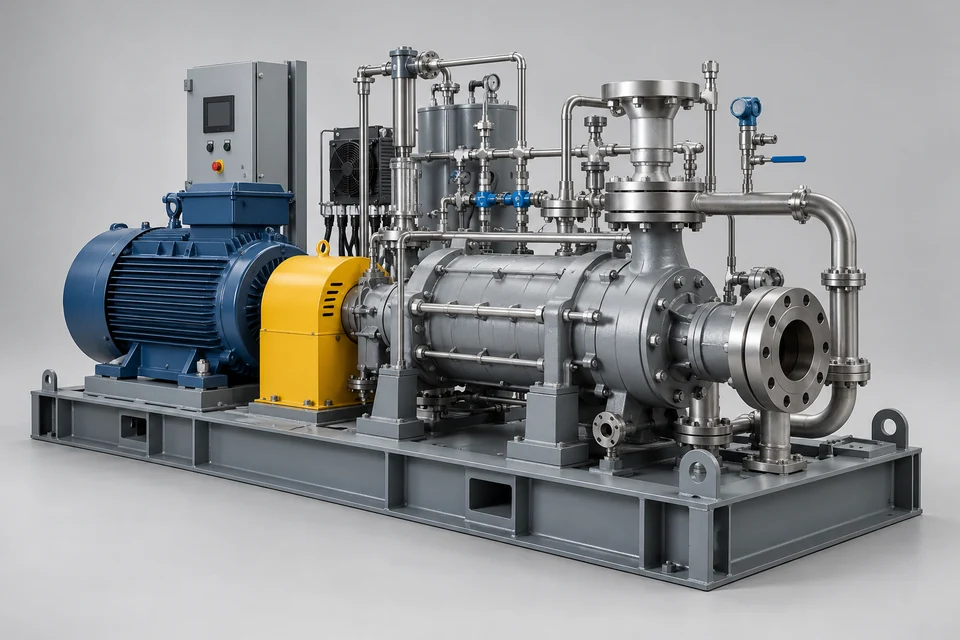
The mechanical composition of a multiphase pumping system typically integrates a high-torque prime mover, such as an electric motor or gas engine, coupled to a specialized pump casing that houses the core hydraulic elements. Beyond the pump unit itself, the system incorporates a lubrication oil unit, a sophisticated control system for Variable Speed Drive (VSD) management, and often a liquid recirculation or "slug catcher" manifold designed to ensure a constant liquid seal within the pump chambers during periods of high gas concentration. The materials used in construction are engineered for extreme durability, often utilizing Duplex stainless steel or specialized tungsten carbide coatings to resist the corrosive and abrasive nature of produced water and formation sand. Modern commercial units, capable of powering up to 6 MW, have demonstrated field-proven reliability since their initial development in the late 1970s, evolving into robust systems that power production across diverse global regions from the North Sea to the Middle East.
Technologically, the industry bifurcates into two primary mechanical strategies: positive displacement and rotodynamic. Twin-screw multiphase pumps utilize two intermeshing, non-contacting rotors within a liner to trap and transport fluid packets axially from suction to discharge. This design is exceptionally robust in handling gas volume fractions ranging from 0% to 100%, offering unparalleled performance in high-pressure-differential scenarios where constant volumetric efficiency is paramount. By maintaining a liquid film between the screws and the liner through integrated recirculation systems, these pumps can operate in extended dry-run conditions while accommodating high-viscosity fluids and abrasive solids. This architecture remains the predominant choice for terrestrial and shallow-water applications, providing a mechanical barrier against the stresses of unpredictable wellbore dynamics.
For high-capacity requirements and ultra-deepwater subsea deployments, the industry relies on helico-axial multiphase pumps, which operate on rotodynamic principles. Functioning as multistage turbomachines, these pumps blend axial compressor and centrifugal principles, utilizing a series of specially profiled impeller-diffuser stages designed to homogenize the gas-liquid mixture through high-velocity kinetic energy transfer. This prevents phase separation within the hydraulic path and allows for high flow rates up to 3300 m³/h. Recent innovations, such as barrier-fluidless configurations and integrated permanent magnet motors, have further simplified subsea architectures by eliminating the need for complex umbilical lines for lubricant supply. These modular, retrievable designs are specifically optimized for the harsh conditions of the seabed, where equipment must operate for years without direct intervention.
From a strategic standpoint, multiphase pumping systems can reduce capital expenditures (CAPEX) by up to 30% through the centralization of processing facilities, smaller equipment footprints, and the elimination of complex infrastructure such as test lines, separators, and flares. By minimizing the need for venting and flaring, these systems also significantly reduce the environmental footprint of oil and gas operations. Historical development has moved toward greater customization through advanced computational fluid dynamics (CFD) and optimization algorithms, allowing for refined designs in upstream and midstream processes. Future perspectives involve expanding these capabilities to sour gas reinjection, wet gas compression for high gas-liquid ratios, and hybrid systems integrating energy recovery through two-phase turbines, ensuring the technology remains at the forefront of global energy recovery efforts.
Equipment converts a defined input into a required mechanical or process result. Usable capacity depends on duty, auxiliaries, control, loading and maintenance, rather than an isolated maximum nameplate value.
What turns activity into demand
Production or operating duty leads to purchases when capacity, qualification and replacement requirements match the supplied machine or component. Site output alone does not determine equipment orders without the installed capacity and duty.
The commercial boundary
For Multiphase Pumps, distinguish the supplied product from its inputs and the complete application. Report types and applications may overlap; retain the selected edition's product definition, geography, period, unit and transaction basis when comparing estimates.
Which conditions determine usable multiphase pumps performance?
Multiphase pumping technology represents a sophisticated engineering solution designed to transport the total raw production from oil and gas wells through a single pipeline, bypassing the conventional requirement for preliminary separation of gas, liquid, and solid phases at the wellhead. Compare the complete supplied assembly under the same operating conditions, including upstream and downstream interfaces, energy use and service requirements. Separate machine hardware, installed process line and maintenance revenue when defining the research boundary.
Selected research
Market Structure
Global Multiphase Pumps Market by Size, by Type, by Application, by Region, History and Forecast 2021-2032
Market perspective
Multiphase pumping technology represents a sophisticated engineering solution designed to transport the total raw production from oil and gas wells through a single pipeline, bypassing the conventional requirement for preliminary separation of gas, liquid, and solid phases at the wellhead. At its core, a multiphase pump is defined as a versatile hydraulic machine capable of handling a wide range of Gas Volume Fractions (GVF), from 0% to 100%, while maintaining operational stability under the unpredictable conditions of transient slug flow. By boosting the pressure of the untreated wellstream directly from wellheads or gathering points, these systems significantly lower the back-pressure exerted on the reservoir, which directly translates to increased flow rates, accelerated production, and the successful recovery of reserves in marginal fields or mature reservoirs that would otherwise be considered stranded or economically unviable. This "total stream" approach serves as a critical enabler for the efficient exploitation of assets where traditional separation infrastructure is technically or financially prohibitive.
The mechanical composition of a multiphase pumping system typically integrates a high-torque prime mover, such as an electric motor or gas engine, coupled to a specialized pump casing that houses the core hydraulic elements. Beyond the pump unit itself, the system incorporates a lubrication oil unit, a sophisticated control system for Variable Speed Drive (VSD) management, and often a liquid recirculation or "slug catcher" manifold designed to ensure a constant liquid seal within the pump chambers during periods of high gas concentration. The materials used in construction are engineered for extreme durability, often utilizing Duplex stainless steel or specialized tungsten carbide coatings to resist the corrosive and abrasive nature of produced water and formation sand. Modern commercial units, capable of powering up to 6 MW, have demonstrated field-proven reliability since their initial development in the late 1970s, evolving into robust systems that power production across diverse global regions from the North Sea to the Middle East.
Technologically, the industry bifurcates into two primary mechanical strategies: positive displacement and rotodynamic. Twin-screw multiphase pumps utilize two intermeshing, non-contacting rotors within a liner to trap and transport fluid packets axially from suction to discharge. This design is exceptionally robust in handling gas volume fractions ranging from 0% to 100%, offering unparalleled performance in high-pressure-differential scenarios where constant volumetric efficiency is paramount. By maintaining a liquid film between the screws and the liner through integrated recirculation systems, these pumps can operate in extended dry-run conditions while accommodating high-viscosity fluids and abrasive solids. This architecture remains the predominant choice for terrestrial and shallow-water applications, providing a mechanical barrier against the stresses of unpredictable wellbore dynamics.
Read the full market overview
For high-capacity requirements and ultra-deepwater subsea deployments, the industry relies on helico-axial multiphase pumps, which operate on rotodynamic principles. Functioning as multistage turbomachines, these pumps blend axial compressor and centrifugal principles, utilizing a series of specially profiled impeller-diffuser stages designed to homogenize the gas-liquid mixture through high-velocity kinetic energy transfer. This prevents phase separation within the hydraulic path and allows for high flow rates up to 3300 m³/h. Recent innovations, such as barrier-fluidless configurations and integrated permanent magnet motors, have further simplified subsea architectures by eliminating the need for complex umbilical lines for lubricant supply. These modular, retrievable designs are specifically optimized for the harsh conditions of the seabed, where equipment must operate for years without direct intervention.
From a strategic standpoint, multiphase pumping systems can reduce capital expenditures (CAPEX) by up to 30% through the centralization of processing facilities, smaller equipment footprints, and the elimination of complex infrastructure such as test lines, separators, and flares. By minimizing the need for venting and flaring, these systems also significantly reduce the environmental footprint of oil and gas operations. Historical development has moved toward greater customization through advanced computational fluid dynamics (CFD) and optimization algorithms, allowing for refined designs in upstream and midstream processes. Future perspectives involve expanding these capabilities to sour gas reinjection, wet gas compression for high gas-liquid ratios, and hybrid systems integrating energy recovery through two-phase turbines, ensuring the technology remains at the forefront of global energy recovery efforts.
The global Multiphase Pumps market is projected to grow from US$ million in 2026 to US$ million by 2032, implying a CAGR of % over 2026-2032.
The US & Canada market for Multiphase Pumps is projected to increase from US$ million in 2026 to US$ million by 2032, at a CAGR of % over 2026-2032.
The Europe market for Multiphase Pumps is projected to increase from US$ million in 2026 to US$ million by 2032, at a CAGR of % over 2026-2032.
The Asia Pacific market for Multiphase Pumps is projected to increase from US$ million in 2026 to US$ million by 2032, at a CAGR of % over 2026-2032.
The China market for Multiphase Pumps is projected to increase from US$ million in 2026 to US$ million by 2032, at a CAGR of % over 2026-2032.
Leading global manufacturers of Multiphase Pumps include ITT Bornemann, Leistritz, Sulzer, CIRCOR International, SLB, NOV, Netzsch Group, HMS Group and Seepex GmbH, among others. In 2025, the top three vendors together accounted for approximately % of global revenue.
On the production side, the report examines Multiphase Pumps output, growth rates, and market shares by manufacturer and by region (at regional and country level) for 2021-2026, with forecasts through 2032.
On the consumption side, the report analyzes sales of Multiphase Pumps by region (regional and country level), company, type, and application for 2021-2026 and provides forecasts through 2032.
The report provides an overview of the global Multiphase Pumps market in terms of capacity, output, revenue, and price, analyzing global market trends using historical revenue and sales data for 2021-2025, estimates for 2026, and projected CAGRs through 2032.
The study covers key producers of Multiphase Pumps and consumption patterns in major regions and countries, assesses future market potential, and highlights priority regions and countries for segmenting the market into sub-sectors, with country-specific market value data for the U.S., Canada, Mexico, Brazil, China, Japan, South Korea, Southeast Asia, India, Germany, the U.K., Italy, the Middle East, Africa, and other countries.
The report also presents Multiphase Pumps sales, revenue, market share, and industry ranking for the main manufacturers for 2021-2026, identifies the major stakeholders in the global market, and analyzes their competitive landscape and market positioning based on recent developments and segmental revenues.
In addition, the report analyzes segment data by type and application—covering sales, revenue, and price—for 2021-2032, and evaluates and forecasts the Multiphase Pumps market size, projected growth trends, production technologies, key applications, and end-use industries.
Multiphase Pumps Segment by Company
ITT Bornemann
Leistritz
Sulzer
CIRCOR International
SLB
NOV
Netzsch Group
HMS Group
Seepex GmbH
PCM Group
CAN-K
EDUR Pump
PSG (Dover Corporation)
Baker Hughes
Xi'an Pump & Valve Plant
Ningbo Heli Mechanical Pump
Multiphase Pumps Segment by Type
Twin-Screw
Helico-Axial
PCP
Multiphase Pumps Segment by Application
Onshore
Offshore
Multiphase Pumps Segment by Region
North America
United States
Canada
Mexico
Europe
Germany
France
U.K.
Italy
Russia
Spain
Netherlands
Switzerland
Sweden
Poland
Asia-Pacific
China
Japan
South Korea
India
Australia
Taiwan
Southeast Asia
South America
Brazil
Argentina
Chile
Colombia
Middle East & Africa
Egypt
South Africa
Israel
Türkiye
GCC Countries
Study Objectives
1. To analyze and research the global status and future forecast, involving, production, value, consumption, growth rate (CAGR), market share, historical and forecast.
2. To present the key manufacturers, capacity, production, revenue, market share, and Recent Developments.
3. To split the breakdown data by regions, type, manufacturers, and Application.
4. To analyze the global and key regions market potential and advantage, opportunity and challenge, restraints, and risks.
5. To identify significant trends, drivers, influence factors in global and regions.
6. To analyze competitive developments such as expansions, agreements, new product launches, and acquisitions in the market.
Reasons to Buy This Report
1. This report will help the readers to understand the competition within the industries and strategies for the competitive environment to enhance the potential profit. The report also focuses on the competitive landscape of the global Multiphase Pumps market, and introduces in detail the market share, industry ranking, competitor ecosystem, market performance, new product development, operation situation, expansion, and acquisition. etc. of the main players, which helps the readers to identify the main competitors and deeply understand the competition pattern of the market.
2. This report will help stakeholders to understand the global industry status and trends of Multiphase Pumps and provides them with information on key market drivers, restraints, challenges, and opportunities.
3. This report will help stakeholders to understand competitors better and gain more insights to strengthen their position in their businesses. The competitive landscape section includes the market share and rank (in volume and value), competitor ecosystem, new product development, expansion, and acquisition.
4. This report stays updated with novel technology integration, features, and the latest developments in the market.
5. This report helps stakeholders to gain insights into which regions to target globally.
6. This report helps stakeholders to gain insights into the end-user perception concerning the adoption of Multiphase Pumps.
7. This report helps stakeholders to identify some of the key players in the market and understand their valuable contribution.
Chapter Outline
Chapter 1: Provides an overview of the Multiphase Pumps market, including product definition, global market growth prospects, production value, capacity, and average price forecasts (2021-2032).
Chapter 2: Analysis key trends, drivers, challenges, and opportunities within the global Multiphase Pumps industry.
Chapter 3: Detailed analysis of Multiphase Pumps market competition landscape. Including Multiphase Pumps manufacturers' output value, output and average price from 2021 to 2026, as well as competition analysis indicators such as origin, product type, application, merger and acquisition information, etc.
Chapter 4: Provides the analysis of various market segments by type, covering the market size and development potential of each market segment, to help readers find the blue ocean market in different market segments.
Chapter 5: Provides the analysis of various market segments by application, covering the market size and development potential of each market segment, to help readers find the blue ocean market in different downstream markets.
Chapter 6: Provides profiles of key players, introducing the basic situation of the main companies in the market in detail, including product production/output, value, price, gross margin, product introduction, recent development, etc.
Chapter 7: Production/Production Value of Multiphase Pumps by region. It provides a quantitative analysis of the market size and development potential of each region in the next six years.
Chapter 8: Consumption of Multiphase Pumps in regional level and country level. It provides a quantitative analysis of the market size and development potential of each region and its main countries and introduces the market development, future development prospects, market space, and production of each country in the world.
Chapter 9: Analysis of industrial chain, including the upstream and downstream of the industry.
Chapter 10: Concluding Insights of the report.
More report detail
Tables and figures
Scope & coverage.
Types
- Twin-Screw
- Helico-Axial
- PCP
Applications
- Onshore
- Offshore
Companies covered
- ITT Bornemann
- Leistritz
- Sulzer
- CIRCOR International
- SLB
- NOV
- Netzsch Group
- HMS Group
- Seepex GmbH
- PCM Group
- CAN-K
- EDUR Pump
- PSG (Dover Corporation)
- Baker Hughes
- Xi'an Pump & Valve Plant
- Ningbo Heli Mechanical Pump
Inside the report.
1 Market Overview
- 1.1 Product Definition
- 1.2 Global Market Growth Prospects
- 1.2.1 Global Multiphase Pumps Production Value Estimates and Forecasts (2021-2032)
- 1.2.2 Global Multiphase Pumps Production Capacity Estimates and Forecasts (2021-2032)
- 1.2.3 Global Multiphase Pumps Production Estimates and Forecasts (2021-2032)
- 1.2.4 Global Multiphase Pumps Market Average Price (2021-2032)
- 1.3 Assumptions and Limitations
- 1.4 Study Goals and Objectives
2 Global Multiphase Pumps Market Dynamics
- 2.1 Multiphase Pumps Industry Trends
- 2.2 Multiphase Pumps Industry Drivers
- 2.3 Multiphase Pumps Industry Opportunities and Challenges
- 2.4 Multiphase Pumps Industry Restraints
3 Multiphase Pumps Market by Manufacturers
- 3.1 Global Multiphase Pumps Production Value by Manufacturers (2021-2026)
- 3.2 Global Multiphase Pumps Production by Manufacturers (2021-2026)
- 3.3 Global Multiphase Pumps Average Price by Manufacturers (2021-2026)
- 3.4 Global Multiphase Pumps Industry Manufacturers Ranking, 2024 VS 2025 VS 2026
- 3.5 Global Multiphase Pumps Key Manufacturers Manufacturing Sites & Headquarters
- 3.6 Global Multiphase Pumps Manufacturers, Product Type & Application
- 3.7 Global Multiphase Pumps Manufacturers Established Date
- 3.8 Market Competitive Analysis
- 3.8.1 Global Multiphase Pumps Market CR5 and HHI
- 3.8.2 Global Top 5 and 10 Multiphase Pumps Players Market Share by Production Value in 2025
- 3.8.3 2025 Multiphase Pumps Tier 1, Tier 2, and Tier 3
4 Multiphase Pumps Market by Type
- 4.1 Multiphase Pumps Type Introduction
- 4.1.1 Twin-Screw
- 4.1.2 Helico-Axial
- 4.1.3 PCP
- 4.2 Global Multiphase Pumps Production by Type
- 4.2.1 Global Multiphase Pumps Production by Type (2021 VS 2025 VS 2032)
- 4.2.2 Global Multiphase Pumps Production by Type (2021-2032)
- 4.2.3 Global Multiphase Pumps Production Market Share by Type (2021-2032)
- 4.3 Global Multiphase Pumps Production Value by Type
- 4.3.1 Global Multiphase Pumps Production Value by Type (2021 VS 2025 VS 2032)
- 4.3.2 Global Multiphase Pumps Production Value by Type (2021-2032)
- 4.3.3 Global Multiphase Pumps Production Value Market Share by Type (2021-2032)
5 Multiphase Pumps Market by Application
- 5.1 Multiphase Pumps Application Introduction
- 5.1.1 Onshore
- 5.1.2 Offshore
- 5.2 Global Multiphase Pumps Production by Application
- 5.2.1 Global Multiphase Pumps Production by Application (2021 VS 2025 VS 2032)
- 5.2.2 Global Multiphase Pumps Production by Application (2021-2032)
- 5.2.3 Global Multiphase Pumps Production Market Share by Application (2021-2032)
- 5.3 Global Multiphase Pumps Production Value by Application
- 5.3.1 Global Multiphase Pumps Production Value by Application (2021 VS 2025 VS 2032)
- 5.3.2 Global Multiphase Pumps Production Value by Application (2021-2032)
- 5.3.3 Global Multiphase Pumps Production Value Market Share by Application (2021-2032)
6 Company Profiles
- 6.1 ITT Bornemann
- 6.1.1 ITT Bornemann Company Information
- 6.1.2 ITT Bornemann Business Overview
- 6.1.3 ITT Bornemann Multiphase Pumps Production, Value and Gross Margin (2021-2026)
- 6.1.4 ITT Bornemann Multiphase Pumps Product Portfolio
- 6.1.5 ITT Bornemann Recent Developments
- 6.2 Leistritz
- 6.2.1 Leistritz Company Information
- 6.2.2 Leistritz Business Overview
- 6.2.3 Leistritz Multiphase Pumps Production, Value and Gross Margin (2021-2026)
- 6.2.4 Leistritz Multiphase Pumps Product Portfolio
- 6.2.5 Leistritz Recent Developments
- 6.3 Sulzer
- 6.3.1 Sulzer Company Information
- 6.3.2 Sulzer Business Overview
- 6.3.3 Sulzer Multiphase Pumps Production, Value and Gross Margin (2021-2026)
- 6.3.4 Sulzer Multiphase Pumps Product Portfolio
- 6.3.5 Sulzer Recent Developments
- 6.4 CIRCOR International
- 6.4.1 CIRCOR International Company Information
- 6.4.2 CIRCOR International Business Overview
- 6.4.3 CIRCOR International Multiphase Pumps Production, Value and Gross Margin (2021-2026)
- 6.4.4 CIRCOR International Multiphase Pumps Product Portfolio
- 6.4.5 CIRCOR International Recent Developments
- 6.5 SLB
- 6.5.1 SLB Company Information
- 6.5.2 SLB Business Overview
- 6.5.3 SLB Multiphase Pumps Production, Value and Gross Margin (2021-2026)
- 6.5.4 SLB Multiphase Pumps Product Portfolio
- 6.5.5 SLB Recent Developments
- 6.6 NOV
- 6.6.1 NOV Company Information
- 6.6.2 NOV Business Overview
- 6.6.3 NOV Multiphase Pumps Production, Value and Gross Margin (2021-2026)
- 6.6.4 NOV Multiphase Pumps Product Portfolio
- 6.6.5 NOV Recent Developments
- 6.7 Netzsch Group
- 6.7.1 Netzsch Group Company Information
- 6.7.2 Netzsch Group Business Overview
- 6.7.3 Netzsch Group Multiphase Pumps Production, Value and Gross Margin (2021-2026)
- 6.7.4 Netzsch Group Multiphase Pumps Product Portfolio
- 6.7.5 Netzsch Group Recent Developments
- 6.8 HMS Group
- 6.8.1 HMS Group Company Information
- 6.8.2 HMS Group Business Overview
- 6.8.3 HMS Group Multiphase Pumps Production, Value and Gross Margin (2021-2026)
- 6.8.4 HMS Group Multiphase Pumps Product Portfolio
- 6.8.5 HMS Group Recent Developments
- 6.9 Seepex GmbH
- 6.9.1 Seepex GmbH Company Information
- 6.9.2 Seepex GmbH Business Overview
- 6.9.3 Seepex GmbH Multiphase Pumps Production, Value and Gross Margin (2021-2026)
- 6.9.4 Seepex GmbH Multiphase Pumps Product Portfolio
- 6.9.5 Seepex GmbH Recent Developments
- 6.10 PCM Group
- 6.10.1 PCM Group Company Information
- 6.10.2 PCM Group Business Overview
- 6.10.3 PCM Group Multiphase Pumps Production, Value and Gross Margin (2021-2026)
- 6.10.4 PCM Group Multiphase Pumps Product Portfolio
- 6.10.5 PCM Group Recent Developments
- 6.11 CAN-K
- 6.11.1 CAN-K Company Information
- 6.11.2 CAN-K Business Overview
- 6.11.3 CAN-K Multiphase Pumps Production, Value and Gross Margin (2021-2026)
- 6.11.4 CAN-K Multiphase Pumps Product Portfolio
- 6.11.5 CAN-K Recent Developments
- 6.12 EDUR Pump
- 6.12.1 EDUR Pump Company Information
- 6.12.2 EDUR Pump Business Overview
- 6.12.3 EDUR Pump Multiphase Pumps Production, Value and Gross Margin (2021-2026)
- 6.12.4 EDUR Pump Multiphase Pumps Product Portfolio
- 6.12.5 EDUR Pump Recent Developments
- 6.13 PSG (Dover Corporation)
- 6.13.1 PSG (Dover Corporation) Company Information
- 6.13.2 PSG (Dover Corporation) Business Overview
- 6.13.3 PSG (Dover Corporation) Multiphase Pumps Production, Value and Gross Margin (2021-2026)
- 6.13.4 PSG (Dover Corporation) Multiphase Pumps Product Portfolio
- 6.13.5 PSG (Dover Corporation) Recent Developments
- 6.14 Baker Hughes
- 6.14.1 Baker Hughes Company Information
- 6.14.2 Baker Hughes Business Overview
- 6.14.3 Baker Hughes Multiphase Pumps Production, Value and Gross Margin (2021-2026)
- 6.14.4 Baker Hughes Multiphase Pumps Product Portfolio
- 6.14.5 Baker Hughes Recent Developments
- 6.15 Xi'an Pump & Valve Plant
- 6.15.1 Xi'an Pump & Valve Plant Company Information
- 6.15.2 Xi'an Pump & Valve Plant Business Overview
- 6.15.3 Xi'an Pump & Valve Plant Multiphase Pumps Production, Value and Gross Margin (2021-2026)
- 6.15.4 Xi'an Pump & Valve Plant Multiphase Pumps Product Portfolio
- 6.15.5 Xi'an Pump & Valve Plant Recent Developments
- 6.16 Ningbo Heli Mechanical Pump
- 6.16.1 Ningbo Heli Mechanical Pump Company Information
- 6.16.2 Ningbo Heli Mechanical Pump Business Overview
- 6.16.3 Ningbo Heli Mechanical Pump Multiphase Pumps Production, Value and Gross Margin (2021-2026)
- 6.16.4 Ningbo Heli Mechanical Pump Multiphase Pumps Product Portfolio
- 6.16.5 Ningbo Heli Mechanical Pump Recent Developments
7 Global Multiphase Pumps Production by Region
- 7.1 Global Multiphase Pumps Production by Region: 2021 VS 2025 VS 2032
- 7.2 Global Multiphase Pumps Production by Region (2021-2032)
- 7.2.1 Global Multiphase Pumps Production by Region (2021-2026)
- 7.2.2 Global Multiphase Pumps Production Forecast by Region (2027-2032)
- 7.3 Global Multiphase Pumps Production by Region: 2021 VS 2025 VS 2032
- 7.4 Global Multiphase Pumps Production Value by Region (2021-2032)
- 7.4.1 Global Multiphase Pumps Production Value by Region (2021-2026)
- 7.4.2 Global Multiphase Pumps Production Value by Region (2027-2032)
- 7.5 Global Multiphase Pumps Market Price Analysis by Region (2021-2032)
- 7.6 Regional Production Value Trends (2021-2032)
- 7.6.1 North America Multiphase Pumps Production Value (2021-2032)
- 7.6.2 Europe Multiphase Pumps Production Value (2021-2032)
- 7.6.3 Asia-Pacific Multiphase Pumps Production Value (2021-2032)
- 7.6.4 South America Multiphase Pumps Production Value (2021-2032)
- 7.6.5 Middle East & Africa Multiphase Pumps Production Value (2021-2032)
8 Global Multiphase Pumps Consumption by Region
- 8.1 Global Multiphase Pumps Consumption by Region: 2021 VS 2025 VS 2032
- 8.2 Global Multiphase Pumps Consumption by Region (2021-2032)
- 8.2.1 Global Multiphase Pumps Consumption by Region (2021-2026)
- 8.2.2 Global Multiphase Pumps Consumption by Region (2027-2032)
- 8.3 North America
- 8.3.1 North America Multiphase Pumps Consumption Growth Rate by Country: 2021 VS 2025 VS 2032
- 8.3.2 North America Multiphase Pumps Consumption by Country (2021-2032)
- 8.3.3 U.S.
- 8.3.4 Canada
- 8.3.5 Mexico
- 8.4 Europe
- 8.4.1 Europe Multiphase Pumps Consumption Growth Rate by Country: 2021 VS 2025 VS 2032
- 8.4.2 Europe Multiphase Pumps Consumption by Country (2021-2032)
- 8.4.3 Germany
- 8.4.4 France
- 8.4.5 U.K.
- 8.4.6 Italy
- 8.4.7 Netherlands
- 8.5 Asia Pacific
- 8.5.1 Asia Pacific Multiphase Pumps Consumption Growth Rate by Country: 2021 VS 2025 VS 2032
- 8.5.2 Asia Pacific Multiphase Pumps Consumption by Country (2021-2032)
- 8.5.3 China
- 8.5.4 Japan
- 8.5.5 South Korea
- 8.5.6 Southeast Asia
- 8.5.7 India
- 8.5.8 Australia
- 8.6 South America
- 8.6.1 South America Multiphase Pumps Consumption Growth Rate by Country: 2021 VS 2025 VS 2032
- 8.6.2 South America Multiphase Pumps Consumption by Country (2021-2032)
- 8.6.3 Brazil
- 8.6.4 Argentina
- 8.6.5 Chile
- 8.6.6 Colombia
- 8.7 Middle East & Africa
- 8.7.1 Middle East & Africa Multiphase Pumps Consumption Growth Rate by Country: 2021 VS 2025 VS 2032
- 8.7.2 Middle East & Africa Multiphase Pumps Consumption by Country (2021-2032)
- 8.7.3 Egypt
- 8.7.4 South Africa
- 8.7.5 Israel
- 8.7.6 Türkiye
- 8.7.7 GCC Countries
9 Value Chain and Sales Channels Analysis
- 9.1 Multiphase Pumps Value Chain Analysis
- 9.1.1 Multiphase Pumps Key Raw Materials
- 9.1.2 Raw Materials Key Suppliers
- 9.1.3 Manufacturing Cost Structure
- 9.1.4 Multiphase Pumps Production Mode & Process
- 9.2 Multiphase Pumps Sales Channels Analysis
- 9.2.1 Direct Comparison with Distribution Share
- 9.2.2 Multiphase Pumps Distributors
- 9.2.3 Multiphase Pumps Customers
10 Concluding Insights
11 Appendix
- 11.1 Reasons for Doing This Study
- 11.2 Research Methodology
- 11.3 Research Process
- 11.4 Authors List of This Report
- 11.5 Data Source
- 11.5.1 Secondary Sources
- 11.5.2 Primary Sources
- 11.6 Disclaimer
GET THE RESEARCH
Choose your license.
Choose who needs access.
All options are for this report and research series.
PDF by email within 3–5 working days after payment confirmation.
Talk to an analyst