APO RESEARCH · REPORT
Ethylene n Butyl Acrylate Copolymer (EnBA)
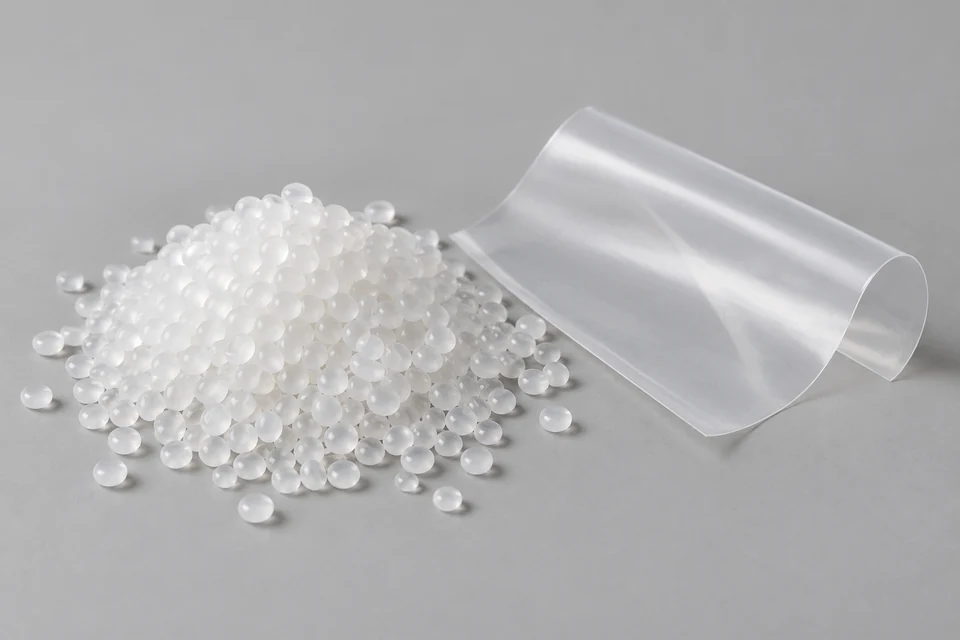
Ethylene n Butyl Acrylate Copolymer (EnBA), also commonly designated EBA in commercial polymer literature, is a thermoplastic ethylene acrylate copolymer formed from ethylene and n butyl acrylate monomer units.
Product & engineering
Understand the product.
Ethylene n Butyl Acrylate Copolymer (EnBA), also commonly designated EBA in commercial polymer literature, is a thermoplastic ethylene acrylate copolymer formed from ethylene and n butyl acrylate monomer units. Its molecular structure consists predominantly of polyethylene chain segments containing randomly incorporated n butyl acrylate units with pendant ester groups. Incorporation of n butyl acrylate disrupts polyethylene crystallinity and molecular packing, reducing stiffness and melting temperature while increasing flexibility, toughness, polarity and low temperature ductility. The magnitude of these effects is governed primarily by n butyl acrylate concentration and molecular weight distribution. Commercial EnBA grades therefore span a wide range of comonomer contents and melt flow characteristics, allowing the material to range from relatively high molecular weight extrusion resins to very high flow adhesive resins. These variables determine crystallinity, modulus, thermal behavior, melt viscosity, filler acceptance, compatibility with polar and nonpolar polymers, interfacial adhesion and conversion behavior. The ester functionality gives EnBA greater polarity than conventional polyethylene while the ethylene rich backbone retains thermoplastic melt processing capability, chemical resistance and polyolefin compatibility.
EnBA is commonly manufactured by high pressure free radical copolymerization and supplied as pelletized resin for extrusion, film conversion, coating, compounding, blending and adhesive formulation. Commercial grades illustrate the breadth of the chemistry. Repsol Ebantix E1770 contains approximately 17% butyl acrylate with a melt flow index of about 7 g per 10 min and is used in extrusion coating and coextrusion applications, representing the lower comonomer portion of the commercial EnBA range. Westlake EBAC SP1802 contains approximately 22.5 wt% butyl acrylate with a melt index of 0.5 g per 10 min and a melting point of about 87°C, providing a relatively high molecular weight, flexible resin for films, compatibilization and impact modification. Dow ELVALOY AC 3427 contains approximately 27% butyl acrylate with a melt index of 4 g per 10 min and a melting point of about 94°C, and is used in polymer modification, compounding and hot melt adhesive formulations. ExxonMobil ENBA330033 contains approximately 32.5 wt% n butyl acrylate and has a melt index of about 330 g per 10 min, giving very high melt flow for hot melt adhesives, sealants and wax blends. These grades demonstrate how increasing comonomer level and changing molecular weight can produce materially different rheological, mechanical and interfacial behavior within the same EnBA chemistry.
The combination of adjustable polarity, flexibility, melt rheology, filler compatibility and adhesion gives EnBA established use in wire and cable compounds, packaging films, extrusion coating, adhesive formulations, masterbatch systems and polymer modification. In wire and cable applications, EnBA is used in compounds and semiconductive materials where polymer compatibility, dispersion of conductive fillers, flexibility and processing stability are critical. In packaging and film applications, lower and intermediate n butyl acrylate grades provide flexibility, low temperature performance, transparency and adhesion to polar substrates. Higher n butyl acrylate and higher flow grades are particularly suited to hot melt adhesive and sealant formulations where melt viscosity and substrate wetting are important formulation parameters. Repsol currently markets EBA grades for film, cable and adhesive applications, while ExxonMobil, Dow and Westlake maintain commercial EnBA or EBA grades spanning adhesive, film, compounding and modification uses.
EnBA is chemically distinct from Ethylene Acrylic Acid Copolymer. EnBA contains ester groups derived from n butyl acrylate. EAA contains free carboxylic acid groups derived from acrylic acid. This difference changes polarity, acid functionality, adhesion mechanism, compatibility, moisture response and downstream formulation behavior, and places EnBA within the functional ethylene acrylate copolymer family used where controlled flexibility and moderate polarity are required.
Composition, supplied form and processing history determine the usable material. Evaluate the property required by the actual application with the specified test method; a chemistry name alone does not define a finished grade.
What turns activity into demand
Qualified formulation or component output creates material purchases through loading, process yield and the supplied mass basis. Raw material, formulated blend and finished-part revenues describe separate transaction stages.
The commercial boundary
For Ethylene n Butyl Acrylate Copolymer (EnBA), distinguish the supplied product from its inputs and the complete application. Report types and applications may overlap; retain the selected edition's product definition, geography, period, unit and transaction basis when comparing estimates.
Which conditions determine usable ethylene n butyl acrylate copolymer (enba) performance?
Ethylene n Butyl Acrylate Copolymer (EnBA), also commonly designated EBA in commercial polymer literature, is a thermoplastic ethylene acrylate copolymer formed from ethylene and n butyl acrylate monomer units. Match formulation and impurity limits to the converting process, then verify the property after processing or curing. Compare like-for-like dry or as-supplied quantities; a finished component and its raw material represent different transaction stages.
Selected research
Industry Growth & Trends
Global Ethylene n Butyl Acrylate Copolymer (EnBA) Industry Growth and Trends Forecast to 2032
Market perspective
According to APO Research, Inc, global ethylene n butyl acrylate copolymer demand reached approximately 101,003.83 tons in 2025, with market revenue of about USD 221.38 million and a weighted factory gate net price of approximately USD 2,191.80 per ton. Sales volume is expected to increase to 106,741.51 tons in 2026, while revenue rises to USD 258.75 million and average price recovers to about USD 2,424.08 per ton. By 2032, global sales volume is projected to reach 126,062.59 tons, with revenue of approximately USD 309.57 million and an average price of about USD 2,455.68 per ton. From 2026 to 2032, volume and revenue are expected to expand at compound annual growth rates of approximately 2.81% and 3.03%, respectively. The limited gap between revenue and volume growth indicates that long range market expansion will rely primarily on additional physical consumption, a gradual normalization of pricing and a richer mix of higher value applications. The global average price reached USD 2,875.15 per ton in 2022 and subsequently declined through 2025 as feedstock, energy, inventory and regional supply conditions normalized. The relatively small scale of EnBA compared with LDPE and EVA also limits the economic case for continuous large capacity additions, favoring staged expansion through flexible high pressure assets, selective retrofits and a limited number of dedicated additions.
The industrial barrier in EnBA lies in the combination of high pressure polymerization assets, repeatable commercial operation and downstream qualification. Production requires high pressure ethylene compression, autoclave or tubular polymerization, precise nBA metering and injection, monomer recycle, separation and pelletizing, while commercial consistency depends on maintaining narrow ranges for nBA content, melt index, molecular weight distribution, gel level, impurities and batch variation. Most major suppliers operate EnBA within shared high pressure ethylene copolymer systems that also manufacture LDPE, EVA, EMA, EEA and related specialty materials. Total high pressure reactor capability therefore differs materially from effective annual EnBA capacity. Reactor time is allocated according to order size, contribution economics, transition losses, minimum campaign size and customer delivery commitments. In 2025, the five largest producers accounted for approximately 62.00% of global sales volume and the ten largest for approximately 98.56%. Established suppliers retain structural advantages from long operating histories, stable process windows, broad grade ranges and customer formulations developed around qualified materials. Hanwha Solutions materially increased Asian supply after commercial production began in 2022, while Chinese capacity is entering the industrial ramp phase. Future share redistribution will depend on sustained qualified output and the speed at which new production is converted into approved customer demand.
Application economics provide a clear direction for future demand. Wire and cable was the largest EnBA application in 2025, consuming approximately 42,522.61 tons and representing about 42.10% of global volume, with revenue of approximately USD 96.37 million. Consumption in this segment is projected to reach 56,980.29 tons by 2032, raising its volume share to approximately 45.20%. High voltage and extra high voltage cable compounds, semiconductive shielding materials, highly filled halogen free flame retardant systems, offshore wind transmission and grid expansion require stable filler loading, carbon black dispersion, flexibility, low temperature performance and extrusion behavior. Qualification cycles are lengthy because changes in base resin can affect compounding, carbon black network formation, extrusion surface, crosslinking behavior and long duration electrical performance. This gives established grades stronger commercial persistence than materials used in less demanding applications. Adhesives and sealants remain the second largest application, with 2025 demand of approximately 24,240.92 tons, although EVA, POE and APAO continue to create substitution pressure. Film and packaging consumed approximately 18,180.69 tons in 2025, while downgauging, multilayer optimization and material efficiency limit the conversion of packaging area growth into resin volume. Polymer modification accounted for approximately 10.20% of global volume in 2025. Products with nBA content of at least 20% represented approximately 52,495.35 tons, or 51.97% of global volume, and continue to command a higher average selling price because of their value in flexible, highly filled and specialized formulations.
Read the full market overview
Regional supply and demand are gradually shifting from a predominantly European and North American structure toward a more balanced system that includes a larger Asian contribution. Europe remains the largest production base, although its share of global output is expected to decline over the forecast period. North America retains a significant role through competitive ethylene supply, established high pressure assets and stable cable, packaging and adhesive demand. Korea has become a meaningful Asian production center, while China is experiencing simultaneous demand growth and the initial development of domestic commercial supply. Chinese EnBA sales are expected to increase from approximately 21,331.03 tons in 2025 to 23,356.48 tons in 2026 and 31,085.16 tons by 2032, placing China slightly above North America and Europe in volume by the end of the forecast period. Growth is being driven by power grid investment, high voltage cable production, industrial materials and functional polymer demand, while domestic commercial production remains in the ramp phase and imports continue to play a significant role. Global production and sales remain closely aligned over time, with annual differences largely reflecting inventory movement, campaign timing and sales recognition. Industry profitability will continue to depend on ethylene and nBA costs, effective asset utilization, transition losses, qualified yield, customer approval, high value application mix and regional supply efficiency. Producers with mature high pressure operating capability, consistent product quality, deep customer qualification and flexible multi product scheduling are expected to retain the strongest competitive economics as Asian supply continues to expand.
Report Scope
This report provides a structured, data-driven view of the global Ethylene n Butyl Acrylate Copolymer (EnBA) market, combining harmonized quantitative metrics with targeted qualitative insight to support business and growth strategy, market positioning, and capital allocation.
The Ethylene n Butyl Acrylate Copolymer (EnBA) market size, estimates, and forecasts are presented in terms of sales volume (t) and revenue (US$ million), with 2025 as the base year and historical and forecast data for 2021-2032. The report segments the global Ethylene n Butyl Acrylate Copolymer (EnBA) market by Type, Application, region/country, and company, provides regional market sizes at the segment level, profiles the competitive landscape and key players and their market ranks, and reviews technology trends and new product developments relevant to Ethylene n Butyl Acrylate Copolymer (EnBA).
Key Companies & Market Share Insights
This section analyzes the strategies and performance of leading manufacturers in the global Ethylene n Butyl Acrylate Copolymer (EnBA) market, including portfolio focus, innovation and product development, mergers and acquisitions, collaborations, and geographic expansion used to sustain or enhance competitive positions. It also summarizes recent corporate developments and key financial indicators and provides global revenue, price, and sales volume data by manufacturer for 2020-2025, enabling benchmarking of scale, pricing, and market share and supporting assessment of market concentration through indicators such as CR5 and CR10.
Ethylene n Butyl Acrylate Copolymer (EnBA) Market by Company
Dow Inc.
SK Functional Polymer
ExxonMobil
Repsol
Borealis
Hanwha Solutions
LUCOBIT
LyondellBasell
Westlake
INEOS
Ethylene n Butyl Acrylate Copolymer (EnBA) Segment by Type
nBA Content ≥20%
nBA Content <20%
Ethylene n Butyl Acrylate Copolymer (EnBA) Segment by Application
Wire & Cable
Adhesives & Sealants
Films & Packaging
Polymer Modification
Others
Ethylene n Butyl Acrylate Copolymer (EnBA) Segment by Region
North America
United States
Canada
Mexico
Europe
Germany
France
U.K.
Italy
Russia
Spain
Netherlands
Switzerland
Sweden
Poland
Asia-Pacific
China
Japan
South Korea
India
Australia
Taiwan
Southeast Asia
South America
Brazil
Argentina
Chile
Colombia
Middle East & Africa
Egypt
South Africa
Israel
Türkiye
GCC Countries
Key Drivers & Barriers
High-impact rendering factors and drivers have been studied in this report to aid the readers to understand the general development. Moreover, the report includes restraints and challenges that may act as stumbling blocks on the way of the players. This will assist the users to be attentive and make informed decisions related to business. Specialists have also laid their focus on the upcoming business prospects.
Reasons to Buy This Report
1. This report will help the readers to understand the competition within the industries and strategies for the competitive environment to enhance the potential profit. The report also focuses on the competitive landscape of the global Ethylene n Butyl Acrylate Copolymer (EnBA) market, and introduces in detail the market share, industry ranking, competitor ecosystem, market performance, new product development, operation situation, expansion, and acquisition. etc. of the main players, which helps the readers to identify the main competitors and deeply understand the competition pattern of the market.
2. This report will help stakeholders to understand the global industry status and trends of Ethylene n Butyl Acrylate Copolymer (EnBA) and provides them with information on key market drivers, restraints, challenges, and opportunities.
3. This report will help stakeholders to understand competitors better and gain more insights to strengthen their position in their businesses. The competitive landscape section includes the market share and rank (in volume and value), competitor ecosystem, new product development, expansion, and acquisition.
4. This report stays updated with novel technology integration, features, and the latest developments in the market.
5. This report helps stakeholders to gain insights into which regions to target globally.
6. This report helps stakeholders to gain insights into the end-user perception concerning the adoption of Ethylene n Butyl Acrylate Copolymer (EnBA).
7. This report helps stakeholders to identify some of the key players in the market and understand their valuable contribution.
Chapter Outline
Chapter 1: Introduces the study scope of this report, executive summary of market segments by type, market size segments for North America, Europe, Asia Pacific, South America, Middle East & Africa.
Chapter 2: Introduces the market dynamics, latest developments of the market, the driving factors and restrictive factors of the market, the challenges and risks faced by manufacturers in the industry, and the analysis of relevant policies in the industry.
Chapter 3: Detailed analysis of Ethylene n Butyl Acrylate Copolymer (EnBA) manufacturers competitive landscape, price, sales, revenue, market share and ranking, latest development plan, merger, and acquisition information, etc.
Chapter 4: Sales, revenue of Ethylene n Butyl Acrylate Copolymer (EnBA) in regional level. It provides a quantitative analysis of the market size and development potential of each region and introduces the future development prospects, and market space in the world.
Chapter 5: Introduces market segments by application, market size segment for North America, Europe, Asia Pacific, South America, Middle East & Africa.
Chapter 6: Provides profiles of key players, introducing the basic situation of the main companies in the market in detail, including product sales, revenue, price, gross margin, product introduction, recent development, etc.
Chapter 7, 8, 9, 10 and 11: North America, Europe, Asia Pacific, South America, Middle East & Africa, sales and revenue by country.
Chapter 12: Analysis of industrial chain, key raw materials, manufacturing cost, and market dynamics.
Chapter 13: Concluding Insights of the report.
More report detail
Tables and figures
Scope & coverage.
Types
- nBA Content ≥20%
- nBA Content <20%
Applications
- Wire & Cable
- Adhesives & Sealants
- Films & Packaging
- Polymer Modification
- Others
Companies covered
- Dow Inc.
- SK Functional Polymer
- ExxonMobil
- Repsol
- Borealis
- Hanwha Solutions
- LUCOBIT
- LyondellBasell
- Westlake
- INEOS
Inside the report.
1 Market Overview
- 1.1 Product Definition
- 1.2 Global Market Growth Prospects
- 1.2.1 Global Ethylene n Butyl Acrylate Copolymer (EnBA) Market Size Estimates and Forecasts (2021-2032)
- 1.2.2 Global Ethylene n Butyl Acrylate Copolymer (EnBA) Sales Estimates and Forecasts (2021-2032)
- 1.3 Ethylene n Butyl Acrylate Copolymer (EnBA) Market by Type
- 1.3.1 nBA Content ≥20%
- 1.3.2 nBA Content <20%
- 1.4 Global Ethylene n Butyl Acrylate Copolymer (EnBA) Market Size by Type
- 1.4.1 Global Ethylene n Butyl Acrylate Copolymer (EnBA) Market Size Overview by Type (2021-2032)
- 1.4.2 Global Ethylene n Butyl Acrylate Copolymer (EnBA) Historic Market Size Review by Type (2021-2026)
- 1.4.3 Global Ethylene n Butyl Acrylate Copolymer (EnBA) Forecasted Market Size by Type (2027-2032)
- 1.5 Key Regions Market Size by Type
- 1.5.1 North America Ethylene n Butyl Acrylate Copolymer (EnBA) Sales Breakdown by Type (2021-2026)
- 1.5.2 Europe Ethylene n Butyl Acrylate Copolymer (EnBA) Sales Breakdown by Type (2021-2026)
- 1.5.3 Asia-Pacific Ethylene n Butyl Acrylate Copolymer (EnBA) Sales Breakdown by Type (2021-2026)
- 1.5.4 South America Ethylene n Butyl Acrylate Copolymer (EnBA) Sales Breakdown by Type (2021-2026)
- 1.5.5 Middle East and Africa Ethylene n Butyl Acrylate Copolymer (EnBA) Sales Breakdown by Type (2021-2026)
2 Global Market Dynamics
- 2.1 Ethylene n Butyl Acrylate Copolymer (EnBA) Industry Trends
- 2.2 Ethylene n Butyl Acrylate Copolymer (EnBA) Industry Drivers
- 2.3 Ethylene n Butyl Acrylate Copolymer (EnBA) Industry Opportunities and Challenges
- 2.4 Ethylene n Butyl Acrylate Copolymer (EnBA) Industry Restraints
3 Market Competitive Landscape by Company
- 3.1 Global Top Players by Ethylene n Butyl Acrylate Copolymer (EnBA) Revenue (2021-2026)
- 3.2 Global Top Players by Ethylene n Butyl Acrylate Copolymer (EnBA) Sales (2021-2026)
- 3.3 Global Top Players by Ethylene n Butyl Acrylate Copolymer (EnBA) Price (2021-2026)
- 3.4 Global Ethylene n Butyl Acrylate Copolymer (EnBA) Industry Company Ranking, 2024 VS 2025 VS 2026
- 3.5 Global Ethylene n Butyl Acrylate Copolymer (EnBA) Major Company Production Sites & Headquarters
- 3.6 Global Ethylene n Butyl Acrylate Copolymer (EnBA) Company, Product Type & Application
- 3.7 Global Ethylene n Butyl Acrylate Copolymer (EnBA) Company Establishment Date
- 3.8 Market Competitive Analysis
- 3.8.1 Global Ethylene n Butyl Acrylate Copolymer (EnBA) Market CR5 and HHI
- 3.8.2 Global Top 5 and 10 Ethylene n Butyl Acrylate Copolymer (EnBA) Players Market Share by Revenue in 2025
- 3.8.3 2025 Ethylene n Butyl Acrylate Copolymer (EnBA) Tier 1, Tier 2, and Tier 3
4 Ethylene n Butyl Acrylate Copolymer (EnBA) Regional Status and Outlook
- 4.1 Global Ethylene n Butyl Acrylate Copolymer (EnBA) Market Size and CAGR by Region: 2021 VS 2025 VS 2032
- 4.2 Global Ethylene n Butyl Acrylate Copolymer (EnBA) Historic Market Size by Region
- 4.2.1 Global Ethylene n Butyl Acrylate Copolymer (EnBA) Sales in Volume by Region (2021-2026)
- 4.2.2 Global Ethylene n Butyl Acrylate Copolymer (EnBA) Sales in Value by Region (2021-2026)
- 4.2.3 Global Ethylene n Butyl Acrylate Copolymer (EnBA) Sales (Volume & Value), Price and Gross Margin (2021-2026)
- 4.3 Global Ethylene n Butyl Acrylate Copolymer (EnBA) Forecasted Market Size by Region
- 4.3.1 Global Ethylene n Butyl Acrylate Copolymer (EnBA) Sales in Volume by Region (2027-2032)
- 4.3.2 Global Ethylene n Butyl Acrylate Copolymer (EnBA) Sales in Value by Region (2027-2032)
- 4.3.3 Global Ethylene n Butyl Acrylate Copolymer (EnBA) Sales (Volume & Value), Price and Gross Margin (2027-2032)
5 Ethylene n Butyl Acrylate Copolymer (EnBA) by Application
- 5.1 Ethylene n Butyl Acrylate Copolymer (EnBA) Market by Application
- 5.1.1 Wire & Cable
- 5.1.2 Adhesives & Sealants
- 5.1.3 Films & Packaging
- 5.1.4 Polymer Modification
- 5.1.5 Others
- 5.2 Global Ethylene n Butyl Acrylate Copolymer (EnBA) Market Size by Application
- 5.2.1 Global Ethylene n Butyl Acrylate Copolymer (EnBA) Market Size Overview by Application (2021-2032)
- 5.2.2 Global Ethylene n Butyl Acrylate Copolymer (EnBA) Historic Market Size Review by Application (2021-2026)
- 5.2.3 Global Ethylene n Butyl Acrylate Copolymer (EnBA) Forecasted Market Size by Application (2027-2032)
- 5.3 Key Regions Market Size by Application
- 5.3.1 North America Ethylene n Butyl Acrylate Copolymer (EnBA) Sales Breakdown by Application (2021-2026)
- 5.3.2 Europe Ethylene n Butyl Acrylate Copolymer (EnBA) Sales Breakdown by Application (2021-2026)
- 5.3.3 Asia-Pacific Ethylene n Butyl Acrylate Copolymer (EnBA) Sales Breakdown by Application (2021-2026)
- 5.3.4 South America Ethylene n Butyl Acrylate Copolymer (EnBA) Sales Breakdown by Application (2021-2026)
- 5.3.5 Middle East and Africa Ethylene n Butyl Acrylate Copolymer (EnBA) Sales Breakdown by Application (2021-2026)
6 Company Profiles
- 6.1 Dow Inc.
- 6.1.1 Dow Inc. Company Information
- 6.1.2 Dow Inc. Business Overview
- 6.1.3 Dow Inc. Ethylene n Butyl Acrylate Copolymer (EnBA) Sales, Revenue and Gross Margin (2021-2026)
- 6.1.4 Dow Inc. Ethylene n Butyl Acrylate Copolymer (EnBA) Product Portfolio
- 6.1.5 Dow Inc. Recent Developments
- 6.2 SK Functional Polymer
- 6.2.1 SK Functional Polymer Company Information
- 6.2.2 SK Functional Polymer Business Overview
- 6.2.3 SK Functional Polymer Ethylene n Butyl Acrylate Copolymer (EnBA) Sales, Revenue and Gross Margin (2021-2026)
- 6.2.4 SK Functional Polymer Ethylene n Butyl Acrylate Copolymer (EnBA) Product Portfolio
- 6.2.5 SK Functional Polymer Recent Developments
- 6.3 ExxonMobil
- 6.3.1 ExxonMobil Company Information
- 6.3.2 ExxonMobil Business Overview
- 6.3.3 ExxonMobil Ethylene n Butyl Acrylate Copolymer (EnBA) Sales, Revenue and Gross Margin (2021-2026)
- 6.3.4 ExxonMobil Ethylene n Butyl Acrylate Copolymer (EnBA) Product Portfolio
- 6.3.5 ExxonMobil Recent Developments
- 6.4 Repsol
- 6.4.1 Repsol Company Information
- 6.4.2 Repsol Business Overview
- 6.4.3 Repsol Ethylene n Butyl Acrylate Copolymer (EnBA) Sales, Revenue and Gross Margin (2021-2026)
- 6.4.4 Repsol Ethylene n Butyl Acrylate Copolymer (EnBA) Product Portfolio
- 6.4.5 Repsol Recent Developments
- 6.5 Borealis
- 6.5.1 Borealis Company Information
- 6.5.2 Borealis Business Overview
- 6.5.3 Borealis Ethylene n Butyl Acrylate Copolymer (EnBA) Sales, Revenue and Gross Margin (2021-2026)
- 6.5.4 Borealis Ethylene n Butyl Acrylate Copolymer (EnBA) Product Portfolio
- 6.5.5 Borealis Recent Developments
- 6.6 Hanwha Solutions
- 6.6.1 Hanwha Solutions Company Information
- 6.6.2 Hanwha Solutions Business Overview
- 6.6.3 Hanwha Solutions Ethylene n Butyl Acrylate Copolymer (EnBA) Sales, Revenue and Gross Margin (2021-2026)
- 6.6.4 Hanwha Solutions Ethylene n Butyl Acrylate Copolymer (EnBA) Product Portfolio
- 6.6.5 Hanwha Solutions Recent Developments
- 6.7 LUCOBIT
- 6.7.1 LUCOBIT Company Information
- 6.7.2 LUCOBIT Business Overview
- 6.7.3 LUCOBIT Ethylene n Butyl Acrylate Copolymer (EnBA) Sales, Revenue and Gross Margin (2021-2026)
- 6.7.4 LUCOBIT Ethylene n Butyl Acrylate Copolymer (EnBA) Product Portfolio
- 6.7.5 LUCOBIT Recent Developments
- 6.8 LyondellBasell
- 6.8.1 LyondellBasell Company Information
- 6.8.2 LyondellBasell Business Overview
- 6.8.3 LyondellBasell Ethylene n Butyl Acrylate Copolymer (EnBA) Sales, Revenue and Gross Margin (2021-2026)
- 6.8.4 LyondellBasell Ethylene n Butyl Acrylate Copolymer (EnBA) Product Portfolio
- 6.8.5 LyondellBasell Recent Developments
- 6.9 Westlake
- 6.9.1 Westlake Company Information
- 6.9.2 Westlake Business Overview
- 6.9.3 Westlake Ethylene n Butyl Acrylate Copolymer (EnBA) Sales, Revenue and Gross Margin (2021-2026)
- 6.9.4 Westlake Ethylene n Butyl Acrylate Copolymer (EnBA) Product Portfolio
- 6.9.5 Westlake Recent Developments
- 6.10 INEOS
- 6.10.1 INEOS Company Information
- 6.10.2 INEOS Business Overview
- 6.10.3 INEOS Ethylene n Butyl Acrylate Copolymer (EnBA) Sales, Revenue and Gross Margin (2021-2026)
- 6.10.4 INEOS Ethylene n Butyl Acrylate Copolymer (EnBA) Product Portfolio
- 6.10.5 INEOS Recent Developments
7 North America by Country
- 7.1 North America Ethylene n Butyl Acrylate Copolymer (EnBA) Sales by Country
- 7.1.1 North America Ethylene n Butyl Acrylate Copolymer (EnBA) Sales Growth Rate (CAGR) by Country: 2021 VS 2025 VS 2032
- 7.1.2 North America Ethylene n Butyl Acrylate Copolymer (EnBA) Sales by Country (2021-2026)
- 7.1.3 North America Ethylene n Butyl Acrylate Copolymer (EnBA) Sales Forecast by Country (2027-2032)
- 7.2 North America Ethylene n Butyl Acrylate Copolymer (EnBA) Market Size by Country
- 7.2.1 North America Ethylene n Butyl Acrylate Copolymer (EnBA) Market Size Growth Rate (CAGR) by Country: 2021 VS 2025 VS 2032
- 7.2.2 North America Ethylene n Butyl Acrylate Copolymer (EnBA) Market Size by Country (2021-2026)
- 7.2.3 North America Ethylene n Butyl Acrylate Copolymer (EnBA) Market Size Forecast by Country (2027-2032)
8 Europe by Country
- 8.1 Europe Ethylene n Butyl Acrylate Copolymer (EnBA) Sales by Country
- 8.1.1 Europe Ethylene n Butyl Acrylate Copolymer (EnBA) Sales Growth Rate (CAGR) by Country: 2021 VS 2025 VS 2032
- 8.1.2 Europe Ethylene n Butyl Acrylate Copolymer (EnBA) Sales by Country (2021-2026)
- 8.1.3 Europe Ethylene n Butyl Acrylate Copolymer (EnBA) Sales Forecast by Country (2027-2032)
- 8.2 Europe Ethylene n Butyl Acrylate Copolymer (EnBA) Market Size by Country
- 8.2.1 Europe Ethylene n Butyl Acrylate Copolymer (EnBA) Market Size Growth Rate (CAGR) by Country: 2021 VS 2025 VS 2032
- 8.2.2 Europe Ethylene n Butyl Acrylate Copolymer (EnBA) Market Size by Country (2021-2026)
- 8.2.3 Europe Ethylene n Butyl Acrylate Copolymer (EnBA) Market Size Forecast by Country (2027-2032)
9 Asia-Pacific by Country
- 9.1 Asia-Pacific Ethylene n Butyl Acrylate Copolymer (EnBA) Sales by Country
- 9.1.1 Asia-Pacific Ethylene n Butyl Acrylate Copolymer (EnBA) Sales Growth Rate (CAGR) by Country: 2021 VS 2025 VS 2032
- 9.1.2 Asia-Pacific Ethylene n Butyl Acrylate Copolymer (EnBA) Sales by Country (2021-2026)
- 9.1.3 Asia-Pacific Ethylene n Butyl Acrylate Copolymer (EnBA) Sales Forecast by Country (2027-2032)
- 9.2 Asia-Pacific Ethylene n Butyl Acrylate Copolymer (EnBA) Market Size by Country
- 9.2.1 Asia-Pacific Ethylene n Butyl Acrylate Copolymer (EnBA) Market Size Growth Rate (CAGR) by Country: 2021 VS 2025 VS 2032
- 9.2.2 Asia-Pacific Ethylene n Butyl Acrylate Copolymer (EnBA) Market Size by Country (2021-2026)
- 9.2.3 Asia-Pacific Ethylene n Butyl Acrylate Copolymer (EnBA) Market Size Forecast by Country (2027-2032)
10 South America by Country
- 10.1 South America Ethylene n Butyl Acrylate Copolymer (EnBA) Sales by Country
- 10.1.1 South America Ethylene n Butyl Acrylate Copolymer (EnBA) Sales Growth Rate (CAGR) by Country: 2021 VS 2025 VS 2032
- 10.1.2 South America Ethylene n Butyl Acrylate Copolymer (EnBA) Sales by Country (2021-2026)
- 10.1.3 South America Ethylene n Butyl Acrylate Copolymer (EnBA) Sales Forecast by Country (2027-2032)
- 10.2 South America Ethylene n Butyl Acrylate Copolymer (EnBA) Market Size by Country
- 10.2.1 South America Ethylene n Butyl Acrylate Copolymer (EnBA) Market Size Growth Rate (CAGR) by Country: 2021 VS 2025 VS 2032
- 10.2.2 South America Ethylene n Butyl Acrylate Copolymer (EnBA) Market Size by Country (2021-2026)
- 10.2.3 South America Ethylene n Butyl Acrylate Copolymer (EnBA) Market Size Forecast by Country (2027-2032)
11 Middle East and Africa by Country
- 11.1 Middle East and Africa Ethylene n Butyl Acrylate Copolymer (EnBA) Sales by Country
- 11.1.1 Middle East and Africa Ethylene n Butyl Acrylate Copolymer (EnBA) Sales Growth Rate (CAGR) by Country: 2021 VS 2025 VS 2032
- 11.1.2 Middle East and Africa Ethylene n Butyl Acrylate Copolymer (EnBA) Sales by Country (2021-2026)
- 11.1.3 Middle East and Africa Ethylene n Butyl Acrylate Copolymer (EnBA) Sales Forecast by Country (2027-2032)
- 11.2 Middle East and Africa Ethylene n Butyl Acrylate Copolymer (EnBA) Market Size by Country
- 11.2.1 Middle East and Africa Ethylene n Butyl Acrylate Copolymer (EnBA) Market Size Growth Rate (CAGR) by Country: 2021 VS 2025 VS 2032
- 11.2.2 Middle East and Africa Ethylene n Butyl Acrylate Copolymer (EnBA) Market Size by Country (2021-2026)
- 11.2.3 Middle East and Africa Ethylene n Butyl Acrylate Copolymer (EnBA) Market Size Forecast by Country (2027-2032)
12 Value Chain and Sales Channels Analysis
- 12.1 Ethylene n Butyl Acrylate Copolymer (EnBA) Value Chain Analysis
- 12.1.1 Ethylene n Butyl Acrylate Copolymer (EnBA) Key Raw Materials
- 12.1.2 Key Raw Materials Price
- 12.1.3 Raw Materials Key Suppliers
- 12.1.4 Manufacturing Cost Structure
- 12.1.5 Ethylene n Butyl Acrylate Copolymer (EnBA) Production Mode & Process
- 12.2 Ethylene n Butyl Acrylate Copolymer (EnBA) Sales Channels Analysis
- 12.2.1 Direct Comparison with Distribution Share
- 12.2.2 Ethylene n Butyl Acrylate Copolymer (EnBA) Distributors
- 12.2.3 Ethylene n Butyl Acrylate Copolymer (EnBA) Customers
13 Concluding Insights
14 Appendix
- 14.1 Reasons for Doing This Study
- 14.2 Research Methodology
- 14.3 Research Process
- 14.4 Authors List of This Report
- 14.5 Data Source
- 14.5.1 Secondary Sources
- 14.5.2 Primary Sources
- 14.6 Disclaimer
GET THE RESEARCH
Choose your license.
Choose who needs access.
All options are for this report and research series.
PDF by email within 3–5 working days after payment confirmation.
Talk to an analyst