APO RESEARCH · REPORT
HDPE Double Wall Corrugated Pipe
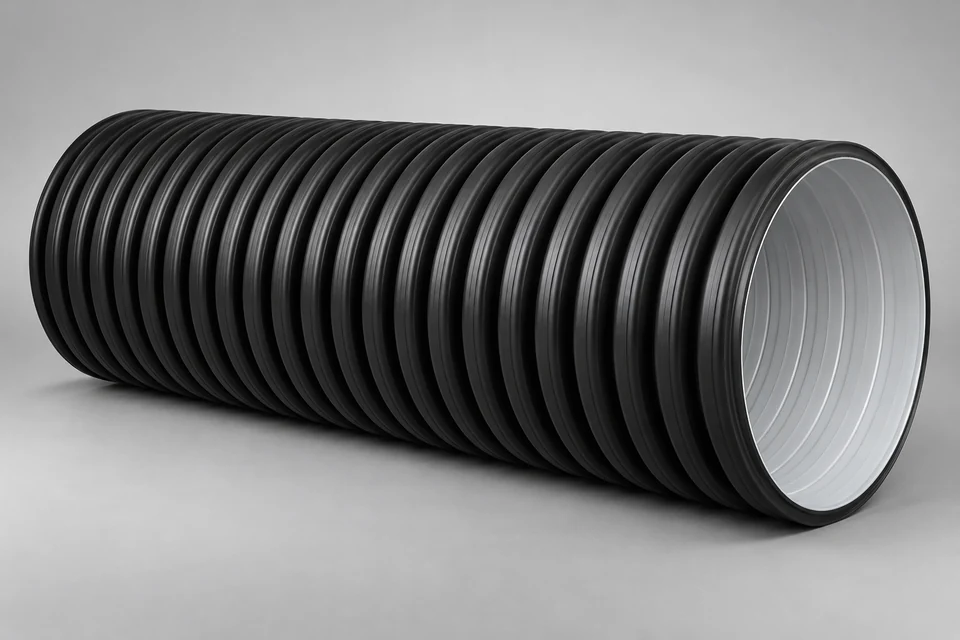
HDPE double wall corrugated pipe is an annular structured wall thermoplastic pipe formed from high density polyethylene as an integral double wall section.
Product & engineering
Understand the product.
HDPE double wall corrugated pipe is an annular structured wall thermoplastic pipe formed from high density polyethylene as an integral double wall section. Its cross section consists of a continuous smooth inner liner and a regularly corrugated outer wall joined at the corrugation valleys during melt forming. The inner liner provides a continuous hydraulic bore, while the corrugated outer profile places polymer farther from the sectional neutral axis, increasing the second moment of area and circumferential rigidity without the mass of an equivalent solid wall section. The resulting structure combines low internal flow resistance with the radial flexibility and external load resistance required for buried gravity drainage, sewerage, culvert and conduit systems.
The material is a pipe grade HDPE compound with controlled density, molecular weight distribution, melt flow behaviour, tensile yield response, flexural modulus, impact strength, oxidation stability and slow crack growth resistance. These characteristics govern melt processing, wall fusion, profile stability and long term mechanical behaviour. The formulation generally contains primary and secondary antioxidants, carbon black or another ultraviolet stabilisation system, pigments and limited processing aids. Carbon black limits photo oxidation before burial and during exposed service. A lighter inner liner may be incorporated to improve bore visibility. Its colour has no primary structural function.
Virgin polyethylene, qualified internal process rework and controlled recycled polyethylene may be incorporated according to the applicable material specification. Finished performance depends on the composition and consistency of the compound. Mixed polymer contamination, inorganic inclusions, volatile matter, excessive thermal history, unstable melt viscosity and poor carbon black or pigment dispersion can disrupt extrusion, weaken the fused interface, reduce low temperature impact strength and accelerate environmental stress cracking. Repeated thermal processing can also consume stabilisers and reduce molecular integrity even when the nominal polymer remains polyethylene.
Production uses simultaneous double layer extrusion followed by continuous annular corrugation forming. A typical line includes gravimetric feeders, blending equipment, two single screw extruders, melt filtration components, a coextrusion die, a continuous corrugator with circulating mould blocks, vacuum and internal air systems, water cooling circuits, haul off equipment, cutting units, socket forming equipment and marking systems. One extruder supplies the melt forming the corrugated structural wall. The second supplies the melt forming the smooth inner liner. Their output ratio controls material distribution between the two walls and directly influences liner thickness, corrugation fill, unit mass and ring stiffness.
The coextrusion die delivers two concentric polyethylene melt streams into the moving corrugator. Vacuum draws the outer melt against the annular cavities of the mould blocks, producing the corrugation crowns, sidewalls and valleys. Die geometry, a forming mandrel and controlled internal air pressure maintain the cylindrical inner surface. The inner melt contacts the outer wall at the corrugation valleys while both layers retain sufficient temperature and molecular mobility for interfacial diffusion. The resulting fusion zones connect the liner and corrugated wall into a continuous structural section without adhesive or mechanical lamination.
Progressive cooling fixes the corrugation depth, pitch, crown width, valley geometry and bore diameter while controlling shrinkage and residual stress. The pipe remains supported within the mould train until its profile has sufficient dimensional stability. It is subsequently cooled, cut to length and formed with an integral socket where a bell and spigot connection is required. Perforation may be introduced for groundwater collection products. Solid wall continuity is retained in nonperforated products intended for closed conveyance.
Melt temperature, melt pressure, extruder output, inner and outer wall output ratio, line speed, vacuum level, internal forming pressure, mould temperature and cooling rate jointly determine the finished section. These variables control liner thickness, corrugation depth, pitch, crown formation, valley fusion, mass per unit length, diameter, ovality and residual stress. Insufficient inner wall output produces local thinning and reduces impact and abrasion allowance. Inadequate interface temperature or contact pressure produces weak fusion, voids or wall separation. Pressure fluctuations can generate inner wall waviness, irregular corrugations and longitudinal mass variation. Uneven cooling can produce asymmetric shrinkage, ovality, local collapse and locked in stress. Additional polymer contributes effectively to ring stiffness only when it is placed within a geometrically efficient and fully fused profile.
Dimensions are designated according to either nominal internal diameter, DN ID, or nominal external diameter, DN OD. The two systems define different physical geometries at the same nominal number and cannot be treated as equivalent. The actual internal diameter determines hydraulic area, while external diameter, corrugation depth and material distribution influence radial stiffness and joint geometry. Commercial products commonly extend from approximately DN 100 mm to DN 1500 mm, with smaller and larger sizes available from specialised production systems. Pipe length, socket dimensions, corrugation pitch and wall distribution vary with diameter, stiffness class and the dimensional series applied by the manufacturer.
Ring stiffness expresses the resistance of the complete pipe profile to diametral deformation under parallel plate loading. It arises from the modulus of the polyethylene and the geometric efficiency of the structured wall section. Corrugation depth, pitch, crown width, sidewall angle, valley width, liner thickness, radial material distribution and fusion continuity all influence the stiffness obtained from a given unit mass. ISO based systems commonly express nominal ring stiffness as SN 2, SN 4, SN 8, SN 12.5 or SN 16 in kilonewtons per square metre. ASTM pipe stiffness uses a different test expression and has no direct numerical equivalence to ISO SN classifications.
Ring flexibility describes the capacity of the section to undergo substantial diametral deformation while retaining wall continuity. Creep represents the time dependent strain response of polyethylene under sustained stress. Local buckling resistance reflects the stability of individual corrugation crowns, sidewalls, valleys and the inner liner under radial deformation. These behaviours depend on material modulus, profile geometry, wall thickness, fusion quality and initial dimensional imperfections. Ring stiffness therefore describes one component of radial behaviour. It does not independently represent resistance to wall separation, brittle fracture, creep deformation or local profile instability.
As a flexible pipe, the corrugated section deforms under external radial loading and develops circumferential strain throughout the wall profile. The surrounding soil restrains lateral expansion in buried service and becomes part of the load carrying system. This interaction explains why the pipe combines lower inherent rigidity with substantial installed load capacity. Excessive radial deformation can produce ovalisation, inner liner instability, corrugation buckling, joint displacement or wall crushing. The form and location of these responses are governed by diameter, profile geometry, material modulus, creep behaviour and fusion continuity.
The principal connection consists of an integral bell and spigot joint fitted with an elastomeric sealing ring. External couplers, split couplers, wraparound bands and fabricated connectors are also used. Bends, branches, reducers, end closures, manhole adaptors and transitions may be moulded or fabricated from compatible pipe sections. Joint behaviour is controlled by socket geometry, spigot dimensions, insertion depth, gasket compression, circumferential contact pressure, pipe end ovality and elastomer properties. Soil tight joints limit the movement of surrounding fines through the connection. Watertight joints limit infiltration and exfiltration. Limited angular movement can be accommodated through deformation of the socket and sealing ring while circumferential sealing contact is maintained.
HDPE is electrically insulating and resistant to electrochemical corrosion. It does not undergo rust formation, galvanic attack or corrosion related section loss. The polymer is resistant to water, moist soil, road salts and many aqueous acids, alkalis and inorganic salts. Chemical response remains dependent on concentration, temperature, duration and mechanical stress. Strong oxidising substances can attack the polyethylene molecular chain. Selected hydrocarbons and organic solvents may cause absorption, swelling, softening or accelerated environmental stress cracking.
Abrasion resistance arises from the toughness, low surface hardness and elastic recovery of the polyethylene matrix. The smooth bore can tolerate sustained transport of water containing sand, silt and other suspended mineral particles without the corrosion assisted wear mechanisms present in metallic pipe. Actual wear depends on particle hardness, concentration, velocity, impact angle, turbulence and flow pattern. Corrugations remain outside the principal flow surface, preventing the profile geometry from directly increasing internal turbulence or trapping solids.
Low temperature impact resistance derives from the ductile response of pipe grade polyethylene and the capacity of the corrugated section to absorb energy through local deformation. The retained impact strength depends on resin molecular structure, compound quality, wall thickness, corrugation geometry, interface fusion and prior surface damage. Sharp notches, inclusions, voids and poorly fused valleys create local stress concentrations and may initiate cracking under impact or sustained loading.
Slow crack growth resistance governs the propagation of cracks from small defects under stresses below the short term yield strength of the polymer. Molecular weight distribution, tie molecule density, resin architecture, thermal history and compound purity influence this behaviour. Environmental stress cracking can develop when mechanical stress acts together with chemically active substances. Antioxidants retard thermo oxidative chain scission, while carbon black absorbs ultraviolet radiation and limits photo oxidation. Poor stabiliser dispersion creates locally underprotected regions. Elevated temperature lowers modulus, reduces ring stiffness and accelerates creep, oxidation and crack growth processes.
The smooth inner liner forms a continuous bore with low hydraulic roughness and isolates the conveyed fluid from the external corrugation profile. Hydraulic capacity is determined principally by actual internal diameter, gradient, flow depth, bore deformation and surface condition. The absence of metallic corrosion products preserves the basic flow geometry and avoids roughness growth caused by rust scale. Sediment, grease, mineral deposits and biological films can still reduce the effective flow area. The inner liner also provides a continuous abrasion surface and limits fluid contact with the structural cavities of the outer profile.
Perforated HDPE double wall corrugated pipe incorporates defined openings through the wall for groundwater interception and subsurface drainage. The opening pattern, slot or hole geometry, total inlet area and surrounding filter medium determine inflow behaviour and soil retention. Nonperforated pipe retains a closed bore for the conveyance of sewage, stormwater, groundwater, industrial drainage and other chemically compatible liquids under gravity flow. Cable protection variants use the same smooth inner wall and corrugated outer wall principle, with their diameter, flexibility, internal friction, colour and connection geometry adapted to power and telecommunications conduits.
The principal applications include municipal sewerage, stormwater drainage and culverts, agricultural drainage, industrial drainage and underground cable protection. Municipal use includes gravity sewers, storm drains, roadway cross drains, detention and retention pipework, ditch enclosures and interconnections between drainage structures. Agricultural use principally concerns subsurface water collection and water table control. Industrial use includes chemically compatible process drainage, mine drainage, site runoff and gravity wastewater conveyance. Culvert products carry surface water beneath roads, railways and embankments, where the corrugated profile provides radial structural efficiency at large diameters.
The principal product frameworks include ISO 21138 parts 1 and 3 and EN 13476 parts 1 and 3 for underground nonpressure drainage and sewerage systems using structured wall thermoplastic pipe. ASTM F2306 and ASTM F2648 cover corresponding polyethylene corrugated pipe products in North America, while AASHTO M252 and AASHTO M294 address highway drainage applications. GB/T 19472.1 covers polyethylene double wall corrugated piping systems in China. ISO 9969 defines ring stiffness measurement, and ISO 13259 and ASTM D3212 address elastomeric sealed joint tightness. Material composition, dimensional basis, diameter, profile geometry, inner wall continuity, interwall fusion, ring stiffness, ring flexibility, impact behaviour, connection structure and intended fluid duty collectively define the technical identity of HDPE double wall corrugated pipe.
Composition, supplied form and processing history determine the usable material. Evaluate the property required by the actual application with the specified test method; a chemistry name alone does not define a finished grade.
What turns activity into demand
Qualified formulation or component output creates material purchases through loading, process yield and the supplied mass basis. Raw material, formulated blend and finished-part revenues describe separate transaction stages.
The commercial boundary
For HDPE Double Wall Corrugated Pipe, distinguish the supplied product from its inputs and the complete application. Report types and applications may overlap; retain the selected edition's product definition, geography, period, unit and transaction basis when comparing estimates.
Which conditions determine usable hdpe double wall corrugated pipe performance?
HDPE double wall corrugated pipe is an annular structured wall thermoplastic pipe formed from high density polyethylene as an integral double wall section. Match formulation and impurity limits to the converting process, then verify the property after processing or curing. Compare like-for-like dry or as-supplied quantities; a finished component and its raw material represent different transaction stages.
Selected research
Market Structure
Global HDPE Double Wall Corrugated Pipe Market by Size, by Type, by Application, by Region, History and Forecast 2021-2032
Market perspective
HDPE double wall corrugated pipe is an annular structured wall thermoplastic pipe formed from high density polyethylene as an integral double wall section. Its cross section consists of a continuous smooth inner liner and a regularly corrugated outer wall joined at the corrugation valleys during melt forming. The inner liner provides a continuous hydraulic bore, while the corrugated outer profile places polymer farther from the sectional neutral axis, increasing the second moment of area and circumferential rigidity without the mass of an equivalent solid wall section. The resulting structure combines low internal flow resistance with the radial flexibility and external load resistance required for buried gravity drainage, sewerage, culvert and conduit systems.
The material is a pipe grade HDPE compound with controlled density, molecular weight distribution, melt flow behaviour, tensile yield response, flexural modulus, impact strength, oxidation stability and slow crack growth resistance. These characteristics govern melt processing, wall fusion, profile stability and long term mechanical behaviour. The formulation generally contains primary and secondary antioxidants, carbon black or another ultraviolet stabilisation system, pigments and limited processing aids. Carbon black limits photo oxidation before burial and during exposed service. A lighter inner liner may be incorporated to improve bore visibility. Its colour has no primary structural function.
Virgin polyethylene, qualified internal process rework and controlled recycled polyethylene may be incorporated according to the applicable material specification. Finished performance depends on the composition and consistency of the compound. Mixed polymer contamination, inorganic inclusions, volatile matter, excessive thermal history, unstable melt viscosity and poor carbon black or pigment dispersion can disrupt extrusion, weaken the fused interface, reduce low temperature impact strength and accelerate environmental stress cracking. Repeated thermal processing can also consume stabilisers and reduce molecular integrity even when the nominal polymer remains polyethylene.
Read the full market overview
Production uses simultaneous double layer extrusion followed by continuous annular corrugation forming. A typical line includes gravimetric feeders, blending equipment, two single screw extruders, melt filtration components, a coextrusion die, a continuous corrugator with circulating mould blocks, vacuum and internal air systems, water cooling circuits, haul off equipment, cutting units, socket forming equipment and marking systems. One extruder supplies the melt forming the corrugated structural wall. The second supplies the melt forming the smooth inner liner. Their output ratio controls material distribution between the two walls and directly influences liner thickness, corrugation fill, unit mass and ring stiffness.
The coextrusion die delivers two concentric polyethylene melt streams into the moving corrugator. Vacuum draws the outer melt against the annular cavities of the mould blocks, producing the corrugation crowns, sidewalls and valleys. Die geometry, a forming mandrel and controlled internal air pressure maintain the cylindrical inner surface. The inner melt contacts the outer wall at the corrugation valleys while both layers retain sufficient temperature and molecular mobility for interfacial diffusion. The resulting fusion zones connect the liner and corrugated wall into a continuous structural section without adhesive or mechanical lamination.
Progressive cooling fixes the corrugation depth, pitch, crown width, valley geometry and bore diameter while controlling shrinkage and residual stress. The pipe remains supported within the mould train until its profile has sufficient dimensional stability. It is subsequently cooled, cut to length and formed with an integral socket where a bell and spigot connection is required. Perforation may be introduced for groundwater collection products. Solid wall continuity is retained in nonperforated products intended for closed conveyance.
Melt temperature, melt pressure, extruder output, inner and outer wall output ratio, line speed, vacuum level, internal forming pressure, mould temperature and cooling rate jointly determine the finished section. These variables control liner thickness, corrugation depth, pitch, crown formation, valley fusion, mass per unit length, diameter, ovality and residual stress. Insufficient inner wall output produces local thinning and reduces impact and abrasion allowance. Inadequate interface temperature or contact pressure produces weak fusion, voids or wall separation. Pressure fluctuations can generate inner wall waviness, irregular corrugations and longitudinal mass variation. Uneven cooling can produce asymmetric shrinkage, ovality, local collapse and locked in stress. Additional polymer contributes effectively to ring stiffness only when it is placed within a geometrically efficient and fully fused profile.
Dimensions are designated according to either nominal internal diameter, DN ID, or nominal external diameter, DN OD. The two systems define different physical geometries at the same nominal number and cannot be treated as equivalent. The actual internal diameter determines hydraulic area, while external diameter, corrugation depth and material distribution influence radial stiffness and joint geometry. Commercial products commonly extend from approximately DN 100 mm to DN 1500 mm, with smaller and larger sizes available from specialised production systems. Pipe length, socket dimensions, corrugation pitch and wall distribution vary with diameter, stiffness class and the dimensional series applied by the manufacturer.
Ring stiffness expresses the resistance of the complete pipe profile to diametral deformation under parallel plate loading. It arises from the modulus of the polyethylene and the geometric efficiency of the structured wall section. Corrugation depth, pitch, crown width, sidewall angle, valley width, liner thickness, radial material distribution and fusion continuity all influence the stiffness obtained from a given unit mass. ISO based systems commonly express nominal ring stiffness as SN 2, SN 4, SN 8, SN 12.5 or SN 16 in kilonewtons per square metre. ASTM pipe stiffness uses a different test expression and has no direct numerical equivalence to ISO SN classifications.
Ring flexibility describes the capacity of the section to undergo substantial diametral deformation while retaining wall continuity. Creep represents the time dependent strain response of polyethylene under sustained stress. Local buckling resistance reflects the stability of individual corrugation crowns, sidewalls, valleys and the inner liner under radial deformation. These behaviours depend on material modulus, profile geometry, wall thickness, fusion quality and initial dimensional imperfections. Ring stiffness therefore describes one component of radial behaviour. It does not independently represent resistance to wall separation, brittle fracture, creep deformation or local profile instability.
As a flexible pipe, the corrugated section deforms under external radial loading and develops circumferential strain throughout the wall profile. The surrounding soil restrains lateral expansion in buried service and becomes part of the load carrying system. This interaction explains why the pipe combines lower inherent rigidity with substantial installed load capacity. Excessive radial deformation can produce ovalisation, inner liner instability, corrugation buckling, joint displacement or wall crushing. The form and location of these responses are governed by diameter, profile geometry, material modulus, creep behaviour and fusion continuity.
The principal connection consists of an integral bell and spigot joint fitted with an elastomeric sealing ring. External couplers, split couplers, wraparound bands and fabricated connectors are also used. Bends, branches, reducers, end closures, manhole adaptors and transitions may be moulded or fabricated from compatible pipe sections. Joint behaviour is controlled by socket geometry, spigot dimensions, insertion depth, gasket compression, circumferential contact pressure, pipe end ovality and elastomer properties. Soil tight joints limit the movement of surrounding fines through the connection. Watertight joints limit infiltration and exfiltration. Limited angular movement can be accommodated through deformation of the socket and sealing ring while circumferential sealing contact is maintained.
HDPE is electrically insulating and resistant to electrochemical corrosion. It does not undergo rust formation, galvanic attack or corrosion related section loss. The polymer is resistant to water, moist soil, road salts and many aqueous acids, alkalis and inorganic salts. Chemical response remains dependent on concentration, temperature, duration and mechanical stress. Strong oxidising substances can attack the polyethylene molecular chain. Selected hydrocarbons and organic solvents may cause absorption, swelling, softening or accelerated environmental stress cracking.
Abrasion resistance arises from the toughness, low surface hardness and elastic recovery of the polyethylene matrix. The smooth bore can tolerate sustained transport of water containing sand, silt and other suspended mineral particles without the corrosion assisted wear mechanisms present in metallic pipe. Actual wear depends on particle hardness, concentration, velocity, impact angle, turbulence and flow pattern. Corrugations remain outside the principal flow surface, preventing the profile geometry from directly increasing internal turbulence or trapping solids.
Low temperature impact resistance derives from the ductile response of pipe grade polyethylene and the capacity of the corrugated section to absorb energy through local deformation. The retained impact strength depends on resin molecular structure, compound quality, wall thickness, corrugation geometry, interface fusion and prior surface damage. Sharp notches, inclusions, voids and poorly fused valleys create local stress concentrations and may initiate cracking under impact or sustained loading.
Slow crack growth resistance governs the propagation of cracks from small defects under stresses below the short term yield strength of the polymer. Molecular weight distribution, tie molecule density, resin architecture, thermal history and compound purity influence this behaviour. Environmental stress cracking can develop when mechanical stress acts together with chemically active substances. Antioxidants retard thermo oxidative chain scission, while carbon black absorbs ultraviolet radiation and limits photo oxidation. Poor stabiliser dispersion creates locally underprotected regions. Elevated temperature lowers modulus, reduces ring stiffness and accelerates creep, oxidation and crack growth processes.
The smooth inner liner forms a continuous bore with low hydraulic roughness and isolates the conveyed fluid from the external corrugation profile. Hydraulic capacity is determined principally by actual internal diameter, gradient, flow depth, bore deformation and surface condition. The absence of metallic corrosion products preserves the basic flow geometry and avoids roughness growth caused by rust scale. Sediment, grease, mineral deposits and biological films can still reduce the effective flow area. The inner liner also provides a continuous abrasion surface and limits fluid contact with the structural cavities of the outer profile.
Perforated HDPE double wall corrugated pipe incorporates defined openings through the wall for groundwater interception and subsurface drainage. The opening pattern, slot or hole geometry, total inlet area and surrounding filter medium determine inflow behaviour and soil retention. Nonperforated pipe retains a closed bore for the conveyance of sewage, stormwater, groundwater, industrial drainage and other chemically compatible liquids under gravity flow. Cable protection variants use the same smooth inner wall and corrugated outer wall principle, with their diameter, flexibility, internal friction, colour and connection geometry adapted to power and telecommunications conduits.
The principal applications include municipal sewerage, stormwater drainage and culverts, agricultural drainage, industrial drainage and underground cable protection. Municipal use includes gravity sewers, storm drains, roadway cross drains, detention and retention pipework, ditch enclosures and interconnections between drainage structures. Agricultural use principally concerns subsurface water collection and water table control. Industrial use includes chemically compatible process drainage, mine drainage, site runoff and gravity wastewater conveyance. Culvert products carry surface water beneath roads, railways and embankments, where the corrugated profile provides radial structural efficiency at large diameters.
The principal product frameworks include ISO 21138 parts 1 and 3 and EN 13476 parts 1 and 3 for underground nonpressure drainage and sewerage systems using structured wall thermoplastic pipe. ASTM F2306 and ASTM F2648 cover corresponding polyethylene corrugated pipe products in North America, while AASHTO M252 and AASHTO M294 address highway drainage applications. GB/T 19472.1 covers polyethylene double wall corrugated piping systems in China. ISO 9969 defines ring stiffness measurement, and ISO 13259 and ASTM D3212 address elastomeric sealed joint tightness. Material composition, dimensional basis, diameter, profile geometry, inner wall continuity, interwall fusion, ring stiffness, ring flexibility, impact behaviour, connection structure and intended fluid duty collectively define the technical identity of HDPE double wall corrugated pipe.
The global HDPE Double Wall Corrugated Pipe market is projected to grow from US$ million in 2026 to US$ million by 2032, implying a CAGR of % over 2026-2032.
The US & Canada market for HDPE Double Wall Corrugated Pipe is projected to increase from US$ million in 2026 to US$ million by 2032, at a CAGR of % over 2026-2032.
The Europe market for HDPE Double Wall Corrugated Pipe is projected to increase from US$ million in 2026 to US$ million by 2032, at a CAGR of % over 2026-2032.
The Asia Pacific market for HDPE Double Wall Corrugated Pipe is projected to increase from US$ million in 2026 to US$ million by 2032, at a CAGR of % over 2026-2032.
The China market for HDPE Double Wall Corrugated Pipe is projected to increase from US$ million in 2026 to US$ million by 2032, at a CAGR of % over 2026-2032.
Leading global manufacturers of HDPE Double Wall Corrugated Pipe include Advanced Drainage Systems (ADS), Vasen, Qinglong Pipe, Junxing, Huangsheng, Guangdong Sanling Technology, Goody Science and Technology, ERA Pipes and China Lesso, among others. In 2025, the top three vendors together accounted for approximately % of global revenue.
On the production side, the report examines HDPE Double Wall Corrugated Pipe output, growth rates, and market shares by manufacturer and by region (at regional and country level) for 2021-2026, with forecasts through 2032.
On the consumption side, the report analyzes sales of HDPE Double Wall Corrugated Pipe by region (regional and country level), company, type, and application for 2021-2026 and provides forecasts through 2032.
The report provides an overview of the global HDPE Double Wall Corrugated Pipe market in terms of capacity, output, revenue, and price, analyzing global market trends using historical revenue and sales data for 2021-2025, estimates for 2026, and projected CAGRs through 2032.
The study covers key producers of HDPE Double Wall Corrugated Pipe and consumption patterns in major regions and countries, assesses future market potential, and highlights priority regions and countries for segmenting the market into sub-sectors, with country-specific market value data for the U.S., Canada, Mexico, Brazil, China, Japan, South Korea, Southeast Asia, India, Germany, the U.K., Italy, the Middle East, Africa, and other countries.
The report also presents HDPE Double Wall Corrugated Pipe sales, revenue, market share, and industry ranking for the main manufacturers for 2021-2026, identifies the major stakeholders in the global market, and analyzes their competitive landscape and market positioning based on recent developments and segmental revenues.
In addition, the report analyzes segment data by type and application—covering sales, revenue, and price—for 2021-2032, and evaluates and forecasts the HDPE Double Wall Corrugated Pipe market size, projected growth trends, production technologies, key applications, and end-use industries.
HDPE Double Wall Corrugated Pipe Segment by Company
Advanced Drainage Systems (ADS)
Vasen
Qinglong Pipe
Junxing
Huangsheng
Guangdong Sanling Technology
Goody Science and Technology
ERA Pipes
China Lesso
Dalian Donggao New Pipe
Kangtai Plastic Technology
Ginde Plastic Pipe
Zhongcai Pipes
Lane Enterprises
Prinsco
Wavin
Vinidex
JM Eagle
Pipelife International
Frankische Rohrwerke
Soleno
Timewell Drainage Products
Polypipe Civils
Polieco Group
Supreme Industries Limited
Prince Pipes And Fittings
Alwasail Industrial
HDPE Double Wall Corrugated Pipe Segment by Nominal Internal Diameter
DN < 300 mm
DN 300 mm to 600 mm
DN > 600 mm
HDPE Double Wall Corrugated Pipe Segment by Application
Sanitary Sewerage
Stormwater Drainage and Culverts
Agricultural Drainage
Industrial Drainage
Cable Protection
Others
HDPE Double Wall Corrugated Pipe Segment by Region
North America
United States
Canada
Mexico
Europe
Germany
France
U.K.
Italy
Russia
Spain
Netherlands
Switzerland
Sweden
Poland
Asia-Pacific
China
Japan
South Korea
India
Australia
Taiwan
Southeast Asia
South America
Brazil
Argentina
Chile
Colombia
Middle East & Africa
Egypt
South Africa
Israel
Türkiye
GCC Countries
Study Objectives
1. To analyze and research the global status and future forecast, involving, production, value, consumption, growth rate (CAGR), market share, historical and forecast.
2. To present the key manufacturers, capacity, production, revenue, market share, and Recent Developments.
3. To split the breakdown data by regions, type, manufacturers, and Application.
4. To analyze the global and key regions market potential and advantage, opportunity and challenge, restraints, and risks.
5. To identify significant trends, drivers, influence factors in global and regions.
6. To analyze competitive developments such as expansions, agreements, new product launches, and acquisitions in the market.
Reasons to Buy This Report
1. This report will help the readers to understand the competition within the industries and strategies for the competitive environment to enhance the potential profit. The report also focuses on the competitive landscape of the global HDPE Double Wall Corrugated Pipe market, and introduces in detail the market share, industry ranking, competitor ecosystem, market performance, new product development, operation situation, expansion, and acquisition. etc. of the main players, which helps the readers to identify the main competitors and deeply understand the competition pattern of the market.
2. This report will help stakeholders to understand the global industry status and trends of HDPE Double Wall Corrugated Pipe and provides them with information on key market drivers, restraints, challenges, and opportunities.
3. This report will help stakeholders to understand competitors better and gain more insights to strengthen their position in their businesses. The competitive landscape section includes the market share and rank (in volume and value), competitor ecosystem, new product development, expansion, and acquisition.
4. This report stays updated with novel technology integration, features, and the latest developments in the market.
5. This report helps stakeholders to gain insights into which regions to target globally.
6. This report helps stakeholders to gain insights into the end-user perception concerning the adoption of HDPE Double Wall Corrugated Pipe.
7. This report helps stakeholders to identify some of the key players in the market and understand their valuable contribution.
Chapter Outline
Chapter 1: Provides an overview of the HDPE Double Wall Corrugated Pipe market, including product definition, global market growth prospects, production value, capacity, and average price forecasts (2021-2032).
Chapter 2: Analysis key trends, drivers, challenges, and opportunities within the global HDPE Double Wall Corrugated Pipe industry.
Chapter 3: Detailed analysis of HDPE Double Wall Corrugated Pipe market competition landscape. Including HDPE Double Wall Corrugated Pipe manufacturers' output value, output and average price from 2021 to 2026, as well as competition analysis indicators such as origin, product type, application, merger and acquisition information, etc.
Chapter 4: Provides the analysis of various market segments by type, covering the market size and development potential of each market segment, to help readers find the blue ocean market in different market segments.
Chapter 5: Provides the analysis of various market segments by application, covering the market size and development potential of each market segment, to help readers find the blue ocean market in different downstream markets.
Chapter 6: Provides profiles of key players, introducing the basic situation of the main companies in the market in detail, including product production/output, value, price, gross margin, product introduction, recent development, etc.
Chapter 7: Production/Production Value of HDPE Double Wall Corrugated Pipe by region. It provides a quantitative analysis of the market size and development potential of each region in the next six years.
Chapter 8: Consumption of HDPE Double Wall Corrugated Pipe in regional level and country level. It provides a quantitative analysis of the market size and development potential of each region and its main countries and introduces the market development, future development prospects, market space, and production of each country in the world.
Chapter 9: Analysis of industrial chain, including the upstream and downstream of the industry.
Chapter 10: Concluding Insights of the report.
More report detail
Tables and figures
Scope & coverage.
Types
- DN < 300 mm
- DN 300 mm to 600 mm
- DN > 600 mm
Applications
- Sanitary Sewerage
- Stormwater Drainage and Culverts
- Agricultural Drainage
- Industrial Drainage
- Cable Protection
- Others
Companies covered
- Advanced Drainage Systems (ADS)
- Vasen
- Qinglong Pipe
- Junxing
- Huangsheng
- Guangdong Sanling Technology
- Goody Science and Technology
- ERA Pipes
- China Lesso
- Dalian Donggao New Pipe
- Kangtai Plastic Technology
- Ginde Plastic Pipe
- Zhongcai Pipes
- Lane Enterprises
- Prinsco
- Wavin
- Vinidex
- JM Eagle
- Pipelife International
- Frankische Rohrwerke
- Soleno
- Timewell Drainage Products
- Polypipe Civils
- Polieco Group
- Supreme Industries Limited
- Prince Pipes And Fittings
- Alwasail Industrial
Inside the report.
1 Market Overview
- 1.1 Product Definition
- 1.2 Global Market Growth Prospects
- 1.2.1 Global HDPE Double Wall Corrugated Pipe Production Value Estimates and Forecasts (2021-2032)
- 1.2.2 Global HDPE Double Wall Corrugated Pipe Production Capacity Estimates and Forecasts (2021-2032)
- 1.2.3 Global HDPE Double Wall Corrugated Pipe Production Estimates and Forecasts (2021-2032)
- 1.2.4 Global HDPE Double Wall Corrugated Pipe Market Average Price (2021-2032)
- 1.3 Assumptions and Limitations
- 1.4 Study Goals and Objectives
2 Global HDPE Double Wall Corrugated Pipe Market Dynamics
- 2.1 HDPE Double Wall Corrugated Pipe Industry Trends
- 2.2 HDPE Double Wall Corrugated Pipe Industry Drivers
- 2.3 HDPE Double Wall Corrugated Pipe Industry Opportunities and Challenges
- 2.4 HDPE Double Wall Corrugated Pipe Industry Restraints
3 HDPE Double Wall Corrugated Pipe Market by Manufacturers
- 3.1 Global HDPE Double Wall Corrugated Pipe Production Value by Manufacturers (2021-2026)
- 3.2 Global HDPE Double Wall Corrugated Pipe Production by Manufacturers (2021-2026)
- 3.3 Global HDPE Double Wall Corrugated Pipe Average Price by Manufacturers (2021-2026)
- 3.4 Global HDPE Double Wall Corrugated Pipe Industry Manufacturers Ranking, 2024 VS 2025 VS 2026
- 3.5 Global HDPE Double Wall Corrugated Pipe Key Manufacturers Manufacturing Sites & Headquarters
- 3.6 Global HDPE Double Wall Corrugated Pipe Manufacturers, Product Type & Application
- 3.7 Global HDPE Double Wall Corrugated Pipe Manufacturers Established Date
- 3.8 Market Competitive Analysis
- 3.8.1 Global HDPE Double Wall Corrugated Pipe Market CR5 and HHI
- 3.8.2 Global Top 5 and 10 HDPE Double Wall Corrugated Pipe Players Market Share by Production Value in 2025
- 3.8.3 2025 HDPE Double Wall Corrugated Pipe Tier 1, Tier 2, and Tier 3
4 HDPE Double Wall Corrugated Pipe Market by Type
- 4.1 HDPE Double Wall Corrugated Pipe Type Introduction
- 4.1.1 DN < 300 mm
- 4.1.2 DN 300 mm to 600 mm
- 4.1.3 DN > 600 mm
- 4.2 Global HDPE Double Wall Corrugated Pipe Production by Type
- 4.2.1 Global HDPE Double Wall Corrugated Pipe Production by Type (2021 VS 2025 VS 2032)
- 4.2.2 Global HDPE Double Wall Corrugated Pipe Production by Type (2021-2032)
- 4.2.3 Global HDPE Double Wall Corrugated Pipe Production Market Share by Type (2021-2032)
- 4.3 Global HDPE Double Wall Corrugated Pipe Production Value by Type
- 4.3.1 Global HDPE Double Wall Corrugated Pipe Production Value by Type (2021 VS 2025 VS 2032)
- 4.3.2 Global HDPE Double Wall Corrugated Pipe Production Value by Type (2021-2032)
- 4.3.3 Global HDPE Double Wall Corrugated Pipe Production Value Market Share by Type (2021-2032)
5 HDPE Double Wall Corrugated Pipe Market by Application
- 5.1 HDPE Double Wall Corrugated Pipe Application Introduction
- 5.1.1 Sanitary Sewerage
- 5.1.2 Stormwater Drainage and Culverts
- 5.1.3 Agricultural Drainage
- 5.1.4 Industrial Drainage
- 5.1.5 Cable Protection
- 5.1.6 Others
- 5.2 Global HDPE Double Wall Corrugated Pipe Production by Application
- 5.2.1 Global HDPE Double Wall Corrugated Pipe Production by Application (2021 VS 2025 VS 2032)
- 5.2.2 Global HDPE Double Wall Corrugated Pipe Production by Application (2021-2032)
- 5.2.3 Global HDPE Double Wall Corrugated Pipe Production Market Share by Application (2021-2032)
- 5.3 Global HDPE Double Wall Corrugated Pipe Production Value by Application
- 5.3.1 Global HDPE Double Wall Corrugated Pipe Production Value by Application (2021 VS 2025 VS 2032)
- 5.3.2 Global HDPE Double Wall Corrugated Pipe Production Value by Application (2021-2032)
- 5.3.3 Global HDPE Double Wall Corrugated Pipe Production Value Market Share by Application (2021-2032)
6 Company Profiles
- 6.1 Advanced Drainage Systems (ADS)
- 6.1.1 Advanced Drainage Systems (ADS) Company Information
- 6.1.2 Advanced Drainage Systems (ADS) Business Overview
- 6.1.3 Advanced Drainage Systems (ADS) HDPE Double Wall Corrugated Pipe Production, Value and Gross Margin (2021-2026)
- 6.1.4 Advanced Drainage Systems (ADS) HDPE Double Wall Corrugated Pipe Product Portfolio
- 6.1.5 Advanced Drainage Systems (ADS) Recent Developments
- 6.2 Vasen
- 6.2.1 Vasen Company Information
- 6.2.2 Vasen Business Overview
- 6.2.3 Vasen HDPE Double Wall Corrugated Pipe Production, Value and Gross Margin (2021-2026)
- 6.2.4 Vasen HDPE Double Wall Corrugated Pipe Product Portfolio
- 6.2.5 Vasen Recent Developments
- 6.3 Qinglong Pipe
- 6.3.1 Qinglong Pipe Company Information
- 6.3.2 Qinglong Pipe Business Overview
- 6.3.3 Qinglong Pipe HDPE Double Wall Corrugated Pipe Production, Value and Gross Margin (2021-2026)
- 6.3.4 Qinglong Pipe HDPE Double Wall Corrugated Pipe Product Portfolio
- 6.3.5 Qinglong Pipe Recent Developments
- 6.4 Junxing
- 6.4.1 Junxing Company Information
- 6.4.2 Junxing Business Overview
- 6.4.3 Junxing HDPE Double Wall Corrugated Pipe Production, Value and Gross Margin (2021-2026)
- 6.4.4 Junxing HDPE Double Wall Corrugated Pipe Product Portfolio
- 6.4.5 Junxing Recent Developments
- 6.5 Huangsheng
- 6.5.1 Huangsheng Company Information
- 6.5.2 Huangsheng Business Overview
- 6.5.3 Huangsheng HDPE Double Wall Corrugated Pipe Production, Value and Gross Margin (2021-2026)
- 6.5.4 Huangsheng HDPE Double Wall Corrugated Pipe Product Portfolio
- 6.5.5 Huangsheng Recent Developments
- 6.6 Guangdong Sanling Technology
- 6.6.1 Guangdong Sanling Technology Company Information
- 6.6.2 Guangdong Sanling Technology Business Overview
- 6.6.3 Guangdong Sanling Technology HDPE Double Wall Corrugated Pipe Production, Value and Gross Margin (2021-2026)
- 6.6.4 Guangdong Sanling Technology HDPE Double Wall Corrugated Pipe Product Portfolio
- 6.6.5 Guangdong Sanling Technology Recent Developments
- 6.7 Goody Science and Technology
- 6.7.1 Goody Science and Technology Company Information
- 6.7.2 Goody Science and Technology Business Overview
- 6.7.3 Goody Science and Technology HDPE Double Wall Corrugated Pipe Production, Value and Gross Margin (2021-2026)
- 6.7.4 Goody Science and Technology HDPE Double Wall Corrugated Pipe Product Portfolio
- 6.7.5 Goody Science and Technology Recent Developments
- 6.8 ERA Pipes
- 6.8.1 ERA Pipes Company Information
- 6.8.2 ERA Pipes Business Overview
- 6.8.3 ERA Pipes HDPE Double Wall Corrugated Pipe Production, Value and Gross Margin (2021-2026)
- 6.8.4 ERA Pipes HDPE Double Wall Corrugated Pipe Product Portfolio
- 6.8.5 ERA Pipes Recent Developments
- 6.9 China Lesso
- 6.9.1 China Lesso Company Information
- 6.9.2 China Lesso Business Overview
- 6.9.3 China Lesso HDPE Double Wall Corrugated Pipe Production, Value and Gross Margin (2021-2026)
- 6.9.4 China Lesso HDPE Double Wall Corrugated Pipe Product Portfolio
- 6.9.5 China Lesso Recent Developments
- 6.10 Dalian Donggao New Pipe
- 6.10.1 Dalian Donggao New Pipe Company Information
- 6.10.2 Dalian Donggao New Pipe Business Overview
- 6.10.3 Dalian Donggao New Pipe HDPE Double Wall Corrugated Pipe Production, Value and Gross Margin (2021-2026)
- 6.10.4 Dalian Donggao New Pipe HDPE Double Wall Corrugated Pipe Product Portfolio
- 6.10.5 Dalian Donggao New Pipe Recent Developments
- 6.11 Kangtai Plastic Technology
- 6.11.1 Kangtai Plastic Technology Company Information
- 6.11.2 Kangtai Plastic Technology Business Overview
- 6.11.3 Kangtai Plastic Technology HDPE Double Wall Corrugated Pipe Production, Value and Gross Margin (2021-2026)
- 6.11.4 Kangtai Plastic Technology HDPE Double Wall Corrugated Pipe Product Portfolio
- 6.11.5 Kangtai Plastic Technology Recent Developments
- 6.12 Ginde Plastic Pipe
- 6.12.1 Ginde Plastic Pipe Company Information
- 6.12.2 Ginde Plastic Pipe Business Overview
- 6.12.3 Ginde Plastic Pipe HDPE Double Wall Corrugated Pipe Production, Value and Gross Margin (2021-2026)
- 6.12.4 Ginde Plastic Pipe HDPE Double Wall Corrugated Pipe Product Portfolio
- 6.12.5 Ginde Plastic Pipe Recent Developments
- 6.13 Zhongcai Pipes
- 6.13.1 Zhongcai Pipes Company Information
- 6.13.2 Zhongcai Pipes Business Overview
- 6.13.3 Zhongcai Pipes HDPE Double Wall Corrugated Pipe Production, Value and Gross Margin (2021-2026)
- 6.13.4 Zhongcai Pipes HDPE Double Wall Corrugated Pipe Product Portfolio
- 6.13.5 Zhongcai Pipes Recent Developments
- 6.14 Lane Enterprises
- 6.14.1 Lane Enterprises Company Information
- 6.14.2 Lane Enterprises Business Overview
- 6.14.3 Lane Enterprises HDPE Double Wall Corrugated Pipe Production, Value and Gross Margin (2021-2026)
- 6.14.4 Lane Enterprises HDPE Double Wall Corrugated Pipe Product Portfolio
- 6.14.5 Lane Enterprises Recent Developments
- 6.15 Prinsco
- 6.15.1 Prinsco Company Information
- 6.15.2 Prinsco Business Overview
- 6.15.3 Prinsco HDPE Double Wall Corrugated Pipe Production, Value and Gross Margin (2021-2026)
- 6.15.4 Prinsco HDPE Double Wall Corrugated Pipe Product Portfolio
- 6.15.5 Prinsco Recent Developments
- 6.16 Wavin
- 6.16.1 Wavin Company Information
- 6.16.2 Wavin Business Overview
- 6.16.3 Wavin HDPE Double Wall Corrugated Pipe Production, Value and Gross Margin (2021-2026)
- 6.16.4 Wavin HDPE Double Wall Corrugated Pipe Product Portfolio
- 6.16.5 Wavin Recent Developments
- 6.17 Vinidex
- 6.17.1 Vinidex Company Information
- 6.17.2 Vinidex Business Overview
- 6.17.3 Vinidex HDPE Double Wall Corrugated Pipe Production, Value and Gross Margin (2021-2026)
- 6.17.4 Vinidex HDPE Double Wall Corrugated Pipe Product Portfolio
- 6.17.5 Vinidex Recent Developments
- 6.18 JM Eagle
- 6.18.1 JM Eagle Company Information
- 6.18.2 JM Eagle Business Overview
- 6.18.3 JM Eagle HDPE Double Wall Corrugated Pipe Production, Value and Gross Margin (2021-2026)
- 6.18.4 JM Eagle HDPE Double Wall Corrugated Pipe Product Portfolio
- 6.18.5 JM Eagle Recent Developments
- 6.19 Pipelife International
- 6.19.1 Pipelife International Company Information
- 6.19.2 Pipelife International Business Overview
- 6.19.3 Pipelife International HDPE Double Wall Corrugated Pipe Production, Value and Gross Margin (2021-2026)
- 6.19.4 Pipelife International HDPE Double Wall Corrugated Pipe Product Portfolio
- 6.19.5 Pipelife International Recent Developments
- 6.20 Frankische Rohrwerke
- 6.20.1 Frankische Rohrwerke Company Information
- 6.20.2 Frankische Rohrwerke Business Overview
- 6.20.3 Frankische Rohrwerke HDPE Double Wall Corrugated Pipe Production, Value and Gross Margin (2021-2026)
- 6.20.4 Frankische Rohrwerke HDPE Double Wall Corrugated Pipe Product Portfolio
- 6.20.5 Frankische Rohrwerke Recent Developments
- 6.21 Soleno
- 6.21.1 Soleno Company Information
- 6.21.2 Soleno Business Overview
- 6.21.3 Soleno HDPE Double Wall Corrugated Pipe Production, Value and Gross Margin (2021-2026)
- 6.21.4 Soleno HDPE Double Wall Corrugated Pipe Product Portfolio
- 6.21.5 Soleno Recent Developments
- 6.22 Timewell Drainage Products
- 6.22.1 Timewell Drainage Products Company Information
- 6.22.2 Timewell Drainage Products Business Overview
- 6.22.3 Timewell Drainage Products HDPE Double Wall Corrugated Pipe Production, Value and Gross Margin (2021-2026)
- 6.22.4 Timewell Drainage Products HDPE Double Wall Corrugated Pipe Product Portfolio
- 6.22.5 Timewell Drainage Products Recent Developments
- 6.23 Polypipe Civils
- 6.23.1 Polypipe Civils Company Information
- 6.23.2 Polypipe Civils Business Overview
- 6.23.3 Polypipe Civils HDPE Double Wall Corrugated Pipe Production, Value and Gross Margin (2021-2026)
- 6.23.4 Polypipe Civils HDPE Double Wall Corrugated Pipe Product Portfolio
- 6.23.5 Polypipe Civils Recent Developments
- 6.24 Polieco Group
- 6.24.1 Polieco Group Company Information
- 6.24.2 Polieco Group Business Overview
- 6.24.3 Polieco Group HDPE Double Wall Corrugated Pipe Production, Value and Gross Margin (2021-2026)
- 6.24.4 Polieco Group HDPE Double Wall Corrugated Pipe Product Portfolio
- 6.24.5 Polieco Group Recent Developments
- 6.25 Supreme Industries Limited
- 6.25.1 Supreme Industries Limited Company Information
- 6.25.2 Supreme Industries Limited Business Overview
- 6.25.3 Supreme Industries Limited HDPE Double Wall Corrugated Pipe Production, Value and Gross Margin (2021-2026)
- 6.25.4 Supreme Industries Limited HDPE Double Wall Corrugated Pipe Product Portfolio
- 6.25.5 Supreme Industries Limited Recent Developments
- 6.26 Prince Pipes And Fittings
- 6.26.1 Prince Pipes And Fittings Company Information
- 6.26.2 Prince Pipes And Fittings Business Overview
- 6.26.3 Prince Pipes And Fittings HDPE Double Wall Corrugated Pipe Production, Value and Gross Margin (2021-2026)
- 6.26.4 Prince Pipes And Fittings HDPE Double Wall Corrugated Pipe Product Portfolio
- 6.26.5 Prince Pipes And Fittings Recent Developments
- 6.27 Alwasail Industrial
- 6.27.1 Alwasail Industrial Company Information
- 6.27.2 Alwasail Industrial Business Overview
- 6.27.3 Alwasail Industrial HDPE Double Wall Corrugated Pipe Production, Value and Gross Margin (2021-2026)
- 6.27.4 Alwasail Industrial HDPE Double Wall Corrugated Pipe Product Portfolio
- 6.27.5 Alwasail Industrial Recent Developments
7 Global HDPE Double Wall Corrugated Pipe Production by Region
- 7.1 Global HDPE Double Wall Corrugated Pipe Production by Region: 2021 VS 2025 VS 2032
- 7.2 Global HDPE Double Wall Corrugated Pipe Production by Region (2021-2032)
- 7.2.1 Global HDPE Double Wall Corrugated Pipe Production by Region (2021-2026)
- 7.2.2 Global HDPE Double Wall Corrugated Pipe Production Forecast by Region (2027-2032)
- 7.3 Global HDPE Double Wall Corrugated Pipe Production by Region: 2021 VS 2025 VS 2032
- 7.4 Global HDPE Double Wall Corrugated Pipe Production Value by Region (2021-2032)
- 7.4.1 Global HDPE Double Wall Corrugated Pipe Production Value by Region (2021-2026)
- 7.4.2 Global HDPE Double Wall Corrugated Pipe Production Value by Region (2027-2032)
- 7.5 Global HDPE Double Wall Corrugated Pipe Market Price Analysis by Region (2021-2032)
- 7.6 Regional Production Value Trends (2021-2032)
- 7.6.1 North America HDPE Double Wall Corrugated Pipe Production Value (2021-2032)
- 7.6.2 Europe HDPE Double Wall Corrugated Pipe Production Value (2021-2032)
- 7.6.3 Asia-Pacific HDPE Double Wall Corrugated Pipe Production Value (2021-2032)
- 7.6.4 South America HDPE Double Wall Corrugated Pipe Production Value (2021-2032)
- 7.6.5 Middle East & Africa HDPE Double Wall Corrugated Pipe Production Value (2021-2032)
8 Global HDPE Double Wall Corrugated Pipe Consumption by Region
- 8.1 Global HDPE Double Wall Corrugated Pipe Consumption by Region: 2021 VS 2025 VS 2032
- 8.2 Global HDPE Double Wall Corrugated Pipe Consumption by Region (2021-2032)
- 8.2.1 Global HDPE Double Wall Corrugated Pipe Consumption by Region (2021-2026)
- 8.2.2 Global HDPE Double Wall Corrugated Pipe Consumption by Region (2027-2032)
- 8.3 North America
- 8.3.1 North America HDPE Double Wall Corrugated Pipe Consumption Growth Rate by Country: 2021 VS 2025 VS 2032
- 8.3.2 North America HDPE Double Wall Corrugated Pipe Consumption by Country (2021-2032)
- 8.3.3 U.S.
- 8.3.4 Canada
- 8.3.5 Mexico
- 8.4 Europe
- 8.4.1 Europe HDPE Double Wall Corrugated Pipe Consumption Growth Rate by Country: 2021 VS 2025 VS 2032
- 8.4.2 Europe HDPE Double Wall Corrugated Pipe Consumption by Country (2021-2032)
- 8.4.3 Germany
- 8.4.4 France
- 8.4.5 U.K.
- 8.4.6 Italy
- 8.4.7 Netherlands
- 8.5 Asia Pacific
- 8.5.1 Asia Pacific HDPE Double Wall Corrugated Pipe Consumption Growth Rate by Country: 2021 VS 2025 VS 2032
- 8.5.2 Asia Pacific HDPE Double Wall Corrugated Pipe Consumption by Country (2021-2032)
- 8.5.3 China
- 8.5.4 Japan
- 8.5.5 South Korea
- 8.5.6 Southeast Asia
- 8.5.7 India
- 8.5.8 Australia
- 8.6 South America
- 8.6.1 South America HDPE Double Wall Corrugated Pipe Consumption Growth Rate by Country: 2021 VS 2025 VS 2032
- 8.6.2 South America HDPE Double Wall Corrugated Pipe Consumption by Country (2021-2032)
- 8.6.3 Brazil
- 8.6.4 Argentina
- 8.6.5 Chile
- 8.6.6 Colombia
- 8.7 Middle East & Africa
- 8.7.1 Middle East & Africa HDPE Double Wall Corrugated Pipe Consumption Growth Rate by Country: 2021 VS 2025 VS 2032
- 8.7.2 Middle East & Africa HDPE Double Wall Corrugated Pipe Consumption by Country (2021-2032)
- 8.7.3 Egypt
- 8.7.4 South Africa
- 8.7.5 Israel
- 8.7.6 Türkiye
- 8.7.7 GCC Countries
9 Value Chain and Sales Channels Analysis
- 9.1 HDPE Double Wall Corrugated Pipe Value Chain Analysis
- 9.1.1 HDPE Double Wall Corrugated Pipe Key Raw Materials
- 9.1.2 Raw Materials Key Suppliers
- 9.1.3 Manufacturing Cost Structure
- 9.1.4 HDPE Double Wall Corrugated Pipe Production Mode & Process
- 9.2 HDPE Double Wall Corrugated Pipe Sales Channels Analysis
- 9.2.1 Direct Comparison with Distribution Share
- 9.2.2 HDPE Double Wall Corrugated Pipe Distributors
- 9.2.3 HDPE Double Wall Corrugated Pipe Customers
10 Concluding Insights
11 Appendix
- 11.1 Reasons for Doing This Study
- 11.2 Research Methodology
- 11.3 Research Process
- 11.4 Authors List of This Report
- 11.5 Data Source
- 11.5.1 Secondary Sources
- 11.5.2 Primary Sources
- 11.6 Disclaimer
GET THE RESEARCH
Choose your license.
Choose who needs access.
All options are for this report and research series.
PDF by email within 3–5 working days after payment confirmation.
Talk to an analyst