APO RESEARCH · REPORT
Virtual Patient Simulator Platform
Virtual patient simulator platforms combine patient scenarios, interactive decisions and feedback to support education and assessment through screen-based or immersive software environments.
Product & engineering
Understand the product.
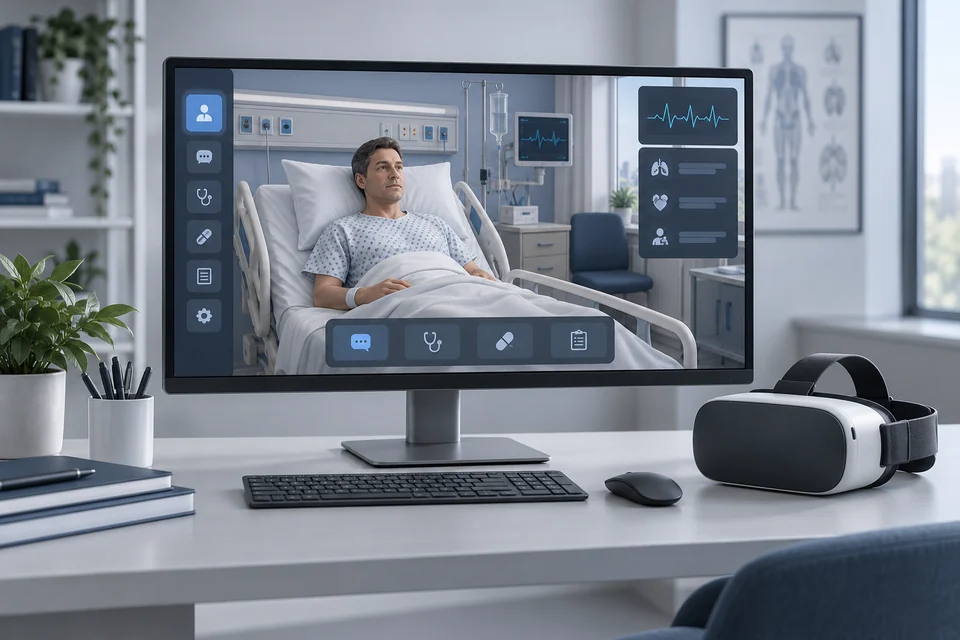
Virtual Patient Simulator Platform is a software based clinical simulation system that represents a patient as an interactive digital entity and reproduces the clinical state, behavior, physiological response and care trajectory of a real patient within a controlled simulation environment. The virtual patient can be presented through a conventional computer screen, mobile device, immersive virtual reality headset, augmented reality interface or mixed reality environment. The underlying system typically integrates a patient model, disease and physiology engine, clinical scenario engine, interaction engine, diagnostic and therapeutic action library, clinical data layer, assessment logic, analytics and debriefing functions. The virtual patient can contain demographic characteristics, medical history, symptoms, physical examination findings, vital signs, laboratory results, imaging findings, medications, physiological parameters and behavioral responses. These variables can change during the encounter according to disease progression, elapsed clinical time and actions taken by the learner.
A simulation session commonly reproduces the sequence of an actual patient encounter. The learner may interview the patient, collect the medical history, perform physical examinations, monitor vital signs, request laboratory and imaging tests, review clinical information, formulate differential diagnoses, determine a final diagnosis, administer medications, initiate procedures, select therapeutic interventions and reassess the patient. The simulation engine processes these actions and updates the patient state according to predefined clinical logic, physiological equations, disease models, pharmacological responses and scenario conditions. Advanced systems calculate continuous changes in cardiovascular, respiratory, neurological and other physiological variables, allowing symptoms, vital signs, organ function, compensatory mechanisms and treatment responses to evolve during the encounter. Artificial intelligence can add natural language dialogue, contextual patient responses, voice interaction and adaptive communication behavior.
Body Interact, developed by Take The Wind, is a representative screen based virtual patient simulator. Its clinical scenarios use a real time physiology engine in which vital signs, symptom progression, organ function and compensatory mechanisms respond dynamically to learner decisions. Learners assess evolving virtual patients, establish diagnoses, administer treatment and observe subsequent physiological changes. Current versions also incorporate AI patient conversations through voice or text, allowing learners to obtain clinical information through natural interaction with the simulated patient.
SimX represents the immersive virtual reality architecture of the category. Learners enter three dimensional clinical environments and interact directly with virtual patients, clinical tools, medications and other participants. Its Virtual Manikin system allows instructors to control patient appearance, vital signs, animations, physical examination findings, laboratory data, imaging results, dialogue and final diagnosis during a simulation. Multiplayer functionality allows several clinicians or students to manage the same virtual patient simultaneously, reproducing team based clinical care, emergency response and multidisciplinary decision making. Its commercial scenario library covers areas including emergency medicine, critical care, pediatrics, cardiology, obstetrics, psychiatry, nursing, EMS and military medicine.
Oxford Medical Simulation represents another immersive clinical simulation architecture. Its system places learners inside fully interactive virtual clinical scenarios using VR headsets. Students, physicians, nurses and other healthcare professionals assess patients, communicate, make clinical decisions, undertake interventions and receive feedback on their performance. OMS combines immersive clinical scenarios with AI, learner analytics and structured feedback, allowing repeated standardized encounters and measurement of clinical decision making, patient assessment and communication performance.
Virtual Patient Simulator Platform therefore encompasses several technical architectures within the same clinical simulation category. Screen based systems emphasize accessible patient interaction, clinical reasoning and dynamic physiology. Immersive VR systems reproduce spatial clinical environments, physical interaction, teamwork and contextual care delivery. AI enabled systems extend the patient model with natural language communication and adaptive behavior. Physiology driven systems continuously calculate changes in patient condition following interventions and delays. Across these architectures, the defining technical element is an executable digital patient whose clinical state can be observed, investigated and modified through healthcare decisions, with the resulting patient response generated by the simulation system and recorded for assessment, analytics and debriefing.
Selected research
Market Structure
Global Virtual Patient Simulator Platform Market by Size, by Type, by Application, by Region, History and Forecast 2021-2032
Market perspective
According to APO Research, Inc, the global Virtual Patient Simulator Platform market was valued at USD 246.18 million in 2025 and is expected to reach USD 278.40 million in 2026 and USD 587.35 million by 2032, representing a CAGR of 13.25% from 2026 to 2032. The market is expected to add USD 308.95 million in annual revenue over this period. North America is expected to contribute the largest absolute increment, reflecting the scale of medical schools, nursing programs, hospital based simulation programs, emergency medical education and institutional digital learning expenditure in the United States and Canada. Europe remains a major revenue base through medical and nursing education systems in the United Kingdom, the Nordic countries, Germany, France and other developed healthcare markets. Asia Pacific is expected to contribute a rising share of incremental demand as medical schools, nursing colleges, teaching hospitals and clinical training institutions expand digital simulation capacity, particularly in China, Japan, South Korea, Australia and Singapore.
Screen based virtual patient systems remain a major commercial category because they can be deployed across existing computers, tablets and mobile devices with limited additional hardware requirements. Representative products include Body Interact from Take The Wind, Shadow Health from Elsevier, Full Code, InSimu and virtual patient products from DxR Development Group. These systems combine clinical case libraries, patient histories, examination findings, diagnostic testing, treatment selection and structured assessment. Body Interact adds a dynamic physiology engine that changes vital signs, symptoms and physiological responses according to disease progression and learner interventions. AI enabled products increasingly incorporate natural language dialogue, voice interaction and adaptive patient responses, expanding the simulation of history taking, communication, clinical reasoning and treatment decisions.
Immersive virtual reality is the other major technical route. SimX, Oxford Medical Simulation, UbiSim from Labster, GigXR and related suppliers place learners inside three dimensional clinical environments where they interact with virtual patients, equipment, medications and other members of a care team. SimX has developed multiplayer clinical environments and virtual manikin functionality for emergency medicine, critical care, nursing, EMS and military medical scenarios. Oxford Medical Simulation combines immersive clinical encounters with performance analytics, structured feedback and AI functions. UbiSim focuses heavily on nursing scenarios and faculty controlled simulation. Mixed reality and spatial patient systems, including products such as HoloPatient, extend virtual patient visualization into physical teaching spaces and permit direct observation of patient appearance, symptoms and clinical progression.
Read the full market overview
Medical education and nursing education account for the principal institutional use cases, with additional revenue generated by clinical training, EMS training and specialized professional education. Medical schools use virtual patients for history taking, differential diagnosis, treatment planning and repeated exposure to standardized clinical cases. Nursing programs emphasize patient assessment, medication administration, deterioration recognition, communication and prioritization of care. Hospitals and health systems use the systems for clinician onboarding, competency assessment, emergency response training and continuing professional education. EMS applications emphasize time critical assessment, stabilization and treatment decisions in prehospital environments. The software structure allows the same clinical scenario to be repeated under standardized conditions while recording decision sequence, response time, diagnostic accuracy, treatment selection and subsequent patient state.
Competition remains fragmented across large medical education publishers and specialist simulation developers. Elsevier, Wolters Kluwer, Laerdal Medical and Kaplan participate through established medical and nursing education channels, while Take The Wind, SimX, Oxford Medical Simulation, Labster, GigXR, Full Code Medical, InSimu, MedIT Solutions and other specialist companies compete through proprietary physiology engines, immersive environments, AI patient interaction, scenario libraries and assessment functions. Revenue models include institutional licenses, annual subscriptions, learner licenses, scenario content, faculty authoring tools and enterprise deployments. From 2026 to 2032, the market expansion is expected to be increasingly associated with AI based patient conversation, dynamic physiology, immersive clinical environments, reusable scenario authoring, measurable competency assessment and integration of virtual simulation into formal medical, nursing and clinical training curricula.
Report Includes
This report provides an overview of the global Virtual Patient Simulator Platform market and its size, analyzing global market trends based on historical revenue data for 2021-2025, estimates for 2026, and projected CAGRs through 2032.
The study covers key producers of Virtual Patient Simulator Platform and revenue in major regions and countries, assesses future market potential, and highlights priority regions and countries for segmenting the market into sub-sectors, with country-specific market value data for the U.S., Canada, Mexico, Brazil, China, Japan, South Korea, Southeast Asia, India, Germany, the U.K., Italy, the Middle East, Africa, and other countries.
The report also presents Virtual Patient Simulator Platform revenue, market share, and industry ranking for the main manufacturers for 2021-2026, identifies the major stakeholders in the global market, and analyzes their competitive landscape and market positioning based on recent developments and segmental revenues.
In addition, the report analyzes segment data by Type and Application—covering revenue and growth rates—for 2021-2032, and evaluates and forecasts the Virtual Patient Simulator Platform market size, projected growth trends, production technologies, key applications, and end-use industries.
Virtual Patient Simulator Platform Segment by Company
Take The Wind (Body Interact)
InSimu
Edocate
MedIT Solutions
SimforHealth
Full Code Medical
PCS.AI
SimX
Oxford Medical Simulation
MVR Technologies
MedVision
Arch Virtual
Virtual Education Systems
Labster
DxR Development Group
Elsevier
Kaplan
Wolters Kluwer
Laerdal Medical
GigXR
Lumeto
Vcom3D
ReelDx
Geeky Medics
Intulect
MedAscend
Patient Ready
SimConverse
MedVR Education
Virti
Interactive Health International
ThinkClinical
Medceptor
Sentinel U
Ascend Learning
ClinicalSim
Elevate Healthcare
MedCognition
AIBODY
ClinCaseQuest
Virtual Medical Coaching
Virtual Patient Simulator Platform Segment by Type
Screen Based Simulation
Immersive VR Simulation
AR and MR Simulation
Other
Virtual Patient Simulator Platform Segment by Application
Medical Education
Nursing Education
EMS Training
Other
Virtual Patient Simulator Platform Segment by Region
North America
United States
Canada
Mexico
Europe
Germany
France
U.K.
Italy
Russia
Spain
Netherlands
Switzerland
Sweden
Poland
Asia-Pacific
China
Japan
South Korea
India
Australia
Taiwan
Southeast Asia
South America
Brazil
Argentina
Chile
Colombia
Middle East & Africa
Egypt
South Africa
Israel
Türkiye
GCC Countries
Study Objectives
1. To analyze and research the global status and future forecast, involving, production, value, consumption, growth rate (CAGR), market share, historical and forecast.
2. To present the key manufacturers, capacity, production, revenue, market share, and Recent Developments.
3. To split the breakdown data by regions, type, manufacturers, and Application.
4. To analyze the global and key regions market potential and advantage, opportunity and challenge, restraints, and risks.
5. To identify significant trends, drivers, influence factors in global and regions.
6. To analyze competitive developments such as expansions, agreements, new product launches, and acquisitions in the market.
Reasons to Buy This Report
1. This report will help the readers to understand the competition within the industries and strategies for the competitive environment to enhance the potential profit. The report also focuses on the competitive landscape of the global Virtual Patient Simulator Platform market, and introduces in detail the market share, industry ranking, competitor ecosystem, market performance, new product development, operation situation, expansion, and acquisition. etc. of the main players, which helps the readers to identify the main competitors and deeply understand the competition pattern of the market.
2. This report will help stakeholders to understand the global industry status and trends of Virtual Patient Simulator Platform and provides them with information on key market drivers, restraints, challenges, and opportunities.
3. This report will help stakeholders to understand competitors better and gain more insights to strengthen their position in their businesses. The competitive landscape section includes the market share and rank (in volume and value), competitor ecosystem, new product development, expansion, and acquisition.
4. This report stays updated with novel technology integration, features, and the latest developments in the market.
5. This report helps stakeholders to gain insights into which regions to target globally.
6. This report helps stakeholders to gain insights into the end-user perception concerning the adoption of Virtual Patient Simulator Platform.
7. This report helps stakeholders to identify some of the key players in the market and understand their valuable contribution.
Chapter Outline
Chapter 1: Introduces the report scope of the report, executive summary of different market segments (product type, application, etc), including the market size of each market segment, future development potential, and so on. Revenue of Virtual Patient Simulator Platform in global and regional level. It provides a quantitative analysis of the market size and development potential of each region and its main countries and introduces the market development, future development prospects, market space, and capacity of each country in the world. It offers a high-level view of the current state of the market and its likely evolution in the short to mid-term, and long term.
Chapter 2: Analysis key trends, drivers, challenges, and opportunities within the global Virtual Patient Simulator Platform industry.
Chapter 3: Detailed analysis of Virtual Patient Simulator Platform companies' competitive landscape, revenue, market share and industry ranking, latest development plan, merger, and acquisition information, etc.
Chapter 4: Provides the analysis of various market segments by type, covering the revenue, and development potential of each market segment, to help readers find the blue ocean market in different market segments.
Chapter 5: Provides the analysis of various market segments by application, covering the revenue, and development potential of each market segment, to help readers find the blue ocean market in different downstream markets.
Chapter 6: Provides profiles of key companies, introducing the basic situation of the main companies in the market in detail, including product descriptions and specifications, Virtual Patient Simulator Platformrevenue, gross margin, and recent development, etc.
Chapter 7: North America (US & Canada) by type, by application and by country, revenue for each segment.
Chapter 8: Europe by type, by application and by country, revenue for each segment.
Chapter 9: China by type, and by application, revenue for each segment.
Chapter 10: Asia (excluding China) by type, by application and by region, revenue for each segment.
Chapter 11: South America, Middle East & Africa by type, by application and by country, revenue for each segment.
Chapter 12: Concluding Insights of the report.
More report detail
Tables and figures
Scope & coverage.
Types
- Screen Based Simulation
- Immersive VR Simulation
- AR and MR Simulation
- Other
Applications
- Medical Education
- Nursing Education
- EMS Training
- Other
Companies covered
- Take The Wind (Body Interact)
- InSimu
- Edocate
- MedIT Solutions
- SimforHealth
- Full Code Medical
- PCS.AI
- SimX
- Oxford Medical Simulation
- MVR Technologies
- MedVision
- Arch Virtual
- Virtual Education Systems
- Labster
- DxR Development Group
- Elsevier
- Kaplan
- Wolters Kluwer
- Laerdal Medical
- GigXR
- Lumeto
- Vcom3D
- ReelDx
- Geeky Medics
- Intulect
- MedAscend
- Patient Ready
- SimConverse
- MedVR Education
- Virti
- Interactive Health International
- ThinkClinical
- Medceptor
- Sentinel U
- Ascend Learning
- ClinicalSim
- Elevate Healthcare
- MedCognition
- AIBODY
- ClinCaseQuest
- Virtual Medical Coaching
Inside the report.
1 Market Overview
- 1.1 Product Definition
- 1.2 Market Analysis by Type
- 1.2.1 Global Virtual Patient Simulator Platform Market Size Growth Rate by Type: 2021 VS 2025 VS 2032
- 1.2.2 Screen Based Simulation
- 1.2.3 Immersive VR Simulation
- 1.2.4 AR and MR Simulation
- 1.2.5 Other
- 1.3 Market Analysis by Application
- 1.3.1 Global Virtual Patient Simulator Platform Market Size Growth Rate by Application: 2021 VS 2025 VS 2032
- 1.3.2 Medical Education
- 1.3.3 Nursing Education
- 1.3.4 EMS Training
- 1.3.5 Other
- 1.4 Global Market Growth Prospects
- 1.5 Global Virtual Patient Simulator Platform Growth Trends by Region
- 1.5.1 Global Virtual Patient Simulator Platform Market Size by Region: 2021 VS 2025 VS 2032
- 1.5.2 Virtual Patient Simulator Platform Market Size by Region (2021-2026)
- 1.5.3 Virtual Patient Simulator Platform Market Size by Region (2027-2032)
- 1.6 Assumptions and Limitations
- 1.7 Study Goals and Objectives
- 1.8 Years Considered
2 Global Virtual Patient Simulator Platform Market Dynamics
- 2.1 Virtual Patient Simulator Platform Industry Trends
- 2.2 Virtual Patient Simulator Platform Industry Drivers
- 2.3 Virtual Patient Simulator Platform Industry Opportunities and Challenges
- 2.4 Virtual Patient Simulator Platform Industry Restraints
3 Competitive Landscape by Company
- 3.1 Global Virtual Patient Simulator Platform Revenue by Company (2021-2026)
- 3.2 Global Virtual Patient Simulator Platform Players Revenue Ranking, 2024 VS 2025 VS 2026
- 3.3 Global Virtual Patient Simulator Platform Key Company Head office and Area Served
- 3.4 Global Virtual Patient Simulator Platform Company, Product Type & Application
- 3.5 Global Virtual Patient Simulator Platform Company Establishment Date
- 3.6 Market Competitive Analysis
- 3.6.1 Global Virtual Patient Simulator Platform Market CR5 and HHI
- 3.6.2 Global Top 5 and 10 Virtual Patient Simulator Platform Players Market Share by Revenue in 2025
- 3.6.3 2025 Virtual Patient Simulator Platform Tier 1, Tier 2, and Tier 3
4 Virtual Patient Simulator Platform Market by Type
- 4.1 Global Virtual Patient Simulator Platform Market Size by Type (2021 VS 2025 VS 2032)
- 4.2 Global Virtual Patient Simulator Platform Market Size by Type (2021-2032)
- 4.3 Global Virtual Patient Simulator Platform Market Size Share by Type (2021-2032)
5 Virtual Patient Simulator Platform Market by Application
- 5.1 Global Virtual Patient Simulator Platform Market Size by Application (2021 VS 2025 VS 2032)
- 5.2 Global Virtual Patient Simulator Platform Market Size by Application (2021-2032)
- 5.3 Global Virtual Patient Simulator Platform Market Size Share by Application (2021-2032)
6 Company Profiles
- 6.1 Take The Wind (Body Interact)
- 6.1.1 Take The Wind (Body Interact) Company Information
- 6.1.2 Take The Wind (Body Interact) Business Overview
- 6.1.3 Take The Wind (Body Interact) Virtual Patient Simulator Platform Revenue and Gross Margin (US$ Million) & (2021-2026)
- 6.1.4 Take The Wind (Body Interact) Virtual Patient Simulator Platform Product Portfolio
- 6.1.5 Take The Wind (Body Interact) Recent Developments
- 6.2 InSimu
- 6.2.1 InSimu Company Information
- 6.2.2 InSimu Business Overview
- 6.2.3 InSimu Virtual Patient Simulator Platform Revenue and Gross Margin (US$ Million) & (2021-2026)
- 6.2.4 InSimu Virtual Patient Simulator Platform Product Portfolio
- 6.2.5 InSimu Recent Developments
- 6.3 Edocate
- 6.3.1 Edocate Company Information
- 6.3.2 Edocate Business Overview
- 6.3.3 Edocate Virtual Patient Simulator Platform Revenue and Gross Margin (US$ Million) & (2021-2026)
- 6.3.4 Edocate Virtual Patient Simulator Platform Product Portfolio
- 6.3.5 Edocate Recent Developments
- 6.4 MedIT Solutions
- 6.4.1 MedIT Solutions Company Information
- 6.4.2 MedIT Solutions Business Overview
- 6.4.3 MedIT Solutions Virtual Patient Simulator Platform Revenue and Gross Margin (US$ Million) & (2021-2026)
- 6.4.4 MedIT Solutions Virtual Patient Simulator Platform Product Portfolio
- 6.4.5 MedIT Solutions Recent Developments
- 6.5 SimforHealth
- 6.5.1 SimforHealth Company Information
- 6.5.2 SimforHealth Business Overview
- 6.5.3 SimforHealth Virtual Patient Simulator Platform Revenue and Gross Margin (US$ Million) & (2021-2026)
- 6.5.4 SimforHealth Virtual Patient Simulator Platform Product Portfolio
- 6.5.5 SimforHealth Recent Developments
- 6.6 Full Code Medical
- 6.6.1 Full Code Medical Company Information
- 6.6.2 Full Code Medical Business Overview
- 6.6.3 Full Code Medical Virtual Patient Simulator Platform Revenue and Gross Margin (US$ Million) & (2021-2026)
- 6.6.4 Full Code Medical Virtual Patient Simulator Platform Product Portfolio
- 6.6.5 Full Code Medical Recent Developments
- 6.7 PCS.AI
- 6.7.1 PCS.AI Company Information
- 6.7.2 PCS.AI Business Overview
- 6.7.3 PCS.AI Virtual Patient Simulator Platform Revenue and Gross Margin (US$ Million) & (2021-2026)
- 6.7.4 PCS.AI Virtual Patient Simulator Platform Product Portfolio
- 6.7.5 PCS.AI Recent Developments
- 6.8 SimX
- 6.8.1 SimX Company Information
- 6.8.2 SimX Business Overview
- 6.8.3 SimX Virtual Patient Simulator Platform Revenue and Gross Margin (US$ Million) & (2021-2026)
- 6.8.4 SimX Virtual Patient Simulator Platform Product Portfolio
- 6.8.5 SimX Recent Developments
- 6.9 Oxford Medical Simulation
- 6.9.1 Oxford Medical Simulation Company Information
- 6.9.2 Oxford Medical Simulation Business Overview
- 6.9.3 Oxford Medical Simulation Virtual Patient Simulator Platform Revenue and Gross Margin (US$ Million) & (2021-2026)
- 6.9.4 Oxford Medical Simulation Virtual Patient Simulator Platform Product Portfolio
- 6.9.5 Oxford Medical Simulation Recent Developments
- 6.10 MVR Technologies
- 6.10.1 MVR Technologies Company Information
- 6.10.2 MVR Technologies Business Overview
- 6.10.3 MVR Technologies Virtual Patient Simulator Platform Revenue and Gross Margin (US$ Million) & (2021-2026)
- 6.10.4 MVR Technologies Virtual Patient Simulator Platform Product Portfolio
- 6.10.5 MVR Technologies Recent Developments
- 6.11 MedVision
- 6.11.1 MedVision Company Information
- 6.11.2 MedVision Business Overview
- 6.11.3 MedVision Virtual Patient Simulator Platform Revenue and Gross Margin (US$ Million) & (2021-2026)
- 6.11.4 MedVision Virtual Patient Simulator Platform Product Portfolio
- 6.11.5 MedVision Recent Developments
- 6.12 Arch Virtual
- 6.12.1 Arch Virtual Company Information
- 6.12.2 Arch Virtual Business Overview
- 6.12.3 Arch Virtual Virtual Patient Simulator Platform Revenue and Gross Margin (US$ Million) & (2021-2026)
- 6.12.4 Arch Virtual Virtual Patient Simulator Platform Product Portfolio
- 6.12.5 Arch Virtual Recent Developments
- 6.13 Virtual Education Systems
- 6.13.1 Virtual Education Systems Company Information
- 6.13.2 Virtual Education Systems Business Overview
- 6.13.3 Virtual Education Systems Virtual Patient Simulator Platform Revenue and Gross Margin (US$ Million) & (2021-2026)
- 6.13.4 Virtual Education Systems Virtual Patient Simulator Platform Product Portfolio
- 6.13.5 Virtual Education Systems Recent Developments
- 6.14 Labster
- 6.14.1 Labster Company Information
- 6.14.2 Labster Business Overview
- 6.14.3 Labster Virtual Patient Simulator Platform Revenue and Gross Margin (US$ Million) & (2021-2026)
- 6.14.4 Labster Virtual Patient Simulator Platform Product Portfolio
- 6.14.5 Labster Recent Developments
- 6.15 DxR Development Group
- 6.15.1 DxR Development Group Company Information
- 6.15.2 DxR Development Group Business Overview
- 6.15.3 DxR Development Group Virtual Patient Simulator Platform Revenue and Gross Margin (US$ Million) & (2021-2026)
- 6.15.4 DxR Development Group Virtual Patient Simulator Platform Product Portfolio
- 6.15.5 DxR Development Group Recent Developments
- 6.16 Elsevier
- 6.16.1 Elsevier Company Information
- 6.16.2 Elsevier Business Overview
- 6.16.3 Elsevier Virtual Patient Simulator Platform Revenue and Gross Margin (US$ Million) & (2021-2026)
- 6.16.4 Elsevier Virtual Patient Simulator Platform Product Portfolio
- 6.16.5 Elsevier Recent Developments
- 6.17 Kaplan
- 6.17.1 Kaplan Company Information
- 6.17.2 Kaplan Business Overview
- 6.17.3 Kaplan Virtual Patient Simulator Platform Revenue and Gross Margin (US$ Million) & (2021-2026)
- 6.17.4 Kaplan Virtual Patient Simulator Platform Product Portfolio
- 6.17.5 Kaplan Recent Developments
- 6.18 Wolters Kluwer
- 6.18.1 Wolters Kluwer Company Information
- 6.18.2 Wolters Kluwer Business Overview
- 6.18.3 Wolters Kluwer Virtual Patient Simulator Platform Revenue and Gross Margin (US$ Million) & (2021-2026)
- 6.18.4 Wolters Kluwer Virtual Patient Simulator Platform Product Portfolio
- 6.18.5 Wolters Kluwer Recent Developments
- 6.19 Laerdal Medical
- 6.19.1 Laerdal Medical Company Information
- 6.19.2 Laerdal Medical Business Overview
- 6.19.3 Laerdal Medical Virtual Patient Simulator Platform Revenue and Gross Margin (US$ Million) & (2021-2026)
- 6.19.4 Laerdal Medical Virtual Patient Simulator Platform Product Portfolio
- 6.19.5 Laerdal Medical Recent Developments
- 6.20 GigXR
- 6.20.1 GigXR Company Information
- 6.20.2 GigXR Business Overview
- 6.20.3 GigXR Virtual Patient Simulator Platform Revenue and Gross Margin (US$ Million) & (2021-2026)
- 6.20.4 GigXR Virtual Patient Simulator Platform Product Portfolio
- 6.20.5 GigXR Recent Developments
- 6.21 Lumeto
- 6.21.1 Lumeto Company Information
- 6.21.2 Lumeto Business Overview
- 6.21.3 Lumeto Virtual Patient Simulator Platform Revenue and Gross Margin (US$ Million) & (2021-2026)
- 6.21.4 Lumeto Virtual Patient Simulator Platform Product Portfolio
- 6.21.5 Lumeto Recent Developments
- 6.22 Vcom3D
- 6.22.1 Vcom3D Company Information
- 6.22.2 Vcom3D Business Overview
- 6.22.3 Vcom3D Virtual Patient Simulator Platform Revenue and Gross Margin (US$ Million) & (2021-2026)
- 6.22.4 Vcom3D Virtual Patient Simulator Platform Product Portfolio
- 6.22.5 Vcom3D Recent Developments
- 6.23 ReelDx
- 6.23.1 ReelDx Company Information
- 6.23.2 ReelDx Business Overview
- 6.23.3 ReelDx Virtual Patient Simulator Platform Revenue and Gross Margin (US$ Million) & (2021-2026)
- 6.23.4 ReelDx Virtual Patient Simulator Platform Product Portfolio
- 6.23.5 ReelDx Recent Developments
- 6.24 Geeky Medics
- 6.24.1 Geeky Medics Company Information
- 6.24.2 Geeky Medics Business Overview
- 6.24.3 Geeky Medics Virtual Patient Simulator Platform Revenue and Gross Margin (US$ Million) & (2021-2026)
- 6.24.4 Geeky Medics Virtual Patient Simulator Platform Product Portfolio
- 6.24.5 Geeky Medics Recent Developments
- 6.25 Intulect
- 6.25.1 Intulect Company Information
- 6.25.2 Intulect Business Overview
- 6.25.3 Intulect Virtual Patient Simulator Platform Revenue and Gross Margin (US$ Million) & (2021-2026)
- 6.25.4 Intulect Virtual Patient Simulator Platform Product Portfolio
- 6.25.5 Intulect Recent Developments
- 6.26 MedAscend
- 6.26.1 MedAscend Company Information
- 6.26.2 MedAscend Business Overview
- 6.26.3 MedAscend Virtual Patient Simulator Platform Revenue and Gross Margin (US$ Million) & (2021-2026)
- 6.26.4 MedAscend Virtual Patient Simulator Platform Product Portfolio
- 6.26.5 MedAscend Recent Developments
- 6.27 Patient Ready
- 6.27.1 Patient Ready Company Information
- 6.27.2 Patient Ready Business Overview
- 6.27.3 Patient Ready Virtual Patient Simulator Platform Revenue and Gross Margin (US$ Million) & (2021-2026)
- 6.27.4 Patient Ready Virtual Patient Simulator Platform Product Portfolio
- 6.27.5 Patient Ready Recent Developments
- 6.28 SimConverse
- 6.28.1 SimConverse Company Information
- 6.28.2 SimConverse Business Overview
- 6.28.3 SimConverse Virtual Patient Simulator Platform Revenue and Gross Margin (US$ Million) & (2021-2026)
- 6.28.4 SimConverse Virtual Patient Simulator Platform Product Portfolio
- 6.28.5 SimConverse Recent Developments
- 6.29 MedVR Education
- 6.29.1 MedVR Education Company Information
- 6.29.2 MedVR Education Business Overview
- 6.29.3 MedVR Education Virtual Patient Simulator Platform Revenue and Gross Margin (US$ Million) & (2021-2026)
- 6.29.4 MedVR Education Virtual Patient Simulator Platform Product Portfolio
- 6.29.5 MedVR Education Recent Developments
- 6.30 Virti
- 6.30.1 Virti Company Information
- 6.30.2 Virti Business Overview
- 6.30.3 Virti Virtual Patient Simulator Platform Revenue and Gross Margin (US$ Million) & (2021-2026)
- 6.30.4 Virti Virtual Patient Simulator Platform Product Portfolio
- 6.30.5 Virti Recent Developments
- 6.31 Interactive Health International
- 6.31.1 Interactive Health International Company Information
- 6.31.2 Interactive Health International Business Overview
- 6.31.3 Interactive Health International Virtual Patient Simulator Platform Revenue and Gross Margin (US$ Million) & (2021-2026)
- 6.31.4 Interactive Health International Virtual Patient Simulator Platform Product Portfolio
- 6.31.5 Interactive Health International Recent Developments
- 6.32 ThinkClinical
- 6.32.1 ThinkClinical Company Information
- 6.32.2 ThinkClinical Business Overview
- 6.32.3 ThinkClinical Virtual Patient Simulator Platform Revenue and Gross Margin (US$ Million) & (2021-2026)
- 6.32.4 ThinkClinical Virtual Patient Simulator Platform Product Portfolio
- 6.32.5 ThinkClinical Recent Developments
- 6.33 Medceptor
- 6.33.1 Medceptor Company Information
- 6.33.2 Medceptor Business Overview
- 6.33.3 Medceptor Virtual Patient Simulator Platform Revenue and Gross Margin (US$ Million) & (2021-2026)
- 6.33.4 Medceptor Virtual Patient Simulator Platform Product Portfolio
- 6.33.5 Medceptor Recent Developments
- 6.34 Sentinel U
- 6.34.1 Sentinel U Company Information
- 6.34.2 Sentinel U Business Overview
- 6.34.3 Sentinel U Virtual Patient Simulator Platform Revenue and Gross Margin (US$ Million) & (2021-2026)
- 6.34.4 Sentinel U Virtual Patient Simulator Platform Product Portfolio
- 6.34.5 Sentinel U Recent Developments
- 6.35 Ascend Learning
- 6.35.1 Ascend Learning Company Information
- 6.35.2 Ascend Learning Business Overview
- 6.35.3 Ascend Learning Virtual Patient Simulator Platform Revenue and Gross Margin (US$ Million) & (2021-2026)
- 6.35.4 Ascend Learning Virtual Patient Simulator Platform Product Portfolio
- 6.35.5 Ascend Learning Recent Developments
- 6.36 ClinicalSim
- 6.36.1 ClinicalSim Company Information
- 6.36.2 ClinicalSim Business Overview
- 6.36.3 ClinicalSim Virtual Patient Simulator Platform Revenue and Gross Margin (US$ Million) & (2021-2026)
- 6.36.4 ClinicalSim Virtual Patient Simulator Platform Product Portfolio
- 6.36.5 ClinicalSim Recent Developments
- 6.37 Elevate Healthcare
- 6.37.1 Elevate Healthcare Company Information
- 6.37.2 Elevate Healthcare Business Overview
- 6.37.3 Elevate Healthcare Virtual Patient Simulator Platform Revenue and Gross Margin (US$ Million) & (2021-2026)
- 6.37.4 Elevate Healthcare Virtual Patient Simulator Platform Product Portfolio
- 6.37.5 Elevate Healthcare Recent Developments
- 6.38 MedCognition
- 6.38.1 MedCognition Company Information
- 6.38.2 MedCognition Business Overview
- 6.38.3 MedCognition Virtual Patient Simulator Platform Revenue and Gross Margin (US$ Million) & (2021-2026)
- 6.38.4 MedCognition Virtual Patient Simulator Platform Product Portfolio
- 6.38.5 MedCognition Recent Developments
- 6.39 AIBODY
- 6.39.1 AIBODY Company Information
- 6.39.2 AIBODY Business Overview
- 6.39.3 AIBODY Virtual Patient Simulator Platform Revenue and Gross Margin (US$ Million) & (2021-2026)
- 6.39.4 AIBODY Virtual Patient Simulator Platform Product Portfolio
- 6.39.5 AIBODY Recent Developments
- 6.40 ClinCaseQuest
- 6.40.1 ClinCaseQuest Company Information
- 6.40.2 ClinCaseQuest Business Overview
- 6.40.3 ClinCaseQuest Virtual Patient Simulator Platform Revenue and Gross Margin (US$ Million) & (2021-2026)
- 6.40.4 ClinCaseQuest Virtual Patient Simulator Platform Product Portfolio
- 6.40.5 ClinCaseQuest Recent Developments
- 6.41 Virtual Medical Coaching
7 North America
- 7.1 North America Virtual Patient Simulator Platform Market Size (2021-2032)
- 7.2 North America Virtual Patient Simulator Platform Market Size by Type
- 7.2.1 North America Virtual Patient Simulator Platform Market Size by Type (2021-2026)
- 7.2.2 North America Virtual Patient Simulator Platform Market Size by Type (2027-2032)
- 7.2.3 North America Virtual Patient Simulator Platform Market Share by Type (2021-2032)
- 7.3 North America Virtual Patient Simulator Platform Market Size by Application
- 7.3.1 North America Virtual Patient Simulator Platform Market Size by Application (2021-2026)
- 7.3.2 North America Virtual Patient Simulator Platform Market Size by Application (2027-2032)
- 7.3.3 North America Virtual Patient Simulator Platform Market Share by Application (2021-2032)
- 7.4 North America Virtual Patient Simulator Platform Market Size by Country
- 7.4.1 North America Virtual Patient Simulator Platform Market Size by Country (2021 VS 2025 VS 2032)
- 7.4.2 North America Virtual Patient Simulator Platform Market Size by Country (2021-2026)
- 7.4.3 North America Virtual Patient Simulator Platform Market Size by Country (2027-2032)
- 7.4.4 North America Virtual Patient Simulator Platform Market Share by Country (2021-2032)
- 7.4.5 United States
- 7.4.6 Canada
- 7.4.7 Mexico
8 Europe
- 8.1 Europe Virtual Patient Simulator Platform Market Size (2021-2032)
- 8.2 Europe Virtual Patient Simulator Platform Market Size by Type
- 8.2.1 Europe Virtual Patient Simulator Platform Market Size by Type (2021-2026)
- 8.2.2 Europe Virtual Patient Simulator Platform Market Size by Type (2027-2032)
- 8.2.3 Europe Virtual Patient Simulator Platform Market Share by Type (2021-2032)
- 8.3 Europe Virtual Patient Simulator Platform Market Size by Application
- 8.3.1 Europe Virtual Patient Simulator Platform Market Size by Application (2021-2026)
- 8.3.2 Europe Virtual Patient Simulator Platform Market Size by Application (2027-2032)
- 8.3.3 Europe Virtual Patient Simulator Platform Market Share by Application (2021-2032)
- 8.4 Europe Virtual Patient Simulator Platform Market Size by Country
- 8.4.1 Europe Virtual Patient Simulator Platform Market Size by Country (2021 VS 2025 VS 2032)
- 8.4.2 Europe Virtual Patient Simulator Platform Market Size by Country (2021-2026)
- 8.4.3 Europe Virtual Patient Simulator Platform Market Size by Country (2027-2032)
- 8.4.4 Europe Virtual Patient Simulator Platform Market Share by Country (2021-2032)
- 8.4.5 Germany
- 8.4.6 France
- 8.4.7 U.K.
- 8.4.8 Italy
- 8.4.9 Russia
- 8.4.10 Nordic Countries
9 China
- 9.1 China Virtual Patient Simulator Platform Market Size (2021-2032)
- 9.2 China Virtual Patient Simulator Platform Market Size by Type
- 9.2.1 China Virtual Patient Simulator Platform Market Size by Type (2021-2026)
- 9.2.2 China Virtual Patient Simulator Platform Market Size by Type (2027-2032)
- 9.2.3 China Virtual Patient Simulator Platform Market Share by Type (2021-2032)
- 9.3 China Virtual Patient Simulator Platform Market Size by Application
- 9.3.1 China Virtual Patient Simulator Platform Market Size by Application (2021-2026)
- 9.3.2 China Virtual Patient Simulator Platform Market Size by Application (2027-2032)
- 9.3.3 China Virtual Patient Simulator Platform Market Share by Application (2021-2032)
10 Asia (Excluding China)
- 10.1 Asia Virtual Patient Simulator Platform Market Size (2021-2032)
- 10.2 Asia Virtual Patient Simulator Platform Market Size by Type
- 10.2.1 Asia Virtual Patient Simulator Platform Market Size by Type (2021-2026)
- 10.2.2 Asia Virtual Patient Simulator Platform Market Size by Type (2027-2032)
- 10.2.3 Asia Virtual Patient Simulator Platform Market Share by Type (2021-2032)
- 10.3 Asia Virtual Patient Simulator Platform Market Size by Application
- 10.3.1 Asia Virtual Patient Simulator Platform Market Size by Application (2021-2026)
- 10.3.2 Asia Virtual Patient Simulator Platform Market Size by Application (2027-2032)
- 10.3.3 Asia Virtual Patient Simulator Platform Market Share by Application (2021-2032)
- 10.4 Asia Virtual Patient Simulator Platform Market Size by Country
- 10.4.1 Asia Virtual Patient Simulator Platform Market Size by Country (2021 VS 2025 VS 2032)
- 10.4.2 Asia Virtual Patient Simulator Platform Market Size by Country (2021-2026)
- 10.4.3 Asia Virtual Patient Simulator Platform Market Size by Country (2027-2032)
- 10.4.4 Asia Virtual Patient Simulator Platform Market Share by Country (2021-2032)
- 10.4.5 Japan
- 10.4.6 South Korea
- 10.4.7 Taiwan
- 10.4.8 Southeast Asia
- 10.4.9 India
- 10.4.10 Australia
11 South America, Middle East & Africa
- 11.1 South America, Middle East & Africa Virtual Patient Simulator Platform Market Size (2021-2032)
- 11.2 South America, Middle East & Africa Virtual Patient Simulator Platform Market Size by Type
- 11.2.1 South America, Middle East & Africa Virtual Patient Simulator Platform Market Size by Type (2021-2026)
- 11.2.2 South America, Middle East & Africa Virtual Patient Simulator Platform Market Size by Type (2027-2032)
- 11.2.3 South America, Middle East & Africa Virtual Patient Simulator Platform Market Share by Type (2021-2032)
- 11.3 South America, Middle East & Africa Virtual Patient Simulator Platform Market Size by Application
- 11.3.1 South America, Middle East & Africa Virtual Patient Simulator Platform Market Size by Application (2021-2026)
- 11.3.2 South America, Middle East & Africa Virtual Patient Simulator Platform Market Size by Application (2027-2032)
- 11.3.3 South America, Middle East & Africa Virtual Patient Simulator Platform Market Share by Application (2021-2032)
- 11.4 South America, Middle East & Africa Virtual Patient Simulator Platform Market Size by Country
- 11.4.1 South America, Middle East & Africa Virtual Patient Simulator Platform Market Size by Country (2021 VS 2025 VS 2032)
- 11.4.2 South America, Middle East & Africa Virtual Patient Simulator Platform Market Size by Country (2021-2026)
- 11.4.3 South America, Middle East & Africa Virtual Patient Simulator Platform Market Size by Country (2027-2032)
- 11.4.4 South America, Middle East & Africa Virtual Patient Simulator Platform Market Share by Country (2021-2032)
- 11.4.5 Brazil
- 11.4.6 South Africa
- 11.4.7 Saudi Arabia
- 11.4.8 Turkey
- 11.4.9 Argentina
- 11.4.9 UAE
- 11.4.9 Egypt
- 11.4.9 Chile
12 Concluding Insights
13 Appendix
- 13.1 Reasons for Doing This Study
- 13.2 Research Methodology
- 13.3 Research Process
- 13.4 Authors List of This Report
- 13.5 Data Source
- 13.5.1 Secondary Sources
- 13.5.2 Primary Sources
- 13.6 Disclaimer
GET THE RESEARCH
Choose your license.
Choose who needs access.
All options are for this report and research series.
PDF by email within 3–5 working days after payment confirmation.
Talk to an analyst