APO RESEARCH · REPORT
Carbon Fiber
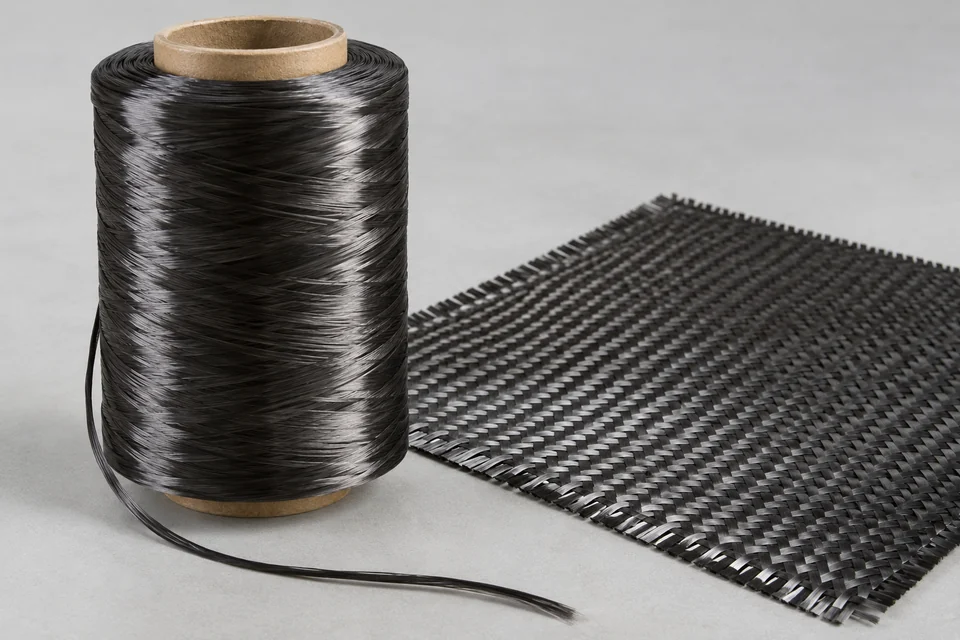
Carbon fibre consists of carbon-rich filaments supplied in forms such as tow, fabric or chopped fibre.
Product & engineering
Understand the product.
Carbon fiber is a continuous filamentary material of roughly 5–10 µm diameter whose composition is predominantly carbon (typically >92 % up to ≈99 %), arranged in a turbostratic graphitic microstructure where stacked graphene layers exhibit strong axial covalent bonding and weak transverse cohesion. Industrial grades derive mainly from polyacrylonitrile (PAN) or mesophase pitch precursors, with legacy rayon-based grades largely displaced; PAN-based fibers dominate high-strength applications, while mesophase-pitch fibers provide very high axial modulus and thermal conductivity. Fibers are supplied as tows designated by filament count (e.g., 1K–24K for aerospace, 24K–200K for industrial) and converted into prepregs, unidirectional tapes, woven/NCF fabrics, chopped or milled forms with a surface sizing compatible with thermoset epoxies, vinyl esters, polyesters, or high-temperature thermoplastics such as PEEK, PEKK, PPS, and PA. Typical properties span tensile strengths on the order of several gigapascals, axial tensile moduli from standard (~230 GPa) through intermediate (~300 GPa) to high and ultra-high (>350 GPa), densities near 1.75–1.95 g·cm⁻³, near-zero to slightly negative axial CTE, high specific stiffness and strength, pronounced anisotropy of electrical/thermal conduction, and compressive and shear response governed by fiber morphology and interfacial coupling.
Manufacture from PAN involves solution spinning (wet or dry-jet wet) of acrylonitrile copolymers to precursor fibers, oxidative stabilization in air (~200–300 °C) with cyclization and dehydrogenation to form a ladder polymer, high-temperature carbonization in inert atmosphere (~1000–1600 °C) to expel non-carbon elements, and optional graphitization (~2500–3000 °C) to raise modulus. Surface treatment—typically controlled electrochemical oxidation—creates oxygen-bearing functional groups that promote adhesion, after which a thin polymer sizing is applied and the tow is dried, wound, and qualified. Mesophase-pitch routes start from a liquid-crystalline pitch refined and melt-spun, followed by oxidative stabilization to lock in molecular orientation and extended carbonization/graphitization to achieve very high axial order; pitch-based fibers cover isotropic, intermediate, and high-modulus families, with the highest-modulus grades trading off compressive strain and handling robustness. Process controls address filament uniformity, defect and flaw population, tow flatness, residual twist, moisture and volatile content, surface oxygen level, and sizing weight, because these set translation efficiency into composite performance and dictate drape, tack, and consolidation in downstream layup.
Applications are centered on fiber-reinforced composites where axial properties are exploited through laminate architecture: primary and secondary structures in aircraft, spacecraft, and launch vehicles; wind-turbine spar caps and shells; Type III/IV pressure vessels for CNG/H₂; automotive body-in-white members, monocoques, and crash structures; sporting goods and instrumentation; civil engineering strengthening using plates, fabrics, and strands; marine hulls and masts; and electronics thermal-management elements and EMI/ESD structures. At higher temperatures carbon/carbon composites made from carbon fiber preforms densified with pyrolytic carbon serve in aircraft and industrial brakes, re-entry thermal protection, and furnace fixtures. Selection among PAN and pitch families, tow size, modulus class, and sizing chemistry is dictated by required stiffness, strength, damage tolerance, processing route, and operating environment, with laminate design and matrix choice determining compression, interlaminar, impact, and durability performance in service.
Fibre modulus, strength and sizing influence reinforcement selection. Tow architecture and resin compatibility affect processing and load transfer.
Fibre direction, volume fraction and defects determine the completed composite. Fibre properties cannot be applied directly to an isotropic finished part.
What turns activity into demand
Fibre demand follows qualified composite structures and their fibre content. Design certification, lay-up and manufacturing yield determine reachable volume; fibre, prepreg and finished components are successive value stages and must not be summed as independent demand.
The commercial boundary
Separate fibre mass from prepreg, cured composites and finished components.
Technical reading
Selected research
Industry Research
Carbon Fiber Industry Research Report 2026
Market perspective
Carbon fiber is a continuous filamentary material of roughly 5–10 µm diameter whose composition is predominantly carbon (typically >92 % up to ≈99 %), arranged in a turbostratic graphitic microstructure where stacked graphene layers exhibit strong axial covalent bonding and weak transverse cohesion. Industrial grades derive mainly from polyacrylonitrile (PAN) or mesophase pitch precursors, with legacy rayon-based grades largely displaced; PAN-based fibers dominate high-strength applications, while mesophase-pitch fibers provide very high axial modulus and thermal conductivity. Fibers are supplied as tows designated by filament count (e.g., 1K–24K for aerospace, 24K–200K for industrial) and converted into prepregs, unidirectional tapes, woven/NCF fabrics, chopped or milled forms with a surface sizing compatible with thermoset epoxies, vinyl esters, polyesters, or high-temperature thermoplastics such as PEEK, PEKK, PPS, and PA. Typical properties span tensile strengths on the order of several gigapascals, axial tensile moduli from standard (~230 GPa) through intermediate (~300 GPa) to high and ultra-high (>350 GPa), densities near 1.75–1.95 g·cm⁻³, near-zero to slightly negative axial CTE, high specific stiffness and strength, pronounced anisotropy of electrical/thermal conduction, and compressive and shear response governed by fiber morphology and interfacial coupling.
Manufacture from PAN involves solution spinning (wet or dry-jet wet) of acrylonitrile copolymers to precursor fibers, oxidative stabilization in air (~200–300 °C) with cyclization and dehydrogenation to form a ladder polymer, high-temperature carbonization in inert atmosphere (~1000–1600 °C) to expel non-carbon elements, and optional graphitization (~2500–3000 °C) to raise modulus. Surface treatment—typically controlled electrochemical oxidation—creates oxygen-bearing functional groups that promote adhesion, after which a thin polymer sizing is applied and the tow is dried, wound, and qualified. Mesophase-pitch routes start from a liquid-crystalline pitch refined and melt-spun, followed by oxidative stabilization to lock in molecular orientation and extended carbonization/graphitization to achieve very high axial order; pitch-based fibers cover isotropic, intermediate, and high-modulus families, with the highest-modulus grades trading off compressive strain and handling robustness. Process controls address filament uniformity, defect and flaw population, tow flatness, residual twist, moisture and volatile content, surface oxygen level, and sizing weight, because these set translation efficiency into composite performance and dictate drape, tack, and consolidation in downstream layup.
Applications are centered on fiber-reinforced composites where axial properties are exploited through laminate architecture: primary and secondary structures in aircraft, spacecraft, and launch vehicles; wind-turbine spar caps and shells; Type III/IV pressure vessels for CNG/H₂; automotive body-in-white members, monocoques, and crash structures; sporting goods and instrumentation; civil engineering strengthening using plates, fabrics, and strands; marine hulls and masts; and electronics thermal-management elements and EMI/ESD structures. At higher temperatures carbon/carbon composites made from carbon fiber preforms densified with pyrolytic carbon serve in aircraft and industrial brakes, re-entry thermal protection, and furnace fixtures. Selection among PAN and pitch families, tow size, modulus class, and sizing chemistry is dictated by required stiffness, strength, damage tolerance, processing route, and operating environment, with laminate design and matrix choice determining compression, interlaminar, impact, and durability performance in service.
Read the full market overview
The global Carbon Fiber market was valued at US$ million in 2025 and is projected to reach US$ million by 2032, implying a CAGR of % over 2026–2032.
The North America market for Carbon Fiber is forecast to increase from US$ million in 2026 to US$ million by 2032, corresponding to a CAGR of % over 2026–2032.
The Europe market for Carbon Fiber is projected to rise from US$ million in 2026 to US$ million by 2032, registering a CAGR of % over 2026–2032.
The Asia Pacific market for Carbon Fiber is expected to grow from US$ million in 2026 to US$ million by 2032, at a CAGR of % over 2026–2032.
Leading global manufacturers of Carbon Fiber include , among others. In 2025, the top three vendors together accounted for approximately % of global revenue.
Report Scope
This report quantifies the global Carbon Fiber market in revenue (US$ million) and, where applicable, sales volume (t), using 2025 as the base year and providing annual historical and forecast data for 2021–2032.
It standardizes definitions of types and applications, harmonizes vendor attribution, and presents comparable time series by company, type, application, and region/country, including indicative price bands (US$/t) and concentration ratios (CR5/CR10).
The outputs are intended to support strategy development, budgeting, and performance benchmarking for manufacturers, new entrants, channel partners, and investors; the report also reviews technology shifts and notable product introductions relevant to Carbon Fiber.
Key Companies & Market Share Insights
This section profiles leading manufacturers, combining 2021–2025 results with a 2026–2032 outlook. It reports revenue, market share, price bands, product and application mix, regional and channel mix, and key developments (M&A, capacity additions, certifications). It also provides global revenue, average price, and—where applicable—sales volume by manufacturer, and calculates CR5/CR10 and rank changes to support comparative benchmarking.
Carbon Fiber Market by Company
Toray
MCCFC
Teijin
Hexcel
Hyosung Advanced Materials
SGL Carbon
Formosa Plastics
DowAksa
Syensqo
UMATEX
Taekwang Industrial
Zhongfu Shenying
Jilin Chemical Fiber
Baowu Carbon
Weihai Guangwei Composites
Sinofibers Technology
Jiangsu Hengshen
Newtech Group
Carbon Fiber Segment by Type
Regular-Tow Carbon Fiber
Large-Tow Carbon Fiber
Carbon Fiber Segment by Application
Wind Energy
Sports/Leisure
Aerospace and Defense
Pressure Vessel
Automotive
Other
Carbon Fiber Segment by Region
North America
United States
Canada
Mexico
Europe
Germany
France
U.K.
Italy
Russia
Spain
Netherlands
Switzerland
Sweden
Poland
Asia-Pacific
China
Japan
South Korea
India
Australia
Taiwan
Southeast Asia
South America
Brazil
Argentina
Chile
Middle East & Africa
Egypt
South Africa
Israel
Türkiye
GCC Countries
Key Drivers & Barriers
High-impact rendering factors and drivers have been studied in this report to aid the readers to understand the general development. Moreover, the report includes restraints and challenges that may act as stumbling blocks on the way of the players. This will assist the users to be attentive and make informed decisions related to business. Specialists have also laid their focus on the upcoming business prospects.
Reasons to Buy This Report
1. This report will help the readers to understand the competition within the industries and strategies for the competitive environment to enhance the potential profit. The report also focuses on the competitive landscape of the global Carbon Fiber market, and introduces in detail the market share, industry ranking, competitor ecosystem, market performance, new product development, operation situation, expansion, and acquisition. etc. of the main players, which helps the readers to identify the main competitors and deeply understand the competition pattern of the market.
2. This report will help stakeholders to understand the global industry status and trends of Carbon Fiber and provides them with information on key market drivers, restraints, challenges, and opportunities.
3. This report will help stakeholders to understand competitors better and gain more insights to strengthen their position in their businesses. The competitive landscape section includes the market share and rank (in volume and value), competitor ecosystem, new product development, expansion, and acquisition.
4. This report stays updated with novel technology integration, features, and the latest developments in the market
5. This report helps stakeholders to gain insights into which regions to target globally
6. This report helps stakeholders to gain insights into the end-user perception concerning the adoption of Carbon Fiber.
7. This report helps stakeholders to identify some of the key players in the market and understand their valuable contribution.
Chapter Outline
Chapter 1: Research objectives, research methods, data sources, data cross-validation;
Chapter 2: Introduces the report scope of the report, executive summary of different market segments (by region, product type, application, etc), including the market size of each market segment, future development potential, and so on. It offers a high-level view of the current state of the market and its likely evolution in the short to mid-term, and long term.
Chapter 3: Detailed analysis of Carbon Fiber manufacturers competitive landscape, price, production and value market share, latest development plan, merger, and acquisition information, etc.
Chapter 4: Provides profiles of key players, introducing the basic situation of the main companies in the market in detail, including product production/output, value, price, gross margin, product introduction, recent development, etc.
Chapter 5: Production/output, value of Carbon Fiber by region/country. It provides a quantitative analysis of the market size and development potential of each region in the next six years.
Chapter 6: Consumption of Carbon Fiber in regional level and country level. It provides a quantitative analysis of the market size and development potential of each region and its main countries and introduces the market development, future development prospects, market space, and production of each country in the world.
Chapter 7: Provides the analysis of various market segments by type, covering the market size and development potential of each market segment, to help readers find the blue ocean market in different market segments.
Chapter 8: Provides the analysis of various market segments by application, covering the market size and development potential of each market segment, to help readers find the blue ocean market in different downstream markets.
Chapter 9: Analysis of industrial chain, including the upstream and downstream of the industry.
Chapter 10: Introduces the market dynamics, latest developments of the market, the driving factors and restrictive factors of the market, the challenges and risks faced by manufacturers in the industry, and the analysis of relevant policies in the industry.
Chapter 11: The main points and conclusions of the report.
More report detail
Tables and figures
Scope & coverage.
Types
- Regular-Tow Carbon Fiber
- Large-Tow Carbon Fiber
Applications
- Wind Energy
- Sports/Leisure
- Aerospace and Defense
- Pressure Vessel
- Automotive
- Other
Companies covered
- Toray
- MCCFC
- Teijin
- Hexcel
- Hyosung Advanced Materials
- SGL Carbon
- Formosa Plastics
- DowAksa
- Syensqo
- UMATEX
- Taekwang Industrial
- Zhongfu Shenying
- Jilin Chemical Fiber
- Baowu Carbon
- Weihai Guangwei Composites
- Sinofibers Technology
- Jiangsu Hengshen
- Newtech Group
Inside the report.
1 Preface
- 1.1 Scope of Report
- 1.2 Reasons for Doing This Study
- 1.3 Research Methodology
- 1.4 Research Process
- 1.5 Data Source
- 1.5.1 Secondary Sources
- 1.5.2 Primary Sources
2 Market Overview
- 2.1 Product Definition
- 2.2 Carbon Fiber by Type
- 2.2.1 Market Value Comparison by Type (2021 VS 2025 VS 2032) & (US$ Million)
- 2.2.2 Regular-Tow Carbon Fiber
- 2.2.3 Large-Tow Carbon Fiber
- 2.3 Carbon Fiber by Application
- 2.3.1 Market Value Comparison by Application (2021 VS 2025 VS 2032) & (US$ Million)
- 2.3.2 Wind Energy
- 2.3.3 Sports/Leisure
- 2.3.4 Aerospace and Defense
- 2.3.5 Pressure Vessel
- 2.3.6 Automotive
- 2.3.7 Other
- 2.4 Global Market Growth Prospects
- 2.4.1 Global Carbon Fiber Production Value Estimates and Forecasts (2021-2032)
- 2.4.2 Global Carbon Fiber Production Capacity Estimates and Forecasts (2021-2032)
- 2.4.3 Global Carbon Fiber Production Estimates and Forecasts (2021-2032)
- 2.4.4 Global Carbon Fiber Market Average Price (2021-2032)
3 Market Competitive Landscape by Manufacturers
- 3.1 Global Carbon Fiber Production by Manufacturers (2021-2026)
- 3.2 Global Carbon Fiber Production Value by Manufacturers (2021-2026)
- 3.3 Global Carbon Fiber Average Price by Manufacturers (2021-2026)
- 3.4 Global Carbon Fiber Industry Manufacturers Ranking, 2024 VS 2025 VS 2026
- 3.5 Global Carbon Fiber Key Manufacturers, Manufacturing Sites & Headquarters
- 3.6 Global Carbon Fiber Manufacturers, Product Type & Application
- 3.7 Global Carbon Fiber Manufacturers Established Date
- 3.8 Global Carbon Fiber Market CR5 and HHI
- 3.9 Global Manufacturers Mergers & Acquisition
4 Manufacturers Profiled
- 4.1 Toray
- 4.1.1 Toray Carbon Fiber Company Information
- 4.1.2 Toray Carbon Fiber Business Overview
- 4.1.3 Toray Carbon Fiber Production Capacity, Value and Gross Margin (2021-2026)
- 4.1.4 Toray Product Portfolio
- 4.1.5 Toray Recent Developments
- 4.2 MCCFC
- 4.2.1 MCCFC Carbon Fiber Company Information
- 4.2.2 MCCFC Carbon Fiber Business Overview
- 4.2.3 MCCFC Carbon Fiber Production Capacity, Value and Gross Margin (2021-2026)
- 4.2.4 MCCFC Product Portfolio
- 4.2.5 MCCFC Recent Developments
- 4.3 Teijin
- 4.3.1 Teijin Carbon Fiber Company Information
- 4.3.2 Teijin Carbon Fiber Business Overview
- 4.3.3 Teijin Carbon Fiber Production Capacity, Value and Gross Margin (2021-2026)
- 4.3.4 Teijin Product Portfolio
- 4.3.5 Teijin Recent Developments
- 4.4 Hexcel
- 4.4.1 Hexcel Carbon Fiber Company Information
- 4.4.2 Hexcel Carbon Fiber Business Overview
- 4.4.3 Hexcel Carbon Fiber Production Capacity, Value and Gross Margin (2021-2026)
- 4.4.4 Hexcel Product Portfolio
- 4.4.5 Hexcel Recent Developments
- 4.5 Hyosung Advanced Materials
- 4.5.1 Hyosung Advanced Materials Carbon Fiber Company Information
- 4.5.2 Hyosung Advanced Materials Carbon Fiber Business Overview
- 4.5.3 Hyosung Advanced Materials Carbon Fiber Production Capacity, Value and Gross Margin (2021-2026)
- 4.5.4 Hyosung Advanced Materials Product Portfolio
- 4.5.5 Hyosung Advanced Materials Recent Developments
- 4.6 SGL Carbon
- 4.6.1 SGL Carbon Carbon Fiber Company Information
- 4.6.2 SGL Carbon Carbon Fiber Business Overview
- 4.6.3 SGL Carbon Carbon Fiber Production Capacity, Value and Gross Margin (2021-2026)
- 4.6.4 SGL Carbon Product Portfolio
- 4.6.5 SGL Carbon Recent Developments
- 4.7 Formosa Plastics
- 4.7.1 Formosa Plastics Carbon Fiber Company Information
- 4.7.2 Formosa Plastics Carbon Fiber Business Overview
- 4.7.3 Formosa Plastics Carbon Fiber Production Capacity, Value and Gross Margin (2021-2026)
- 4.7.4 Formosa Plastics Product Portfolio
- 4.7.5 Formosa Plastics Recent Developments
- 4.8 DowAksa
- 4.8.1 DowAksa Carbon Fiber Company Information
- 4.8.2 DowAksa Carbon Fiber Business Overview
- 4.8.3 DowAksa Carbon Fiber Production Capacity, Value and Gross Margin (2021-2026)
- 4.8.4 DowAksa Product Portfolio
- 4.8.5 DowAksa Recent Developments
- 4.9 Syensqo
- 4.9.1 Syensqo Carbon Fiber Company Information
- 4.9.2 Syensqo Carbon Fiber Business Overview
- 4.9.3 Syensqo Carbon Fiber Production Capacity, Value and Gross Margin (2021-2026)
- 4.9.4 Syensqo Product Portfolio
- 4.9.5 Syensqo Recent Developments
- 4.10 UMATEX
- 4.10.1 UMATEX Carbon Fiber Company Information
- 4.10.2 UMATEX Carbon Fiber Business Overview
- 4.10.3 UMATEX Carbon Fiber Production Capacity, Value and Gross Margin (2021-2026)
- 4.10.4 UMATEX Product Portfolio
- 4.10.5 UMATEX Recent Developments
- 4.11 Taekwang Industrial
- 4.11.1 Taekwang Industrial Carbon Fiber Company Information
- 4.11.2 Taekwang Industrial Carbon Fiber Business Overview
- 4.11.3 Taekwang Industrial Carbon Fiber Production Capacity, Value and Gross Margin (2021-2026)
- 4.11.4 Taekwang Industrial Product Portfolio
- 4.11.5 Taekwang Industrial Recent Developments
- 4.12 Zhongfu Shenying
- 4.12.1 Zhongfu Shenying Carbon Fiber Company Information
- 4.12.2 Zhongfu Shenying Carbon Fiber Business Overview
- 4.12.3 Zhongfu Shenying Carbon Fiber Production Capacity, Value and Gross Margin (2021-2026)
- 4.12.4 Zhongfu Shenying Product Portfolio
- 4.12.5 Zhongfu Shenying Recent Developments
- 4.13 Jilin Chemical Fiber
- 4.13.1 Jilin Chemical Fiber Carbon Fiber Company Information
- 4.13.2 Jilin Chemical Fiber Carbon Fiber Business Overview
- 4.13.3 Jilin Chemical Fiber Carbon Fiber Production Capacity, Value and Gross Margin (2021-2026)
- 4.13.4 Jilin Chemical Fiber Product Portfolio
- 4.13.5 Jilin Chemical Fiber Recent Developments
- 4.14 Baowu Carbon
- 4.14.1 Baowu Carbon Carbon Fiber Company Information
- 4.14.2 Baowu Carbon Carbon Fiber Business Overview
- 4.14.3 Baowu Carbon Carbon Fiber Production Capacity, Value and Gross Margin (2021-2026)
- 4.14.4 Baowu Carbon Product Portfolio
- 4.14.5 Baowu Carbon Recent Developments
- 4.15 Weihai Guangwei Composites
- 4.15.1 Weihai Guangwei Composites Carbon Fiber Company Information
- 4.15.2 Weihai Guangwei Composites Carbon Fiber Business Overview
- 4.15.3 Weihai Guangwei Composites Carbon Fiber Production Capacity, Value and Gross Margin (2021-2026)
- 4.15.4 Weihai Guangwei Composites Product Portfolio
- 4.15.5 Weihai Guangwei Composites Recent Developments
- 4.16 Sinofibers Technology
- 4.16.1 Sinofibers Technology Carbon Fiber Company Information
- 4.16.2 Sinofibers Technology Carbon Fiber Business Overview
- 4.16.3 Sinofibers Technology Carbon Fiber Production Capacity, Value and Gross Margin (2021-2026)
- 4.16.4 Sinofibers Technology Product Portfolio
- 4.16.5 Sinofibers Technology Recent Developments
- 4.17 Jiangsu Hengshen
- 4.17.1 Jiangsu Hengshen Carbon Fiber Company Information
- 4.17.2 Jiangsu Hengshen Carbon Fiber Business Overview
- 4.17.3 Jiangsu Hengshen Carbon Fiber Production Capacity, Value and Gross Margin (2021-2026)
- 4.17.4 Jiangsu Hengshen Product Portfolio
- 4.17.5 Jiangsu Hengshen Recent Developments
- 4.18 Newtech Group
- 4.18.1 Newtech Group Carbon Fiber Company Information
- 4.18.2 Newtech Group Carbon Fiber Business Overview
- 4.18.3 Newtech Group Carbon Fiber Production Capacity, Value and Gross Margin (2021-2026)
- 4.18.4 Newtech Group Product Portfolio
- 4.18.5 Newtech Group Recent Developments
5 Global Carbon Fiber Production by Region
- 5.1 Global Carbon Fiber Production Estimates and Forecasts by Region: 2021 VS 2025 VS 2032
- 5.2 Global Carbon Fiber Production by Region: 2021-2032
- 5.2.1 Global Carbon Fiber Production by Region: 2021-2026
- 5.2.2 Global Carbon Fiber Production Forecast by Region (2027-2032)
- 5.3 Global Carbon Fiber Production Value Estimates and Forecasts by Region: 2021 VS 2025 VS 2032
- 5.4 Global Carbon Fiber Production Value by Region: 2021-2032
- 5.4.1 Global Carbon Fiber Production Value by Region: 2021-2026
- 5.4.2 Global Carbon Fiber Production Value Forecast by Region (2027-2032)
- 5.5 Global Carbon Fiber Market Price Analysis by Region (2021-2026)
- 5.6 Global Carbon Fiber Production and Value, YOY Growth
- 5.6.1 North America Carbon Fiber Production Value Estimates and Forecasts (2021-2032)
- 5.6.2 Europe Carbon Fiber Production Value Estimates and Forecasts (2021-2032)
- 5.6.3 China Carbon Fiber Production Value Estimates and Forecasts (2021-2032)
- 5.6.4 Japan Carbon Fiber Production Value Estimates and Forecasts (2021-2032)
6 Global Carbon Fiber Consumption by Region
- 6.1 Global Carbon Fiber Consumption Estimates and Forecasts by Region: 2021 VS 2025 VS 2032
- 6.2 Global Carbon Fiber Consumption by Region (2021-2032)
- 6.2.1 Global Carbon Fiber Consumption by Region: 2021-2026
- 6.2.2 Global Carbon Fiber Forecasted Consumption by Region (2027-2032)
- 6.3 North America
- 6.3.1 North America Carbon Fiber Consumption Growth Rate by Country: 2021 VS 2025 VS 2032
- 6.3.2 North America Carbon Fiber Consumption by Country (2021-2032)
- 6.3.3 United States
- 6.3.4 Canada
- 6.3.5 Mexico
- 6.4 Europe
- 6.4.1 Europe Carbon Fiber Consumption Growth Rate by Country: 2021 VS 2025 VS 2032
- 6.4.2 Europe Carbon Fiber Consumption by Country (2021-2032)
- 6.4.3 Germany
- 6.4.4 France
- 6.4.5 U.K.
- 6.4.6 Italy
- 6.4.7 Russia
- 6.4.8 Spain
- 6.4.9 Netherlands
- 6.4.10 Switzerland
- 6.4.11 Sweden
- 6.4.12 Poland
- 6.5 Asia Pacific
- 6.5.1 Asia Pacific Carbon Fiber Consumption Growth Rate by Country: 2021 VS 2025 VS 2032
- 6.5.2 Asia Pacific Carbon Fiber Consumption by Country (2021-2032)
- 6.5.3 China
- 6.5.4 Japan
- 6.5.5 South Korea
- 6.5.6 India
- 6.5.7 Australia
- 6.5.8 Taiwan
- 6.5.9 Southeast Asia
- 6.6 South America, Middle East & Africa
- 6.6.1 South America, Middle East & Africa Carbon Fiber Consumption Growth Rate by Country: 2021 VS 2025 VS 2032
- 6.6.2 South America, Middle East & Africa Carbon Fiber Consumption by Country (2021-2032)
- 6.6.3 Brazil
- 6.6.4 Argentina
- 6.6.5 Chile
- 6.6.6 Turkey
- 6.6.7 GCC Countries
7 Segment by Type
- 7.1 Global Carbon Fiber Production by Type (2021-2032)
- 7.1.1 Global Carbon Fiber Production by Type (2021-2032) & (t)
- 7.1.2 Global Carbon Fiber Production Market Share by Type (2021-2032)
- 7.2 Global Carbon Fiber Production Value by Type (2021-2032)
- 7.2.1 Global Carbon Fiber Production Value by Type (2021-2032) & (US$ Million)
- 7.2.2 Global Carbon Fiber Production Value Market Share by Type (2021-2032)
- 7.3 Global Carbon Fiber Price by Type (2021-2032)
8 Segment by Application
- 8.1 Global Carbon Fiber Production by Application (2021-2032)
- 8.1.1 Global Carbon Fiber Production by Application (2021-2032) & (t)
- 8.1.2 Global Carbon Fiber Production Market Share by Application (2021-2032)
- 8.2 Global Carbon Fiber Production Value by Application (2021-2032)
- 8.2.1 Global Carbon Fiber Production Value by Application (2021-2032) & (US$ Million)
- 8.2.2 Global Carbon Fiber Production Value Market Share by Application (2021-2032)
- 8.3 Global Carbon Fiber Price by Application (2021-2032)
9 Value Chain and Sales Channels Analysis of the Market
- 9.1 Carbon Fiber Value Chain Analysis
- 9.1.1 Carbon Fiber Key Raw Materials
- 9.1.2 Raw Materials Key Suppliers
- 9.1.3 Carbon Fiber Production Mode & Process
- 9.2 Carbon Fiber Sales Channels Analysis
- 9.2.1 Direct Comparison with Distribution Share
- 9.2.2 Carbon Fiber Distributors
- 9.2.3 Carbon Fiber Customers
10 Global Carbon Fiber Analyzing Market Dynamics
- 10.1 Carbon Fiber Industry Trends
- 10.2 Carbon Fiber Industry Drivers
- 10.3 Carbon Fiber Industry Opportunities and Challenges
- 10.4 Carbon Fiber Industry Restraints
11 Report Conclusion
12 Disclaimer
GET THE RESEARCH
Choose your license.
Choose who needs access.
All options are for this report and research series.
PDF by email within 3–5 working days after payment confirmation.
Talk to an analyst