APO RESEARCH · REPORT
AI Companion Toys
AI companion toys are physical play objects that use sensing and software to select responsive speech, sound or movement, with hardware and continuing digital services forming distinct offerings.
Product & engineering
Understand the product.
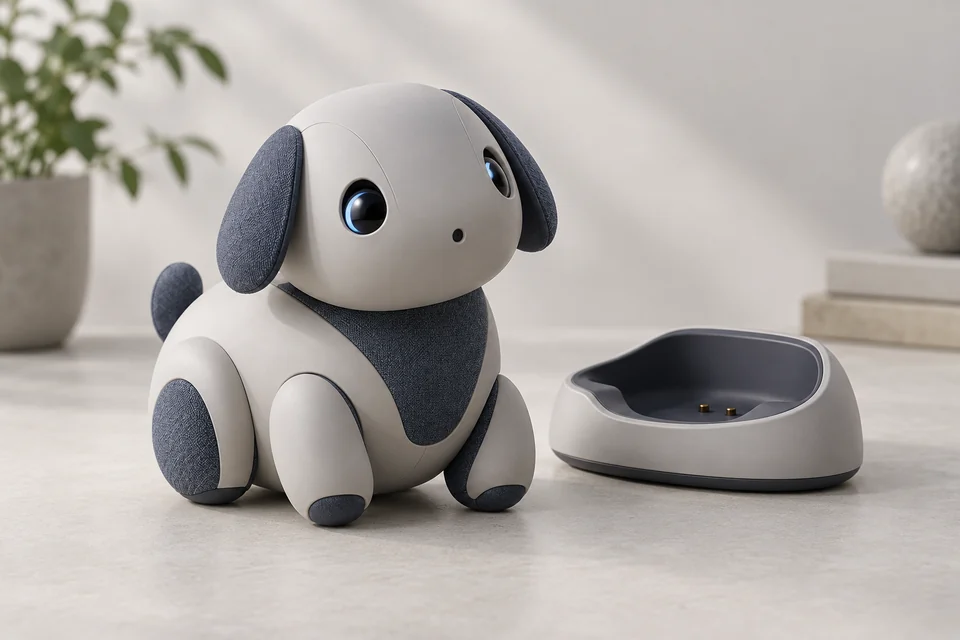
AI Companion Toys are physical play objects in which artificial intelligence governs socially responsive interaction, allowing speech, movement, expression or touch responses to vary with user input, interaction history and internal behavioral states. Their defining characteristic is adaptive social behavior embodied in a tangible object, with perceived personality and continuity emerging from the relationship between perception, memory and response generation.
The underlying intelligence may combine speech and visual recognition, natural language processing, dialogue generation, machine learning and behavioral control. Conversational models generate spoken responses and may retain selected information across interactions. Nonverbal models express behavioral states through gaze, posture, motion, sound and tactile responses. Computation may occur within the toy, in connected cloud systems or across both. Physical form, sensing capability, memory architecture and behavioral variability jointly determine the character of the interaction. Terms such as emotion and personality describe computationally represented states and observable behavior; they do not establish subjective experience or human emotional understanding.
Selected research
Industry Research
AI Companion Toys Industry Research Report 2026
Market perspective
According to APO Research, Inc, global AI Companion Toys revenue is estimated at 184.00 MUSD in 2025 and projected to reach 285.60 MUSD in 2026 and 1,110.56 MUSD by 2032, representing a CAGR of 25.40% from 2026 to 2032. Demand spans children’s conversational companions, adult emotional companions and robotic pets. Purchasing decisions depend on character appeal, interaction quality and the ability to maintain familiarity across repeated use. Lower priced plush products can expand access to companionship functions, while robotic pets require additional consumer spending for movement, sensing and autonomous behaviour. Changes in this product mix will influence average selling prices and the relationship between shipment growth and revenue growth.
Haivivi’s BubblePal adds conversational functionality to existing plush toys, while its CocoMate products integrate interaction with specific characters. Robopoet’s Fuzozo combines a portable plush form with connected emotional interaction, supported by cooperation with Tuya. Casio’s Moflin and GROOVE X’s LOVOT illustrate a different approach, using physical responses and evolving behaviour to establish familiarity. These product architectures create distinct development requirements. Conversational products depend heavily on voice processing, memory and character consistency; robotic companions also require coordination between perception, motion and physical interaction. Access to general AI models does not resolve these integration requirements.
Manufacturing economics vary with mechanical complexity and the extent of continuing cloud services. Plush companions combine textile production with audio electronics, connectivity, batteries and final assembly. Moving robots add actuators, transmissions, sensors and more demanding functional testing. Cloud inference, speech processing, software maintenance and content management generate costs after the hardware sale. Products sold with extended service access therefore require adequate provision for future usage. Frequent interaction can strengthen attachment while increasing service expenditure, making pricing and service design closely connected to product profitability.
Read the full market overview
China’s electronics and toy supply chains provide components and assembly capabilities for conversational and plush products, while Japanese manufacturers contribute established approaches to physical companionship. Haivivi’s entry into the United States adds language, content and channel requirements to its international expansion. Across markets, durable demand depends on reliable interaction after the initial novelty declines. Battery wear, mechanical faults and continued software availability affect usable product life. Attachment to a familiar character may encourage repair and continued service use, limiting the assumption that hardware replacement alone will generate repeat revenue. Sustaining the forecast growth requires broader household adoption, effective distribution and viable servicing of an expanding installed base.
Report Scope
This report quantifies the global AI Companion Toys market in terms of revenue (US$ million) and, where applicable, sales volume (k units), using 2025 as the base year and providing annual historical and forecast data for 2021–2032.
It standardizes definitions of Types and Applications, harmonizes vendor attribution, and presents comparable time series by company, Type, Application, and region/country, including indicative price bands (US$/k units) and concentration ratios (CR5/CR10).
The outputs are intended to support strategy development, budgeting, and performance benchmarking for brand owners, manufacturers, retailers, channel partners, and investors; data are structured with consistent units and fields to facilitate integration into internal FP&A and BI systems.
Key Companies & Market Share Insights
This section profiles leading manufacturers, combining 2021–2025 results with a 2026–2032 outlook. It reports revenue, market share, price bands, product and application mix, regional and channel mix, and key developments (M&A, capacity additions, certifications). It also provides global revenue, average price, and—where applicable—sales volume by manufacturer, and calculates CR5/CR10 and rank changes to support comparative benchmarking.
AI Companion Toys Market by Company
Sony
Panasonic
Sharp
Casio
MIXI
Alpha Group
UBTECH Robotics
Zhejiang Jinke Tom Culture Industry
Shifeng Cultural Development
Miko
GROOVE X
KEYi Tech
Elephant Robotics
Haivivi
Robopoet
Yukai Engineering
Ropet
LivingAI
Energize Lab
Shanghai SiliconPear Technology
Curio Interactive
AI Companion Toys Segment by Type
Conversational
Nonverbal
AI Companion Toys Segment by Application
Households
Educational Institutions
Care Facilities
Other Settings
AI Companion Toys Segment by Region
North America
United States
Canada
Mexico
Europe
Germany
France
U.K.
Italy
Russia
Spain
Netherlands
Switzerland
Sweden
Poland
Asia-Pacific
China
Japan
South Korea
India
Australia
Taiwan
Southeast Asia
South America
Brazil
Argentina
Chile
Colombia
Middle East & Africa
Egypt
South Africa
Israel
Türkiye
GCC Countries
Key Drivers & Barriers
High-impact rendering factors and drivers have been studied in this report to aid the readers to understand the general development. Moreover, the report includes restraints and challenges that may act as stumbling blocks on the way of the players. This will assist the users to be attentive and make informed decisions related to business. Specialists have also laid their focus on the upcoming business prospects.
Reasons to Buy This Report
1. This report will help the readers to understand the competition within the industries and strategies for the competitive environment to enhance the potential profit. The report also focuses on the competitive landscape of the global AI Companion Toys market, and introduces in detail the market share, industry ranking, competitor ecosystem, market performance, new product development, operation situation, expansion, and acquisition. etc. of the main players, which helps the readers to identify the main competitors and deeply understand the competition pattern of the market.
2. This report will help stakeholders to understand the global industry status and trends of AI Companion Toys and provides them with information on key market drivers, restraints, challenges, and opportunities.
3. This report will help stakeholders to understand competitors better and gain more insights to strengthen their position in their businesses. The competitive landscape section includes the market share and rank (in volume and value), competitor ecosystem, new product development, expansion, and acquisition.
4. This report stays updated with novel technology integration, features, and the latest developments in the market
5. This report helps stakeholders to gain insights into which regions to target globally
6. This report helps stakeholders to gain insights into the end-user perception concerning the adoption of AI Companion Toys.
7. This report helps stakeholders to identify some of the key players in the market and understand their valuable contribution.
Chapter Outline
Chapter 1: Research objectives, research methods, data sources, data cross-validation;
Chapter 2: Introduces the report scope of the report, executive summary of different market segments (by region, product type, application, etc.), including the market size of each market segment, future development potential, and so on. It offers a high-level view of the current state of the market and its likely evolution in the short to mid-term, and long term.
Chapter 3: Detailed analysis of AI Companion Toys manufacturers competitive landscape, price, production and value market share, latest development plan, merger, and acquisition information, etc.
Chapter 4: Provides profiles of key players, introducing the basic situation of the main companies in the market in detail, including product production/output, value, price, gross margin, product introduction, recent development, etc.
Chapter 5: Production/output, value of AI Companion Toys by region/country. It provides a quantitative analysis of the market size and development potential of each region in the next six years.
Chapter 6: Consumption of AI Companion Toys in regional level and country level. It provides a quantitative analysis of the market size and development potential of each region and its main countries and introduces the market development, future development prospects, market space, and production of each country in the world.
Chapter 7: Provides the analysis of various market segments by type, covering the market size and development potential of each market segment, to help readers find the blue ocean market in different market segments.
Chapter 8: Provides the analysis of various market segments by application, covering the market size and development potential of each market segment, to help readers find the blue ocean market in different downstream markets.
Chapter 9: Analysis of industrial chain, including the upstream and downstream of the industry.
Chapter 10: Introduces the market dynamics, latest developments of the market, the driving factors and restrictive factors of the market, the challenges and risks faced by manufacturers in the industry, and the analysis of relevant policies in the industry.
Chapter 11: The main points and conclusions of the report.
More report detail
Tables and figures
Scope & coverage.
Types
- Conversational
- Nonverbal
Applications
- Households
- Educational Institutions
- Care Facilities
- Other Settings
Companies covered
- Sony
- Panasonic
- Sharp
- Casio
- MIXI
- Alpha Group
- UBTECH Robotics
- Zhejiang Jinke Tom Culture Industry
- Shifeng Cultural Development
- Miko
- GROOVE X
- KEYi Tech
- Elephant Robotics
- Haivivi
- Robopoet
- Yukai Engineering
- Ropet
- LivingAI
- Energize Lab
- Shanghai SiliconPear Technology
- Curio Interactive
Inside the report.
1 Preface
- 1.1 Scope of Report
- 1.2 Reasons for Doing This Study
- 1.3 Research Methodology
- 1.4 Research Process
- 1.5 Data Source
- 1.5.1 Secondary Sources
- 1.5.2 Primary Sources
2 Market Overview
- 2.1 Product Definition
- 2.2 Global Market Growth Prospects
- 2.2.1 Global AI Companion Toys Market Size (2021-2032)
- 2.2.2 Global AI Companion Toys Sales (2021-2032)
- 2.2.3 Global AI Companion Toys Market Average Price (2021-2032)
- 2.3 AI Companion Toys by Type
- 2.3.1 Market Value Comparison by Type (2021 VS 2025 VS 2032) & (US$ Million)
- 2.3.2 Conversational
- 2.3.3 Nonverbal
- 2.4 AI Companion Toys by Application
- 2.4.1 Market Value Comparison by Application (2021 VS 2025 VS 2032)
- 2.4.2 Households
- 2.4.3 Educational Institutions
- 2.4.4 Care Facilities
- 2.4.5 Other Settings
3 Market Competitive Landscape by Manufacturers
- 3.1 Global AI Companion Toys Market Competitive Situation by Manufacturers (2021 Versus 2025)
- 3.2 Global AI Companion Toys Sales (k units) of Manufacturers (2021-2026)
- 3.3 Global AI Companion Toys Revenue of Manufacturers (2021-2026)
- 3.4 Global AI Companion Toys Average Price by Manufacturers (2021-2026)
- 3.5 Global AI Companion Toys Industry Ranking, 2024 VS 2025 VS 2026
- 3.6 Global Manufacturers of AI Companion Toys, Manufacturing Sites & Headquarters
- 3.7 Global Manufacturers of AI Companion Toys, Product Type & Application
- 3.8 Global Manufacturers of AI Companion Toys, Established Date
- 3.9 Global AI Companion Toys Market CR5 and HHI
- 3.10 Global Manufacturers Mergers & Acquisition
4 Manufacturers Profiled
- 4.1 Sony
- 4.1.1 Sony Company Information
- 4.1.2 Sony Business Overview
- 4.1.3 Sony AI Companion Toys Sales, Revenue and Gross Margin (2021-2026)
- 4.1.4 Sony AI Companion Toys Product Portfolio
- 4.1.5 Sony Recent Developments
- 4.2 Panasonic
- 4.2.1 Panasonic Company Information
- 4.2.2 Panasonic Business Overview
- 4.2.3 Panasonic AI Companion Toys Sales, Revenue and Gross Margin (2021-2026)
- 4.2.4 Panasonic AI Companion Toys Product Portfolio
- 4.2.5 Panasonic Recent Developments
- 4.3 Sharp
- 4.3.1 Sharp Company Information
- 4.3.2 Sharp Business Overview
- 4.3.3 Sharp AI Companion Toys Sales, Revenue and Gross Margin (2021-2026)
- 4.3.4 Sharp AI Companion Toys Product Portfolio
- 4.3.5 Sharp Recent Developments
- 4.4 Casio
- 4.4.1 Casio Company Information
- 4.4.2 Casio Business Overview
- 4.4.3 Casio AI Companion Toys Sales, Revenue and Gross Margin (2021-2026)
- 4.4.4 Casio AI Companion Toys Product Portfolio
- 4.4.5 Casio Recent Developments
- 4.5 MIXI
- 4.5.1 MIXI Company Information
- 4.5.2 MIXI Business Overview
- 4.5.3 MIXI AI Companion Toys Sales, Revenue and Gross Margin (2021-2026)
- 4.5.4 MIXI AI Companion Toys Product Portfolio
- 4.5.5 MIXI Recent Developments
- 4.6 Alpha Group
- 4.6.1 Alpha Group Company Information
- 4.6.2 Alpha Group Business Overview
- 4.6.3 Alpha Group AI Companion Toys Sales, Revenue and Gross Margin (2021-2026)
- 4.6.4 Alpha Group AI Companion Toys Product Portfolio
- 4.6.5 Alpha Group Recent Developments
- 4.7 UBTECH Robotics
- 4.7.1 UBTECH Robotics Company Information
- 4.7.2 UBTECH Robotics Business Overview
- 4.7.3 UBTECH Robotics AI Companion Toys Sales, Revenue and Gross Margin (2021-2026)
- 4.7.4 UBTECH Robotics AI Companion Toys Product Portfolio
- 4.7.5 UBTECH Robotics Recent Developments
- 4.8 Zhejiang Jinke Tom Culture Industry
- 4.8.1 Zhejiang Jinke Tom Culture Industry Company Information
- 4.8.2 Zhejiang Jinke Tom Culture Industry Business Overview
- 4.8.3 Zhejiang Jinke Tom Culture Industry AI Companion Toys Sales, Revenue and Gross Margin (2021-2026)
- 4.8.4 Zhejiang Jinke Tom Culture Industry AI Companion Toys Product Portfolio
- 4.8.5 Zhejiang Jinke Tom Culture Industry Recent Developments
- 4.9 Shifeng Cultural Development
- 4.9.1 Shifeng Cultural Development Company Information
- 4.9.2 Shifeng Cultural Development Business Overview
- 4.9.3 Shifeng Cultural Development AI Companion Toys Sales, Revenue and Gross Margin (2021-2026)
- 4.9.4 Shifeng Cultural Development AI Companion Toys Product Portfolio
- 4.9.5 Shifeng Cultural Development Recent Developments
- 4.10 Miko
- 4.10.1 Miko Company Information
- 4.10.2 Miko Business Overview
- 4.10.3 Miko AI Companion Toys Sales, Revenue and Gross Margin (2021-2026)
- 4.10.4 Miko AI Companion Toys Product Portfolio
- 4.10.5 Miko Recent Developments
- 4.11 GROOVE X
- 4.11.1 GROOVE X Company Information
- 4.11.2 GROOVE X Business Overview
- 4.11.3 GROOVE X AI Companion Toys Sales, Revenue and Gross Margin (2021-2026)
- 4.11.4 GROOVE X AI Companion Toys Product Portfolio
- 4.11.5 GROOVE X Recent Developments
- 4.12 KEYi Tech
- 4.12.1 KEYi Tech Company Information
- 4.12.2 KEYi Tech Business Overview
- 4.12.3 KEYi Tech AI Companion Toys Sales, Revenue and Gross Margin (2021-2026)
- 4.12.4 KEYi Tech AI Companion Toys Product Portfolio
- 4.12.5 KEYi Tech Recent Developments
- 4.13 Elephant Robotics
- 4.13.1 Elephant Robotics Company Information
- 4.13.2 Elephant Robotics Business Overview
- 4.13.3 Elephant Robotics AI Companion Toys Sales, Revenue and Gross Margin (2021-2026)
- 4.13.4 Elephant Robotics AI Companion Toys Product Portfolio
- 4.13.5 Elephant Robotics Recent Developments
- 4.14 Haivivi
- 4.14.1 Haivivi Company Information
- 4.14.2 Haivivi Business Overview
- 4.14.3 Haivivi AI Companion Toys Sales, Revenue and Gross Margin (2021-2026)
- 4.14.4 Haivivi AI Companion Toys Product Portfolio
- 4.14.5 Haivivi Recent Developments
- 4.15 Robopoet
- 4.15.1 Robopoet Company Information
- 4.15.2 Robopoet Business Overview
- 4.15.3 Robopoet AI Companion Toys Sales, Revenue and Gross Margin (2021-2026)
- 4.15.4 Robopoet AI Companion Toys Product Portfolio
- 4.15.5 Robopoet Recent Developments
- 4.16 Yukai Engineering
- 4.16.1 Yukai Engineering Company Information
- 4.16.2 Yukai Engineering Business Overview
- 4.16.3 Yukai Engineering AI Companion Toys Sales, Revenue and Gross Margin (2021-2026)
- 4.16.4 Yukai Engineering AI Companion Toys Product Portfolio
- 4.16.5 Yukai Engineering Recent Developments
- 4.17 Ropet
- 4.17.1 Ropet Company Information
- 4.17.2 Ropet Business Overview
- 4.17.3 Ropet AI Companion Toys Sales, Revenue and Gross Margin (2021-2026)
- 4.17.4 Ropet AI Companion Toys Product Portfolio
- 4.17.5 Ropet Recent Developments
- 4.18 LivingAI
- 4.18.1 LivingAI Company Information
- 4.18.2 LivingAI Business Overview
- 4.18.3 LivingAI AI Companion Toys Sales, Revenue and Gross Margin (2021-2026)
- 4.18.4 LivingAI AI Companion Toys Product Portfolio
- 4.18.5 LivingAI Recent Developments
- 4.19 Energize Lab
- 4.19.1 Energize Lab Company Information
- 4.19.2 Energize Lab Business Overview
- 4.19.3 Energize Lab AI Companion Toys Sales, Revenue and Gross Margin (2021-2026)
- 4.19.4 Energize Lab AI Companion Toys Product Portfolio
- 4.19.5 Energize Lab Recent Developments
- 4.20 Shanghai SiliconPear Technology
- 4.20.1 Shanghai SiliconPear Technology Company Information
- 4.20.2 Shanghai SiliconPear Technology Business Overview
- 4.20.3 Shanghai SiliconPear Technology AI Companion Toys Sales, Revenue and Gross Margin (2021-2026)
- 4.20.4 Shanghai SiliconPear Technology AI Companion Toys Product Portfolio
- 4.20.5 Shanghai SiliconPear Technology Recent Developments
- 4.21 Curio Interactive
- 4.21.1 Curio Interactive Company Information
- 4.21.2 Curio Interactive Business Overview
- 4.21.3 Curio Interactive AI Companion Toys Sales, Revenue and Gross Margin (2021-2026)
- 4.21.4 Curio Interactive AI Companion Toys Product Portfolio
- 4.21.5 Curio Interactive Recent Developments
5 Global AI Companion Toys Market Scenario by Region
- 5.1 Global AI Companion Toys Market Size by Region: 2021 VS 2025 VS 2032
- 5.2 Global AI Companion Toys Sales by Region: 2021-2032
- 5.2.1 Global AI Companion Toys Sales by Region: 2021-2026
- 5.2.2 Global AI Companion Toys Sales by Region: 2027-2032
- 5.3 Global AI Companion Toys Revenue by Region: 2021-2032
- 5.3.1 Global AI Companion Toys Revenue by Region: 2021-2026
- 5.3.2 Global AI Companion Toys Revenue by Region: 2027-2032
- 5.4 North America AI Companion Toys Market Facts & Figures by Country
- 5.4.1 North America AI Companion Toys Market Size by Country: 2021 VS 2025 VS 2032
- 5.4.2 North America AI Companion Toys Sales by Country (2021-2032)
- 5.4.3 North America AI Companion Toys Revenue by Country (2021-2032)
- 5.4.4 United States
- 5.4.5 Canada
- 5.4.6 Mexico
- 5.5 Europe AI Companion Toys Market Facts & Figures by Country
- 5.5.1 Europe AI Companion Toys Market Size by Country: 2021 VS 2025 VS 2032
- 5.5.2 Europe AI Companion Toys Sales by Country (2021-2032)
- 5.5.3 Europe AI Companion Toys Revenue by Country (2021-2032)
- 5.5.4 Germany
- 5.5.5 France
- 5.5.6 U.K.
- 5.5.7 Italy
- 5.5.8 Russia
- 5.5.9 Spain
- 5.5.10 Netherlands
- 5.5.11 Switzerland
- 5.5.12 Sweden
- 5.5.13 Poland
- 5.6 Asia Pacific AI Companion Toys Market Facts & Figures by Country
- 5.6.1 Asia Pacific AI Companion Toys Market Size by Country: 2021 VS 2025 VS 2032
- 5.6.2 Asia Pacific AI Companion Toys Sales by Country (2021-2032)
- 5.6.3 Asia Pacific AI Companion Toys Revenue by Country (2021-2032)
- 5.6.4 China
- 5.6.5 Japan
- 5.6.6 South Korea
- 5.6.7 India
- 5.6.8 Australia
- 5.6.9 Taiwan
- 5.6.10 Southeast Asia
- 5.7 South America AI Companion Toys Market Facts & Figures by Country
- 5.7.1 South America AI Companion Toys Market Size by Country: 2021 VS 2025 VS 2032
- 5.7.2 South America AI Companion Toys Sales by Country (2021-2032)
- 5.7.3 South America AI Companion Toys Revenue by Country (2021-2032)
- 5.7.4 Brazil
- 5.7.5 Argentina
- 5.7.6 Chile
- 5.7.7 Colombia
- 5.8 Middle East and Africa AI Companion Toys Market Facts & Figures by Country
- 5.8.1 Middle East and Africa AI Companion Toys Market Size by Country: 2021 VS 2025 VS 2032
- 5.8.2 Middle East and Africa AI Companion Toys Sales by Country (2021-2032)
- 5.8.3 Middle East and Africa AI Companion Toys Revenue by Country (2021-2032)
- 5.8.4 Egypt
- 5.8.5 South Africa
- 5.8.6 Israel
- 5.8.7 Türkiye
- 5.8.8 GCC Countries
6 Segment by Type
- 6.1 Global AI Companion Toys Sales by Type (2021-2032)
- 6.1.1 Global AI Companion Toys Sales by Type (2021-2032) & (k units)
- 6.1.2 Global AI Companion Toys Sales Market Share by Type (2021-2032)
- 6.2 Global AI Companion Toys Revenue by Type (2021-2032)
- 6.2.1 Global AI Companion Toys Sales by Type (2021-2032) & (US$ Million)
- 6.2.2 Global AI Companion Toys Revenue Market Share by Type (2021-2032)
- 6.3 Global AI Companion Toys Price by Type (2021-2032)
7 Segment by Application
- 7.1 Global AI Companion Toys Sales by Application (2021-2032)
- 7.1.1 Global AI Companion Toys Sales by Application (2021-2032) & (k units)
- 7.1.2 Global AI Companion Toys Sales Market Share by Application (2021-2032)
- 7.2 Global AI Companion Toys Revenue by Application (2021-2032)
- 7.2.1 Global AI Companion Toys Sales by Application (2021-2032) & (US$ Million)
- 7.2.2 Global AI Companion Toys Revenue Market Share by Application (2021-2032)
- 7.3 Global AI Companion Toys Price by Application (2021-2032)
8 Value Chain and Sales Channels Analysis of the Market
- 8.1 AI Companion Toys Value Chain Analysis
- 8.1.1 AI Companion Toys Key Raw Materials
- 8.1.2 Raw Materials Key Suppliers
- 8.1.3 AI Companion Toys Production Mode & Process
- 8.2 AI Companion Toys Sales Channels Analysis
- 8.2.1 Direct Comparison with Distribution Share
- 8.2.2 AI Companion Toys Distributors
- 8.2.3 AI Companion Toys Customers
9 Global AI Companion Toys Analyzing Market Dynamics
- 9.1 AI Companion Toys Industry Trends
- 9.2 AI Companion Toys Industry Drivers
- 9.3 AI Companion Toys Industry Opportunities and Challenges
- 9.4 AI Companion Toys Industry Restraints
10 Report Conclusion
11 Disclaimer
GET THE RESEARCH
Choose your license.
Choose who needs access.
All options are for this report and research series.
PDF by email within 3–5 working days after payment confirmation.
Talk to an analyst