APO RESEARCH · REPORT
Stretch Film Packaging
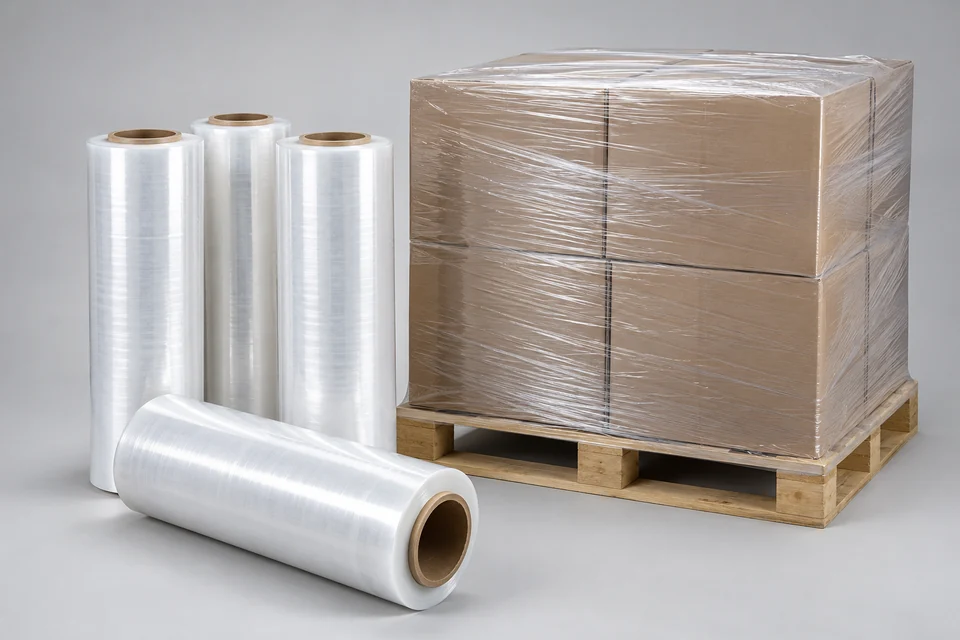
Stretch film packaging comprises thin extensible polymer films that secure individual products, bundles, rolls, trays, and palletized loads through tensile deformation, elastic recovery, surface cling, and overlapping wrap geometry.
Product & engineering
Understand the product.
Stretch film packaging comprises thin extensible polymer films that secure individual products, bundles, rolls, trays, and palletized loads through tensile deformation, elastic recovery, surface cling, and overlapping wrap geometry. Mechanical elongation stores elastic energy within the film. Subsequent molecular recovery generates circumferential containment force around the load, while adhesion between overlapping layers maintains package continuity. Load restraint derives from the retained tensile stress of the film, the number and distribution of effective layers, wrap angle, contact friction, and the mechanical response of the packaged goods.
Industrial stretch film is produced predominantly from linear low density polyethylene containing butene, hexene, or octene comonomers. Short chain branching reduces crystal packing efficiency and forms a semicrystalline structure combining extensibility, toughness, impact resistance, and recoverable deformation. Metallocene linear low density polyethylene and polyethylene plastomers provide narrower molecular weight and comonomer distributions, permitting thinner gauges, more uniform deformation, higher puncture resistance, and controlled stress retention. Formulations may also contain low density polyethylene, very low density polyethylene, ethylene vinyl acetate, polyisobutylene cling agents, polymeric tackifiers, slip agents, antiblock agents, processing aids, pigments, ultraviolet stabilizers, antistatic additives, and recycled polyethylene. Typical polymer density lies between approximately 0.90 and 0.94 g/cm³.
Modern stretch films commonly use three, five, seven, or nine coextruded layers. Microlayer structures may contain several dozen discrete layers. The internal core carries most of the tensile load and governs elongation, toughness, puncture resistance, elastic recovery, and stress relaxation. The cling surface contains migratory or permanent tack components that produce adhesion between successive wraps. The external surface controls slip, pallet contact, abrasion, blocking, unwind force, and surface friction. Layer thickness ratios, resin compatibility, crystallinity, molecular orientation, interfacial bonding, and cooling history determine the mechanical balance between stretchability, stiffness, toughness, recovery, and retained force.
Cast stretch film is produced by melting and homogenizing polymer streams in separate extruders, combining them through a feedblock or multilayer die, discharging the melt through a flat die, and rapidly cooling the web on a chilled roll. Typical polyethylene melt temperatures are approximately 180 to 250 °C. Rapid quenching limits crystal growth and produces high clarity, uniform thickness, stable roll geometry, controlled cling distribution, and low unwind noise. Blown stretch film is extruded through an annular die into a tubular bubble, expanded by internal air pressure, drawn longitudinally, cooled, collapsed, slit, and wound. The combined blow up ratio and haul off ratio create biaxial molecular orientation, producing a different balance of puncture resistance, tear propagation, toughness, optical properties, and elastic recovery. Die geometry, melt temperature, output rate, cooling rate, draw ratio, layer distribution, edge trim, web tension, and winding pressure determine film uniformity and roll integrity.
Commercial pallet stretch films commonly have nominal thicknesses of approximately 8 to 35 µm. Thin gauge high performance products may fall below this range, while heavy duty and specialty films may exceed it. A nominal width near 500 mm is common for pallet wrapping. Narrow bundling films, hand rolls, wide machine webs, jumbo rolls, and converted prestretched films use different dimensions. Ultimate elongation commonly ranges from approximately 300 to 700 percent, with tensile strength frequently falling between approximately 20 and 60 MPa according to formulation, thickness, test speed, and orientation. Applied elongation generally ranges from approximately 50 to 150 percent for hand film and approximately 150 to 300 percent for machine film. Certain high performance machine grades operate above 300 percent. Prestretched film is mechanically drawn before rewinding, partially relaxed, and wound at a reduced effective gauge while retaining recoverable molecular strain.
Stretch film performance is defined by tensile strength in the machine and transverse directions, elongation at break, yield behavior, elastic modulus, puncture energy, tear initiation, tear propagation, dart impact resistance, cling force, coefficient of friction, haze, gloss, unwind force, permanent deformation, elastic recovery, stress relaxation, and retained force. Initial wrap force determines the immediate tensile load applied to the package. Polymer recovery maintains containment after application. Viscoelastic stress relaxation progressively reduces retained force with time, temperature, and sustained strain. Film stiffness affects load compression and corner pressure. Toughness and puncture resistance control survival around sharp edges and irregular surfaces. Surface friction influences interaction between the film, the load, adjacent pallets, and handling equipment.
Manufacturing and service failures include gauge bands, gels, contamination, die lines, interlayer instability, weak edges, wrinkles, blocking, irregular cling, excessive slip, telescoping, core deformation, roll edge damage, nonuniform elongation, necking, puncture initiation, tear propagation, web rupture, creep, permanent set, and loss of containment through stress relaxation. The resulting package is a coupled mechanical structure in which polymer formulation, layer architecture, film geometry, molecular orientation, residual stress, surface properties, load shape, edge condition, and environmental temperature collectively determine stability during handling, storage, vibration, acceleration, impact, and transport.
Packaging performance arises from the material, converted geometry, closure and filling or handling process. Material shipments, empty packs and filled-product sales are different objects and must be measured separately.
What turns activity into demand
Accepted filled packs create packaging demand through material per pack, converting yield and filling losses. The package, packaging material and the product it contains are different transaction objects.
The commercial boundary
For Stretch Film Packaging, distinguish the supplied product from its inputs and the complete application. Report types and applications may overlap; retain the selected edition's product definition, geography, period, unit and transaction basis when comparing estimates.
Which conditions determine usable stretch film packaging performance?
Stretch film packaging comprises thin extensible polymer films that secure individual products, bundles, rolls, trays, and palletized loads through tensile deformation, elastic recovery, surface cling, and overlapping wrap geometry. Verify barrier, sealing and mechanical requirements against the specified contents and handling duty. Relate accepted pack count to material intensity, converting yield and line loss; a material name alone does not establish pack performance.
Selected research
Industry Research
Stretch Film Packaging Industry Research Report 2026
Market perspective
Stretch film packaging comprises thin extensible polymer films that secure individual products, bundles, rolls, trays, and palletized loads through tensile deformation, elastic recovery, surface cling, and overlapping wrap geometry. Mechanical elongation stores elastic energy within the film. Subsequent molecular recovery generates circumferential containment force around the load, while adhesion between overlapping layers maintains package continuity. Load restraint derives from the retained tensile stress of the film, the number and distribution of effective layers, wrap angle, contact friction, and the mechanical response of the packaged goods.
Industrial stretch film is produced predominantly from linear low density polyethylene containing butene, hexene, or octene comonomers. Short chain branching reduces crystal packing efficiency and forms a semicrystalline structure combining extensibility, toughness, impact resistance, and recoverable deformation. Metallocene linear low density polyethylene and polyethylene plastomers provide narrower molecular weight and comonomer distributions, permitting thinner gauges, more uniform deformation, higher puncture resistance, and controlled stress retention. Formulations may also contain low density polyethylene, very low density polyethylene, ethylene vinyl acetate, polyisobutylene cling agents, polymeric tackifiers, slip agents, antiblock agents, processing aids, pigments, ultraviolet stabilizers, antistatic additives, and recycled polyethylene. Typical polymer density lies between approximately 0.90 and 0.94 g/cm³.
Modern stretch films commonly use three, five, seven, or nine coextruded layers. Microlayer structures may contain several dozen discrete layers. The internal core carries most of the tensile load and governs elongation, toughness, puncture resistance, elastic recovery, and stress relaxation. The cling surface contains migratory or permanent tack components that produce adhesion between successive wraps. The external surface controls slip, pallet contact, abrasion, blocking, unwind force, and surface friction. Layer thickness ratios, resin compatibility, crystallinity, molecular orientation, interfacial bonding, and cooling history determine the mechanical balance between stretchability, stiffness, toughness, recovery, and retained force.
Read the full market overview
Cast stretch film is produced by melting and homogenizing polymer streams in separate extruders, combining them through a feedblock or multilayer die, discharging the melt through a flat die, and rapidly cooling the web on a chilled roll. Typical polyethylene melt temperatures are approximately 180 to 250 °C. Rapid quenching limits crystal growth and produces high clarity, uniform thickness, stable roll geometry, controlled cling distribution, and low unwind noise. Blown stretch film is extruded through an annular die into a tubular bubble, expanded by internal air pressure, drawn longitudinally, cooled, collapsed, slit, and wound. The combined blow up ratio and haul off ratio create biaxial molecular orientation, producing a different balance of puncture resistance, tear propagation, toughness, optical properties, and elastic recovery. Die geometry, melt temperature, output rate, cooling rate, draw ratio, layer distribution, edge trim, web tension, and winding pressure determine film uniformity and roll integrity.
Commercial pallet stretch films commonly have nominal thicknesses of approximately 8 to 35 µm. Thin gauge high performance products may fall below this range, while heavy duty and specialty films may exceed it. A nominal width near 500 mm is common for pallet wrapping. Narrow bundling films, hand rolls, wide machine webs, jumbo rolls, and converted prestretched films use different dimensions. Ultimate elongation commonly ranges from approximately 300 to 700 percent, with tensile strength frequently falling between approximately 20 and 60 MPa according to formulation, thickness, test speed, and orientation. Applied elongation generally ranges from approximately 50 to 150 percent for hand film and approximately 150 to 300 percent for machine film. Certain high performance machine grades operate above 300 percent. Prestretched film is mechanically drawn before rewinding, partially relaxed, and wound at a reduced effective gauge while retaining recoverable molecular strain.
Stretch film performance is defined by tensile strength in the machine and transverse directions, elongation at break, yield behavior, elastic modulus, puncture energy, tear initiation, tear propagation, dart impact resistance, cling force, coefficient of friction, haze, gloss, unwind force, permanent deformation, elastic recovery, stress relaxation, and retained force. Initial wrap force determines the immediate tensile load applied to the package. Polymer recovery maintains containment after application. Viscoelastic stress relaxation progressively reduces retained force with time, temperature, and sustained strain. Film stiffness affects load compression and corner pressure. Toughness and puncture resistance control survival around sharp edges and irregular surfaces. Surface friction influences interaction between the film, the load, adjacent pallets, and handling equipment.
Manufacturing and service failures include gauge bands, gels, contamination, die lines, interlayer instability, weak edges, wrinkles, blocking, irregular cling, excessive slip, telescoping, core deformation, roll edge damage, nonuniform elongation, necking, puncture initiation, tear propagation, web rupture, creep, permanent set, and loss of containment through stress relaxation. The resulting package is a coupled mechanical structure in which polymer formulation, layer architecture, film geometry, molecular orientation, residual stress, surface properties, load shape, edge condition, and environmental temperature collectively determine stability during handling, storage, vibration, acceleration, impact, and transport.
The global Stretch Film Packaging market was valued at US$ million in 2025 and is projected to reach US$ million by 2032, implying a CAGR of % over 2026–2032.
The North America market for Stretch Film Packaging is forecast to increase from US$ million in 2026 to US$ million by 2032, corresponding to a CAGR of % over 2026–2032.
The Europe market for Stretch Film Packaging is projected to rise from US$ million in 2026 to US$ million by 2032, registering a CAGR of % over 2026–2032.
The Asia Pacific market for Stretch Film Packaging is expected to grow from US$ million in 2026 to US$ million by 2032, at a CAGR of % over 2026–2032.
Leading global manufacturers of Stretch Film Packaging include , among others. In 2025, the top three vendors together accounted for approximately % of global revenue.
Report Scope
This report quantifies the global Stretch Film Packaging market in revenue (US$ million) and, where applicable, sales volume (kt), using 2025 as the base year and providing annual historical and forecast data for 2021–2032.
It standardizes definitions of types and applications, harmonizes vendor attribution, and presents comparable time series by company, type, application, and region/country, including indicative price bands (US$/kt) and concentration ratios (CR5/CR10).
The outputs are intended to support strategy development, budgeting, and performance benchmarking for manufacturers, new entrants, channel partners, and investors; the report also reviews technology shifts and notable product introductions relevant to Stretch Film Packaging.
Key Companies & Market Share Insights
This section profiles leading manufacturers, combining 2021–2025 results with a 2026–2032 outlook. It reports revenue, market share, price bands, product and application mix, regional and channel mix, and key developments (M&A, capacity additions, certifications). It also provides global revenue, average price, and—where applicable—sales volume by manufacturer, and calculates CR5/CR10 and rank changes to support comparative benchmarking.
Stretch Film Packaging Market by Company
Amcor plc
Sigma Plastics Group
Inteplast Group
Manupackaging Group
Paragon Films
Trioworld Group
Scientex Berhad
Pro Pac Packaging
Thong Guan Industries Berhad
Signode
Efekt Plus
DUO PLAST AG
Huatong United (Nantong)
IPG
POLIFILM Group
Coveris
HIPAC Group
Revolution Company
Rani Plast
ERGIS S.A.
Plastotecnica S.p.A.
Megaplast Group
Stretch Film Packaging Segment by Type
Machine Stretch Film
Manual Stretch Film
Stretch Film Packaging Segment by Application
Food & Beverage
Industrial Manufacturing
Logistics & Warehousing
Agriculture
Healthcare & Pharmaceuticals
Others
Stretch Film Packaging Segment by Region
North America
United States
Canada
Mexico
Europe
Germany
France
U.K.
Italy
Russia
Spain
Netherlands
Switzerland
Sweden
Poland
Asia-Pacific
China
Japan
South Korea
India
Australia
Taiwan
Southeast Asia
South America
Brazil
Argentina
Chile
Colombia
Middle East & Africa
Egypt
South Africa
Israel
Türkiye
GCC Countries
Key Drivers & Barriers
High-impact rendering factors and drivers have been studied in this report to aid the readers to understand the general development. Moreover, the report includes restraints and challenges that may act as stumbling blocks on the way of the players. This will assist the users to be attentive and make informed decisions related to business. Specialists have also laid their focus on the upcoming business prospects.
Reasons to Buy This Report
1. This report will help the readers to understand the competition within the industries and strategies for the competitive environment to enhance the potential profit. The report also focuses on the competitive landscape of the global Stretch Film Packaging market, and introduces in detail the market share, industry ranking, competitor ecosystem, market performance, new product development, operation situation, expansion, and acquisition. etc. of the main players, which helps the readers to identify the main competitors and deeply understand the competition pattern of the market.
2. This report will help stakeholders to understand the global industry status and trends of Stretch Film Packaging and provides them with information on key market drivers, restraints, challenges, and opportunities.
3. This report will help stakeholders to understand competitors better and gain more insights to strengthen their position in their businesses. The competitive landscape section includes the market share and rank (in volume and value), competitor ecosystem, new product development, expansion, and acquisition.
4. This report stays updated with novel technology integration, features, and the latest developments in the market
5. This report helps stakeholders to gain insights into which regions to target globally
6. This report helps stakeholders to gain insights into the end-user perception concerning the adoption of Stretch Film Packaging.
7. This report helps stakeholders to identify some of the key players in the market and understand their valuable contribution.
Chapter Outline
Chapter 1: Research objectives, research methods, data sources, data cross-validation;
Chapter 2: Introduces the report scope of the report, executive summary of different market segments (by region, product type, application, etc), including the market size of each market segment, future development potential, and so on. It offers a high-level view of the current state of the market and its likely evolution in the short to mid-term, and long term.
Chapter 3: Detailed analysis of Stretch Film Packaging manufacturers competitive landscape, price, production and value market share, latest development plan, merger, and acquisition information, etc.
Chapter 4: Provides profiles of key players, introducing the basic situation of the main companies in the market in detail, including product production/output, value, price, gross margin, product introduction, recent development, etc.
Chapter 5: Production/output, value of Stretch Film Packaging by region/country. It provides a quantitative analysis of the market size and development potential of each region in the next six years.
Chapter 6: Consumption of Stretch Film Packaging in regional level and country level. It provides a quantitative analysis of the market size and development potential of each region and its main countries and introduces the market development, future development prospects, market space, and production of each country in the world.
Chapter 7: Provides the analysis of various market segments by type, covering the market size and development potential of each market segment, to help readers find the blue ocean market in different market segments.
Chapter 8: Provides the analysis of various market segments by application, covering the market size and development potential of each market segment, to help readers find the blue ocean market in different downstream markets.
Chapter 9: Analysis of industrial chain, including the upstream and downstream of the industry.
Chapter 10: Introduces the market dynamics, latest developments of the market, the driving factors and restrictive factors of the market, the challenges and risks faced by manufacturers in the industry, and the analysis of relevant policies in the industry.
Chapter 11: The main points and conclusions of the report.
More report detail
Tables and figures
Scope & coverage.
Types
- Machine Stretch Film
- Manual Stretch Film
Applications
- Food & Beverage
- Industrial Manufacturing
- Logistics & Warehousing
- Agriculture
- Healthcare & Pharmaceuticals
- Others
Companies covered
- Amcor plc
- Sigma Plastics Group
- Inteplast Group
- Manupackaging Group
- Paragon Films
- Trioworld Group
- Scientex Berhad
- Pro Pac Packaging
- Thong Guan Industries Berhad
- Signode
- Efekt Plus
- DUO PLAST AG
- Huatong United (Nantong)
- IPG
- POLIFILM Group
- Coveris
- HIPAC Group
- Revolution Company
- Rani Plast
- ERGIS S.A.
- Plastotecnica S.p.A.
- Megaplast Group
Inside the report.
1 Preface
- 1.1 Scope of Report
- 1.2 Reasons for Doing This Study
- 1.3 Research Methodology
- 1.4 Research Process
- 1.5 Data Source
- 1.5.1 Secondary Sources
- 1.5.2 Primary Sources
2 Market Overview
- 2.1 Product Definition
- 2.2 Stretch Film Packaging by Type
- 2.2.1 Market Value Comparison by Type (2021 VS 2025 VS 2032) & (US$ Million)
- 2.2.2 Machine Stretch Film
- 2.2.3 Manual Stretch Film
- 2.3 Stretch Film Packaging by Application
- 2.3.1 Market Value Comparison by Application (2021 VS 2025 VS 2032) & (US$ Million)
- 2.3.2 Food & Beverage
- 2.3.3 Industrial Manufacturing
- 2.3.4 Logistics & Warehousing
- 2.3.5 Agriculture
- 2.3.6 Healthcare & Pharmaceuticals
- 2.3.7 Others
- 2.4 Global Market Growth Prospects
- 2.4.1 Global Stretch Film Packaging Production Value Estimates and Forecasts (2021-2032)
- 2.4.2 Global Stretch Film Packaging Production Capacity Estimates and Forecasts (2021-2032)
- 2.4.3 Global Stretch Film Packaging Production Estimates and Forecasts (2021-2032)
- 2.4.4 Global Stretch Film Packaging Market Average Price (2021-2032)
3 Market Competitive Landscape by Manufacturers
- 3.1 Global Stretch Film Packaging Production by Manufacturers (2021-2026)
- 3.2 Global Stretch Film Packaging Production Value by Manufacturers (2021-2026)
- 3.3 Global Stretch Film Packaging Average Price by Manufacturers (2021-2026)
- 3.4 Global Stretch Film Packaging Industry Manufacturers Ranking, 2024 VS 2025 VS 2026
- 3.5 Global Stretch Film Packaging Key Manufacturers, Manufacturing Sites & Headquarters
- 3.6 Global Stretch Film Packaging Manufacturers, Product Type & Application
- 3.7 Global Stretch Film Packaging Manufacturers Established Date
- 3.8 Global Stretch Film Packaging Market CR5 and HHI
- 3.9 Global Manufacturers Mergers & Acquisition
4 Manufacturers Profiled
- 4.1 Amcor plc
- 4.1.1 Amcor plc Stretch Film Packaging Company Information
- 4.1.2 Amcor plc Stretch Film Packaging Business Overview
- 4.1.3 Amcor plc Stretch Film Packaging Production Capacity, Value and Gross Margin (2021-2026)
- 4.1.4 Amcor plc Product Portfolio
- 4.1.5 Amcor plc Recent Developments
- 4.2 Sigma Plastics Group
- 4.2.1 Sigma Plastics Group Stretch Film Packaging Company Information
- 4.2.2 Sigma Plastics Group Stretch Film Packaging Business Overview
- 4.2.3 Sigma Plastics Group Stretch Film Packaging Production Capacity, Value and Gross Margin (2021-2026)
- 4.2.4 Sigma Plastics Group Product Portfolio
- 4.2.5 Sigma Plastics Group Recent Developments
- 4.3 Inteplast Group
- 4.3.1 Inteplast Group Stretch Film Packaging Company Information
- 4.3.2 Inteplast Group Stretch Film Packaging Business Overview
- 4.3.3 Inteplast Group Stretch Film Packaging Production Capacity, Value and Gross Margin (2021-2026)
- 4.3.4 Inteplast Group Product Portfolio
- 4.3.5 Inteplast Group Recent Developments
- 4.4 Manupackaging Group
- 4.4.1 Manupackaging Group Stretch Film Packaging Company Information
- 4.4.2 Manupackaging Group Stretch Film Packaging Business Overview
- 4.4.3 Manupackaging Group Stretch Film Packaging Production Capacity, Value and Gross Margin (2021-2026)
- 4.4.4 Manupackaging Group Product Portfolio
- 4.4.5 Manupackaging Group Recent Developments
- 4.5 Paragon Films
- 4.5.1 Paragon Films Stretch Film Packaging Company Information
- 4.5.2 Paragon Films Stretch Film Packaging Business Overview
- 4.5.3 Paragon Films Stretch Film Packaging Production Capacity, Value and Gross Margin (2021-2026)
- 4.5.4 Paragon Films Product Portfolio
- 4.5.5 Paragon Films Recent Developments
- 4.6 Trioworld Group
- 4.6.1 Trioworld Group Stretch Film Packaging Company Information
- 4.6.2 Trioworld Group Stretch Film Packaging Business Overview
- 4.6.3 Trioworld Group Stretch Film Packaging Production Capacity, Value and Gross Margin (2021-2026)
- 4.6.4 Trioworld Group Product Portfolio
- 4.6.5 Trioworld Group Recent Developments
- 4.7 Scientex Berhad
- 4.7.1 Scientex Berhad Stretch Film Packaging Company Information
- 4.7.2 Scientex Berhad Stretch Film Packaging Business Overview
- 4.7.3 Scientex Berhad Stretch Film Packaging Production Capacity, Value and Gross Margin (2021-2026)
- 4.7.4 Scientex Berhad Product Portfolio
- 4.7.5 Scientex Berhad Recent Developments
- 4.8 Pro Pac Packaging
- 4.8.1 Pro Pac Packaging Stretch Film Packaging Company Information
- 4.8.2 Pro Pac Packaging Stretch Film Packaging Business Overview
- 4.8.3 Pro Pac Packaging Stretch Film Packaging Production Capacity, Value and Gross Margin (2021-2026)
- 4.8.4 Pro Pac Packaging Product Portfolio
- 4.8.5 Pro Pac Packaging Recent Developments
- 4.9 Thong Guan Industries Berhad
- 4.9.1 Thong Guan Industries Berhad Stretch Film Packaging Company Information
- 4.9.2 Thong Guan Industries Berhad Stretch Film Packaging Business Overview
- 4.9.3 Thong Guan Industries Berhad Stretch Film Packaging Production Capacity, Value and Gross Margin (2021-2026)
- 4.9.4 Thong Guan Industries Berhad Product Portfolio
- 4.9.5 Thong Guan Industries Berhad Recent Developments
- 4.10 Signode
- 4.10.1 Signode Stretch Film Packaging Company Information
- 4.10.2 Signode Stretch Film Packaging Business Overview
- 4.10.3 Signode Stretch Film Packaging Production Capacity, Value and Gross Margin (2021-2026)
- 4.10.4 Signode Product Portfolio
- 4.10.5 Signode Recent Developments
- 4.11 Efekt Plus
- 4.11.1 Efekt Plus Stretch Film Packaging Company Information
- 4.11.2 Efekt Plus Stretch Film Packaging Business Overview
- 4.11.3 Efekt Plus Stretch Film Packaging Production Capacity, Value and Gross Margin (2021-2026)
- 4.11.4 Efekt Plus Product Portfolio
- 4.11.5 Efekt Plus Recent Developments
- 4.12 DUO PLAST AG
- 4.12.1 DUO PLAST AG Stretch Film Packaging Company Information
- 4.12.2 DUO PLAST AG Stretch Film Packaging Business Overview
- 4.12.3 DUO PLAST AG Stretch Film Packaging Production Capacity, Value and Gross Margin (2021-2026)
- 4.12.4 DUO PLAST AG Product Portfolio
- 4.12.5 DUO PLAST AG Recent Developments
- 4.13 Huatong United (Nantong)
- 4.13.1 Huatong United (Nantong) Stretch Film Packaging Company Information
- 4.13.2 Huatong United (Nantong) Stretch Film Packaging Business Overview
- 4.13.3 Huatong United (Nantong) Stretch Film Packaging Production Capacity, Value and Gross Margin (2021-2026)
- 4.13.4 Huatong United (Nantong) Product Portfolio
- 4.13.5 Huatong United (Nantong) Recent Developments
- 4.14 IPG
- 4.14.1 IPG Stretch Film Packaging Company Information
- 4.14.2 IPG Stretch Film Packaging Business Overview
- 4.14.3 IPG Stretch Film Packaging Production Capacity, Value and Gross Margin (2021-2026)
- 4.14.4 IPG Product Portfolio
- 4.14.5 IPG Recent Developments
- 4.15 POLIFILM Group
- 4.15.1 POLIFILM Group Stretch Film Packaging Company Information
- 4.15.2 POLIFILM Group Stretch Film Packaging Business Overview
- 4.15.3 POLIFILM Group Stretch Film Packaging Production Capacity, Value and Gross Margin (2021-2026)
- 4.15.4 POLIFILM Group Product Portfolio
- 4.15.5 POLIFILM Group Recent Developments
- 4.16 Coveris
- 4.16.1 Coveris Stretch Film Packaging Company Information
- 4.16.2 Coveris Stretch Film Packaging Business Overview
- 4.16.3 Coveris Stretch Film Packaging Production Capacity, Value and Gross Margin (2021-2026)
- 4.16.4 Coveris Product Portfolio
- 4.16.5 Coveris Recent Developments
- 4.17 HIPAC Group
- 4.17.1 HIPAC Group Stretch Film Packaging Company Information
- 4.17.2 HIPAC Group Stretch Film Packaging Business Overview
- 4.17.3 HIPAC Group Stretch Film Packaging Production Capacity, Value and Gross Margin (2021-2026)
- 4.17.4 HIPAC Group Product Portfolio
- 4.17.5 HIPAC Group Recent Developments
- 4.18 Revolution Company
- 4.18.1 Revolution Company Stretch Film Packaging Company Information
- 4.18.2 Revolution Company Stretch Film Packaging Business Overview
- 4.18.3 Revolution Company Stretch Film Packaging Production Capacity, Value and Gross Margin (2021-2026)
- 4.18.4 Revolution Company Product Portfolio
- 4.18.5 Revolution Company Recent Developments
- 4.19 Rani Plast
- 4.19.1 Rani Plast Stretch Film Packaging Company Information
- 4.19.2 Rani Plast Stretch Film Packaging Business Overview
- 4.19.3 Rani Plast Stretch Film Packaging Production Capacity, Value and Gross Margin (2021-2026)
- 4.19.4 Rani Plast Product Portfolio
- 4.19.5 Rani Plast Recent Developments
- 4.20 ERGIS S.A.
- 4.20.1 ERGIS S.A. Stretch Film Packaging Company Information
- 4.20.2 ERGIS S.A. Stretch Film Packaging Business Overview
- 4.20.3 ERGIS S.A. Stretch Film Packaging Production Capacity, Value and Gross Margin (2021-2026)
- 4.20.4 ERGIS S.A. Product Portfolio
- 4.20.5 ERGIS S.A. Recent Developments
- 4.21 Plastotecnica S.p.A.
- 4.21.1 Plastotecnica S.p.A. Stretch Film Packaging Company Information
- 4.21.2 Plastotecnica S.p.A. Stretch Film Packaging Business Overview
- 4.21.3 Plastotecnica S.p.A. Stretch Film Packaging Production Capacity, Value and Gross Margin (2021-2026)
- 4.21.4 Plastotecnica S.p.A. Product Portfolio
- 4.21.5 Plastotecnica S.p.A. Recent Developments
- 4.22 Megaplast Group
- 4.22.1 Megaplast Group Stretch Film Packaging Company Information
- 4.22.2 Megaplast Group Stretch Film Packaging Business Overview
- 4.22.3 Megaplast Group Stretch Film Packaging Production Capacity, Value and Gross Margin (2021-2026)
- 4.22.4 Megaplast Group Product Portfolio
- 4.22.5 Megaplast Group Recent Developments
5 Global Stretch Film Packaging Production by Region
- 5.1 Global Stretch Film Packaging Production Estimates and Forecasts by Region: 2021 VS 2025 VS 2032
- 5.2 Global Stretch Film Packaging Production by Region: 2021-2032
- 5.2.1 Global Stretch Film Packaging Production by Region: 2021-2026
- 5.2.2 Global Stretch Film Packaging Production Forecast by Region (2027-2032)
- 5.3 Global Stretch Film Packaging Production Value Estimates and Forecasts by Region: 2021 VS 2025 VS 2032
- 5.4 Global Stretch Film Packaging Production Value by Region: 2021-2032
- 5.4.1 Global Stretch Film Packaging Production Value by Region: 2021-2026
- 5.4.2 Global Stretch Film Packaging Production Value Forecast by Region (2027-2032)
- 5.5 Global Stretch Film Packaging Market Price Analysis by Region (2021-2026)
- 5.6 Global Stretch Film Packaging Production and Value, YOY Growth
- 5.6.1 North America Stretch Film Packaging Production Value Estimates and Forecasts (2021-2032)
- 5.6.2 Europe Stretch Film Packaging Production Value Estimates and Forecasts (2021-2032)
- 5.6.3 China Stretch Film Packaging Production Value Estimates and Forecasts (2021-2032)
- 5.6.4 Japan Stretch Film Packaging Production Value Estimates and Forecasts (2021-2032)
6 Global Stretch Film Packaging Consumption by Region
- 6.1 Global Stretch Film Packaging Consumption Estimates and Forecasts by Region: 2021 VS 2025 VS 2032
- 6.2 Global Stretch Film Packaging Consumption by Region (2021-2032)
- 6.2.1 Global Stretch Film Packaging Consumption by Region: 2021-2026
- 6.2.2 Global Stretch Film Packaging Forecasted Consumption by Region (2027-2032)
- 6.3 North America
- 6.3.1 North America Stretch Film Packaging Consumption Growth Rate by Country: 2021 VS 2025 VS 2032
- 6.3.2 North America Stretch Film Packaging Consumption by Country (2021-2032)
- 6.3.3 United States
- 6.3.4 Canada
- 6.3.5 Mexico
- 6.4 Europe
- 6.4.1 Europe Stretch Film Packaging Consumption Growth Rate by Country: 2021 VS 2025 VS 2032
- 6.4.2 Europe Stretch Film Packaging Consumption by Country (2021-2032)
- 6.4.3 Germany
- 6.4.4 France
- 6.4.5 U.K.
- 6.4.6 Italy
- 6.4.7 Russia
- 6.4.8 Spain
- 6.4.9 Netherlands
- 6.4.10 Switzerland
- 6.4.11 Sweden
- 6.4.12 Poland
- 6.5 Asia Pacific
- 6.5.1 Asia Pacific Stretch Film Packaging Consumption Growth Rate by Country: 2021 VS 2025 VS 2032
- 6.5.2 Asia Pacific Stretch Film Packaging Consumption by Country (2021-2032)
- 6.5.3 China
- 6.5.4 Japan
- 6.5.5 South Korea
- 6.5.6 India
- 6.5.7 Australia
- 6.5.8 Taiwan
- 6.5.9 Southeast Asia
- 6.6 South America, Middle East & Africa
- 6.6.1 South America, Middle East & Africa Stretch Film Packaging Consumption Growth Rate by Country: 2021 VS 2025 VS 2032
- 6.6.2 South America, Middle East & Africa Stretch Film Packaging Consumption by Country (2021-2032)
- 6.6.3 Brazil
- 6.6.4 Argentina
- 6.6.5 Chile
- 6.6.6 Turkey
- 6.6.7 GCC Countries
7 Segment by Type
- 7.1 Global Stretch Film Packaging Production by Type (2021-2032)
- 7.1.1 Global Stretch Film Packaging Production by Type (2021-2032) & (kt)
- 7.1.2 Global Stretch Film Packaging Production Market Share by Type (2021-2032)
- 7.2 Global Stretch Film Packaging Production Value by Type (2021-2032)
- 7.2.1 Global Stretch Film Packaging Production Value by Type (2021-2032) & (US$ Million)
- 7.2.2 Global Stretch Film Packaging Production Value Market Share by Type (2021-2032)
- 7.3 Global Stretch Film Packaging Price by Type (2021-2032)
8 Segment by Application
- 8.1 Global Stretch Film Packaging Production by Application (2021-2032)
- 8.1.1 Global Stretch Film Packaging Production by Application (2021-2032) & (kt)
- 8.1.2 Global Stretch Film Packaging Production Market Share by Application (2021-2032)
- 8.2 Global Stretch Film Packaging Production Value by Application (2021-2032)
- 8.2.1 Global Stretch Film Packaging Production Value by Application (2021-2032) & (US$ Million)
- 8.2.2 Global Stretch Film Packaging Production Value Market Share by Application (2021-2032)
- 8.3 Global Stretch Film Packaging Price by Application (2021-2032)
9 Value Chain and Sales Channels Analysis of the Market
- 9.1 Stretch Film Packaging Value Chain Analysis
- 9.1.1 Stretch Film Packaging Key Raw Materials
- 9.1.2 Raw Materials Key Suppliers
- 9.1.3 Stretch Film Packaging Production Mode & Process
- 9.2 Stretch Film Packaging Sales Channels Analysis
- 9.2.1 Direct Comparison with Distribution Share
- 9.2.2 Stretch Film Packaging Distributors
- 9.2.3 Stretch Film Packaging Customers
10 Global Stretch Film Packaging Analyzing Market Dynamics
- 10.1 Stretch Film Packaging Industry Trends
- 10.2 Stretch Film Packaging Industry Drivers
- 10.3 Stretch Film Packaging Industry Opportunities and Challenges
- 10.4 Stretch Film Packaging Industry Restraints
11 Report Conclusion
12 Disclaimer
GET THE RESEARCH
Choose your license.
Choose who needs access.
All options are for this report and research series.
PDF by email within 3–5 working days after payment confirmation.
Talk to an analyst