APO RESEARCH · REPORT
Polycaprolactone
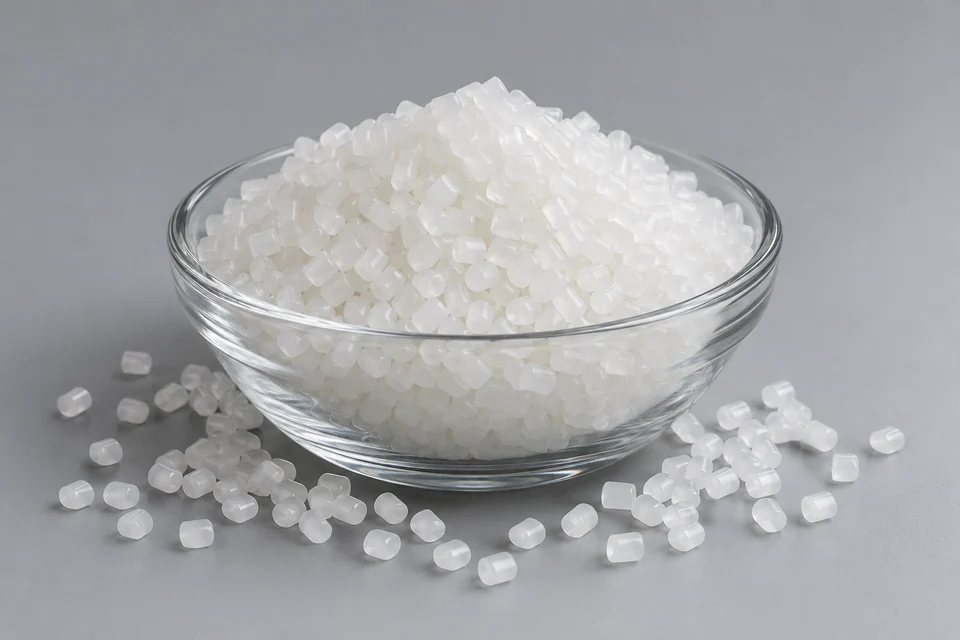
Polycaprolactone (PCL) is a synthetic semicrystalline biodegradable polyester with a melting point of approximately 60 °C and a glass transition temperature of about −60 °C.
Product & engineering
Understand the product.
Polycaprolactone (PCL) is a synthetic semicrystalline biodegradable polyester with a melting point of approximately 60 °C and a glass transition temperature of about −60 °C. It is most commonly used in the production of specialty polyurethanes, imparting excellent resistance to water, oil, solvents, and chlorine. Chemically, it consists of the repeating unit (C₆H₁₀O₂)ₙ, with the systematic IUPAC name poly(hexano-6-lactone) and CAS registry number 24980-41-4. Typical physical properties include a density of 1.145 g/cm³ and thermal conductivity of 0.05 W/(m·K) at 25 °C. PCL undergoes biodegradation through hydrolysis of its ester bonds under physiological conditions and is degradable by microorganisms from the Bacillota and Pseudomonadota phyla. It has received FDA approval for select human applications such as drug delivery devices, sutures, and adhesion barriers.
Polycaprolactone is synthesized primarily by ring-opening polymerization of ε-caprolactone, catalyzed most often by stannous octoate in the presence of low-molecular-weight alcohols as chain-length modifiers. This process enables precise control of molecular weight, yielding products ranging from low-molecular-weight polyols to high-molecular-weight resins. In industrial applications, PCL functions as a specialty polyol for thermoplastic polyurethane elastomers, coatings, adhesives, sealants, and cast elastomers, delivering superior low-temperature flexibility, hydrolytic stability, low melt viscosity, and light stability. In biomedical fields, it serves as a bioabsorbable polymer for long-term implants, controlled-release drug systems, tissue engineering scaffolds, bone repair composites, dental materials, and dermal fillers, with tunable intrinsic viscosity, degradation profiles spanning months to years, and customizable end groups.
Additional uses include resin additives to improve processability and impact resistance, blends with starch for enhanced biodegradability and cost efficiency, polymeric plasticizers for polyvinyl chloride, and filaments for fused deposition modeling 3D printing. Polycaprolactone combines outstanding biocompatibility, complete biodegradability to carbon dioxide and water, and excellent processability through low melt viscosity and good solubility. Its performance can be tailored via molecular weight, copolymer ratios, and end-group chemistry to satisfy GMP-grade and FDA requirements, positioning it as a foundational material for high-performance industrial polyurethanes and advanced biomedical technologies.
Composition, supplied form and processing history determine the usable material. Evaluate the property required by the actual application with the specified test method; a chemistry name alone does not define a finished grade.
What turns activity into demand
Qualified formulation or component output creates material purchases through loading, process yield and the supplied mass basis. Raw material, formulated blend and finished-part revenues describe separate transaction stages.
The commercial boundary
For Polycaprolactone, distinguish the supplied product from its inputs and the complete application. Report types and applications may overlap; retain the selected edition's product definition, geography, period, unit and transaction basis when comparing estimates.
Which conditions determine usable polycaprolactone performance?
Polycaprolactone (PCL) is a synthetic semicrystalline biodegradable polyester with a melting point of approximately 60 °C and a glass transition temperature of about −60 °C. Match formulation and impurity limits to the converting process, then verify the property after processing or curing. Compare like-for-like dry or as-supplied quantities; a finished component and its raw material represent different transaction stages.
Selected research
Industry Growth & Trends
Global Polycaprolactone Industry Growth and Trends Forecast to 2032
Market perspective
Polycaprolactone (PCL) is a synthetic semicrystalline biodegradable polyester with a melting point of approximately 60 °C and a glass transition temperature of about −60 °C. It is most commonly used in the production of specialty polyurethanes, imparting excellent resistance to water, oil, solvents, and chlorine. Chemically, it consists of the repeating unit (C₆H₁₀O₂)ₙ, with the systematic IUPAC name poly(hexano-6-lactone) and CAS registry number 24980-41-4. Typical physical properties include a density of 1.145 g/cm³ and thermal conductivity of 0.05 W/(m·K) at 25 °C. PCL undergoes biodegradation through hydrolysis of its ester bonds under physiological conditions and is degradable by microorganisms from the Bacillota and Pseudomonadota phyla. It has received FDA approval for select human applications such as drug delivery devices, sutures, and adhesion barriers.
Polycaprolactone is synthesized primarily by ring-opening polymerization of ε-caprolactone, catalyzed most often by stannous octoate in the presence of low-molecular-weight alcohols as chain-length modifiers. This process enables precise control of molecular weight, yielding products ranging from low-molecular-weight polyols to high-molecular-weight resins. In industrial applications, PCL functions as a specialty polyol for thermoplastic polyurethane elastomers, coatings, adhesives, sealants, and cast elastomers, delivering superior low-temperature flexibility, hydrolytic stability, low melt viscosity, and light stability. In biomedical fields, it serves as a bioabsorbable polymer for long-term implants, controlled-release drug systems, tissue engineering scaffolds, bone repair composites, dental materials, and dermal fillers, with tunable intrinsic viscosity, degradation profiles spanning months to years, and customizable end groups.
Additional uses include resin additives to improve processability and impact resistance, blends with starch for enhanced biodegradability and cost efficiency, polymeric plasticizers for polyvinyl chloride, and filaments for fused deposition modeling 3D printing. Polycaprolactone combines outstanding biocompatibility, complete biodegradability to carbon dioxide and water, and excellent processability through low melt viscosity and good solubility. Its performance can be tailored via molecular weight, copolymer ratios, and end-group chemistry to satisfy GMP-grade and FDA requirements, positioning it as a foundational material for high-performance industrial polyurethanes and advanced biomedical technologies.
Read the full market overview
The global Polycaprolactone market was valued at US$ million in 2026 and is projected to reach US$ million by 2032, implying a CAGR of xx% over 2026-2032.
The North America market for Polycaprolactone is projected to increase from US$ million in 2026 to US$ million by 2032, corresponding to a CAGR of % over 2026-2032.
The Europe market for Polycaprolactone is projected to increase from US$ million in 2026 to US$ million by 2032, registering a CAGR of % over 2026-2032.
The Asia Pacific market for Polycaprolactone is projected to increase from US$ million in 2026 to US$ million by 2032, at a CAGR of % over 2026-2032.
Leading global manufacturers of Polycaprolactone include Ingevity, Daicel, BASF, Hunan Juren Chemical, Corbion, Seqens International and Shenzhen Esun Industrial, among others. In 2025, the top three vendors together accounted for approximately % of global revenue.
Report Scope
This report provides a structured, data-driven view of the global Polycaprolactone market, combining harmonized quantitative metrics with targeted qualitative insight to support business and growth strategy, market positioning, and capital allocation.
The Polycaprolactone market size, estimates, and forecasts are presented in terms of sales volume (t) and revenue (US$ million), with 2025 as the base year and historical and forecast data for 2021-2032. The report segments the global Polycaprolactone market by Type, Application, region/country, and company, provides regional market sizes at the segment level, profiles the competitive landscape and key players and their market ranks, and reviews technology trends and new product developments relevant to Polycaprolactone.
Key Companies & Market Share Insights
This section analyzes the strategies and performance of leading manufacturers in the global Polycaprolactone market, including portfolio focus, innovation and product development, mergers and acquisitions, collaborations, and geographic expansion used to sustain or enhance competitive positions. It also summarizes recent corporate developments and key financial indicators and provides global revenue, price, and sales volume data by manufacturer for 2020-2025, enabling benchmarking of scale, pricing, and market share and supporting assessment of market concentration through indicators such as CR5 and CR10.
Polycaprolactone Market by Company
Ingevity
Daicel
BASF
Hunan Juren Chemical
Corbion
Seqens International
Shenzhen Esun Industrial
Polycaprolactone Segment by Type
Double Functional Caprolactone
Tri Functional Caprolactone
High Molar Mass PCL Polymers
Others
Polycaprolactone Segment by Application
Resins & Coatings
Elastomers
Adhesives
Medical Devices
Others
Polycaprolactone Segment by Region
North America
United States
Canada
Mexico
Europe
Germany
France
U.K.
Italy
Russia
Spain
Netherlands
Switzerland
Sweden
Poland
Asia-Pacific
China
Japan
South Korea
India
Australia
Taiwan
Southeast Asia
South America
Brazil
Argentina
Chile
Colombia
Middle East & Africa
Egypt
South Africa
Israel
Türkiye
GCC Countries
Key Drivers & Barriers
High-impact rendering factors and drivers have been studied in this report to aid the readers to understand the general development. Moreover, the report includes restraints and challenges that may act as stumbling blocks on the way of the players. This will assist the users to be attentive and make informed decisions related to business. Specialists have also laid their focus on the upcoming business prospects.
Reasons to Buy This Report
1. This report will help the readers to understand the competition within the industries and strategies for the competitive environment to enhance the potential profit. The report also focuses on the competitive landscape of the global Polycaprolactone market, and introduces in detail the market share, industry ranking, competitor ecosystem, market performance, new product development, operation situation, expansion, and acquisition. etc. of the main players, which helps the readers to identify the main competitors and deeply understand the competition pattern of the market.
2. This report will help stakeholders to understand the global industry status and trends of Polycaprolactone and provides them with information on key market drivers, restraints, challenges, and opportunities.
3. This report will help stakeholders to understand competitors better and gain more insights to strengthen their position in their businesses. The competitive landscape section includes the market share and rank (in volume and value), competitor ecosystem, new product development, expansion, and acquisition.
4. This report stays updated with novel technology integration, features, and the latest developments in the market.
5. This report helps stakeholders to gain insights into which regions to target globally.
6. This report helps stakeholders to gain insights into the end-user perception concerning the adoption of Polycaprolactone.
7. This report helps stakeholders to identify some of the key players in the market and understand their valuable contribution.
Chapter Outline
Chapter 1: Introduces the study scope of this report, executive summary of market segments by type, market size segments for North America, Europe, Asia Pacific, South America, Middle East & Africa.
Chapter 2: Introduces the market dynamics, latest developments of the market, the driving factors and restrictive factors of the market, the challenges and risks faced by manufacturers in the industry, and the analysis of relevant policies in the industry.
Chapter 3: Detailed analysis of Polycaprolactone manufacturers competitive landscape, price, sales, revenue, market share and ranking, latest development plan, merger, and acquisition information, etc.
Chapter 4: Sales, revenue of Polycaprolactone in regional level. It provides a quantitative analysis of the market size and development potential of each region and introduces the future development prospects, and market space in the world.
Chapter 5: Introduces market segments by application, market size segment for North America, Europe, Asia Pacific, South America, Middle East & Africa.
Chapter 6: Provides profiles of key players, introducing the basic situation of the main companies in the market in detail, including product sales, revenue, price, gross margin, product introduction, recent development, etc.
Chapter 7, 8, 9, 10 and 11: North America, Europe, Asia Pacific, South America, Middle East & Africa, sales and revenue by country.
Chapter 12: Analysis of industrial chain, key raw materials, manufacturing cost, and market dynamics.
Chapter 13: Concluding Insights of the report.
More report detail
Tables and figures
Scope & coverage.
Types
- Double Functional Caprolactone
- Tri Functional Caprolactone
- High Molar Mass PCL Polymers
- Others
Applications
- Resins & Coatings
- Elastomers
- Adhesives
- Medical Devices
- Others
Companies covered
- Ingevity
- Daicel
- BASF
- Hunan Juren Chemical
- Corbion
- Seqens International
- Shenzhen Esun Industrial
Inside the report.
1 Market Overview
- 1.1 Product Definition
- 1.2 Global Market Growth Prospects
- 1.2.1 Global Polycaprolactone Market Size Estimates and Forecasts (2021-2032)
- 1.2.2 Global Polycaprolactone Sales Estimates and Forecasts (2021-2032)
- 1.3 Polycaprolactone Market by Type
- 1.3.1 Double Functional Caprolactone
- 1.3.2 Tri Functional Caprolactone
- 1.3.3 High Molar Mass PCL Polymers
- 1.3.4 Others
- 1.4 Global Polycaprolactone Market Size by Type
- 1.4.1 Global Polycaprolactone Market Size Overview by Type (2021-2032)
- 1.4.2 Global Polycaprolactone Historic Market Size Review by Type (2021-2026)
- 1.4.3 Global Polycaprolactone Forecasted Market Size by Type (2027-2032)
- 1.5 Key Regions Market Size by Type
- 1.5.1 North America Polycaprolactone Sales Breakdown by Type (2021-2026)
- 1.5.2 Europe Polycaprolactone Sales Breakdown by Type (2021-2026)
- 1.5.3 Asia-Pacific Polycaprolactone Sales Breakdown by Type (2021-2026)
- 1.5.4 South America Polycaprolactone Sales Breakdown by Type (2021-2026)
- 1.5.5 Middle East and Africa Polycaprolactone Sales Breakdown by Type (2021-2026)
2 Global Market Dynamics
- 2.1 Polycaprolactone Industry Trends
- 2.2 Polycaprolactone Industry Drivers
- 2.3 Polycaprolactone Industry Opportunities and Challenges
- 2.4 Polycaprolactone Industry Restraints
3 Market Competitive Landscape by Company
- 3.1 Global Top Players by Polycaprolactone Revenue (2021-2026)
- 3.2 Global Top Players by Polycaprolactone Sales (2021-2026)
- 3.3 Global Top Players by Polycaprolactone Price (2021-2026)
- 3.4 Global Polycaprolactone Industry Company Ranking, 2024 VS 2025 VS 2026
- 3.5 Global Polycaprolactone Major Company Production Sites & Headquarters
- 3.6 Global Polycaprolactone Company, Product Type & Application
- 3.7 Global Polycaprolactone Company Establishment Date
- 3.8 Market Competitive Analysis
- 3.8.1 Global Polycaprolactone Market CR5 and HHI
- 3.8.2 Global Top 5 and 10 Polycaprolactone Players Market Share by Revenue in 2025
- 3.8.3 2025 Polycaprolactone Tier 1, Tier 2, and Tier 3
4 Polycaprolactone Regional Status and Outlook
- 4.1 Global Polycaprolactone Market Size and CAGR by Region: 2021 VS 2025 VS 2032
- 4.2 Global Polycaprolactone Historic Market Size by Region
- 4.2.1 Global Polycaprolactone Sales in Volume by Region (2021-2026)
- 4.2.2 Global Polycaprolactone Sales in Value by Region (2021-2026)
- 4.2.3 Global Polycaprolactone Sales (Volume & Value), Price and Gross Margin (2021-2026)
- 4.3 Global Polycaprolactone Forecasted Market Size by Region
- 4.3.1 Global Polycaprolactone Sales in Volume by Region (2027-2032)
- 4.3.2 Global Polycaprolactone Sales in Value by Region (2027-2032)
- 4.3.3 Global Polycaprolactone Sales (Volume & Value), Price and Gross Margin (2027-2032)
5 Polycaprolactone by Application
- 5.1 Polycaprolactone Market by Application
- 5.1.1 Resins & Coatings
- 5.1.2 Elastomers
- 5.1.3 Adhesives
- 5.1.4 Medical Devices
- 5.1.5 Others
- 5.2 Global Polycaprolactone Market Size by Application
- 5.2.1 Global Polycaprolactone Market Size Overview by Application (2021-2032)
- 5.2.2 Global Polycaprolactone Historic Market Size Review by Application (2021-2026)
- 5.2.3 Global Polycaprolactone Forecasted Market Size by Application (2027-2032)
- 5.3 Key Regions Market Size by Application
- 5.3.1 North America Polycaprolactone Sales Breakdown by Application (2021-2026)
- 5.3.2 Europe Polycaprolactone Sales Breakdown by Application (2021-2026)
- 5.3.3 Asia-Pacific Polycaprolactone Sales Breakdown by Application (2021-2026)
- 5.3.4 South America Polycaprolactone Sales Breakdown by Application (2021-2026)
- 5.3.5 Middle East and Africa Polycaprolactone Sales Breakdown by Application (2021-2026)
6 Company Profiles
- 6.1 Ingevity
- 6.1.1 Ingevity Company Information
- 6.1.2 Ingevity Business Overview
- 6.1.3 Ingevity Polycaprolactone Sales, Revenue and Gross Margin (2021-2026)
- 6.1.4 Ingevity Polycaprolactone Product Portfolio
- 6.1.5 Ingevity Recent Developments
- 6.2 Daicel
- 6.2.1 Daicel Company Information
- 6.2.2 Daicel Business Overview
- 6.2.3 Daicel Polycaprolactone Sales, Revenue and Gross Margin (2021-2026)
- 6.2.4 Daicel Polycaprolactone Product Portfolio
- 6.2.5 Daicel Recent Developments
- 6.3 BASF
- 6.3.1 BASF Company Information
- 6.3.2 BASF Business Overview
- 6.3.3 BASF Polycaprolactone Sales, Revenue and Gross Margin (2021-2026)
- 6.3.4 BASF Polycaprolactone Product Portfolio
- 6.3.5 BASF Recent Developments
- 6.4 Hunan Juren Chemical
- 6.4.1 Hunan Juren Chemical Company Information
- 6.4.2 Hunan Juren Chemical Business Overview
- 6.4.3 Hunan Juren Chemical Polycaprolactone Sales, Revenue and Gross Margin (2021-2026)
- 6.4.4 Hunan Juren Chemical Polycaprolactone Product Portfolio
- 6.4.5 Hunan Juren Chemical Recent Developments
- 6.5 Corbion
- 6.5.1 Corbion Company Information
- 6.5.2 Corbion Business Overview
- 6.5.3 Corbion Polycaprolactone Sales, Revenue and Gross Margin (2021-2026)
- 6.5.4 Corbion Polycaprolactone Product Portfolio
- 6.5.5 Corbion Recent Developments
- 6.6 Seqens International
- 6.6.1 Seqens International Company Information
- 6.6.2 Seqens International Business Overview
- 6.6.3 Seqens International Polycaprolactone Sales, Revenue and Gross Margin (2021-2026)
- 6.6.4 Seqens International Polycaprolactone Product Portfolio
- 6.6.5 Seqens International Recent Developments
- 6.7 Shenzhen Esun Industrial
- 6.7.1 Shenzhen Esun Industrial Company Information
- 6.7.2 Shenzhen Esun Industrial Business Overview
- 6.7.3 Shenzhen Esun Industrial Polycaprolactone Sales, Revenue and Gross Margin (2021-2026)
- 6.7.4 Shenzhen Esun Industrial Polycaprolactone Product Portfolio
- 6.7.5 Shenzhen Esun Industrial Recent Developments
7 North America by Country
- 7.1 North America Polycaprolactone Sales by Country
- 7.1.1 North America Polycaprolactone Sales Growth Rate (CAGR) by Country: 2021 VS 2025 VS 2032
- 7.1.2 North America Polycaprolactone Sales by Country (2021-2026)
- 7.1.3 North America Polycaprolactone Sales Forecast by Country (2027-2032)
- 7.2 North America Polycaprolactone Market Size by Country
- 7.2.1 North America Polycaprolactone Market Size Growth Rate (CAGR) by Country: 2021 VS 2025 VS 2032
- 7.2.2 North America Polycaprolactone Market Size by Country (2021-2026)
- 7.2.3 North America Polycaprolactone Market Size Forecast by Country (2027-2032)
8 Europe by Country
- 8.1 Europe Polycaprolactone Sales by Country
- 8.1.1 Europe Polycaprolactone Sales Growth Rate (CAGR) by Country: 2021 VS 2025 VS 2032
- 8.1.2 Europe Polycaprolactone Sales by Country (2021-2026)
- 8.1.3 Europe Polycaprolactone Sales Forecast by Country (2027-2032)
- 8.2 Europe Polycaprolactone Market Size by Country
- 8.2.1 Europe Polycaprolactone Market Size Growth Rate (CAGR) by Country: 2021 VS 2025 VS 2032
- 8.2.2 Europe Polycaprolactone Market Size by Country (2021-2026)
- 8.2.3 Europe Polycaprolactone Market Size Forecast by Country (2027-2032)
9 Asia-Pacific by Country
- 9.1 Asia-Pacific Polycaprolactone Sales by Country
- 9.1.1 Asia-Pacific Polycaprolactone Sales Growth Rate (CAGR) by Country: 2021 VS 2025 VS 2032
- 9.1.2 Asia-Pacific Polycaprolactone Sales by Country (2021-2026)
- 9.1.3 Asia-Pacific Polycaprolactone Sales Forecast by Country (2027-2032)
- 9.2 Asia-Pacific Polycaprolactone Market Size by Country
- 9.2.1 Asia-Pacific Polycaprolactone Market Size Growth Rate (CAGR) by Country: 2021 VS 2025 VS 2032
- 9.2.2 Asia-Pacific Polycaprolactone Market Size by Country (2021-2026)
- 9.2.3 Asia-Pacific Polycaprolactone Market Size Forecast by Country (2027-2032)
10 South America by Country
- 10.1 South America Polycaprolactone Sales by Country
- 10.1.1 South America Polycaprolactone Sales Growth Rate (CAGR) by Country: 2021 VS 2025 VS 2032
- 10.1.2 South America Polycaprolactone Sales by Country (2021-2026)
- 10.1.3 South America Polycaprolactone Sales Forecast by Country (2027-2032)
- 10.2 South America Polycaprolactone Market Size by Country
- 10.2.1 South America Polycaprolactone Market Size Growth Rate (CAGR) by Country: 2021 VS 2025 VS 2032
- 10.2.2 South America Polycaprolactone Market Size by Country (2021-2026)
- 10.2.3 South America Polycaprolactone Market Size Forecast by Country (2027-2032)
11 Middle East and Africa by Country
- 11.1 Middle East and Africa Polycaprolactone Sales by Country
- 11.1.1 Middle East and Africa Polycaprolactone Sales Growth Rate (CAGR) by Country: 2021 VS 2025 VS 2032
- 11.1.2 Middle East and Africa Polycaprolactone Sales by Country (2021-2026)
- 11.1.3 Middle East and Africa Polycaprolactone Sales Forecast by Country (2027-2032)
- 11.2 Middle East and Africa Polycaprolactone Market Size by Country
- 11.2.1 Middle East and Africa Polycaprolactone Market Size Growth Rate (CAGR) by Country: 2021 VS 2025 VS 2032
- 11.2.2 Middle East and Africa Polycaprolactone Market Size by Country (2021-2026)
- 11.2.3 Middle East and Africa Polycaprolactone Market Size Forecast by Country (2027-2032)
12 Value Chain and Sales Channels Analysis
- 12.1 Polycaprolactone Value Chain Analysis
- 12.1.1 Polycaprolactone Key Raw Materials
- 12.1.2 Key Raw Materials Price
- 12.1.3 Raw Materials Key Suppliers
- 12.1.4 Manufacturing Cost Structure
- 12.1.5 Polycaprolactone Production Mode & Process
- 12.2 Polycaprolactone Sales Channels Analysis
- 12.2.1 Direct Comparison with Distribution Share
- 12.2.2 Polycaprolactone Distributors
- 12.2.3 Polycaprolactone Customers
13 Concluding Insights
14 Appendix
- 14.1 Reasons for Doing This Study
- 14.2 Research Methodology
- 14.3 Research Process
- 14.4 Authors List of This Report
- 14.5 Data Source
- 14.5.1 Secondary Sources
- 14.5.2 Primary Sources
- 14.6 Disclaimer
GET THE RESEARCH
Choose your license.
Choose who needs access.
All options are for this report and research series.
PDF by email within 3–5 working days after payment confirmation.
Talk to an analyst