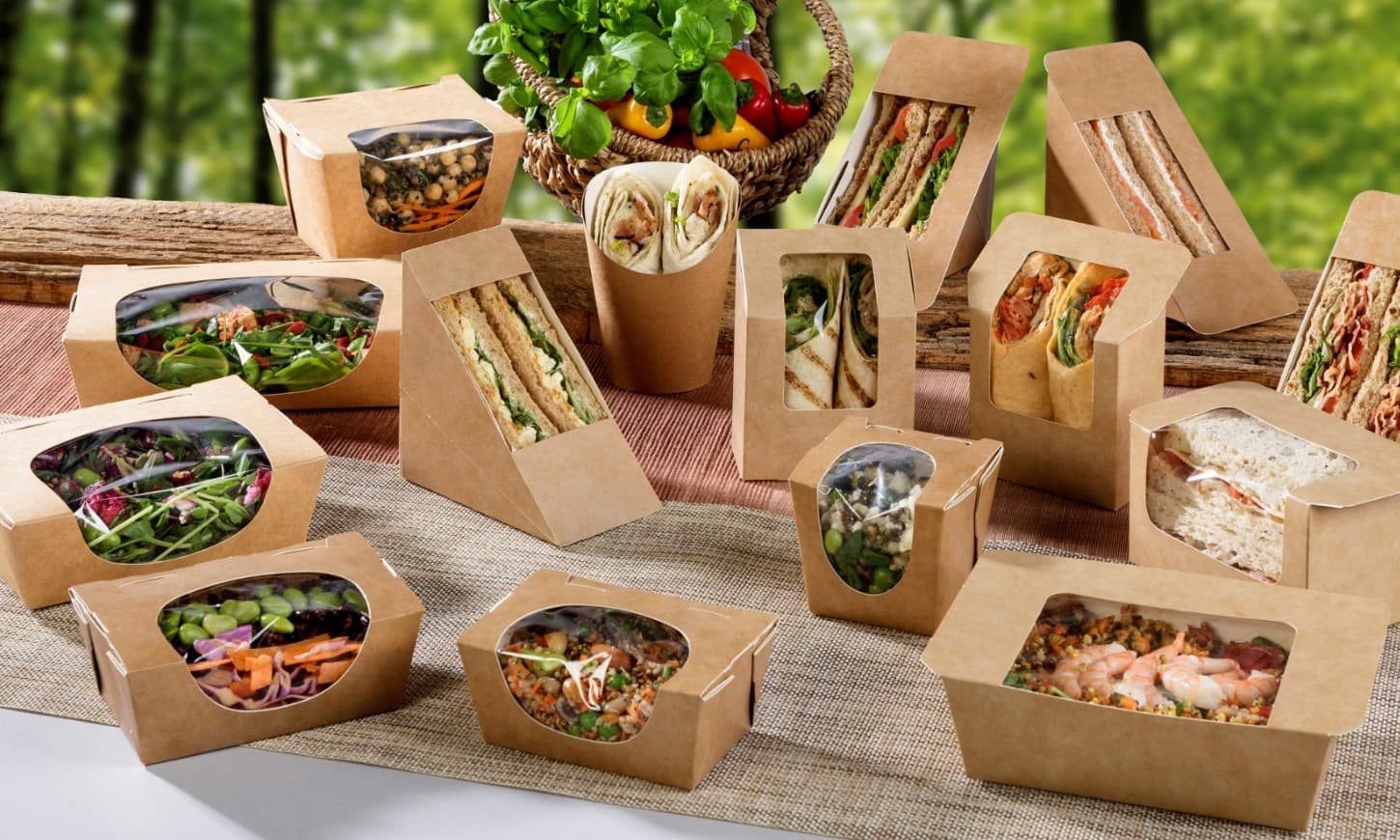
Foodservice packaging refers to single-use or limited-reuse packaging formats used by restaurants, catering, institutional food service, and beverage operators to contain, protect, portion, and deliver prepared foods and drinks across dine-in, takeaway, and delivery use cases, while maintaining food safety and functional performance over a defined service time. The category includes primary contact items such as cups and lids, bowls, trays, clamshells, wraps, liners, cutlery, and condiment pack…
Foodservice packaging refers to single-use or limited-reuse packaging formats used by restaurants, catering, institutional food service, and beverage operators to contain, protect, portion, and deliver prepared foods and drinks across dine-in, takeaway, and delivery use cases, while maintaining food safety and functional performance over a defined service time. The category includes primary contact items such as cups and lids, bowls, trays, clamshells, wraps, liners, cutlery, and condiment packs, and is typically specified by barrier needs (grease, moisture, oxygen), thermal performance (hot-fill, insulation), sealing and leak resistance, stackability and logistics efficiency, and regulatory compliance for food contact and end-of-life requirements (recyclability, compostability, or landfill depending on local systems).
According to the latest report from APO Research in 2026, In 2025 the global foodservice packaging market delivered about US$65.8 billion; it is expected to reach around US$71.5 billion in 2026 and approach US$106.9 billion by 2032, with the market projected to grow at a CAGR of approximately 6.9% from 2026 to 2032. Foodservice packaging sits at the intersection of food-contact compliant materials and high-throughput forming, serving takeout and delivery, beverage programs, quick-service and chain restaurants, and institutional catering. In real procurement, unit price rarely wins on its own; leakage control, heat performance, stiffness and stackability, line compatibility with filling and sealing, and documentation readiness for regulatory and customer audits are what determine supplier stickiness and the true switching cost.
The market remains structurally regional because packaging is bulky, conversion is asset-heavy, and service levels are judged by on-time delivery and defect rates rather than cross-border freight economics. In 2026, North America accounts for about US$31.2 billion and remains the primary spec-setting demand center; Europe is around US$17.4 billion with tighter sustainability and materials constraints embedded into customer specifications; Asia-Pacific is about US$16.8 billion where volume growth and supply expansion run in parallel, particularly in beverage-led and delivery-led formats. South America is roughly US$3.7 billion and the Middle East and Africa about US$2.4 billion, both increasingly tied to urbanization, chain penetration, and channel modernization rather than discretionary premiumization.
Where buyers feel the market most directly is the product mix, because operational failure shows up as refunds, complaints, and labor inefficiency. In 2026, cups represent about US$19.8 billion and remain the single largest product bucket; bags for single-portion and carry-out use are about US$11.6 billion; containers about US$8.7 billion; plates about US$7.9 billion; bowls about US$6.9 billion; and lids and domes about US$5.4 billion. Closures and sealing interfaces are disproportionately decision-critical: many large chains will pay for consistency in lids, leak resistance, and heat tolerance because those attributes directly control beverage spillage rates and delivery failure costs, while bags and containers are often specified around grease resistance, compression strength in rider delivery, and assembly speed at peak hours.
On the supply side, three constraints dominate decision-making through the end of 2032. Material systems are being redesigned under simultaneous pressure from recycled-content requirements, fiber substitution programs, and barrier performance expectations, which pushes innovation into coatings, laminations, and mono-material structures without sacrificing food-contact safety and machinability. Manufacturing economics are dictated by the chosen forming route thermoforming, injection molding, paper converting, molded fiber, and coating and printing each set different ceilings on yield, tooling cadence, and quality control. Finally, compliance is increasingly operational rather than declarative: the winners are the suppliers that can industrialize documentation, change control, and multi-site replication, enabling large buyers to qualify alternates without disrupting line performance.
Competitive supply spans global groups and a long tail of regional converters, with representative players including Novolex, Dart Container, Huhtamaki, Pactiv Evergreen, Graphic Packaging, Sabert, Klöckner Pentaplast, WinCup, Amcor, Genpak, D&W Fine Pack, Anchor Packaging, WestRock, Coveris, Cascades, Berry Global, Georgia-Pacific, Southern Champion Tray, alongside fast-scaling regional suppliers such as Fuling Technology, Hefei Hengxin Life Science, Ningbo Homelink Eco i-Tech, Zhejiang Pando Ep Technology, and Fujian Nanwang. By the end of 2032, share gains are most likely to accrue to suppliers that can deliver a defensible combination of compliance-ready materials, line-proven package performance, and resilient multi-sourcing execution because for large foodservice buyers, packaging is a reliability system as much as it is a consumable.